
Accounts receivable process automation executes invoice delivery, payment matching, collections follow-up, and ledger posting through predefined, auditable workflows. When billing shows an invoice as paid, the ERP still shows an open balance, and a collector is preparing another reminder, the missing piece isn’t another script. It’s an operating model that assigns exceptions, controls approvals, and preserves evidence across systems.
The hard problem isn’t sending invoices. It’s explaining why cash was applied, why a disputed balance was escalated, and who approved the adjustment. A useful workflow leaves those answers in the transaction record, not in someone’s inbox.
Table of Contents
- What Each AR Action Should Do
- Baseline Numbers Worth Measuring First
- Architecture Across ERP CRM and Billing
- Exception Routing Approvals and Audit Evidence
- How to Roll the Workflow Out in Stages
- Maintenance Practices That Prevent Drift
- Questions Controllers Ask Before Starting
What Each AR Action Should Do
Accounts receivable process automation runs predefined, versioned steps that behave consistently for the same inputs. Routine actions proceed within written rules. Exceptions wait for a named person, and every run leaves a reconstructable record.
Which AR actions run alone and which wait
| AR action | How it runs | Who must approve | Evidence retained |
|---|---|---|---|
| Electronic invoice delivery | Deterministic when identifiers are complete | No one if validation rules pass | Invoice, delivery time, recipient |
| Contractual payment reminder | Deterministic from the contract due date | No one on the standard cadence | Term, due date, send log |
| High-confidence cash application | Posts only above the written match threshold | No one above that threshold | Match keys, confidence, ledger write |
| Short pay or missing remittance | Hold the run | Collector | Remittance, open items, proposed application |
| Customer dispute | Hold the run | Collector and credit owner | Invoice, dispute note, customer reply |
| Credit hold | Recommendation only | Credit manager | Exposure, terms, approval |
| Payment-plan change | Recommendation only | Controller | Request, revised schedule, approval |
| Material write-off | Never straight through | Controller | Aging, collection history, approval |
A passed validation must mean something concrete. Customer, invoice, amount, currency, and legal-entity identifiers must agree. A reminder must also check that no active dispute, payment allocation, or approved suppression blocks delivery.
Wrong-entity cash belongs in an exception case even when the amount matches exactly. Amount equality isn’t proof of ownership.
Separate interpretation from authority
Scoped interpretation, such as reading remittance text, can operate under a confidence threshold with a human fallback. A credit hold or write-off needs a person with delegated authority.
In the 2025 BillingPlatform AR automation survey, 67% of respondents were evaluating AI, 14% had deployed it, and 23% reported mostly or fully automated payment processing. Deployment alone doesn’t establish readiness for autonomous collection decisions.
The practical constraints are trust, integration readiness, and governance. A reminder sent on a disputed invoice can damage the relationship while leaving no decision rationale an auditor can test.
Practical rule: Label every action rule, recommendation, or approval before connector work begins.
The action map provides a starting point for reviewing financial purpose alongside execution controls.
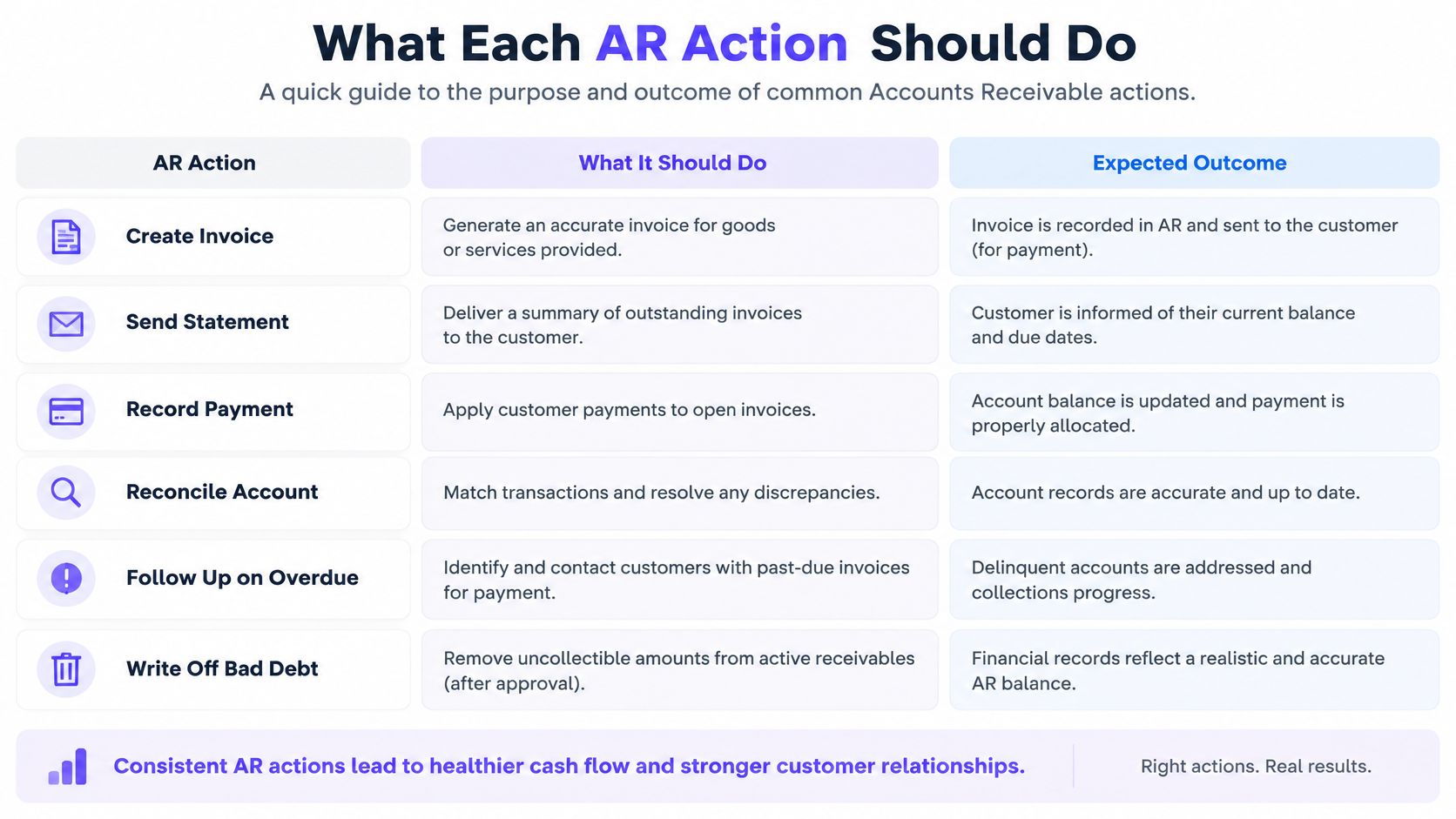
A controller should be able to mark up the decision table without reading implementation code. An engineer should then translate each approved row into explicit conditions, permitted writes, failure behavior, and retained evidence. If those interpretations differ, the workflow isn’t ready.
Baseline Numbers Worth Measuring First
Accounts receivable automation should start with a segmented baseline, not a software purchase. Finance operations should document a legal entity’s path from invoice creation through payment posting, then measure where work waits or returns for correction.
AR baseline metrics and what they mean
The published survey benchmarks below come from a PYMNTS and American Express survey of 460 businesses: low-technology firms averaged 52 days DSO, moderately to highly automated firms followed up in 16 days and reported 24-day average payment terms, and manual AR was associated with roughly 30% longer DSO.
| Metric | Reference point | Source scope | How to use it |
|---|---|---|---|
| DSO | Low or absent AR technology benchmark above | PYMNTS and American Express businesses | Segment before claiming a gain |
| Follow-up latency | Moderate to high automation benchmark above | Same survey | Track by customer payment behavior |
| Reported payment term | Contractual-term benchmark above | Same survey | Don’t confuse payment terms with DSO |
| Manual versus automated DSO | Association reported above | Same survey | Pair results with mix and term changes |
| Severe delinquency context | Industry aging concentration | Dun & Bradstreet industry segments | Context for trapped cash, not adoption |
For working-capital context, Dun & Bradstreet’s Q1 2025 report found 17 of 209 industry segments, approximately 8.1%, had at least 10% of aging dollars 91 or more days past due, following 16 of 210 segments in Q4 2024. Those are trade-credit payment experiences aggregated by industry, not automation adoption rates.
Measure the work behind DSO
An AR scorecard needs operational measures alongside the balance-sheet outcome. A falling DSO can conceal more manual investigation if collectors are compensating for unreliable matching.
- Average days delinquent: Measure overdue time separately from agreed payment terms.
- Follow-up latency: Record elapsed time between an eligible collection trigger and completed contact.
- Dispute count: Separate newly opened, resolved, and unresolved cases.
- Exception rate: Define the denominator and distinguish prevented errors from processing failures.
- Rework hours: Record investigation, correction, and reposting time.
For workflow mapping, the accounts receivable collection process guide provides a companion to the scorecard. Healthcare teams can also consult RevGuard’s resource to optimize healthcare receivables and cash flow when separating payer and patient collection paths.
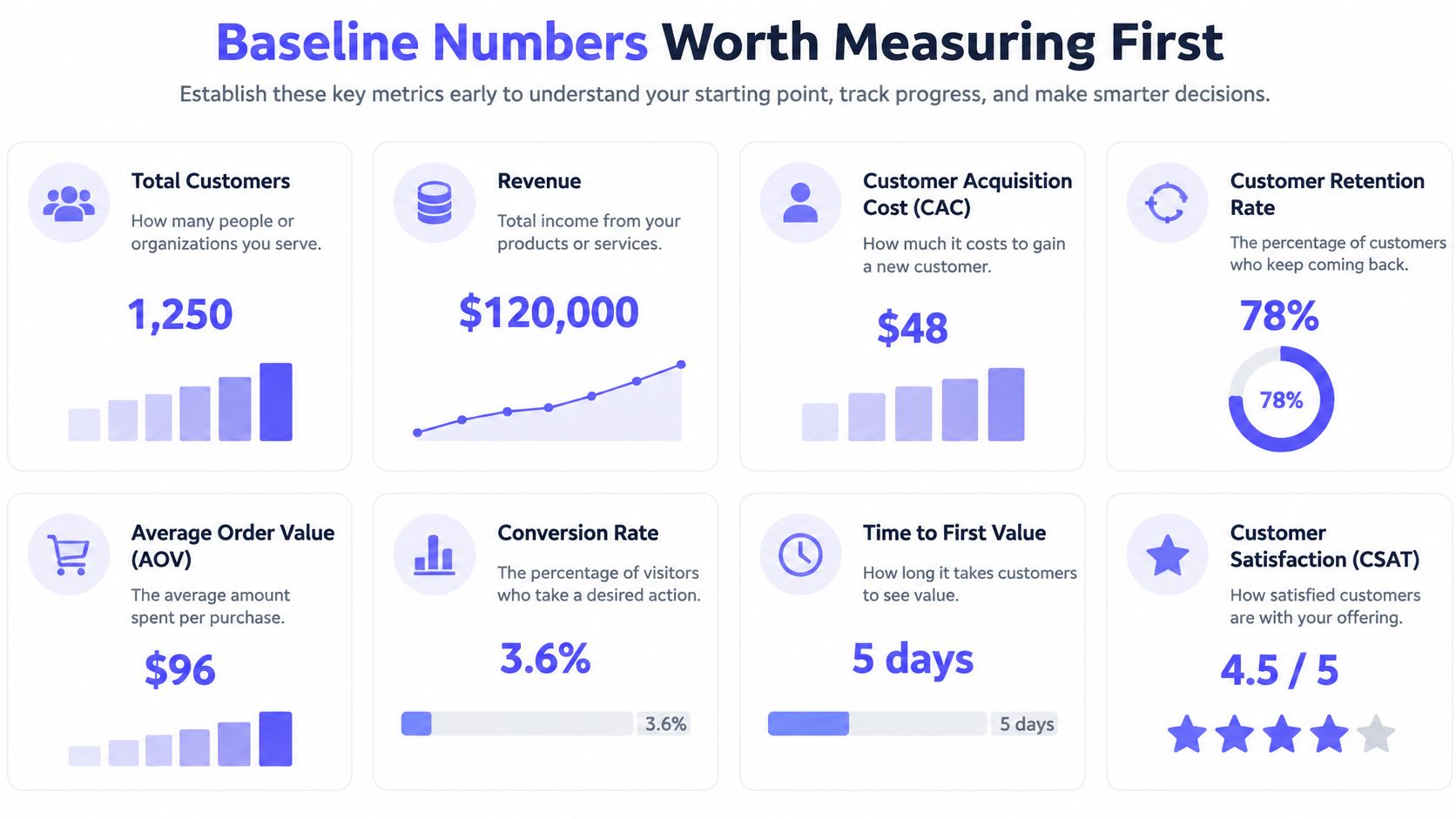
The visual below is a broader business-metrics reminder. The AR scorecard above remains the pilot’s acceptance record.
An explicitly AP, not AR, analogy appears in Nexus’s summary of Ardent Partners’ 2025 study: across 204 AP professionals, average processing cost was $9.84 per invoice and processing time was 8.2 days, implying $98,400 and 82,000 aggregate processing-days at 10,000 documents. Aggregate processing-days aren’t elapsed calendar duration, and the cost isn’t an AR price.
Store the baseline by customer segment, payment channel, and contractual term. Otherwise, a later DSO reduction might reflect a different customer mix rather than better execution.
Architecture Across ERP CRM and Billing
Accounts receivable process automation should coordinate existing systems without replacing the ledger. Each data object needs a named system of record before an engineer writes matching logic or grants posting access.
Connector groups for an AR workflow
| System group | Named options | Role in AR workflow |
|---|---|---|
| Ledger, system of record for posting | NetSuite, Sage Intacct, Workday, QuickBooks | Posts invoices and applied cash |
| Account owner in CRM | Salesforce, HubSpot | Holds customer and account owner identifiers |
| Invoicing and payments | Stripe or the billing system | Issues invoices and receives payment events |
| Bank or lockbox | Bank lockbox or ACH file | Supplies cash for application |
| Document storage | Box, Dropbox, email | Holds remittance files and source documents |
| Approval channels | Slack, Microsoft Teams, email | Routes holds to named owners |
| Legacy screen without API | Permissioned browser session | Writes only where no API exists, with logged writes |
These are architectural options, not interchangeable accounting authorities. Salesforce may own the commercial account relationship while NetSuite owns the receivable balance. A synchronization job shouldn’t overwrite that distinction.
Loopfour, the deterministic finance workflow automation platform, runs predefined steps as versioned code on existing systems rather than replacing the ledger. Alongside native ERP automation and integration middleware, it provides an option for governed cross-system execution.
An isolated script leaves approval context outside its execution record. Loopfour retains actions, approvals, and system writes within an inspectable workflow instead.
Resolve identity before matching
A customer recorded under several names needs a canonical identifier and an explicit alias map. Fuzzy name similarity can propose a relationship. It shouldn’t establish the legal entity receiving cash.
The architecture specification should identify:
- Canonical keys: Customer, invoice, credit-note, remittance, and payment identifiers.
- Duplicate controls: A stable event key that prevents replayed bank files from creating duplicate applications.
- Matching policy: Required fields, tolerance rules, and a written confidence threshold.
- Write ownership: The service account and destination authorized for each mutation.
The automatic data synchronization guide offers additional context for coordinating updates across systems. Healthcare operators mapping separate claim and payment events can consult Happy Billing’s resource to streamline claims and payment workflows.
A permissioned browser session belongs only where a legacy screen lacks an API. The session still needs scoped credentials, logged writes, and a stop condition when the screen changes.
A successful click isn’t evidence that the intended accounting transaction posted.
During the initial shadow period, the workflow should propose applications while an authorized employee performs the actual posting. Comparing proposals with ledger outcomes exposes identity problems before unattended writes begin. Additional payment channels should wait until matching and exception behavior are stable.
Exception Routing Approvals and Audit Evidence
Accounts receivable exception management must answer why a posting happened, who authorized it, and which source documents supported the decision. An exception is an owned case, not merely a failed automation run.
The case-management model should make ownership and evidence visible together.
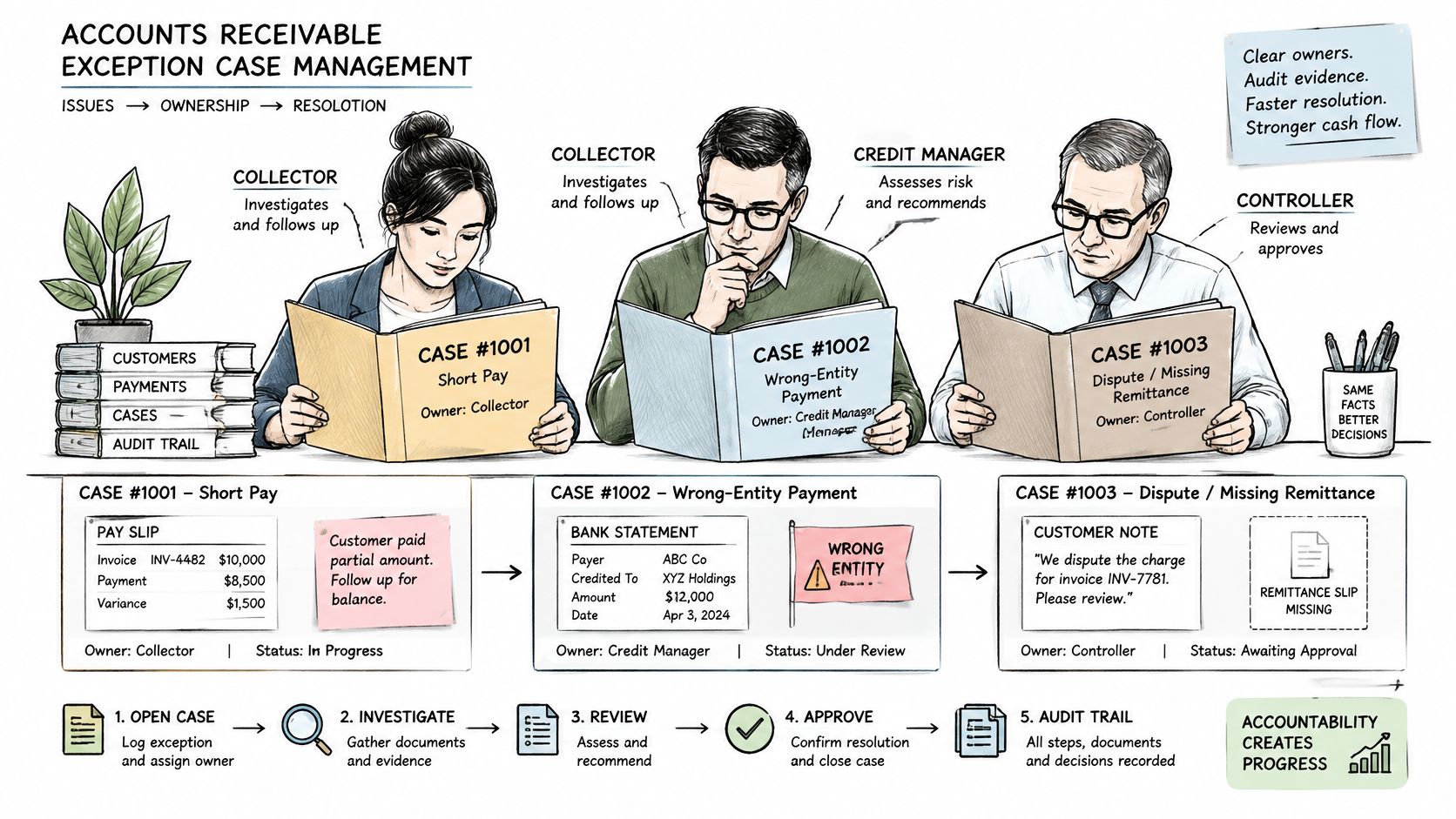
A short payment needs a collector and a response deadline. Wrong-entity cash needs an accountable accounting owner, while a commercial dispute may require both collections and credit review.
The approval file should contain the invoice, contract term, remittance image, customer correspondence, and proposed ledger entry. An approval message without those attachments is a request to investigate, not a decision-ready case.
Build the case before requesting approval
Accounts receivable approvals should attach to a specific proposed action and evidence version. If the amount, entity, or proposed allocation changes, the earlier approval shouldn’t authorize the revised posting.
- Case ownership: Named assignee, backup owner, response deadline, and escalation route.
- Decision package: Supporting documents, open items, proposed treatment, and financial effect.
- Execution tree: Each step, input, output, confidence score, human approval, and system write.
- Access controls: Separate workflow editing, approval authority, and posting permissions.
For EU transactions within scope, the Late Payment Directive generally establishes a 30-calendar-day payment deadline when the contract doesn’t specify one, usually beginning with invoice receipt. Invoice issue, delivery, receipt, and fulfillment therefore need separate event records.
For U.S. electronic business records, IRS guidance requires availability while records remain material to tax administration, reconciliation to books and returns, and transaction detail identifying source documents. The guidance also addresses documentation of processes that create, modify, and maintain retained records.
The audit trail process guide provides a useful framework for linking execution evidence to accounting records. Property teams drafting repayment communications can find tenant repayment agreement scripts from Axis Meter Solutions, while keeping schedule changes behind the controller’s approval gate.
The accompanying video can support the discussion of workflow execution and evidence.
Auditors need the run to hold up under testing. Evidence should be a byproduct of execution, not a binder assembled after close.
SOC 2 Type II, permissions, and access control belong in the same vendor and implementation review. A service assurance report doesn’t replace transaction-level control testing, and broad administrator access doesn’t become appropriate merely because every action is logged.
How to Roll the Workflow Out in Stages
Accounts receivable automation should enter production through a narrow, reconciled pilot. A controller should approve live writes only after the workflow demonstrates correct accounting treatment, controlled exceptions, and usable execution evidence.
The 2024 BlackLine and NACM survey found 43% of credit managers named reworking errors as their most significant AR problem, 38% cited poor data quality and slow processing, and 70% said automation significantly reduces processing time and increases efficiency. The same survey identified integration difficulty at 35%, employee or stakeholder resistance at 30%, security/privacy concerns at 26%, and budget constraints at 17%.
Those findings support a small pilot with staffed data remediation, not a broad launch followed by cleanup. Case files, approval gates, and execution-tree requirements must exist before the pilot starts.
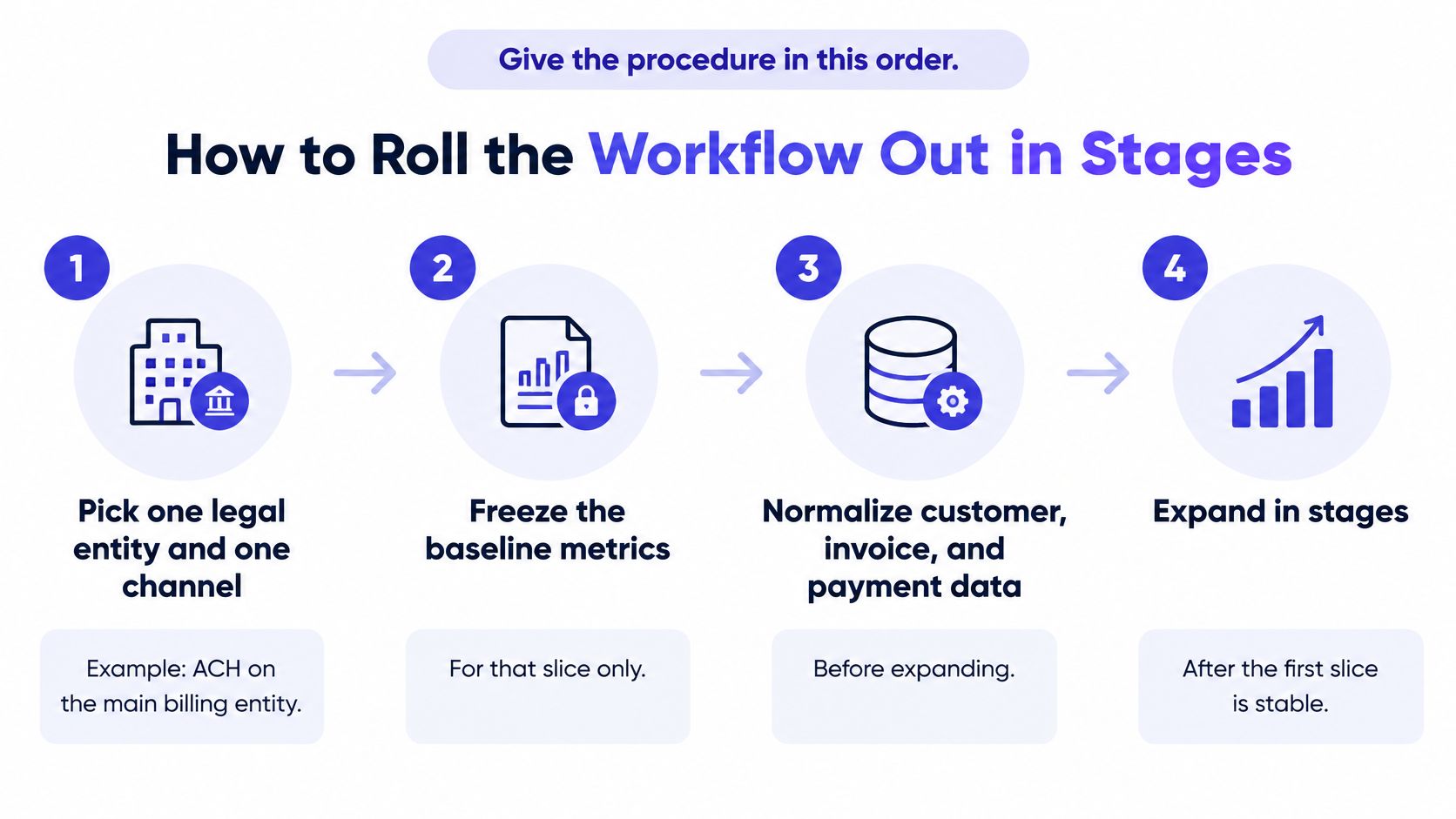
The rollout visual summarizes the main deployment boundaries.
Follow the deployment sequence
The pilot should progress through explicit acceptance gates. Configuration order matters because posting permissions shouldn’t arrive before the controls that constrain them.
-
Pick a legal entity and payment channel. ACH on the main billing entity is a practical candidate when remittance files and ledger ownership are clear. Exclude other entities from the workflow’s write scope.
-
Freeze the baseline for that slice. Save the population definition, open balances, customer segments, terms, and operating measures. A moving denominator makes the comparison unreliable.
-
Normalize identifiers across systems. Reconcile customer, invoice, credit-note, remittance, and payment keys across CRM, billing, bank, and ERP. Assign a named owner to repair source records during the pilot.
-
Write and version matching rules. Specify required keys, amount tolerances, duplicate checks, and confidence thresholds. Include negative test cases, such as a matching amount belonging to the wrong entity.
-
Enable deterministic steps in proposal mode. Configure electronic invoice delivery, contractual reminders, eligible cash applications, and ERP posting. Keep external sends and ledger writes suppressed until their release criteria pass.
-
Route held decisions through approved channels. Low-confidence matches, disputes, credit overrides, and material write-offs should reach named approvers in Slack, Microsoft Teams, or email. Each request must carry its case file and proposed accounting effect.
-
Shadow-post and reconcile every proposal. Compare the proposed application with the authorized ledger posting. Classify differences as bad source data, incorrect rules, missing evidence, or legitimate accounting judgment.
-
Require controller approval for live writes. Review match rate, exception rate, permissions, rollback procedures, and execution logs. Test recovery from a partial failure without replaying a completed posting.
-
Expand only after acceptance. Release the validated channel, confirm its outputs reconcile, and then approve another channel or entity as a separate scope decision. Expansion isn’t permission to reuse untested assumptions.
Release gate: A workflow that posts correctly but can’t explain a rejected transaction hasn’t completed acceptance testing.
Stakeholder resistance needs an operating response. Collectors should know who resolves blocked cases, how to challenge a proposed match, and when an engineer will fix a broken mapping.
A training presentation won’t repair inconsistent customer records. A named data owner with authority to change the source system can.
The pilot is complete when the first channel operates within approved boundaries and the controller accepts its accounting outputs. A running schedule alone isn’t a production sign-off.
Maintenance Practices That Prevent Drift
Accounts receivable workflows need controlled maintenance whenever source fields, contract terms, permissions, or posting behavior change. A finance engineer should own each workflow definition, with an accounting owner approving changes that affect financial treatment.
A billing-field rename can break a mapping without changing the visible invoice. An expired service-account permission can stop posting after matching has already succeeded. Monitoring must distinguish those failures from legitimate business exceptions.
Keep maintenance tied to accounting outcomes
Workflow maintenance should use execution logs and reproducible tests, not recollection of how a script used to behave. The maintenance checklist should remain part of the control record.
- Review operating measures monthly: Inspect match rate, exception rate, latency, and error rate by channel and entity.
- Gate rule changes: Require approval, impact analysis, test evidence, and retained version history.
- Retest upstream releases: Re-run shadow mode after ERP or billing changes before restoring unattended execution.
- Refresh communication rules: Retire reminder copy and escalation schedules that no longer match contractual terms.
- Remove personal dependencies: Keep live controls out of private spreadsheets and personal macros.
For EU B2B transactions, the European Union’s late-payment summary states that agreed payment periods generally cannot exceed 60 calendar days unless expressly agreed and not grossly unfair; late payment brings entitlement to interest and at least €40 in recovery compensation. Applicable jurisdiction, contract terms, and receipt evidence should drive the workflow’s calculations.
A contract amendment should trigger due-date and escalation recalculation from the approved contract record. Previously approved calculations shouldn’t survive a changed underlying obligation without review.
The temporary posting macro is how audit season starts early.
The practical decision is narrow. Select ACH on a legal entity, complete the action decision table, and shadow-post through a close before widening scope. Maintenance ownership should be assigned before that first release, not after the original script author leaves.
Questions Controllers Ask Before Starting
Before an AR workflow goes live, settle who can authorize each action, what evidence the run must retain, and how narrowly to scope the pilot. Those decisions define how the workflow handles exceptions across your ERP, CRM, and billing systems.
What is accounts receivable process automation?
Accounts receivable process automation executes predefined, versioned steps for invoice delivery, cash application, collection follow-up, and posting. When a run hits an exception, it routes the issue to a named owner instead of leaving it in a failed-job queue.
Which AR decisions can run without a person?
Invoice delivery, contractual reminders, and cash application can run without individual approval when they pass written validation rules. Credit holds, payment-plan changes, and material write-offs require an authorized person to decide.
Should AI decide a collection action?
AI should not independently authorize consequential collection actions. Scoped AI interpretation may extract remittance text under a confidence threshold, with a person handling cases that do not meet it. An authorized person should approve actions that change credit treatment, repayment obligations, or accounting disposition.
What records should an AR automation run keep?
Keep invoices, payments, adjustments, source documents, workflow changes, approvals, and an account-level trail that can be reconciled to the general ledger. Each record should identify the source, transformation, and final posting without requiring someone to reconstruct decisions from chat history.
How can a controller tell whether AR automation worked?
Compare DSO and follow-up latency by customer segment with the stored baseline. Track exception workload, rework, and unapplied cash too. Faster processing is not an improvement if it creates more manual cleanup.
What should the first AR automation pilot cover?
Choose one legal entity and payment channel, then run the workflow in shadow mode. Before allowing live writes, have the controller review matching, exception handling, permissions, recovery behavior, and the execution tree.
Loopfour provides deterministic accounts receivable workflows across your existing ERP, CRM, billing, and document systems. The workflows route exceptions to named owners and retain execution evidence. Visit Loopfour to discuss a scoped ACH pilot, including its action decision table, approval gates, and reconciliation criteria before live posting.