
Only 1% of organizations reported fully automated collections in a 2025 survey, while 88% still operated with collections that were fully, mostly, or partially manual. BillingPlatform’s 2025 AR Automation Survey makes the operational problem clear. Most accounts receivable collection process failures aren’t caused by a lack of reminder templates. They come from disconnected ERP, CRM, billing, email, spreadsheet, approval, and reconciliation workflows.
An accounts receivable collection process that scales is a deterministic, auditable workflow. It starts with credit policy and accurate invoicing, calculates due dates from payment terms, monitors aging, sends governed reminders, routes disputes, records promises to pay, escalates exceptions, applies cash, and reconciles the ledger. Each action needs a trigger, owner, system of record, approval rule, and retained evidence.
This distinction matters because collection potential declines as invoices age. Commercial collection data estimates potential recovery at 88.7% one month past due, 68.9% at three months, 51.3% at six months, 37.5% at nine months, and 21.4% at twelve months. The figures appear in Billtrust’s 2026 accounts receivable benchmark report. Waiting is not a neutral operating choice.
Table of Contents
- What the Accounts Receivable Collection Process Actually Is
- How the End to End Collection Workflow Runs
- Routing Exceptions and Approvals Without Losing Control
- KPIs and SLAs That Prove Your Collections Work
- Automation and Integration Patterns for ERP CRM and Billing
- Playbooks Tips and Next Steps for Finance Teams
What the Accounts Receivable Collection Process Actually Is
The accounts receivable collection process is a controlled workflow for moving a customer balance from approved credit and invoice creation to payment, dispute resolution, cash application, and reconciliation. Its quality depends on defined measures, reliable data sources, aging analysis, and actions tied to evidence. Reminder volume alone does not show whether collections are working.
The process starts before an invoice becomes overdue. Credit standards determine whether the customer receives terms and under what conditions. Invoicing creates the receivable, while payment terms and the baseline date determine when it is due. SAP S/4HANA receivables documentation explains how these fields establish the due date, which then controls dunning notices, worklists, and customer contact.
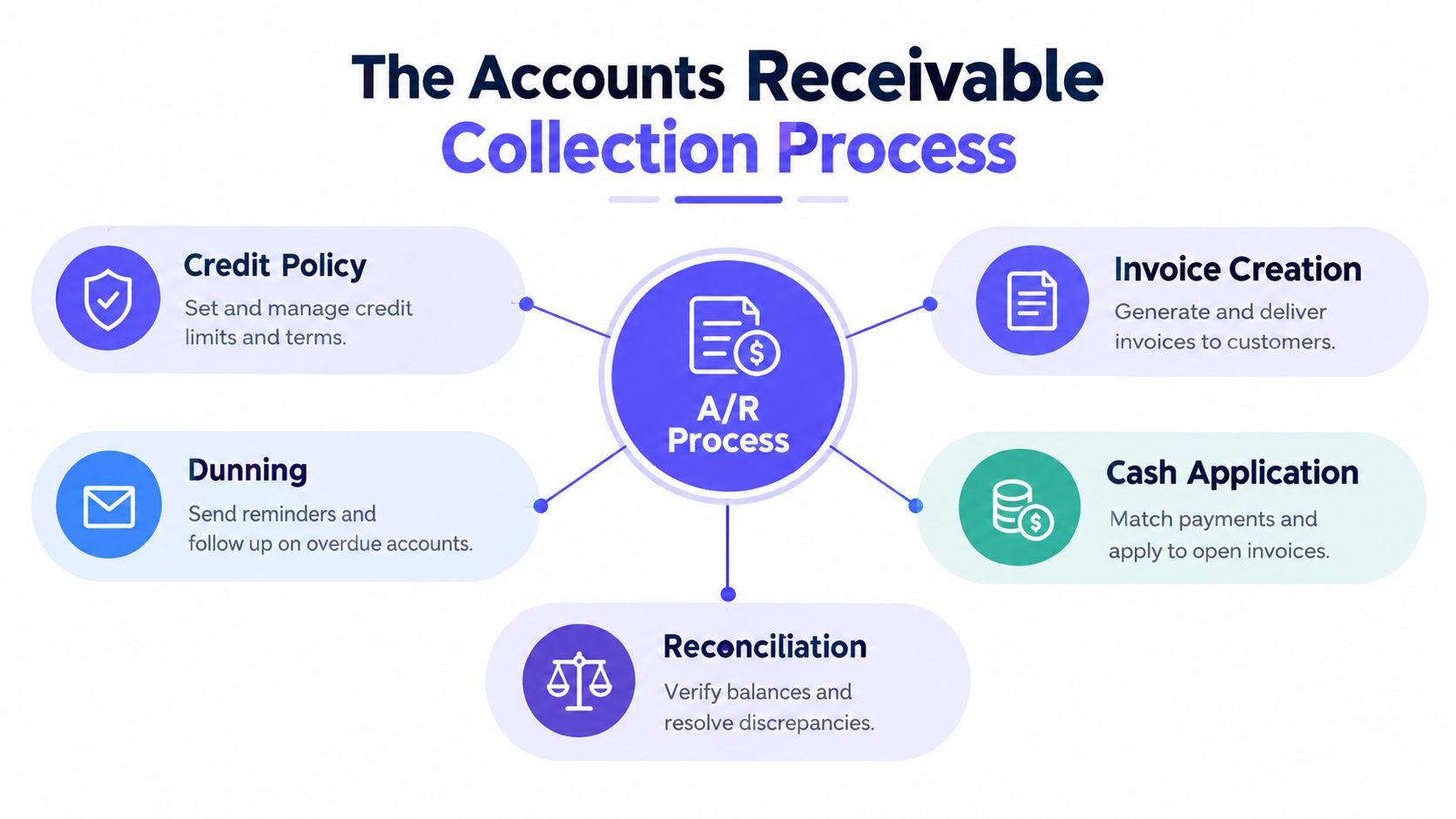
Deterministic workflow beats ad hoc chasing
Ad hoc chasing relies on individual memory. A collector checks a spreadsheet, searches email, reviews an ERP screen, and decides the next action. That approach may hold for a small ledger, but it becomes difficult to control as invoices, subsidiaries, currencies, disputes, and approval rules increase.
A deterministic workflow assigns a defined response to each condition:
- Trigger: An invoice reaches its due date or an aging threshold.
- Decision: The invoice is current, overdue, disputed, short-paid, promised, or high risk.
- Owner: A collector, account manager, billing analyst, treasury specialist, or finance approver receives the task.
- Action: The system sends a notice, creates a CRM task, requests evidence, or pauses dunning.
- Evidence: The workflow retains the input, decision, communication, approval, and system write.
Practical rule: A collection action should be explainable without relying on the collector’s memory.
Governance affects cash because collection potential declines as balances age. A playbook needs early contact and fast dispute routing. A late reminder cannot recover the time already lost.
The CallZent accounts receivable guide offers background on the broader receivables lifecycle. The operating test is narrower: can finance prove why each balance received a specific treatment, and can another employee reproduce that decision from the retained record?
Loopfour, a finance workflow automation platform, treats that requirement as a systems problem. Loopfour Studio can represent predefined workflow steps, governed exception paths, approvals, and execution evidence across an existing finance stack. The objective is controlled activity, not more activity. Controllers and auditors should be able to inspect how the process routed each balance.
How the End to End Collection Workflow Runs
An end to end accounts receivable collection process runs from credit policy through invoice delivery, monitoring, dunning, dispute resolution, escalation, cash application, and reconciliation. Each stage needs a trigger, accountable owner, system of record, and evidence requirement. That structure makes collections deterministic and auditable. Reminder cadence matters, but it cannot compensate for missing terms, unclear ownership, or unresolved data.
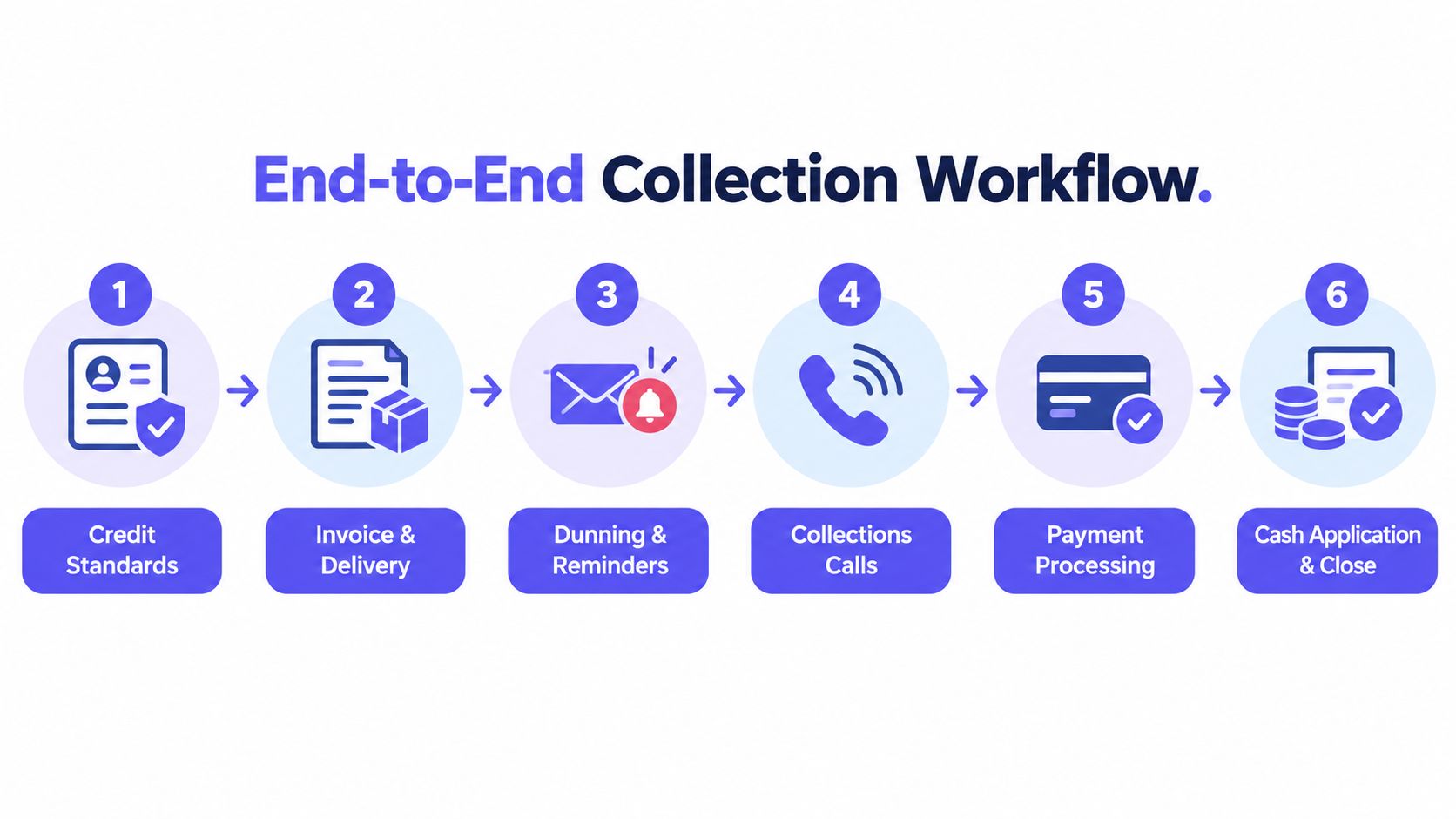
Credit and invoice controls establish the starting point
Credit operations own customer eligibility and payment terms. A new customer, material commercial change, or policy-defined review should create a controlled task. The ERP or credit system should retain approved terms, credit limit, approver, supporting documents, and effective date. Without those records, a collector may chase an invoice under terms that were never formally approved.
Billing owns invoice creation and delivery. A fulfilled order, accepted milestone, subscription event, or other billable event starts the process. The billing system should retain the contract reference, line items, tax treatment, payment terms, baseline date, delivery timestamp, and customer recipient.
A customer that routinely pays later than its approved terms creates a policy question, not only a collections task. The account owner should review the terms while collections continues managing the outstanding invoice under the existing policy. Any change requires recorded approval so forecasting and control remain traceable.
Monitoring turns balances into prioritized work
Collections owns monitoring. A scheduled aging refresh or status change from the ERP, billing system, or payment gateway should update the worklist. The queue should separate current balances, due-soon balances, past-due invoices, active disputes, promises to pay, unapplied cash, and accounts requiring approval.
Pre-due reminders can confirm invoice receipt and payment readiness. Past-due dunning should follow defined rules for aging, value, customer segment, and dispute status. Manual emails and templates remain a common notification method, reported by 49% of organizations in BillingPlatform’s 2025 survey. More messages do not resolve missing ownership or bad account data. Automation improves DSO when it creates timely, correctly assigned work. It adds noise when it just increases contact volume.
A connected ERP, CRM, and billing workflow can write the trigger, task, response, and status back to the relevant system. Loopfour’s order-to-cash automation overview provides context for designing that broader handoff. The control objective is a single traceable record, not a separate spreadsheet of collector activity.
Disputes need a separate operating lane
A disputed line item can delay payment of an otherwise valid invoice. Once the customer supplies a pricing or delivery objection, the collector should record the disputed amount, reason, evidence request, commercial owner, response deadline, and proposed resolution. The workflow should pause or adjust dunning for the affected amount only when policy permits. The undisputed balance remains collectible.
Promise-to-pay handling also needs defined fields. Record the promised date, amount, source of the commitment, responsible collector, and action for a breach. A missed promise should trigger escalation or a revised treatment, rather than disappear into a free-text note.
For human conversations, finance teams can use structured resources such as debt collection call scripts for 2026, then store the call outcome in the CRM. A script supports consistency, while the CRM record supplies the audit trail.
Escalation and close complete the cycle
Escalation ownership follows policy. A collector may issue a final notice, a commercial owner may resolve a relationship issue, and legal or an external collection agency may handle balances meeting approved criteria. Saylor’s accounts receivable course material describes collections as the final stage of credit extension, beginning with reminders and potentially moving to legal action or an agency.
Treasury or cash application owns payment matching. The bank statement or payment gateway supplies the input, and the ERP remains the ledger of record. Evidence includes remittance data, matched invoices, partial-payment treatment, unapplied cash status, and reconciliation results. The workflow is complete only when collection activity becomes applied cash and the balance is reconciled.
Routing Exceptions and Approvals Without Losing Control
Exception routing determines whether automation reduces finance work or merely moves confusion between inboxes. Disputes, short pays, credit memo requests, payment plans, and high-risk balances need predefined routes, approval gates, permissions, and change history.
Manual forwarding does chaos. Loopfour does deterministic routing instead. That contrast isn’t about replacing judgment. It’s about ensuring that judgment reaches the correct owner with the correct evidence and remains visible after the decision.
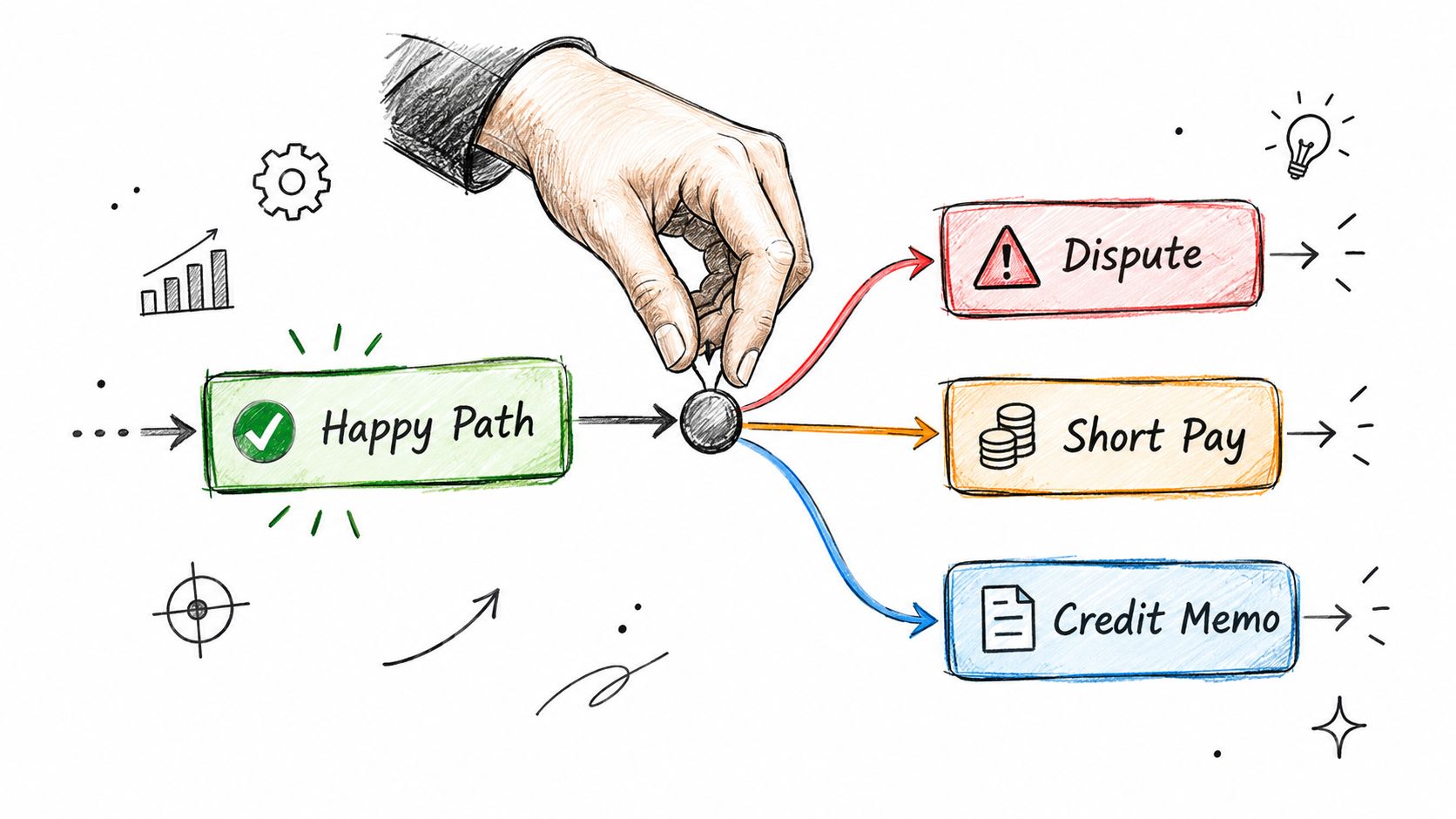
Separate the happy path from the exception path
The happy path handles an undisputed invoice with a known customer, valid payment terms, and a predictable reminder sequence. The exception path handles uncertainty. A useful routing model captures the reason first, then assigns the owner.
| Exception | Primary owner | Required evidence | Approval or next action |
|---|---|---|---|
| Pricing dispute | Billing or commercial owner | Contract, order, invoice line | Confirm correction or reject dispute |
| Short pay | Collections and billing | Remittance, invoice, customer explanation | Approve residual balance treatment |
| Credit memo request | Billing or controller | Dispute evidence and calculation | Controller approval before posting |
| Payment plan | Collections and finance approver | Balance, proposed schedule, risk context | Approve terms and monitor promises |
| High-value or aged balance | Senior collections owner | Aging, contact history, dispute status | Escalate under policy |
The matrix should live in a versioned definition, not in a collector’s private spreadsheet. Each route needs a clear status model. “Waiting for customer” and “waiting for internal approval” are not interchangeable because they imply different service levels and escalation rules.
AI should interpret, not govern
Document parsing can help extract a purchase order reference, remittance detail, or dispute reason. An AI Copilot can propose a classification when confidence meets a predefined threshold. Low-confidence interpretation should route to a human reviewer. The system shouldn’t invent a resolution or post a credit memo without authorization.
Auditors want the workflow to hold up after the original operator has left.
A governed run tree records the source document, extracted fields, confidence result, human override, approval, downstream action, and timestamp. Permissions prevent collectors from approving their own exceptions when segregation of duties requires another role.
Slack, Microsoft Teams, or email can serve as approval surfaces, but the workflow system should remain the authoritative record. A message is an interaction. It isn’t a control framework.
Versioning protects operations from silent drift
Rules change. Credit policies change. Customer segments change. ERP fields change. A controlled process records who changed the definition, what changed, why it changed, who approved it, and when the new version became active.
The same discipline applies to payment plans and credit memos. A workflow should show the original request, the decision path, the final approved terms, and the ERP posting. Manual forwarding does not provide that chain reliably. Deterministic routing does.
KPIs and SLAs That Prove Your Collections Work
Collections performance should connect to cash conversion, delinquency, and collectability. Raw invoice counts measure activity, not results. DSO, average days delinquent, collection effectiveness, aging distribution, and uncollectible-balance ratios show whether the workflow improves cash or only increases contact volume.
Days Sales Outstanding measures the average time required to collect after invoicing. The common formula is Accounts Receivable ÷ Net Credit Sales × Number of Days in the Period, as defined in Singoa’s accounts receivable KPI guidance. That guidance identifies below 45 days as a common DSO target, with net-30 businesses aiming close to 30 days.
Use a metric set, not a vanity dashboard
| KPI | Formula / Definition | Target / Benchmark Signal |
|---|---|---|
| DSO | Accounts Receivable ÷ Net Credit Sales × Number of Days | Below 45 days is a common target. Net-30 businesses often aim close to 30 days. |
| Average Days Delinquent | Average days paid after agreed terms | Lower is better. A rising tail can remain hidden behind stable headline DSO. |
| Collection Effectiveness | Cash collected against receivables available for collection | Measures recovery execution rather than contact volume. |
| Aging distribution | Receivables grouped by current and past-due status | Growing aged buckets signal escalation or credit-policy failure. |
| Uncollectible-balance ratio | Uncollectible balances relative to the selected receivables or sales base | Rising write-offs require credit, dispute, and escalation review. |
A benchmark comparison shows average DSO improving from 45 days in 2024 to 39 days in 2025, while average days delinquent worsened from 5 to 6 days. APQC’s AR benchmarks support the operational reading: headline DSO can improve while overdue resolution slows.
That distinction should shape SLA design. Set first-touch follow-up within days of a missed due date, dispute triage within a predefined business window, and management review for balances crossing a critical aging threshold. The exact SLA should reflect policy, customer segment, and local operating conditions. Each measure also needs an owner, a system field, and an exception path, or the dashboard cannot support an audit.
Global portfolios need segmented targets
A global ledger cannot use one collection script or one escalation clock. Recent benchmark summaries report that 47% of B2B invoices in Western Europe and 43% in North America are paid late, with average DSO around 55 days in Western Europe and 49 days in the United States. The same summary reports 78 days in Italy and 71 days in Spain, while 9.3% of B2B sales were written off as uncollectible in the cited European summary. These figures are documented by Decol Services’ late-payment statistics.
Regional segmentation should influence payment terms, dispute ownership, customer communication, and escalation timing. A single global target can hide market-specific risk and route the wrong accounts to the wrong queue.
Balances drifting beyond 90 days deserve separate monitoring. Collection potential can fall to roughly 21.4% at that stage, according to Billtrust’s accounts receivable benchmark report. A dashboard that celebrates DSO while ignoring that bucket measures the wrong outcome. Track the aged balance, expected recovery, owner, next action, and approval status together.
For finance teams formalizing this operating model, Loopfour’s finance workflow automation perspective connects KPI definitions with workflow triggers, ownership, and evidence. The practical test is simple: every red metric should identify the record, responsible team, required action, and escalation deadline.
Automation and Integration Patterns for ERP CRM and Billing
Automation improves DSO when it removes decision delays and produces a controlled action, not when it increases message volume. The operating model should be deterministic orchestration across ERP, CRM, billing, payment, and document systems, with human review limited to defined exceptions.
The ERP should remain authoritative for balances, terms, postings, and customer master data. Billing creates invoices, the CRM stores account relationships and commercial context, and payment gateways provide transaction signals. The workflow must synchronize these records without creating competing versions of the truth. Teams defining the boundary between systems can refer to this guide on ERP and CRM integration design.
Map automation to a specific control point
Triggered dunning is appropriate when due date, aging, dispute status, communication preference, and customer segment are reliable. The workflow can send an approved notice, record the communication in the CRM, and update collection activity in the ERP or receivables system.
Dispute creation belongs in the CRM or a dispute platform when account context and ownership determine the next action. Cash application should stay close to the ERP and payment systems because matching and posting change the ledger. Reconciliation must return an explicit success, exception, or review state. A workflow that merely reports an error without routing it leaves the operator to rebuild the process manually.
Common systems in this environment include Workday, NetSuite, Sage Intacct, QuickBooks, Salesforce, HubSpot, and Stripe. Native connectors can reduce integration work. Secure browser automation can support legacy or custom tools without APIs, provided sessions, permissions, and actions remain controlled and logged.
Teams assessing connectivity can use Pipecorn’s guide to connecting sales tools to CRM. Finance operations require more than data movement. Every write should have a defined purpose, owner, validation rule, and evidence trail.
Keep interpretation bounded
An AI Copilot can interpret remittance documents, classify dispute text, or identify likely invoice references. It should not set credit policy, approve a credit memo, alter payment terms, or suppress collection activity without a predefined rule and human fallback.
A controlled pattern is:
- Receive: Pull the source record or document.
- Validate: Check required fields, identity, terms, and status.
- Interpret: Use AI only where text or document meaning requires judgment.
- Threshold: Accept classifications that meet the configured confidence requirement.
- Route: Send exceptions to the correct owner.
- Write: Update approved systems of record.
- Observe: Retain run logs, execution trees, latency metrics, and success or error states.
Loopfour provides finance workflow automation through predefined runs, system integrations, exception routing, approvals, and retained execution evidence. Its stated integration model covers ERP, CRM, billing, document, communication, and spreadsheet tools, with workflows deployed on the customer’s existing stack.
Build in a controlled sequence
Start with one narrow workflow, such as due-date monitoring and first-touch dunning. Confirm data lineage before adding escalation. Then extend the design to dispute routing, promise-to-pay monitoring, cash application, and reconciliation.
Each release should define permissions, approval gates, impact analysis, change history, test cases, and rollback criteria. Finance engineers must maintain the workflow as upstream systems and policies change. Black-box automation creates an audit and operating burden when teams cannot explain why a system acted.
Playbooks Tips and Next Steps for Finance Teams
A scalable accounts receivable collection process starts with segmentation, early action, and governed exception handling. Finance teams should design separate playbooks by region, aging, dispute status, customer risk, and approval authority.
The operating checklist is concise:
- Define the metric: Track DSO, average days delinquent, aging distribution, and uncollectible balances.
- Act early: Trigger first-touch follow-up within days of a missed due date.
- Segment markets: Use regional payment behavior to shape terms, scripts, dispute handling, and escalation.
- Protect the ledger: Keep cash application and reconciliation tied to the ERP record of truth.
- Route exceptions: Separate disputes, short pays, credit memos, and payment plans from routine dunning.
- Govern changes: Version definitions, permissions, approval gates, and system writes.
- Preserve evidence: Retain the execution path, human decisions, communications, and final postings.
Manual emails or templates can support communication, but optimizing message volume while ignoring workflow design creates noise. Contract terms also need consistent ingestion. Missing or inconsistent terms can produce incorrect due dates, disputes, and revenue leakage.
Collections should run as predefined, auditable code, with human judgment reserved for the decisions that actually require it.
Finance leaders should test the process with real exceptions, not only clean invoices. The test set should include a disputed line, a short payment, a missed promise, an unapplied receipt, a regional variation, and an approval rejection. A workflow that handles those cases visibly is more valuable than one that performs perfectly only on the happy path.
Loopfour helps finance teams automate invoicing, dunning, exception routing, cash application, and reconciliation across the ERP, CRM, billing, and document tools they already use. Visit Loopfour to see how deterministic workflows, governed approvals, and retained execution evidence can turn collections into an auditable operating system.