
Most advice about data orchestration platforms starts with the wrong buyer. It treats orchestration as pipeline scheduling for data engineers, while finance teams need something more exact: deterministic, auditable execution across ERP, CRM, billing, and document systems. A finance workflow must do more than move records. It must follow predefined rules, survive retries, preserve evidence, and route exceptions to accountable people.
For CFOs and Controllers, the practical definition is simple: a data orchestration platform coordinates multi-step finance operations as governed code. It replaces system-hopping and copy-paste with inspectable runs that can support close, revenue recognition, payment reconciliation, and contract-to-cash control testing. The relevant category is therefore broader than analytics infrastructure. It is finance workflow automation and FinOps infrastructure.
Table of Contents
- What Data Orchestration Platforms Actually Do
- The Architecture of Governed Orchestration
- Deterministic Execution Versus Generic Automation
- Finance Use Cases for ERP and Billing Flows
- Evaluating Platforms for Audit Readiness
- Implementing Orchestration in Your Finance Stack
What Data Orchestration Platforms Actually Do
Data orchestration platforms coordinate dependent work across systems, not merely scheduled data movement. In finance, that means reading an event from a CRM or billing system, applying predefined policy logic, requesting an approval, writing to an ERP, and retaining the execution record.
The popular pipeline definition still matters. Platforms can connect APIs, databases, files, and cloud services, then run transformations and quality checks. But that framing misses the operational problem facing finance. A close process often fails because an analyst must pull a report, reconcile it against another system, request an approval, upload evidence, and repeat the sequence across entities.
A finance-oriented orchestrator makes each action explicit. A workflow can define the source of truth, the dependency order, the approval gate, the permitted write, and the exception owner. The run becomes a governed object rather than a chain of undocumented tasks.
The missing layer between systems and close
ERP, CRM, billing, and document tools each contain part of the transaction story. NetSuite or Workday may hold ledger data. Salesforce or HubSpot may hold commercial terms. Stripe may hold payment events. DocuSign or Ironclad may hold executed agreements. None of those systems alone governs the full operational path.
Orchestration supplies that control layer. It coordinates the handoffs while preserving ownership and evidence. A contract change can trigger term extraction, policy validation, approval, and synchronized posting. A payment event can trigger matching, exception routing, and a controlled update to receivables.
Recent survey coverage describes the larger orchestration gap as operational fragmentation and governance at scale, with teams still determining how to govern workflows, teams, and environments without platform sprawl or control gaps. The 2025 data engineering trends coverage supports a buyer question that is more useful than a generic tool comparison: how can many workflows remain controlled as they cross teams and environments?
Finance leaders assessing operational efficiency tools should therefore examine execution ownership, evidence, and change control alongside connectors and scheduling. The distinction is similar to the one described in finance automation guidance, where repeatable finance work is treated as a governed operating process rather than isolated task automation.
Practical rule: A workflow isn’t finance-ready because it runs automatically. It’s finance-ready when a reviewer can explain what ran, why it ran, what changed, and who approved the outcome.
The Architecture of Governed Orchestration
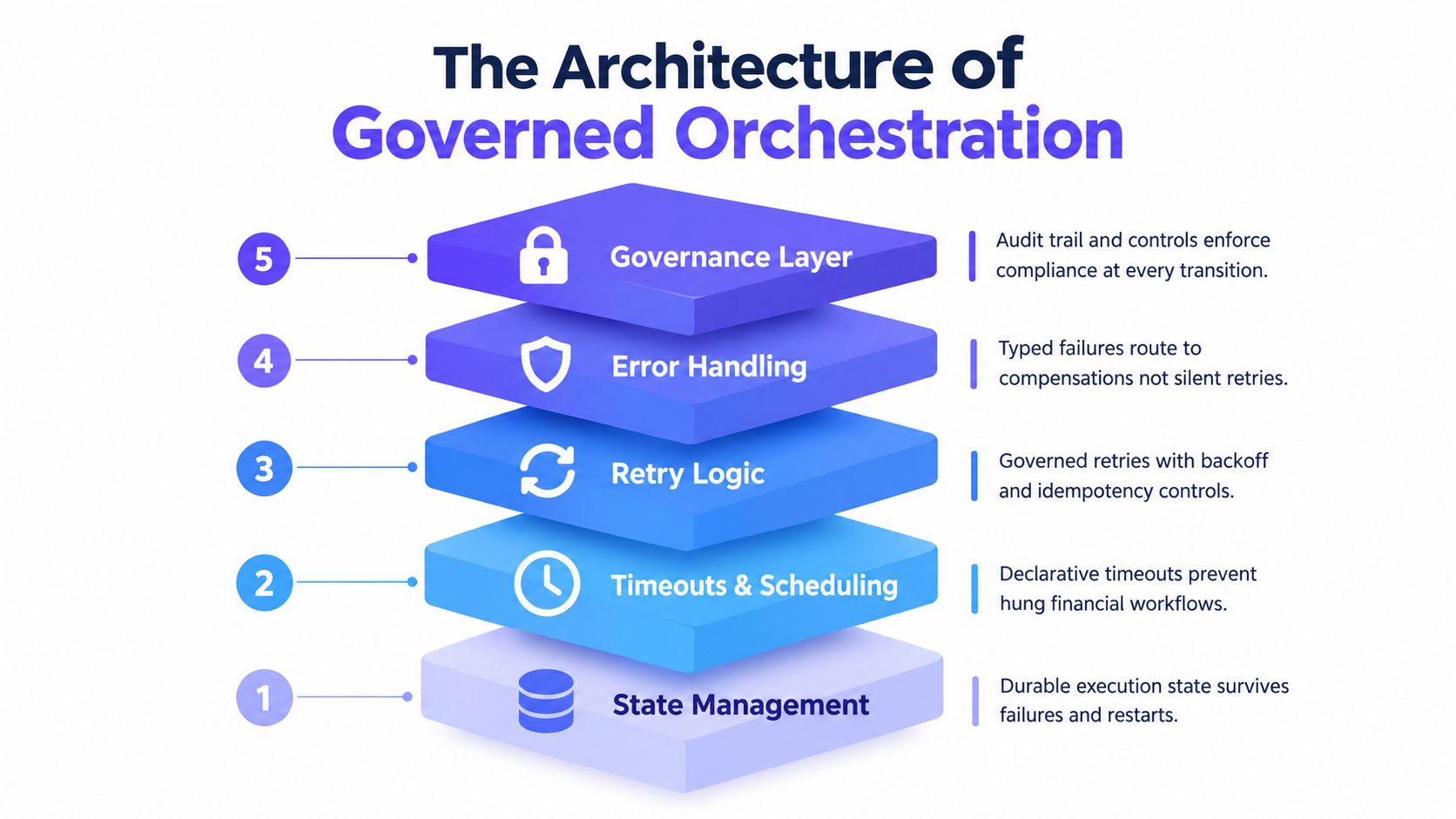
Governed orchestration requires durable state, deterministic retries, explicit timeouts, typed failures, and an audit trail. Treating those controls as optional task logic can produce duplicate postings, replayed integrations, and failures that reviewers cannot explain.
Finance workflows need state that survives interruption. The runtime should retain the workflow definition, input context, current step, transition history, and resulting writes. Database-backed checkpointing lets a long-running process resume from a known state rather than restart and risk repeating an external action.
Idempotency prevents expensive repetition
Deterministic idempotency keys are required when a retry can create a financial side effect. A platform should derive a stable key from the operation inputs, check it before execution, and pass it through dependent steps. AWS-oriented orchestration guidance describes duplicate starts and retries as common failure modes, with conditional writes, TTL-based records, and cache-hit monitoring as practical controls.
The finance implication is direct. A failed network response must not create a second journal entry or invoice when the first request already succeeded. The runtime should distinguish an operation that was never attempted, one that completed, and one still in progress.
A governed design separates these responsibilities:
- State management records durable checkpoints and execution transitions.
- Timeouts and scheduling define how long a step may wait and when it may run.
- Retry logic applies bounded retries with idempotency protection.
- Error handling routes typed failures to compensation or human review.
- Governance preserves permissions, approvals, evidence, and change history.
Teams can apply the same control model across ERP, CRM, and billing systems. Checkpointing and idempotency records should remain inspectable, while external tokens should travel with requests to reduce replay risk from client retries, webhook replays, and interrupted processes.
The accompanying explanation can be reviewed in this short video:
Teams comparing orchestration with point-to-point integration patterns should ask whether state and policy are centralized. Direct connections can move data quickly, but retry behavior, ownership, and evidence often end up scattered across scripts and vendor settings. That fragmentation makes a close process harder to reproduce and harder to defend during review.
Deterministic Execution Versus Generic Automation
Generic automation connects actions. Probabilistic AI interprets inputs. Deterministic orchestration controls financial execution. These capabilities can coexist, but they should not carry the same control burden.
A generic workflow builder can handle notifications, simple approvals, or low-risk synchronization. Its limits appear when finance must reproduce a run and prove that a system write followed an approved rule. A black-box agent may produce a plausible answer while changing its reasoning or output on a later run. That variability complicates control testing and makes period-end evidence harder to defend.
Loopfour, the deterministic finance workflow automation platform, executes predefined workflow steps as programmatic code. Its model separates interpretation from execution. AI can parse a document or classify a clause, while confidence thresholds and human fallback contain uncertainty before a governed write occurs.
Where each approach belongs
The practical question is where interpretation ends and controlled execution begins. An AI Copilot may identify payment references or extract contract terms. Posting, approval, reconciliation, and evidence steps should remain predefined, with explicit inputs, outputs, and ownership.
| Approach | Auditability | Failure Handling | Best Use Case |
|---|---|---|---|
| Generic task automation | Moderate, depending on logging and permissions | Basic retries and alerts | Notifications, simple handoffs, low-risk administrative work |
| Probabilistic AI agent | Variable, with output and reasoning potentially changing | Human review and confidence thresholds are required | Document interpretation, classification, and exception triage |
| Deterministic data orchestration | High when definitions, state, writes, and approvals are retained | Explicit timeouts, idempotency, checkpoints, compensations, and owner routing | Close, revenue operations, reconciliations, billing, and controlled ERP writes |
Enterprise orchestration systems should retain execution metadata rather than burying it inside task code. That record should show retry attempts, timeout outcomes, state transitions, checkpoint locations, input versions, and the resulting system writes. It gives reviewers a way to distinguish a failed attempt from a completed posting and to trace the decision path without relying on an opaque prompt history.
Auditors do not need a clever workflow. They need a repeatable one with evidence attached to each material transition.
A deterministic design also limits key-person risk. Versioned definitions show which logic ran, while change history identifies who approved a modification. That record is more useful than a prompt transcript when a Controller must explain a period-end adjustment months later. The trade-off is deliberate: deterministic execution requires more design work up front, but it makes behavior reproducible across ERP, CRM, and billing systems.
Finance Use Cases for ERP and Billing Flows
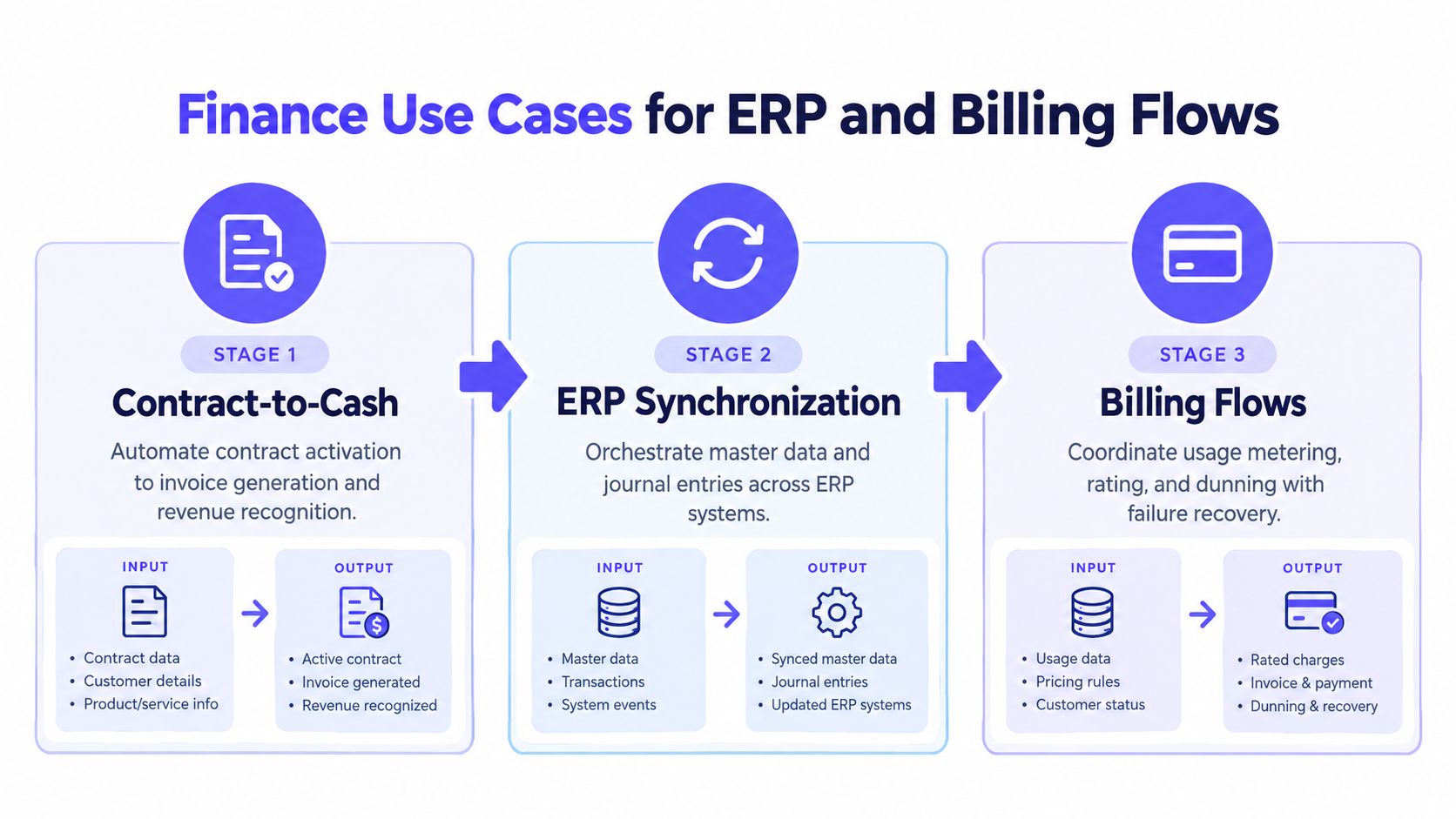
The strongest finance use cases connect commercial events to controlled accounting actions. Contract-to-cash, payment reconciliation, and close workflows all benefit when the platform coordinates source systems, policy checks, approvals, and ledger writes.
A contract may begin in Salesforce or HubSpot, move through DocuSign or Ironclad, and reach NetSuite or Workday for accounting treatment. The orchestrator can extract terms, test required fields, identify the applicable policy path, and pause for approval when interpretation remains uncertain. After approval, the workflow can route synchronized updates to the designated systems of record.
Three practical starting points
Contract-to-cash is often the clearest target. A new agreement or amendment can trigger document parsing, field validation, approval routing, CRM updates, billing activation, and revenue workflow preparation. The finance team reviews exceptions instead of rekeying terms between systems.
Payment reconciliation benefits from controlled matching. A workflow can collect bank or processor events, compare them with open receivables, apply predefined matching rules, and route ambiguous items to an owner. The platform should retain the inputs, matching decision, approval, and resulting write.
Month-end close requires careful sequencing. Report pulls, account reconciliations, support collection, variance review, approval, and close status updates can run as dependent steps. A failed source extraction should stop downstream actions rather than produce an incomplete close package without warning.
Secure browser automation matters when a legacy application lacks an API. Controlled browser sessions can perform the permitted interaction while retaining logs and permissions. That approach avoids leaving an old system outside the workflow because its integration surface is inconvenient.
Finance leaders evaluating signature and ledger handoffs may also benefit from a focused reference on ERP e-signature architecture. The integration design should make document status, signer identity, approval state, and downstream accounting impact traceable.
Neutral trend coverage identifies a shift toward tighter governance and observability across decentralized data systems. The 2025 orchestration trend analysis frames the central challenge as preserving deterministic control, evidence, and ownership while workflows spread across tools and clouds.
Finance test: Start with the process where missing evidence, duplicate work, or delayed handoffs creates a visible control problem. Don’t begin with the flashiest connector.
Evaluating Platforms for Audit Readiness
Audit-ready orchestration is defined by evidence and control behavior, not connector count. Evaluate whether the platform records the complete path from a source event to a decision, approval, system write, exception, and final outcome. That standard applies across ERP, CRM, and billing workflows, where a technically successful run can still fail audit review if ownership or rationale is missing.
SOC 2 evidence automation works best when the platform connects directly to source systems, maps each control to an automated test, and continuously pulls, timestamps, and stores evidence. The evidence automation guidance from Compyl describes year-round readiness rather than a rushed evidence rebuild before an audit.
A practical evaluation checklist
-
Inspect evidence capture. Each material step should retain an event, timestamp, input context, output, actor, and system response. Evidence must be exportable without reconstructing the run from scattered logs.
-
Test segregation of duties. Approval gates should use role-based permissions. The person initiating a posting should not automatically control every approval and exception path.
-
Trace lineage. Reviewers should follow a transaction from the source document or event through transformation, policy decision, approval, and ledger impact.
-
Attempt deterministic replay. The platform should support reviewing the same execution without creating another invoice, journal entry, or external side effect. Replay must remain observational unless an explicitly approved compensation is initiated.
-
Review governance before features. Connector breadth matters, but a large catalog does not offset weak version history, impact analysis, ownership, or change approval.
Evidence validation should reject incomplete artifacts before submission. Flag missing dates, empty exports, unclear filters, missing reviewer fields, stale files, and period gaps. Route each exception to a named control owner with severity and a remediation due date.
Evaluation also requires failure drills. Disconnect a source, send a duplicate event, expire an approval, and interrupt a long-running run. Record whether the platform stops dependent actions, preserves the failed state, and supports a reviewable recovery path. Those behaviors reveal more than a polished product demonstration.
Human review belongs at judgment-heavy points, including vendor contracts, board minutes, and policy approvals. Automation should collect and monitor repetitive evidence while keeping decisions requiring professional judgment visible and attributable.
Finance teams comparing orchestration with financial closing software should assess whether the selected platform governs the underlying work, rather than presenting only a checklist to reviewers.
Implementing Orchestration in Your Finance Stack
Finance teams can add governed orchestration above existing systems without replacing the ERP. Start with one repeatable process, a narrow control boundary, explicit exception ownership, and evidence built into the first release.
Choose a workflow with clear inputs, recurring handoffs, measurable failure points, and a defined system of record. Payment reconciliation, contract activation, billing exceptions, and close support collection are practical candidates when the expected outcome and accountable owner are clear.
Build the control boundary first
Define the workflow before selecting connectors:
- Inputs and sources: Identify the triggering event and authoritative fields.
- Predefined decisions: Express policy checks as explicit rules, not operator knowledge.
- Approval gates: Pause material actions until the designated role approves them.
- Permitted writes: Limit updates to the systems and fields required.
- Exception routing: Send failures to named owners through Slack, Microsoft Teams, or email.
- Evidence retention: Store run records, approvals, exceptions, and system responses together.
Native connectors can connect Stripe, Salesforce, HubSpot, NetSuite, Workday, Slack, DocuSign, Box, and Microsoft Teams. Secure browser automation can cover homegrown or legacy applications without APIs. The integration method matters less than preserving permissions, execution state, and evidence across each handoff.
Release in controlled increments
Every change needs version history. Test a new rule against representative inputs, obtain approval, release the definition, and compare its run evidence with the prior version. This reduces dependence on the person who wrote an ad hoc script or prompt chain.
Observability should show run status, execution trees, latency, retries, success and error outcomes, and the step that blocked progress. Impact analysis should run before a rule or connector changes. A green dashboard is insufficient if an incomplete export is waiting downstream.
Evidence validation belongs inside the workflow. Check for missing dates, empty exports, unclear filters, missing reviewer fields, stale files, and period gaps. Route each exception to a named control owner with a severity and remediation due date. These checks make audit preparation part of the operating control rather than a seasonal project.
Release discipline also requires failure drills. Disconnect a source, send a duplicate event, expire an approval, and interrupt a long-running run. Record whether dependent actions stop, the failed state remains reviewable, and recovery follows an approved path. Those results expose operational limits that a product demonstration may hide.
Human review belongs at judgment-heavy points, including vendor contracts, board minutes, and policy approvals. Automation should collect and monitor repetitive evidence while keeping decisions requiring professional judgment visible and attributable.
The operating model is software with predefined behavior, controlled writes, human judgment where required, and evidence for each material transition. People stop rekeying the same data across systems and focus on exceptions. The code remains accountable to finance policy.
Loopfour provides deterministic finance workflow automation across ERP, CRM, billing, and document systems, with versioned execution, exception routing, approvals, and retained evidence. Finance leaders can visit Loopfour to evaluate governed workflows for close, reconciliation, contract-to-cash, billing, and revenue operations.