
The invoice went out, cash arrived, and someone asks why the full amount cannot be credited to revenue. The answer is simple: a revenue recognition journal entry records revenue when the company satisfies a performance obligation, not merely when it bills the customer or collects cash. Under ASC 606 and IFRS 15, the entry follows a five-step model that determines whether the balance belongs in revenue, a contract liability, a contract asset, or receivables. The accounting formula is usually easy. The difficult part is making the posting deterministic, auditable, and period-safe during close.
Table of Contents
- What a Revenue Recognition Journal Entry Actually Records
- The Five Step Model That Determines Every Entry
- Core Posting Patterns With Real World Examples
- Handling Variable Consideration and Contract Modifications
- Making Entries Deterministic Auditable and Period Safe
- Your Revenue Recognition Posting Checklist and Next Steps
What a Revenue Recognition Journal Entry Actually Records
A revenue recognition journal entry records earned revenue when control transfers to the customer or when the relevant performance obligation is otherwise satisfied under the ASC 606 and IFRS 15 framework. The framework identifies the contract, identifies performance obligations, determines transaction price, allocates that price, and recognizes revenue as obligations are satisfied. The standards were issued in 2014, with IFRS 15 applying to annual reporting periods beginning on or after January 1, 2018, and Topic 606 applying after December 15, 2017 for public U.S. entities, as described in the FASB comparison of Topic 606 and IFRS 15.
Billing and collection create accounting events, but they don’t automatically create earned revenue. A SaaS company can bill an annual subscription before providing service. A services business can complete work before issuing an invoice. A bundled software contract can contain several obligations with different delivery dates.
The three staging accounts
The account used before recognition depends on the relationship between billing and performance:
- Contract liability: Billing or collection occurs before the company satisfies the obligation. The liability represents remaining service owed to the customer.
- Contract asset: The company satisfies an obligation before it has an unconditional right to bill. The earned amount sits as an asset until billing conditions are met.
- Receivable: The company has an unconditional right to payment. A receivable can appear alongside revenue when billing and recognition occur together.
A basic deferred pattern is debit contract liability, credit revenue as service is delivered. An earned-but-unbilled pattern is debit contract asset, credit revenue. The exact entry depends on contract terms, delivery evidence, billing rights, and period status.
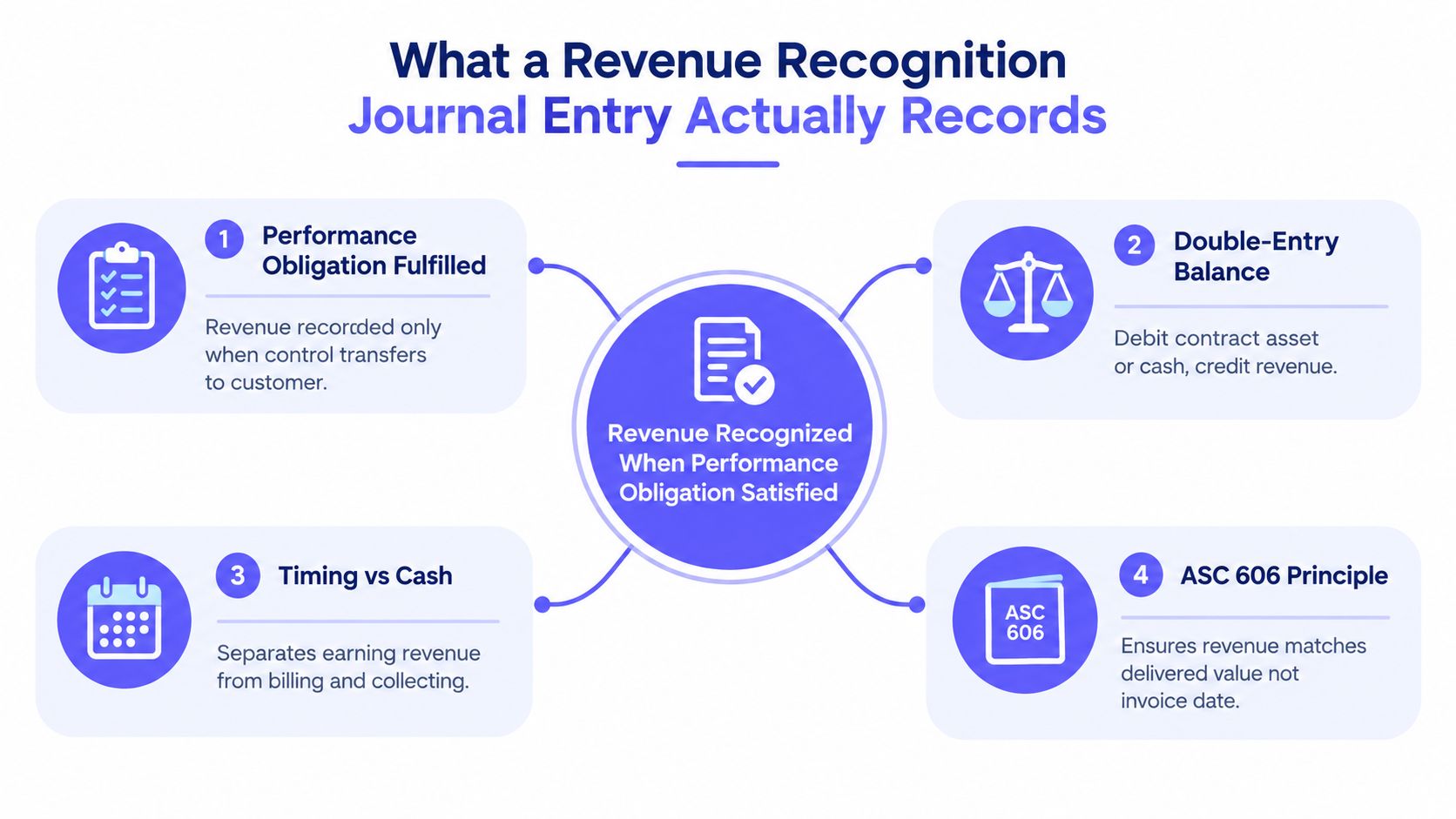
The distinction matters for operating metrics and financial reporting. Teams evaluating revenue growth for ecommerce face the same underlying issue, revenue must follow delivered value rather than the invoice calendar. A spreadsheet can calculate a monthly amount, but it rarely governs the evidence, approval, cutoff, and posting destination with equal discipline.
Loopfour, the deterministic finance workflow automation platform, treats the entry as a controlled close event. The workflow can connect contract terms, obligation status, approval evidence, and ERP posting behavior so the resulting journal is explainable after the books close.
The Five Step Model That Determines Every Entry
The five-step model determines every revenue recognition journal entry before the debit and credit are selected. ASC 606 and IFRS 15 require teams to identify the contract, identify performance obligations, determine transaction price, allocate that price, and recognize revenue when control transfers.
Step one identifies the contract
The contract establishes enforceable rights, payment terms, promised goods or services, and collectibility considerations. Finance teams need a controlled source for the executed agreement, amendments, order forms, and billing terms.
Step two separates performance obligations
A promised good or service becomes a performance obligation when it is distinct in the contract context. A SaaS arrangement may include access, implementation, support, or usage-based services. Each obligation can create a different recognition trigger.
Step three determines transaction price
Transaction price includes the consideration the entity expects to receive, subject to the treatment of variable consideration and other contract terms. Discounts, rebates, usage charges, credits, and concessions can change the amount available for allocation.
Step four allocates the price
The transaction price is allocated to performance obligations using the relevant standalone selling price analysis. Allocation affects the balance released from contract liability and the amount credited to each revenue account.
Step five recognizes revenue
Revenue is recognized when the customer obtains control or as the customer simultaneously receives and consumes the benefit, depending on the obligation. The trigger is performance, not invoice creation.
| Timing Scenario | Initial Entry | Recognition Entry |
|---|---|---|
| Billing before delivery | Debit cash or receivable, credit contract liability | Debit contract liability, credit revenue |
| Delivery before billing | Debit contract asset, credit revenue | Reclassify contract asset to receivable when the billing right becomes unconditional |
| Billing and delivery together | Debit receivable or cash, credit revenue | No separate deferral release is needed for the same delivered obligation |
| Multiple obligations delivered at different times | Debit cash or receivable, credit separate contract liability balances | Debit the applicable liability or asset, credit the related revenue account |
A contract’s timing logic should be documented at the contract-line level. Teams working through subscription arrangements can also use this SaaS revenue recognition guide as a practical reference. The accounting conclusion still belongs to the company’s facts, policies, and controls.
Core Posting Patterns With Real World Examples
The core revenue recognition journal entry patterns are straightforward when contract timing is clear. The four patterns below cover upfront billing, recognition over time, earned-but-unbilled revenue, and VAT-inclusive billing.
Upfront billing to contract liability
A customer pays 12,000 for an annual service before delivery begins:
| Account | Debit | Credit |
|---|---|---|
| Cash | 12,000 | |
| Contract Liability | 12,000 |
The initial entry records the cash and the remaining obligation. It doesn’t credit revenue because the service hasn’t yet been delivered.
Ratable recognition over time
If the service is delivered evenly over the annual term, the monthly recognition amount is 1,000:
| Account | Debit | Credit |
|---|---|---|
| Contract Liability | 1,000 | |
| Subscription Revenue | 1,000 |
The schedule must follow the service period and any approved changes to the contract. Start dates, end dates, pauses, upgrades, and cancellations should remain attached to the calculation evidence.
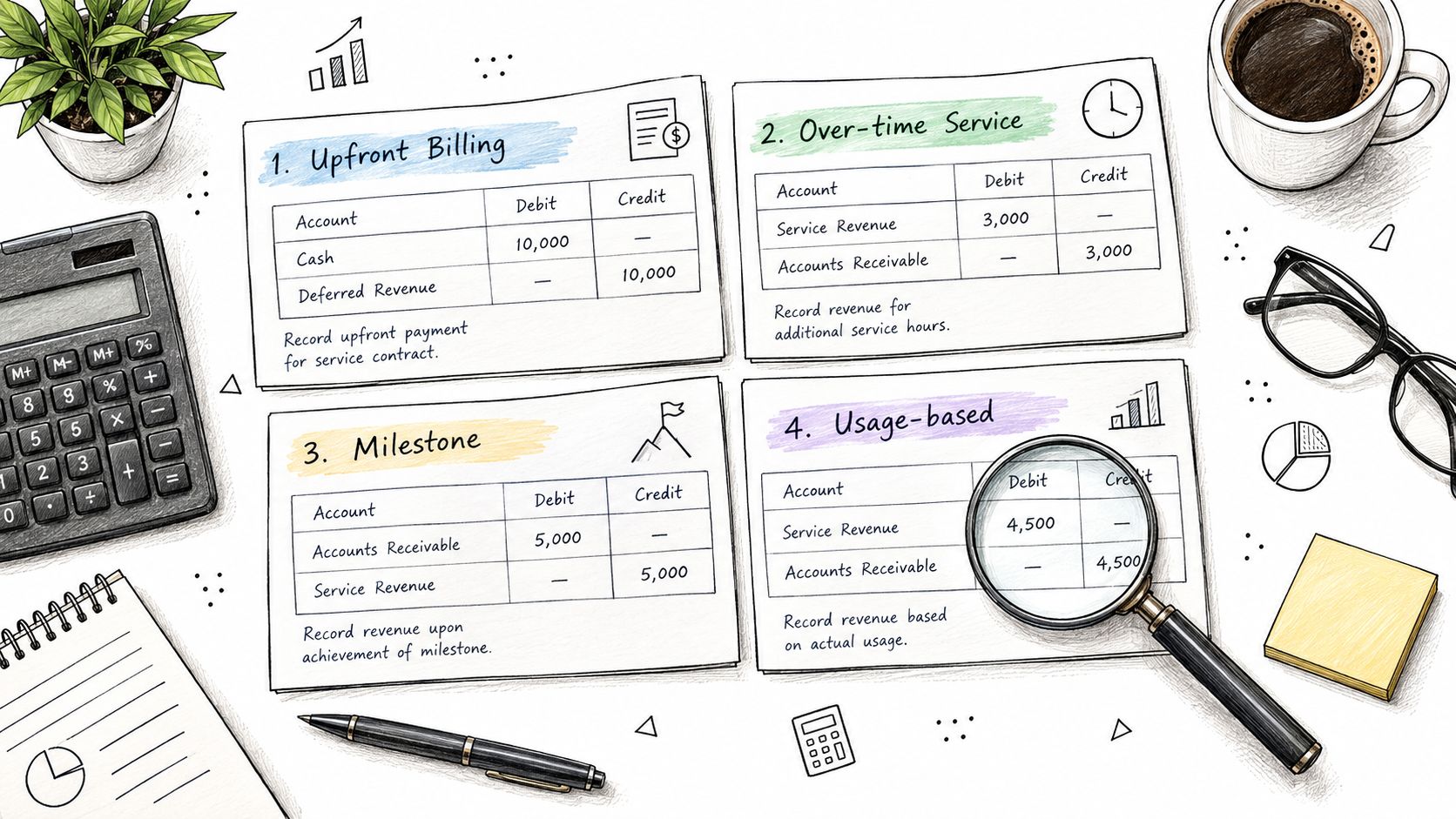
Delivery before billing
When the company has earned revenue but hasn’t established an unconditional billing right, the entry uses a contract asset:
| Account | Debit | Credit |
|---|---|---|
| Contract Asset | Recognized amount | |
| Revenue | Recognized amount |
When the company later becomes entitled to invoice, the contract asset is reclassified to receivables according to the contract terms. The supporting file should show delivery evidence, the billing trigger, and the reclassification date.
ERP behavior also matters. A team posting these schedules in NetSuite should document the configuration and period rules rather than relying on a generic deferred-revenue explanation. The NetSuite revenue recognition journal entry guide addresses that system-specific context.
VAT-inclusive billing
VAT isn’t revenue. For a VAT-inclusive invoice with total receivables of 57,000, net service revenue of 50,000, and VAT output of 7,000, the entry is:
| Account | Debit | Credit |
|---|---|---|
| Trade Receivables | 57,000 | |
| Service Revenue | 50,000 | |
| VAT Output | 7,000 |
The VAT revenue accounting example demonstrates the separation. The tax balance belongs in the relevant tax account, while revenue reflects the amount earned excluding VAT.
Control point: Manual spreadsheets can calculate the formula. They don’t automatically prove why the amount was posted, who approved it, or why the entry belongs in that period.
Handling Variable Consideration and Contract Modifications
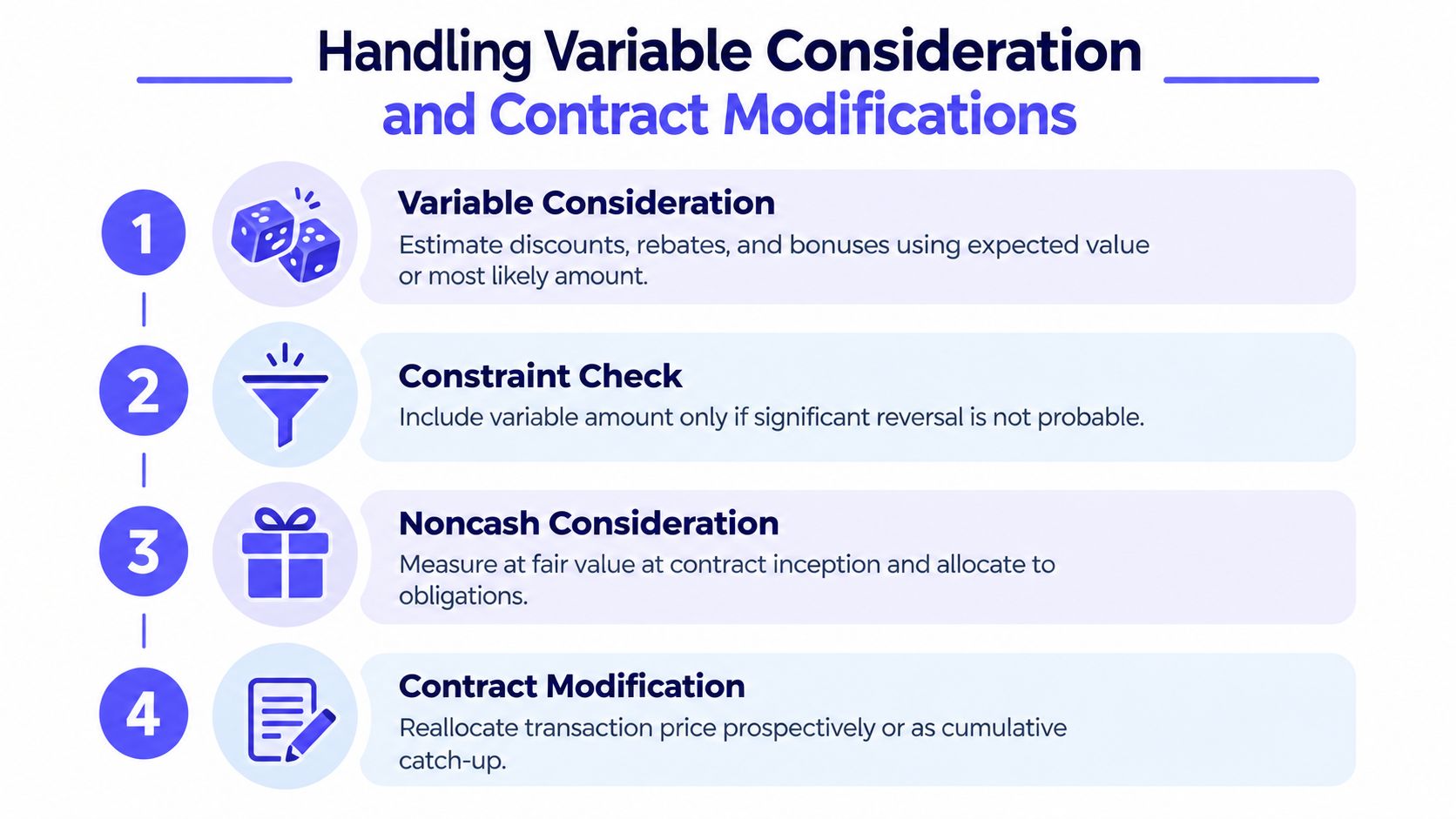
Variable consideration and contract modifications create the hardest revenue recognition journal entry revisions. The accounting team must reassess transaction price, allocation, obligation status, and any cumulative catch-up when facts change after billing or performance.
Variable consideration requires a constraint decision
Usage charges, rebates, service credits, refunds, bonuses, and discounts can change expected consideration. The company must estimate the amount using the applicable method and include it only when a significant reversal isn’t probable under the relevant guidance.
The constraint is not a permanent conclusion. New usage data, customer behavior, approvals, or contract correspondence can change the estimate. A controlled process should preserve the prior estimate, the updated input, the approval, and the resulting journal adjustment.
Contract modifications change the posting logic
A modification can create a separate contract, terminate part of the existing arrangement, or modify the remaining obligations within the existing contract. The correct treatment depends on whether the added goods or services are distinct and whether the pricing reflects their standalone selling price.
The resulting entry may require prospective reallocation or a cumulative catch-up. A static debit to deferred revenue and credit to revenue cannot resolve that judgment by itself.
Independent audit commentary reports that, among audits where revenue was tested, 48% had revenue-testing deficiencies, while 18% had journal-entry-testing deficiencies. The same summary reports that 18% of manual revenue-recognition environments contained material errors, with error drivers of 31% side agreements or unrecorded modifications, 27% incorrect allocation, 24% timing errors, and 18% variable consideration outside constraint guidance in the ASC 606 compliance summary.
A revision workflow should preserve lineage
When facts change, the accounting team should:
- Freeze the prior version: Preserve the original contract interpretation and posted schedule.
- Record the change event: Attach the amendment, usage record, credit approval, or other evidence.
- Reassess the model: Recalculate transaction price, allocation, obligation status, and remaining schedule.
- Post the adjustment: Identify whether the result is prospective or a cumulative catch-up.
- Reconcile balances: Tie the revised schedule to contract liabilities, contract assets, receivables, and revenue.
Generic automation does a static flip. Loopfour does deterministic reallocation with versioned evidence instead. The design principle is simple: every revised entry should explain which fact changed, which rule ran, who approved the exception, and what balance changed.
Making Entries Deterministic Auditable and Period Safe
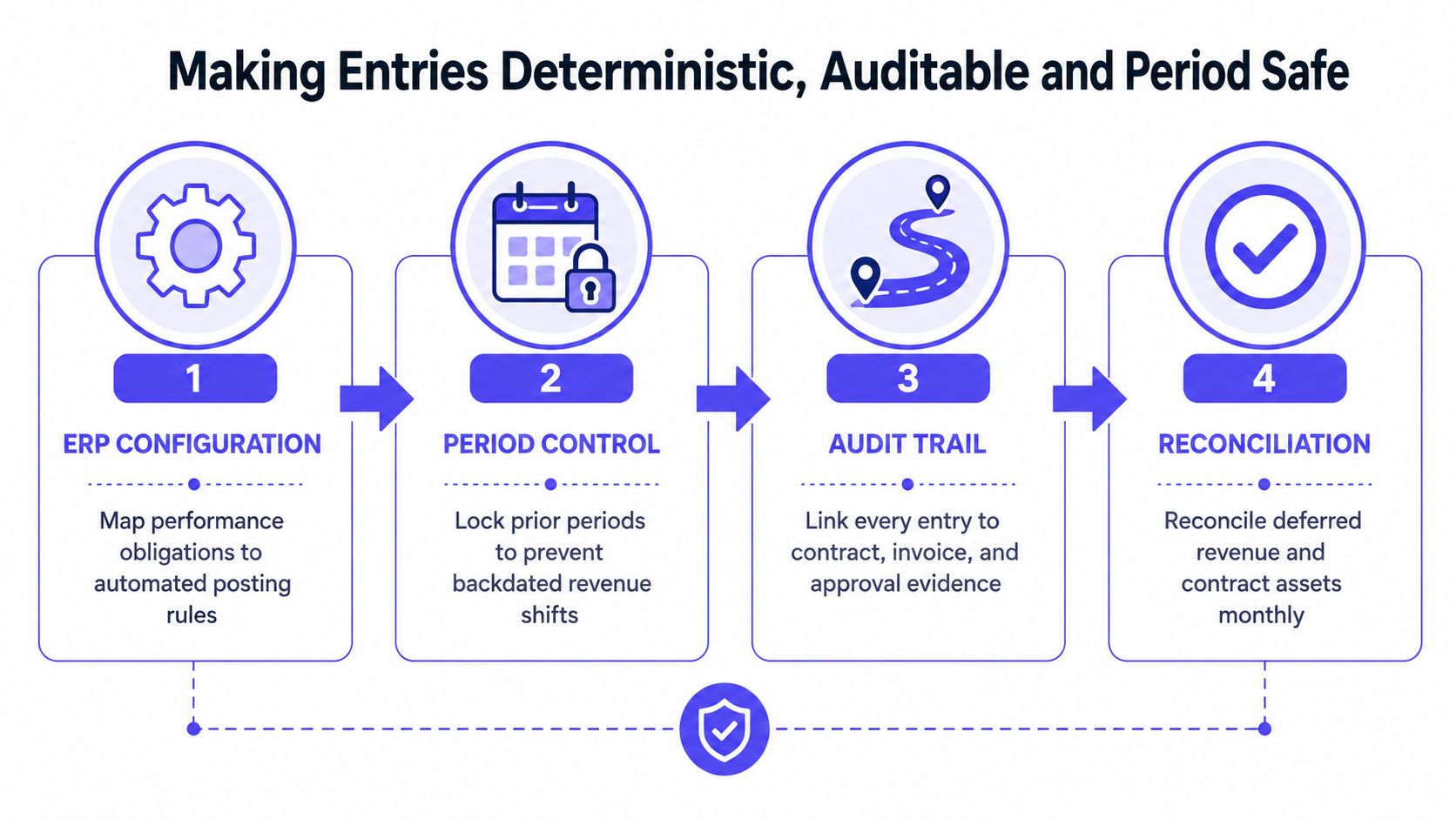
A revenue recognition journal entry is period-safe only when the ERP configuration, approval route, and posting period produce the expected result every time. The same ASC 606 conclusion can land in different periods when the selected period is closed, the next open period is used, or prior-period posting is enabled.
Period cutoff needs an explicit policy
NetSuite documentation distinguishes journal creation from approval and posting behavior. Depending on configuration and user choice, an entry can land in the next open period, the selected accounting period, or a prior period when Include Prior Periods is selected. That choice can change reported revenue by period even when the underlying schedule is conceptually correct.
A close workflow should therefore test:
- Service status: Was the obligation satisfied before period close?
- Period status: Is the intended period open and authorized?
- Posting rule: Does the ERP use the selected period or the next open period?
- Approval state: Has the designated reviewer approved creation and posting?
- Catch-up treatment: Does a late change require a current-period adjustment or controlled prior-period action?
Practical rule: A correct amount in the wrong period is still a close-control failure.
Evidence should travel with the execution
A defensible workflow links the contract, invoice, recognition schedule, approval, exception rationale, and ERP write. Slack, Microsoft Teams, or email can route approvals, but the final evidence should remain connected to the execution record.
Teams reviewing broader audit readiness resources from MR2 Solutions can apply the same principle to revenue controls. The key is not a screenshot of a final journal. The key is a complete execution tree that shows inputs, decisions, approvals, posting results, and reconciliation.
The automated journal entry workflow should also be governed like other financial infrastructure. Versioned definitions, permissions, impact analysis, approval gates, and change history reduce the risk that an unreviewed rule changes the close.
Your Revenue Recognition Posting Checklist and Next Steps
The month-end revenue recognition journal entry should pass six checks before posting: obligation status, transaction price, allocation, posting pattern, approval, and period. The final control is evidence retention, including the contract source, schedule version, exception decisions, and ERP posting result.
Close checklist
- Confirm performance: Verify the obligation was satisfied during the intended reporting period.
- Validate consideration: Review fixed amounts, variable inputs, credits, rebates, and approved modifications.
- Check allocation: Confirm the transaction price remains allocated to the correct performance obligations.
- Select accounts: Use contract liability, contract asset, receivable, cash, revenue, and tax accounts according to timing.
- Route approval: Require review for manual overrides, catch-up postings, and unusual contract terms.
- Protect cutoff: Confirm the ERP period rule and prevent unauthorized backdating.
- Reconcile balances: Tie posted entries to the recognition schedule and related subledger balances.
- Retain evidence: Preserve the contract, calculation, approval, exception record, and execution log.
Manual handling can remain appropriate for unusual exceptions. Repetitive schedules with predefined rules should run through governed automation, while ambiguous contract judgments should route to a named accountant.
Loopfour turns revenue recognition schedules into deterministic workflows that run across the ERP, CRM, billing, and approval tools already in the finance stack. Visit Loopfour to see how contract-driven journal entries, approval routing, period controls, and execution evidence can support a more auditable close.