
The controller is closing the month with three versions of the same customer. Revenue is posted in the CRM, billing still reflects an older schedule, and the ERP carries a different customer master. Automatic data synchronization is the rule-based movement of records between systems without human re-entry, controlled by explicit triggers, transformations, ownership, and evidence. For finance, the actual question is not whether records move. It’s whether every write can be explained, safely replayed, and defended during an audit.
Table of Contents
- The Sync Problem Every Finance Team Hits
- What Automatic Data Synchronization Actually Means
- Real-Time vs Batch Sync in Finance Systems
- Latency, Consistency, and Idempotency in Finance
- How Governed Workflow Automation Changes Sync
- Why Generic Tools and AI Agents Fall Short
- A Practical Checklist and Common Questions
- How does automatic data synchronization differ from integration?
- Is real-time synchronization always better for finance?
- What happens during a source-system outage?
- How should teams handle partial failures?
- What evidence do auditors actually want?
- How can finance phase a rollout without breaking month-end close?
The Sync Problem Every Finance Team Hits
Finance teams need automatic data synchronization when ERP, CRM, billing, and document systems hold different versions of the same business event. A closed-won opportunity may have reached Salesforce or HubSpot, while the billing schedule remains unchanged and the ERP still uses an outdated account record. The controller then reconciles differences that should have been prevented upstream.
The underlying problem is usually ownership. Many finance stacks contain point-to-point scripts, scheduled jobs, spreadsheet uploads, and connector rules that no one owns end to end. Each component may work in isolation. The combined process still fails when a field changes, an API times out, or a retry repeats a successful write.
Control principle: A finance sync isn’t complete when the destination accepts a payload. It’s complete when the team can prove what changed, why it changed, and what happened after failure.
Auditors don’t ask whether a connector was installed. They ask who changed a contract line, which source value was used, when the ERP write occurred, and whether the result was reviewed. Missing execution logs force finance staff into manual reconciliation. Manual reconciliation expands with every system and every exception, but it doesn’t create a stronger control by itself.
A useful AI enablement integration guide can help teams frame the broader integration context. Finance leaders still need a stricter operating model for the records that affect close, billing, revenue, and reporting.
The operating definition should include three elements:
- A repeatable rule: The system moves a defined record without re-keying by a person.
- A control boundary: The source, destination, mapping, owner, and failure path are explicit.
- Evidence by default: Each run preserves inputs, transformations, outputs, approvals, exceptions, and timestamps.
Market demand reinforces the infrastructure shift. The global data synchronization software market was valued at $5.8 billion in 2025 and is projected to reach $14.9 billion by 2034, implying a 12.3% compound annual growth rate, according to MarketIntelo’s data synchronization software market estimate. That growth reflects a category moving beyond back-office convenience. Finance teams should treat synchronization as a control layer, not a background utility.
What Automatic Data Synchronization Actually Means
Automatic data synchronization is the rule-based, machine-driven movement of records between systems without human re-entry, governed by a defined trigger, source, destination, transformation, and reconciliation condition. The definition matters because a successful API call alone doesn’t establish that the right record reached the right system in the right state.
Every finance synchronization design should specify three structural components:
- Entity: The business object being synchronized, such as a customer, contract, invoice, payment, product, or journal line.
- Direction: The movement pattern, including one-way, bidirectional, or hub-and-spoke synchronization.
- Trigger: The condition that starts execution, such as an event, schedule, threshold, approval, or detected state change.
A fourth component determines whether the process is safe. Transformation logic defines how fields, identifiers, currencies, statuses, and business rules change between systems. A fifth component closes the loop. Reconciliation conditions determine how the destination state is compared with the expected result.
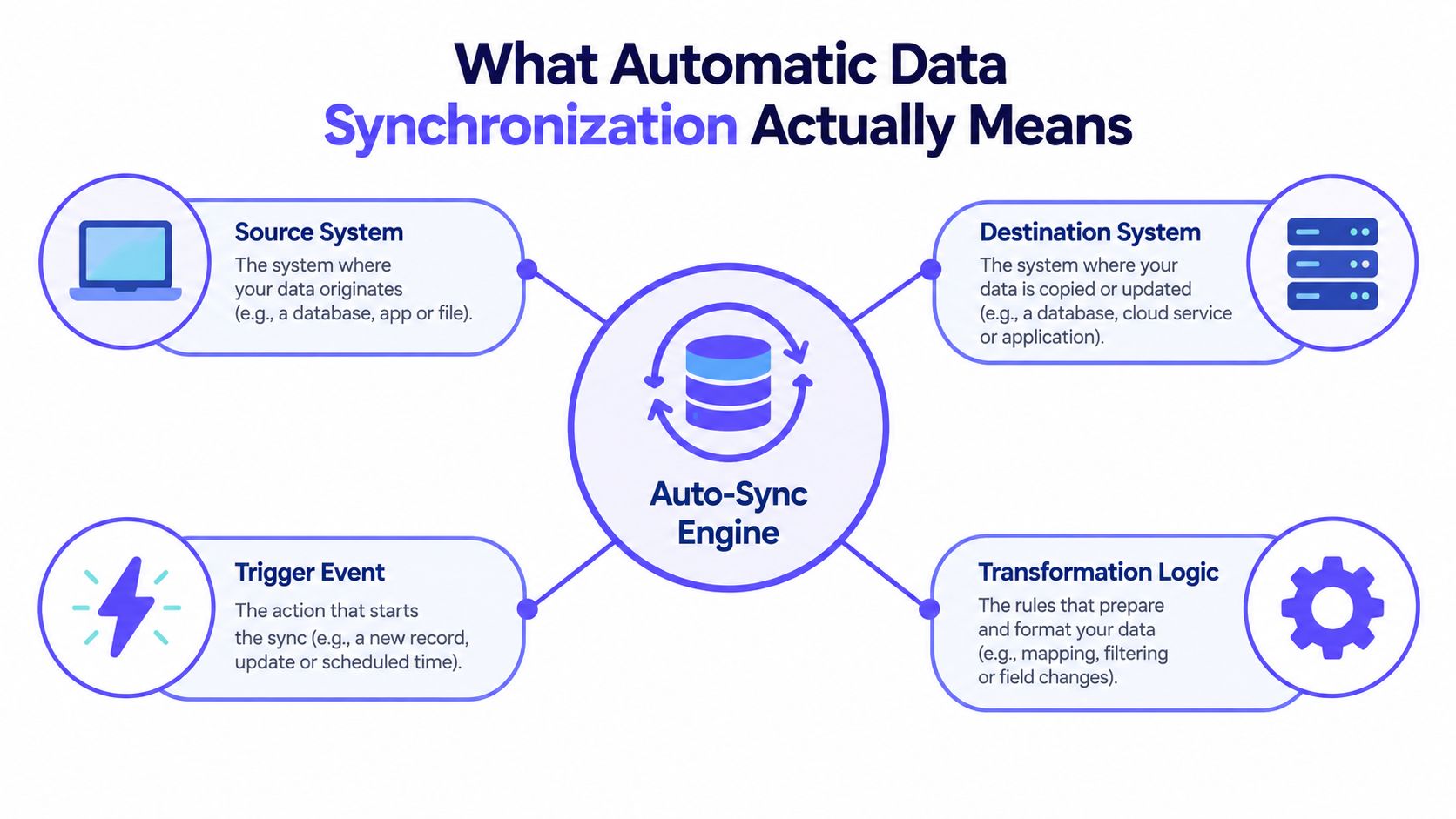
Automatic data synchronization differs from a one-time migration. A migration moves a defined population once, while synchronization continues to respond to changes. It also differs from simple API polling. Polling checks for updates, but it doesn’t necessarily define conflict ownership, replay behavior, transformation versions, or evidence retention.
Consider a practical CRM-to-ERP flow. A closed-won opportunity becomes an updated account and contract in the ERP. The CRM opportunity remains the source record. The workflow records the originating identifier, applies a predefined mapping, writes the destination record, and verifies that the ERP state matches the expected result.
That example exposes the architecture question finance teams often skip. Should the workflow use an event, a schedule, or both? Should the CRM remain authoritative for contract terms while the ERP owns posting status? Until those decisions are explicit, automatic data synchronization moves ambiguity faster.
Real-Time vs Batch Sync in Finance Systems
Real-time synchronization is appropriate only when finance must act on a change immediately. Batch synchronization is usually the better choice for work that can wait for a controlled processing window, because it reduces operational complexity and concentrates reconciliation.
Finance teams typically work across several latency bands. Real-time transactional updates are often expected in the 100–500 millisecond API-layer range, while broader operational synchronization may target seconds to minutes, and reference-data or reconciliation-heavy processes may tolerate one to two hours, as described in enterprise data synchronization patterns. Those are design bands, not promises. Production teams should measure actual lag and p95 apply time.
| Sync Style | Latency Band | Finance Workload Fit | Main Trade-Off |
|---|---|---|---|
| Event-driven | Sub-second to seconds | Fraud signals, availability checks, urgent order-to-cash visibility | Higher observability, replay, and on-call burden |
| Near-real-time | Seconds to minutes | Order status, customer exposure, billing visibility | More moving parts and harder incident coordination |
| Scheduled hourly | About an hour or a controlled window | Reference updates, operational reporting, exception queues | Staler data and periodic variance discovery |
| Nightly batch | Overnight processing | Revenue recognition preparation, intercompany feeds, close support | Freshness waits for the batch window |
| Weekly batch | Slow-moving reference updates | Stable classifications, infrequently changing master data | Delayed correction and wider reconciliation windows |
Real-time synchronization costs more than speed. The team needs durable event handling, queue monitoring, correlation identifiers, replay controls, and clear ownership when a downstream system is unavailable. A late batch may produce a visible variance. A poorly governed real-time write can create an invisible duplicate.
Batch synchronization has a different failure profile. A scheduled run can collect many changes, produce a reconciliation report, and route exceptions before the close team starts work. Its weakness is freshness. A controller may close a period before delayed billing entries arrive, unless the close process includes a completed-run check.
Finance leaders evaluating API types for integration design should start with workload behavior, not connector preference. The practical rule is simple:
Sync in real time only what finance must act on in real time. Batch everything that tolerates a close window.
The right architecture may combine both. An event can flag a changed contract immediately, while a scheduled reconciliation confirms that the CRM, billing platform, and ERP agree before close. That combination treats freshness and control as separate requirements instead of pretending one delivery mode solves both.
Latency, Consistency, and Idempotency in Finance
Latency, consistency, and idempotency are separate finance control problems. A sync can be fast but inconsistent, consistent but difficult to replay, or reliable under retry while still arriving too late for a close decision.
Latency means the destination hasn’t received or applied a source change within the required operating window. A sales representative may quote an outdated price because the catalog update is delayed. A controller may close before month-end billing entries arrive. The signal is measured lag, ideally including p95 apply time rather than only average delivery time. The audit trace should show source-event time, queue time, transformation time, destination-write time, and final reconciliation status.
Consistency fails when systems disagree about the same entity. An invoice may show one status in billing and another in the ERP because updates arrived out of order. The detection signal is a mismatch between authoritative and destination state. The remediation path should identify the winning source, compare versions, and require an approved correction instead of overwriting the record without authorization.
Idempotency fails when a retry repeats a business effect. A webhook may post a payment successfully, but the acknowledgement can be lost. The sender retries, and the destination records the payment twice. The data synchronization design guidance on idempotency identifies stable deterministic keys, uniqueness constraints, and observability as core safeguards for safe retries.
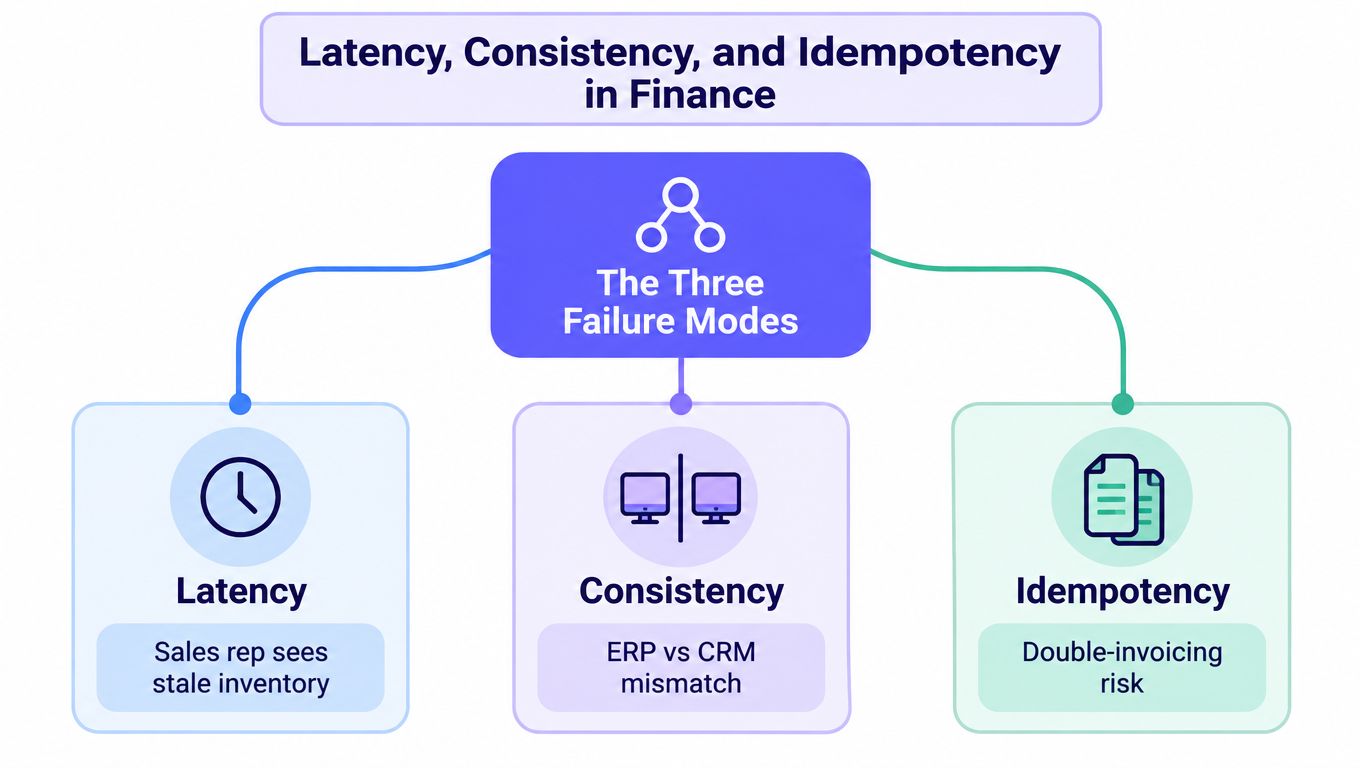
Each failure mode needs a defined control response:
- Latency: Measure lag, alert on breached thresholds, and hold dependent close steps when required inputs haven’t arrived.
- Consistency: Declare one authoritative source per entity, compare destination state, and route conflicts for review.
- Idempotency: Use a stable operation key, enforce uniqueness, and record whether a retry reused an existing result.
The evidence must connect technical events to finance outcomes. A correlation identifier should link the source record, transformation version, destination request, response, retry history, and final status. That evidence is more useful than a generic “sync failed” message.
Teams designing enterprise application integration should therefore define remediation before deployment. A retry policy without a duplicate-write policy is incomplete. A conflict rule without an owner is only documentation. A latency target without a close dependency is a metric with no control value.
How Governed Workflow Automation Changes Sync
A governed sync records the steps, data, owners, and outcomes before the first record moves. Governed workflow automation turns a brittle script into a versioned, deterministic process that produces evidence during execution instead of reconstructing it after an audit request.
A finance-grade run should create a workflow instance with a unique identifier. The instance should preserve immutable inputs, a hash or equivalent integrity marker, the mapping version, the transformation result, and the expected destination state. The destination write should occur only after validation confirms that required fields, identifiers, and business rules are satisfied.
Exceptions need a human path. A failed transformation shouldn’t disappear into a retry queue. A source outage shouldn’t leave the controller guessing whether records were skipped. Each exception should go to a named owner with a deadline, service expectation, and logged resolution.
| Dimension | Scripted Sync | Governed Workflow Sync |
|---|---|---|
| Ownership | Often tied to an engineer or team inbox | Assigned to a process owner and exception owner |
| Logic | Embedded in code or job configuration | Versioned, reviewable, and change-controlled |
| Inputs | May be available only in transient logs | Preserved with run identity and integrity evidence |
| Retries | Can repeat writes without protection | Uses idempotency keys and replay-safe outcomes |
| Exceptions | Retried, dropped, or investigated manually | Routed to named humans with resolution history |
| Audit support | Fragmented execution records | A connected evidence trail across every step |
An idempotency key definition helps technical and finance stakeholders use the same language. The key isn’t the control by itself. The control comes from combining the key with uniqueness enforcement, deterministic transformations, and an observable outcome.
Finance leaders considering data orchestration platforms should ask whether the platform preserves execution history across systems. A workflow that sends an invoice update but can’t show the source value, mapping version, approval, destination response, and retry result hasn’t solved the audit problem.
Loopfour, the deterministic finance workflow automation platform, provides versioned workflows, exception routing, system connectors, browser automation for systems without APIs, and execution evidence across finance processes. The relevant category is finance workflow automation and FinOps infrastructure, not generic task automation.
Why Generic Tools and AI Agents Fall Short
DIY scripts fail through silent drift, generic iPaaS tools move records without owning the control, and unconstrained AI agents introduce non-deterministic decisions. Governed workflow automation treats the synchronization itself as a controlled artifact with predefined logic, replayable runs, and accountable exceptions.
DIY scripts solve a narrow connection. A schema changes, a field becomes mandatory, or an API response changes shape. The script may continue running while producing incomplete records. The original engineer may no longer own the process, leaving finance with a broken control and a familiar request for “the old logic.”
Generic iPaaS connectors solve transport. They can map fields and invoke endpoints, but the finance team still needs to establish version history, control ownership, evidence retention, and exception accountability. Connector logs may show that a request was sent. They may not show the business decision that made the request valid.
AI agents solve interpretation tasks well when bounded by confidence thresholds and human review. They are a poor default for posting invoices, journal entries, or payments. A retry that produces a different mapping decision violates the deterministic behavior required for safe replay.
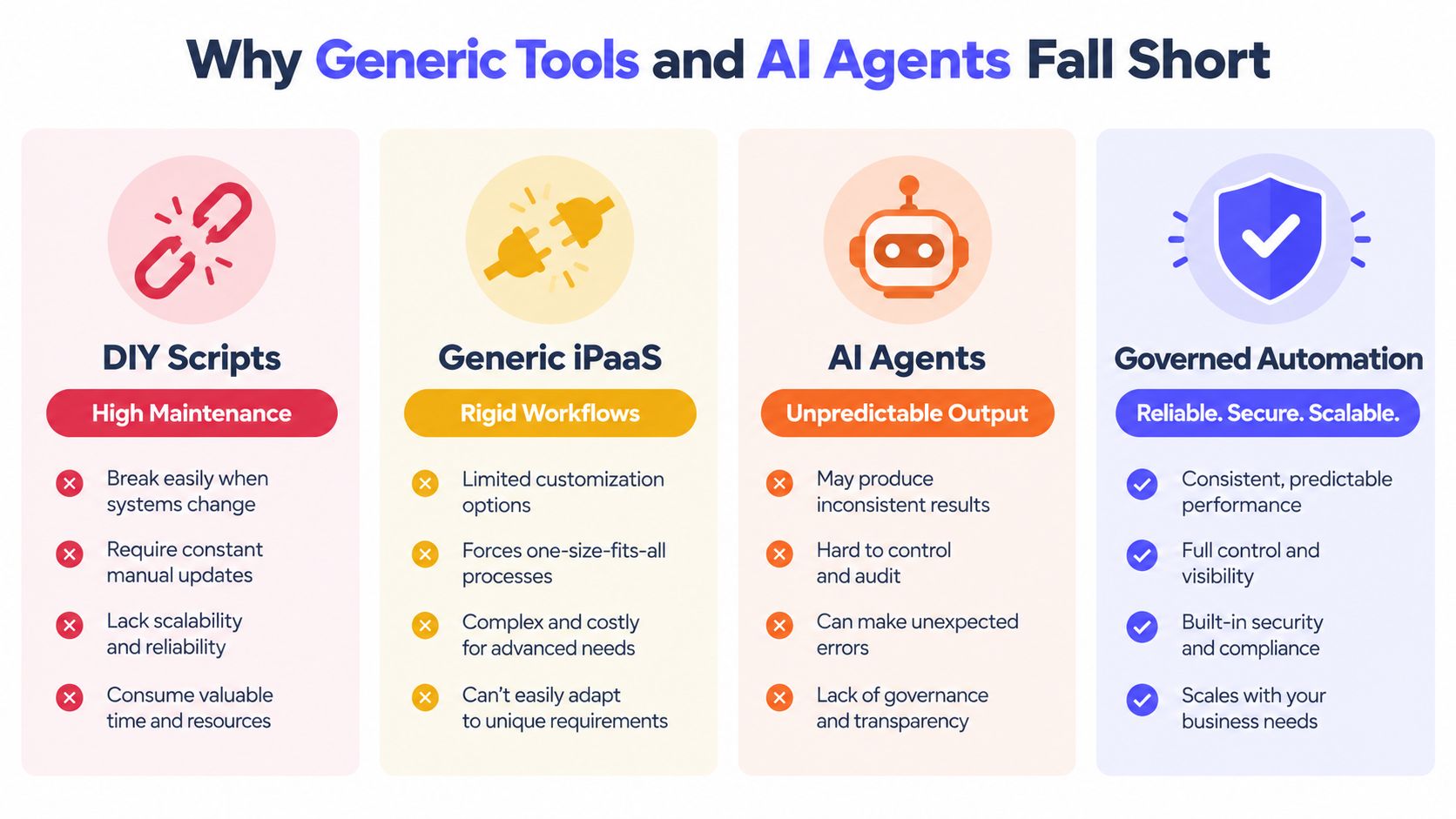
The distinction is easier to apply as a decision table:
- DIY script does: Move a payload on a trigger. Governed workflow automation does instead: Preserve the definition, owner, version, inputs, outputs, and failure path.
- Generic iPaaS does: Connect common endpoints. Governed workflow automation does instead: Apply finance-specific controls around identity, approval, replay, and reconciliation.
- Unconstrained AI agent does: Interpret or select actions probabilistically. Governed workflow automation does instead: Keep posting logic deterministic and use AI only where confidence and human fallback are explicit.
The buyer’s concern is justified. Auditors want the process to hold up, and finance teams need to reconstruct the write without relying on a developer’s memory. The platform choice should follow that requirement.
A Practical Checklist and Common Questions
A procurement-ready synchronization system must prove ownership, replay safety, schema resilience, exception control, and audit history. A controller should be able to answer each question with evidence before approving a production connection.
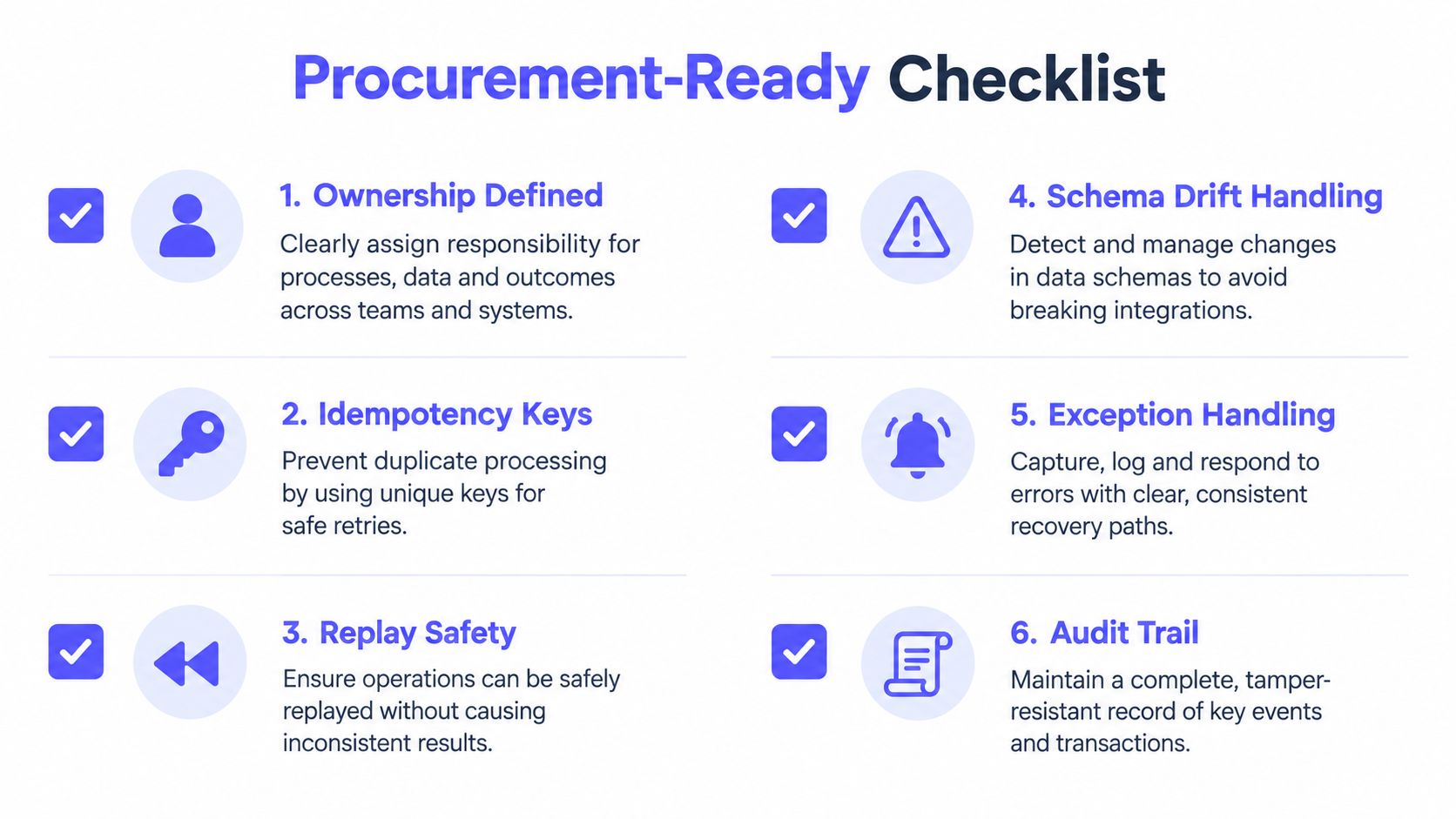
| Control question | Failure it prevents |
|---|---|
| Is ownership defined? Does every workflow and exception have a named finance or operations owner? | Unresolved failures and key-person dependency |
| Are idempotency keys enforced? Can a retry prove that the business effect already occurred? | Duplicate invoices, payments, orders, or journal entries |
| Is replay safe? Can the team rerun a failed step without repeating successful writes? | Manual cleanup after partial outages |
| Is schema drift handled? Does a changed field trigger validation and an accountable review? | Silent truncation or incomplete destination records |
| Are exceptions routed? Does each failure reach a person with a deadline and resolution log? | Hidden queues and close surprises |
| Is the audit trail complete? Does the record include user identity, precise timestamps, event type, result, source, and destination? | Weak control testing evidence |
Financial-services guidance calls for audit trails that capture user identification, precise timestamps synchronized to authoritative time sources, event types, success or failure indicators, and source and destination systems, as set out in finance compliance guidance for auditable data synchronization. Those fields should be treated as minimum evidence, not optional reporting.
How does automatic data synchronization differ from integration?
Integration connects systems so they can exchange data. Automatic data synchronization continuously keeps defined records aligned under explicit rules. Integration may be a one-time connection or a broad transport layer. Synchronization adds entity ownership, direction, trigger logic, transformation rules, conflict handling, and reconciliation.
Is real-time synchronization always better for finance?
No. Real-time synchronization is better only when a finance decision depends on immediate freshness. Real-time processing adds monitoring, replay, incident response, and on-call obligations. A controlled batch is often safer for close preparation, reconciliation, and reference data that can wait.
What happens during a source-system outage?
A governed workflow preserves the source event, pauses or retries according to policy, and records the final outcome. The process should prevent duplicate writes after recovery and route unresolved records to a named owner. Finance should never infer completion from the absence of an error message.
How should teams handle partial failures?
Teams should commit and reconcile each business operation independently, then expose the incomplete state clearly. A successful CRM update and a failed ERP posting are not one completed transaction. The workflow should retain both results, block dependent steps where necessary, and route the ERP exception for resolution.
What evidence do auditors actually want?
Auditors want a traceable record of who acted, what changed, when it changed, which systems participated, and whether the action succeeded. Execution logs should connect source values, mapping versions, approvals, destination writes, retries, exceptions, and remediation. Generic connector status isn’t enough.
How can finance phase a rollout without breaking month-end close?
Finance should start with a bounded, low-risk entity and run the new workflow beside the existing process until reconciliation is stable. The team should define rollback, freeze windows, ownership, and close dependencies before expanding scope. Revenue, billing, and journal-entry synchronization should follow only after the evidence model has passed operational review.
A synchronization project succeeds when finance can trust both the destination record and the explanation behind it. Speed helps. Deterministic execution, predefined controls, and complete evidence protect the close.
Loopfour offers deterministic finance workflows that synchronize ERP, CRM, billing, and document systems while preserving execution evidence and routing exceptions to owners. Finance leaders rebuilding unreliable syncs can use Loopfour to scope a governed workflow, test replay safety, and replace fragile scripts without replacing core systems.