
Enterprise application integration connects ERP, CRM, billing, and document systems so data and actions move without manual rekeying. In large organizations, the problem is already bigger than is widely admitted: companies used an average of 976 applications, yet only 28% were integrated, which is why governance and observability matter more than raw connector count.
Month-end close makes the problem obvious. NetSuite journals don’t reconcile to Salesforce opportunities. Billing disputes pile up. Then someone discovers a custom sync stopped running weeks ago and no one noticed because the script had no owner, no alerting, and no execution evidence.
That is enterprise application integration. It is not a diagram with cheerful arrows. It is the disciplined work of connecting ERP, CRM, billing, procurement, and document systems so transactions, master data, and approval states flow correctly, predictably, and in a way auditors can test. The layered truth is simple. A fast integration that cannot answer who changed what, when, and why is not mature. It is a future control failure.
Author: Daniel Reeves, Finance Systems Architect focused on ERP, CRM, and billing control design
Table of Contents
- What Enterprise Application Integration Actually Does
- Core Integration Patterns Compared
- Architectures That Hold Up in Finance
- Anatomy of a Finance Integration Layer
- Where Most EAI Programs Quietly Break
- Governance and Observability Metrics That Matter
- How Deterministic Workflow Automation Fits In
- A Practical Starting Point for Finance Leaders
What Enterprise Application Integration Actually Does
Enterprise application integration connects business-critical systems so finance data and process state move across tools without changing the underlying applications. IBM defines EAI as the process of connecting disparate systems and software applications, often using APIs and middleware, to reduce silos and streamline processes, while preserving existing systems rather than replacing them (IBM on enterprise application integration, IBM on enterprise integration).
On Monday morning, finance does not care whether the connector used REST, queues, or middleware. Finance cares whether an approved customer record in Salesforce became the right billing account, whether the invoice posted to the ERP, and whether someone can prove each step.
Enterprise application integration is operations, not plumbing
The U.S. Federal Highway Administration defines application integration as bringing data or functions from one application together with another using real-time or near real-time communication, and notes that enterprise application integration is tied to extraction, transformation, and loading between ERP systems and other data sources (FHWA application integration glossary). That is the practical definition finance teams need.
A finance-grade integration layer usually connects:
- ERP systems: NetSuite, Workday, Sage Intacct, QuickBooks
- CRM systems: Salesforce, HubSpot
- Billing systems: Stripe, subscription billing platforms
- Document systems: SharePoint, Box, S3, DocuSign
- Collaboration tools: Slack, Microsoft Teams, email for approvals and exceptions
Practical rule: Connector count is not the scorecard. The scorecard is whether finance can trace a transaction end to end and explain every system write.
Independent guidance also describes enterprise application integration as connecting systems such as CRM, ERP, and supply chain platforms so they can share data and automate business processes (IBM on application integration). That sounds obvious. The harder point is that integration quality is mostly about control design.
Governance matters more than another connector
A major enterprise integration survey found that organizations used an average of 976 applications, with only 28% integrated, and the application count grew by 133 in one year (enterprise integration statistics). Software sprawl is moving faster than integration maturity.
That gap is why a useful IntegrationManagement platform matters more than one more webhook. Fast pipes are nice. Deterministic, auditable, predefined workflows are what keep close clean.
Core Integration Patterns Compared
Enterprise application integration patterns are not equal in finance. Point-to-point is tempting, middleware is usually safer, and event-driven works well only when finance explicitly accepts timing windows and stronger operational discipline.
The mistake is treating these patterns as interchangeable architecture vocabulary. Finance should evaluate them by three questions. Who owns the contract. Who sees the failure. What evidence exists when a controller traces a discrepancy.
EAI Pattern Tradeoffs for Finance Systems
| Pattern | Best Fit in Finance | Where It Breaks Under Audit |
|---|---|---|
| Point-to-point | Small, narrow syncs such as one approval state or one reference-data push | Logic lives in scripts, ownership blurs, and evidence is scattered across systems |
| Middleware or hub-and-spoke | Master data, approval flows, journal-adjacent updates, controlled system-to-system movement | Central logic can become opaque if teams skip documentation, change review, or run-level evidence |
| Event-driven | High-volume billing events, usage signals, downstream notifications | Eventual consistency creates timing disputes, and replay or ordering issues become hard to explain without strong controls |
Point-to-point does today’s task and creates tomorrow’s problem
Point-to-point integration works because it is direct. Sales sends something to billing. Billing sends something to the ERP. No one waits for an architecture committee.
Point-to-point does brittle sprawl. Loopfour does predefined orchestration instead.
The audit problem is not elegance. The audit problem is that each script becomes tribal knowledge. When someone asks why a journal-supporting field changed, the answer often lives in a Lambda function, a bash script, or a former employee’s memory. Teams dealing with that mess should read this breakdown of point-to-point integration.
Middleware earns its keep in finance
Middleware and hub-and-spoke patterns centralize mapping, routing, and monitoring. That gives finance one place to inspect how a customer, invoice, or approval moved between systems.
Middleware does transport and translation. Finance still needs policy, version control, and execution evidence on top.
A controller does not need more “real time.” A controller needs a chain of evidence.
Event-driven is good, but only with rules
Event-driven integration scales well for billing, usage metering, and downstream notifications. Systems emit events. Other systems react. That model is clean when volume is high.
The finance catch is simple. Events can arrive later than expected, in the wrong order, or require replay after downstream failure. That is manageable. It is not free. Finance teams should accept those windows explicitly, not by accident.
Architectures That Hold Up in Finance
The architectures that survive in finance are usually hybrid. Middleware handles synchronous, consistency-sensitive flows. Event-driven components handle high-volume signals where timing windows are acceptable and documented.
Pure ideology fails here. “Everything should be event-driven” is how teams create elegant diagrams and ugly reconciliations. Finance needs boring reliability.
EAI Architecture Fit by Finance Workflow
| Architecture | Finance Workflow | Governance Posture |
|---|---|---|
| Synchronous middleware or hub | Vendor onboarding, chart-of-accounts propagation, approval-state synchronization | Strong when change control, mapping ownership, and approval logic are centralized |
| Event-driven architecture | Usage metering, invoice generation triggers, dunning signals, downstream notifications | Strong only when event contracts, replay rules, and lineage are explicit |
| Hybrid middleware plus event-driven | ERP, CRM, billing, and document ecosystems with mixed latency and control needs | Strongest long-term posture because each workflow uses the right control model |
Where hybrid stacks work best
Synchronous hub patterns fit workflows where a wrong answer is worse than a slow answer. Vendor onboarding is one example. Chart-of-accounts propagation is another. The same goes for approval-state changes that must remain aligned across ERP and procurement tools.
Event patterns fit workflows where throughput matters more than immediate finality. Billing signals and usage events belong here, especially when downstream consumers can process asynchronously without breaking revenue operations.
Anti-patterns that look modern and age badly
Some architectures impress during demos and create maintenance debt later.
- API meshes without a contract registry: Teams expose many endpoints, but no one owns schema changes.
- Serverless glue code with no replay model: A timeout becomes a manual incident with no deterministic recovery path.
- Chat-based workflow tools with weak evidence: Someone clicked approve, but the system cannot prove the full decision path.
Teams evaluating orchestration options should compare them against the broader category of data orchestration platforms. The right architecture compounds over time. The wrong one compounds incident tickets.
Anatomy of a Finance Integration Layer
A finance integration layer needs five parts working together. Connectors move data, mapping makes it meaningful, orchestration controls the sequence, exception routing keeps failures visible, and approvals keep risky actions governed.
A useful architecture looks more like a controlled production line than a set of pipes.
A compact visual helps anchor the stack:
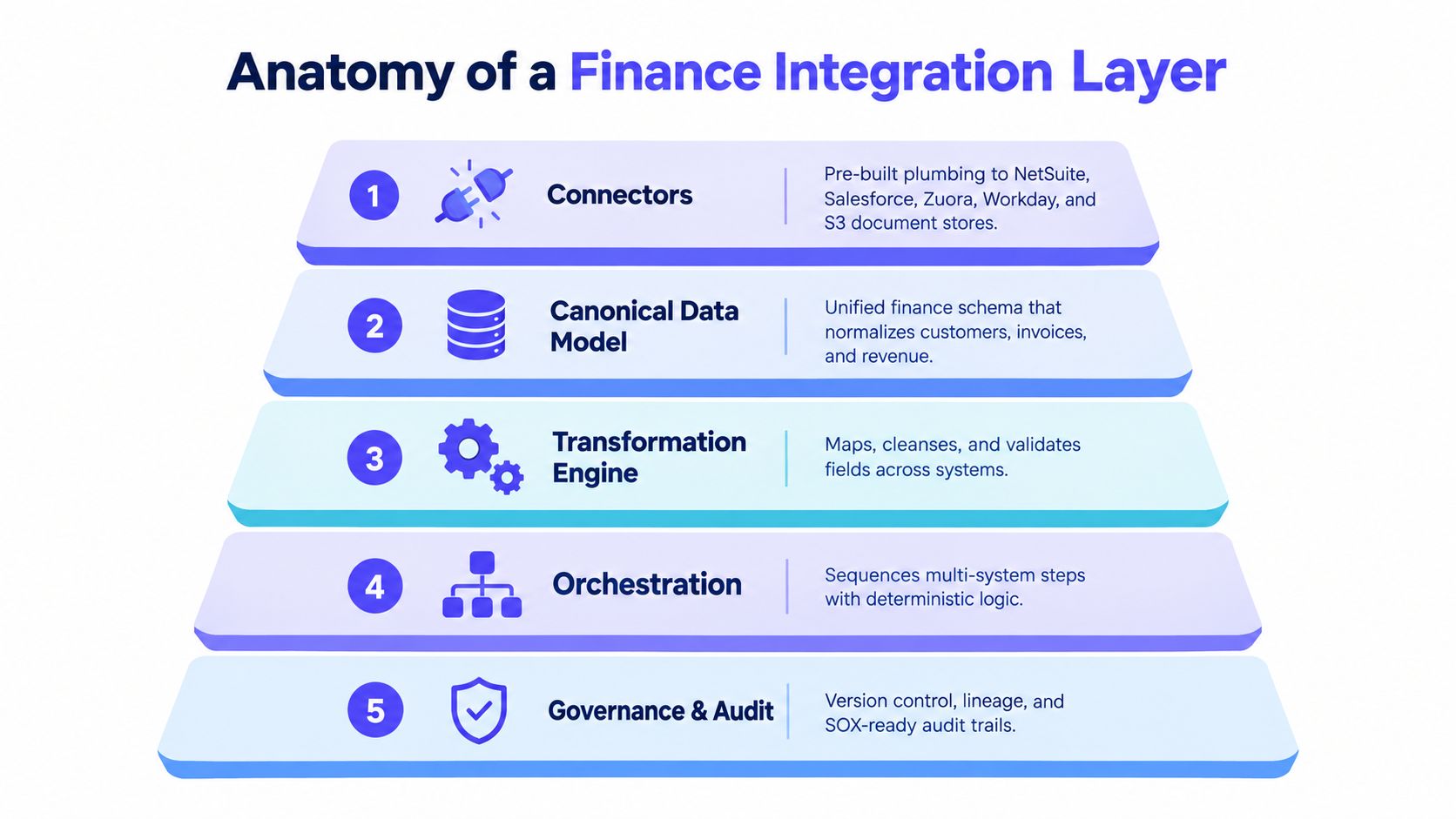
The five components finance actually needs
- Connectors: Connectors handle the oddities of NetSuite, Salesforce, Workday, Stripe, SharePoint, S3, and similar systems. OAuth refresh, pagination, rate limits, and file handling belong here.
- Mapping engine: A sales order line in Salesforce is not automatically an AR invoice line in an ERP. Field translation, validation, tax treatment, and revenue flags must be explicit.
- Orchestration layer: Orchestration enforces sequence, retries, idempotency, and branch logic. Deterministic behavior starts here.
- Exception routing: Failed runs must land somewhere with context. “Job failed” is useless. A controller needs the record, the system, the reason, and the next action.
- Human approval gates: Some actions should pause. New vendor creation, bank detail changes, or large journal-related actions often require predefined approval policies.
Evidence is a feature, not a byproduct
Every component should emit execution evidence. That includes timestamps, payload fingerprints, trigger source, approver identity, and the decision path taken.
The video below shows the kind of workflow control finance teams should expect from a serious orchestration layer.
Control test: If a team cannot reconstruct a run after quarter close, the integration layer is incomplete.
Where Most EAI Programs Quietly Break
Most enterprise application integration programs fail through drift, not explosions. A vendor changes an API, a field rename slips through, or a mapping version gets overwritten. The workflow still “runs,” but the data is now wrong.
That is more dangerous than an obvious outage. An outage gets fixed. Silent corruption reaches the close calendar.
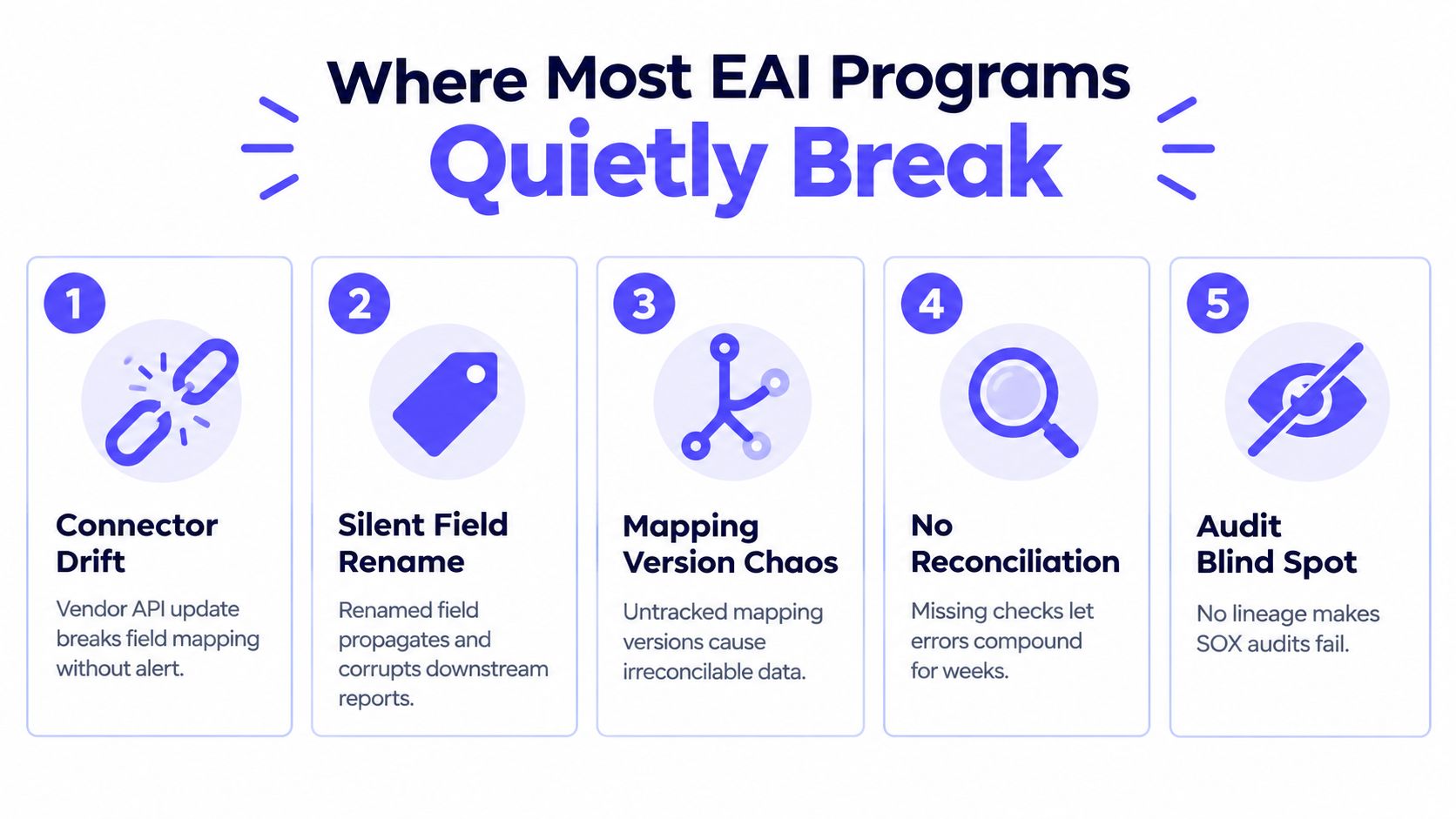
The real failure mode is ungoverned change
A 2026 benchmark reported that the average organization managed 957 applications, only 27% were connected, 27% of APIs were ungoverned, and 49% cited cross-application data governance as a top challenge (2026 connectivity benchmark commentary). That is the right frame. The limiting factor is not API availability. It is API governance.
Version history helps, but version history alone is not enough. A bad change can still be versioned very neatly. Finance needs approval gates before releases, reconciliation checks after writes, and immutable run evidence for every exception.
Treat integration logic like regulated code
A brittle script can post bad data for weeks if no one reviews changes and no one monitors downstream effects.
- Peer review: Mapping changes should be reviewed by both systems and finance owners.
- Approval gates: High-impact workflow edits should require signoff before deployment.
- Immutable logs: Teams need a record of what was sent, received, skipped, retried, and approved.
- Reconciliation checks: The workflow should prove the target state, not just claim it called an API.
A silent failure is rarely silent to the general ledger. It just waits until month-end to speak.
Governance and Observability Metrics That Matter
At 6:40 p.m. on the second-to-last business day of the month, the dashboard still says green. Then finance finds 214 journal entries stuck between approval and ERP posting because a field mapping changed three days ago and nobody tied technical telemetry to accounting outcomes. That is the reporting failure to avoid.
Finance should measure control effectiveness first, transport speed second. API volume and average response time rarely explain why close slips, why reconciliations fail, or why auditors start asking for screenshots instead of evidence.
Finance EAI Metrics That Actually Predict Close Health
| Metric | Why It Matters for Finance | Healthy Benchmark |
|---|---|---|
| End-to-end latency percentiles | Shows whether posting, approvals, and cross-system syncs stay predictable under normal and peak load | User-facing integrations should target p50 under 100 ms, p95 under 300 ms, and p99 under 500 ms (API benchmark guidance for integrations) |
| Failed message rate | Exposes schema drift, connector breakage, and mapping errors before they turn into reconciliation work | Lower is better. Track by connector, workflow, and mapping version |
| Mean time to recovery | Measures whether operations can restore service before billing runs, payroll, or close deadlines are affected | Track incident lifecycle from first failure to verified recovery |
| Sustained throughput and webhook processing latency | Reveals backlog risk during billing spikes, imports, and month-end volume bursts | Trend over time and review degradation by period, not just by incident |
| Reconciliation success rate | Proves the target system reached the expected accounting state | Measure completed, matched, unmatched, and manually overridden runs |
| Change failure rate | Shows whether releases are introducing defects into production finance flows | Track failed deployments, rollback frequency, and post-release exception volume |
Percentiles matter because finance feels the slow tail, not the average. A workflow that usually completes quickly but stalls at the 99th percentile still creates cut-off risk, duplicate retries, and manual cleanup.
The better model is simple. Track every workflow from trigger to committed business result. A call to an API is not success. A posted invoice, matched cash receipt, or approved vendor change is success.
Observability also needs to answer governance questions, not just runtime questions:
- Which mapping version touched this transaction?
- Who approved the release?
- Which retries were automatic, and which exceptions were manually resolved?
- Did the write reach the target system, and did downstream reconciliation confirm it?
- How many transactions bypassed policy through override paths?
Those are operating controls. Without them, teams get pretty logs and weak evidence.
Teams that want a stronger operating model should tie platform telemetry to process metrics used in automation in finance programs, especially exception aging, manual touch rate, approval turnaround time, and reconciliation completion. Those measures expose operational drift early, before close turns into a spreadsheet salvage exercise.
How Deterministic Workflow Automation Fits In
Deterministic workflow automation sits above middleware and iPaaS. It should own cross-system workflow logic, branch rules, exception routing, approvals, and the audit trail. Middleware should still own transport, mapping support, and resilience at the connectivity layer.
That boundary matters. Without it, teams ask middleware to enforce policy and ask workflow tools to behave like message buses. Both choices age badly.
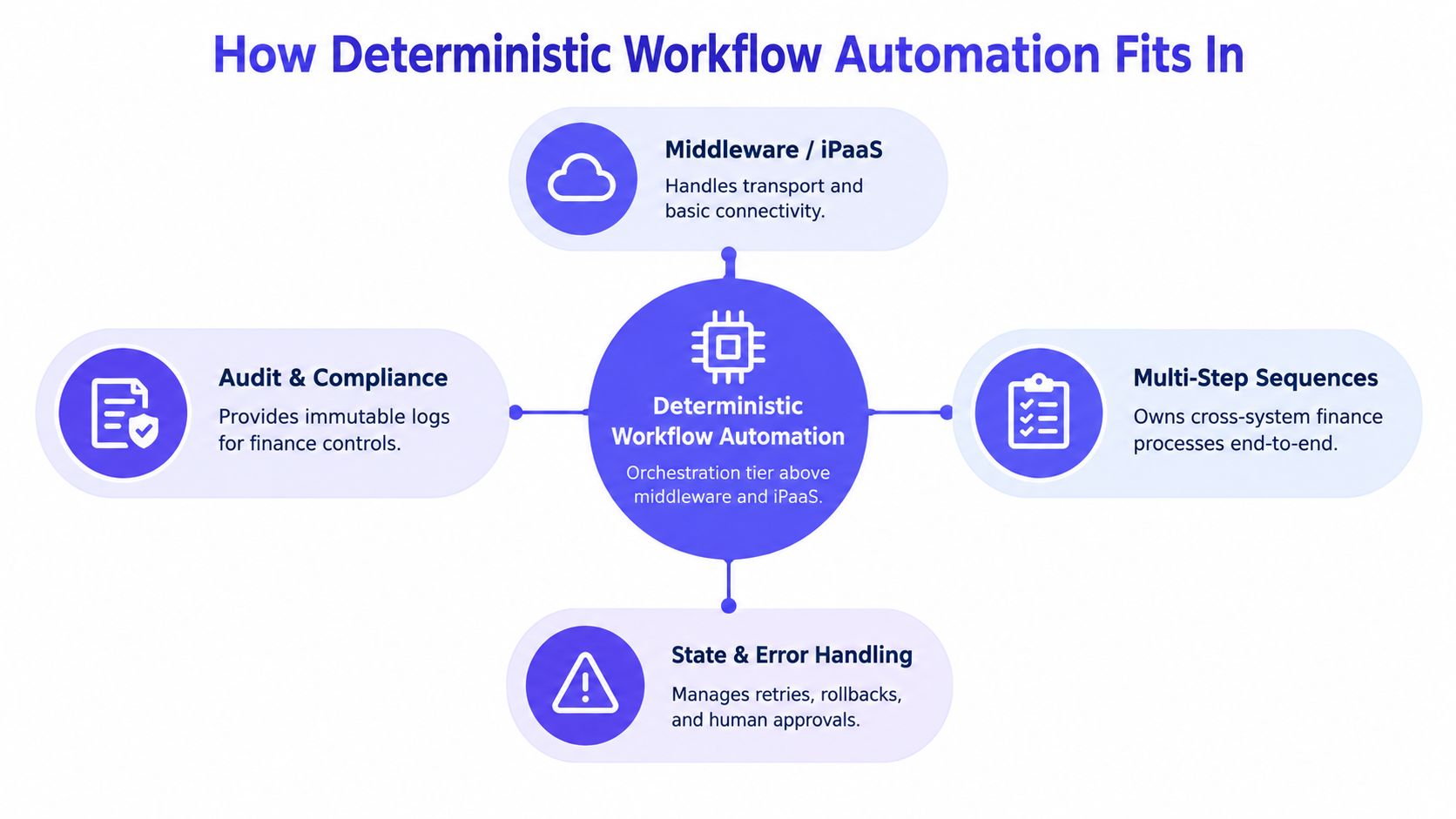
What deterministic automation actually owns
Deterministic automation is the layer that answers, in predefined steps, what happens next.
- A Salesforce opportunity reaches a finance handoff state.
- The workflow validates contract data.
- The billing system creates or updates the account.
- The ERP receives the posting data.
- Exceptions route to named owners.
- Approvals pause the flow where policy requires.
Generic brokers move messages. They do not guarantee the same business path twice unless the workflow logic above them is explicit. RPA bots click screens. They are useful in narrow cases, but they are weak substitutes for governed orchestration.
The fit for finance workflows
Month-end close handoffs, credit memos crossing billing and CRM, and vendor onboarding across ERP, tax, and banking tools all need deterministic handling. They also need evidence. A run should be replayable with the same inputs and yield the same outcome, or the team should know exactly why not.
Loopfour, the deterministic finance workflow automation platform, fits here as the orchestration tier for predefined finance workflows across ERP, CRM, billing, and document systems. Loopfour Studio provides versioned workflow definitions, human approvals, run logs, and execution trees. Its AI Copilot is useful for interpretation tasks, but the workflow itself remains governed and inspectable. That is the right split.
A similar lesson shows up outside finance infrastructure too. Teams replacing identity glue often look for governed building blocks rather than more ad hoc code, which is why some evaluate options to replace Clerk when control and maintainability matter more than quick assembly.
Middleware moves data. Deterministic orchestration decides, records, and proves what happened.
A Practical Starting Point for Finance Leaders
Finance leaders should start with the highest-risk workflow, add governance before adding connectors, and instrument the metrics that predict close failure. Anything else is integration theater.
A sensible program does not begin with a platform bake-off. It begins with one workflow that already hurts.
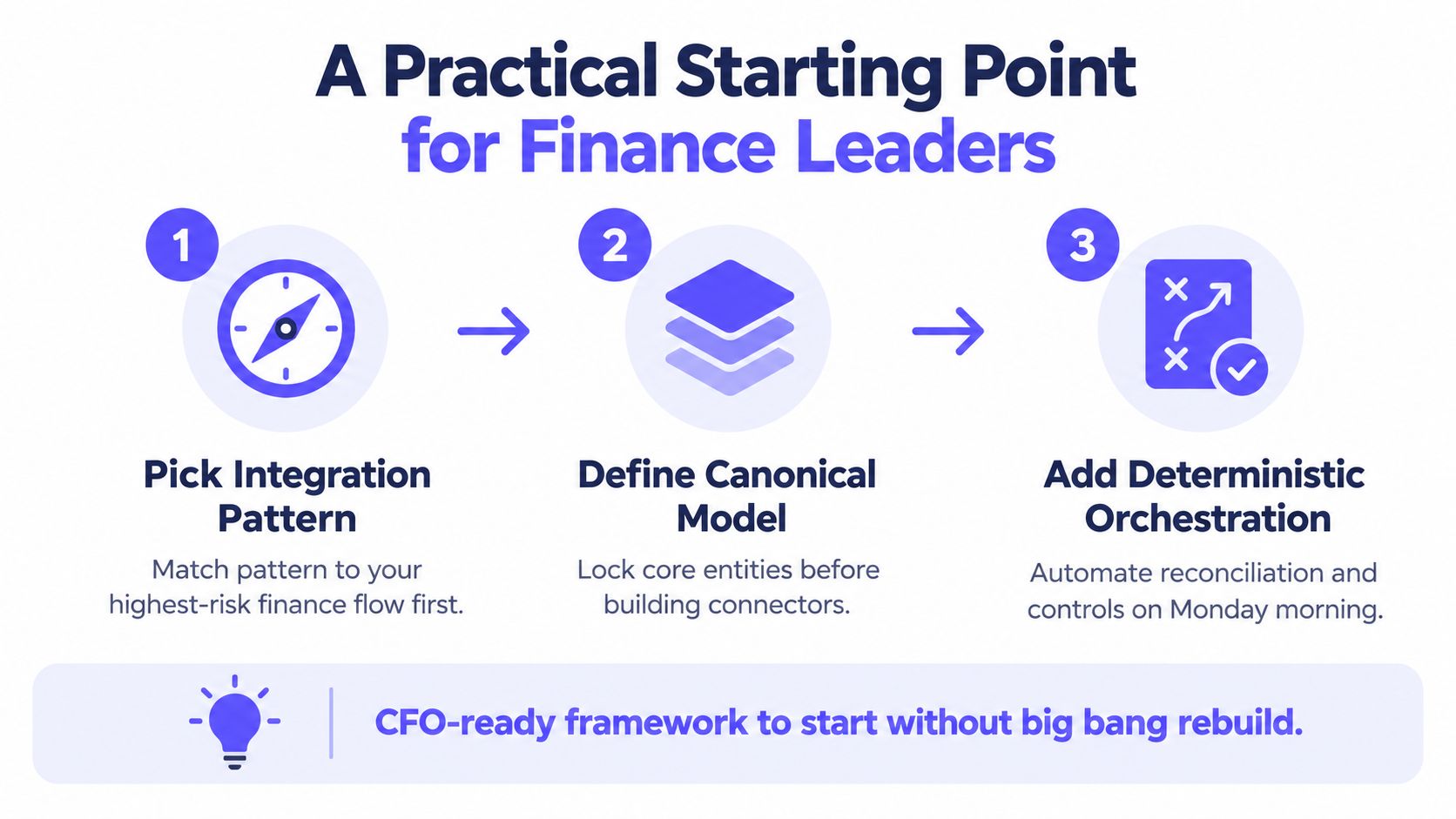
The three decisions that matter first
- Choose pattern by risk, not convenience. Start with the workflow most likely to create reconciliation pain or audit exposure. A journal-adjacent sync deserves more structure than a low-impact notification.
- Choose governance before another connector. A 2026 modernization study reported that moving to a more governed integration layer cut interface complexity by 38%, reduced average latency from 420 ms to 245 ms, lowered mean time to recovery from 155 minutes to 54 minutes, and reduced failed message rate from 3.8% to 1.1% (integration modernization study).
- Choose metrics that predict finance pain. Start with p95 latency on journal-related postings, failed message rate between ERP and billing, and mean time to recovery for broken syncs.
A simple 30-60-90 day motion
- First 30 days: Inventory every point-to-point script, webhook, manual export, and spreadsheet-assisted sync in the finance stack.
- By 60 days: Pick one workflow to migrate. Good candidates are contract-to-cash handoffs, payment reconciliation, or vendor onboarding.
- By 90 days: Assign one integration owner. Without ownership, observability becomes decoration.
Another reason to focus on operations is maintenance debt. In 2026 research, 68% of organizations reported integration projects delayed by 2 to 6 months because of resource constraints, 85% lacked in-house integration expertise, 54% struggled with integrations that fail without warning, 30% were too busy repairing existing integrations to start new ones, and another report found integrations were the largest cost driver for 61% of respondents (state of integration solutions research). The build is rarely the whole story. The upkeep is.
The test that separates real enterprise application integration from theater is blunt. Can the team replay last quarter’s transactions and reproduce the same ledger entries, with every approval on record? If the answer is no, the architecture is still immature.
Loopfour offers deterministic, auditable finance workflow automation on top of the systems finance teams already use. For teams dealing with brittle ERP, CRM, billing, and document handoffs, Loopfour provides governed workflows, approval gates, exception routing, and execution evidence that can stand up to close and controls testing.