
Accounts payable liability is a current liability for goods or services already received but not yet paid. It is generally measured at the invoice amount, adjusted for trade or cash discounts under the gross or net method, and is commonly due within 30 to 90 days or within one operating cycle.
A finance team usually doesn’t get stuck on the definition for long. Friction starts later. The AP subledger ties, but one invoice is sitting unmatched. A prior accrual may still be on the books. A supplier statement doesn’t agree with the ERP. Your auditors want it to hold up.
That’s why accounts payable liability matters beyond classification. A payable is not just a line on the balance sheet. A payable is also a timing decision, a control problem, and a working-capital lever. If the workflow is loose, the liability balance can be technically present and still operationally weak.
Table of Contents
- Introduction Why Accounts Payable Liability Matters Now
- What Accounts Payable Liability Means on the Balance Sheet
- How Accounts Payable Liability Works With Journal Entries
- How Accounts Payable Liability Affects Financial Statements and Working Capital
- Accounts Payable Liability Versus Accrued Liabilities and Other Payables
- Common Reconciliation Issues That Distort Accounts Payable Liability
- How Deterministic Automation Reduces Risk in Accounts Payable Liability Workflows
- FAQ
- Is accounts payable liability an asset or a liability
- When should a company recognize accounts payable liability
- How is accounts payable liability different from an accrued liability
- Why does accounts payable liability matter for working capital
- What controls keep accounts payable liability accurate
- Can AI alone fix accounts payable liability problems
Introduction Why Accounts Payable Liability Matters Now
It is day three of the close. Cash is tight. A supplier is asking for payment. The AP aging looks reasonable, but one invoice is unmatched, one receipt is missing, and one accrual may still be sitting in the wrong period. The question is no longer whether accounts payable is a liability. The question is whether the liability on the books is complete, timely, and supported.
Accounts payable liability matters now because it sits at the point where cash timing, close accuracy, and control quality meet. A payable balance affects more than classification. It affects when cash leaves the business, how working capital is managed, and whether the balance sheet can stand up to review.
That is why AP works like a valve in the working-capital system. If invoices are recorded late, liabilities are understated and cash metrics look better than reality. If approvals stall or duplicate bills slip through, the balance can be overstated or paid twice. The number on the balance sheet may look precise while the evidence under it is weak.
The definition is settled. The operating discipline is not.
A useful AP balance comes from process quality. Finance needs the right amount, in the right period, tied to clear evidence such as the invoice, receipt, purchase order, approval, and payment status.
A practical way to frame it is with days payable outstanding. Many finance teams use DPO to judge how long the business holds supplier cash before payment. The benchmark range varies widely by company size, industry, and payment policy, as noted earlier in the article. That spread matters because AP is a timing lever, not just an accounting label.
The control side is just as important. A payable recorded from weak support is like a sensor reading without calibration. It gives a number. It does not give confidence.
For finance leaders evaluating accounts payable for growing businesses, that distinction becomes sharper as transaction volume rises. More vendors, more exceptions, and more handoffs create more ways for timing errors to enter the close.
A skeptical finance team should ask direct questions. What proves the liability exists? What proves it belongs in this period? What prevents duplicates, missed invoices, and uncleared accruals? Those questions determine the quality of accounts payable liability.
Loopfour, the deterministic finance workflow automation platform, operates in that gap between bookkeeping theory and finance operations reality.
What Accounts Payable Liability Means on the Balance Sheet
A controller closes the month and sees a large AP balance. One reaction is to ask, “How much do we owe?” The better question is, “How much of this balance is real, supported, and in the right period?” On the balance sheet, accounts payable liability is not just a label. It is a time-based record of supplier obligations, and its quality depends on the evidence behind it.
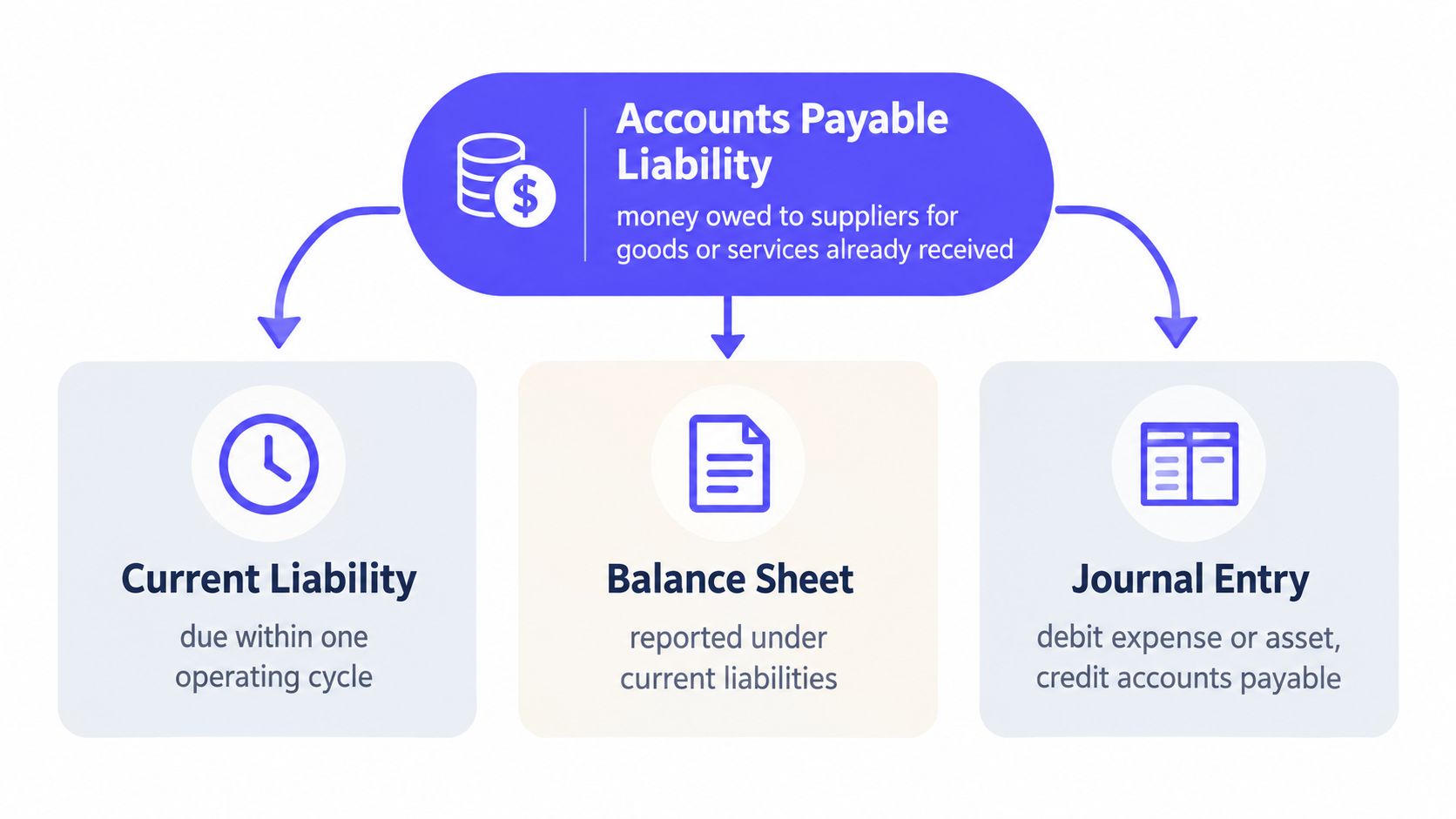
Accounts payable liability means the business has already received goods or services and still owes the supplier. That unpaid amount sits in current liabilities because the company expects to settle it in the near term, usually through normal operating cash outflows.
The balance sheet classification matters for a simple reason. AP is part of short-term liquidity, not long-term financing. It affects the current ratio, working capital, and the timing of cash needs. A payable recorded too early, too late, or twice changes those signals.
Accounts payable liability belongs in current liabilities
AP belongs in current liabilities because the obligation arose from operations and is expected to be paid within the operating cycle or within a year. The business has already taken delivery or received the service. Cash has not left yet. That gap creates the liability.
Three conditions usually make the classification clear:
- The company received value. Goods arrived or services were performed.
- The amount can be tied to support. The invoice is often the starting document, backed by a purchase order, receipt, or approval trail.
- Settlement is near-term. Supplier balances are generally cleared as part of routine payment runs, not stretched out like term debt.
That is why AP sits with other short-term obligations on the balance sheet.
Accounts payable liability is usually measured from the invoice, then tested against evidence
Accounts payable liability is usually recorded at the invoice amount, subject to purchase discounts or similar terms if company policy requires a different treatment. In practice, the invoice gives finance a concrete number. The stronger question is whether that number should be booked yet.
An invoice by itself is not always enough. If the bill arrived before receipt, the timing may be wrong. If receiving happened but the invoice is missing, the liability may still exist even though AP has not recorded it yet. AP works like a checkpoint between operations and accounting. The books reflect reality only if the workflow captures the right evidence at the right moment.
That is the part teams often miss. Two companies can show the same AP balance and have very different liability quality. One balance is tied cleanly to approved invoices and matched receipts. The other includes duplicates, stale items, and bills parked in email inboxes. The first gives a reliable view of obligations. The second distorts working capital.
A good AP balance is not just accurate in total. It is traceable line by line.
For finance teams improving close quality, process design matters as much as account classification. Resources on streamlining accounting with Rally are useful because they focus on making the recorded liability match the underlying operational evidence.
How Accounts Payable Liability Works With Journal Entries
Accounts payable liability increases when a business records a vendor bill and decreases when the business pays that bill. In double-entry terms, the AP account normally carries a credit balance.
That means the pattern is stable. On invoice receipt, a company debits an expense or asset account and credits accounts payable. On payment, the company debits accounts payable and credits cash.
The basic debit and credit logic
Accounts payable liability is the credit side of a purchase on terms. The debit depends on what the company received.
If the company bought office supplies, the debit may hit an expense. If the company bought inventory or equipment, the debit may hit an asset account instead. The AP side is unchanged. The company still owes the vendor.
| Accounts Payable Liability Journal Entry Examples | ||
|---|---|---|
| Transaction | Debit | Credit |
| Vendor invoice for supplies received | Supplies Expense | Accounts Payable |
| Utility invoice received for current period | Utilities Expense | Accounts Payable |
| Payment of supplier invoice | Accounts Payable | Cash |
| Invoice recorded with discount treatment under gross or net method | Expense or Asset account, based on purchase | Accounts Payable, adjusted for applicable discount method |
The timing matters as much as the entry
Accounts payable liability should be recorded when the obligation becomes supportable, not when someone finally opens the email. That is where many close issues begin.
A receiving team may confirm delivery on one date. AP may receive the invoice on another date. Treasury may release payment later. Those are three separate moments. The liability entry is tied to recognition rules and documentation, not convenience.
For teams standardizing ledger behavior across systems, automated journal entries are useful when they preserve deterministic posting logic and a clean approval trail.
A payable posted late doesn’t just move a liability. A payable posted late also shifts expense recognition, vendor aging, and period cutoff.
A short example finance teams can reuse
Accounts payable liability follows the same journal pattern across routine operating spend. The account changes only in amount and support.
A practical review sequence looks like this:
- Confirm the source document: The team verifies the vendor invoice exists.
- Confirm what was received: The team checks the PO or receiving evidence where relevant.
- Post the bill: The debit goes to the related expense or asset. The credit goes to AP.
- Clear the bill on payment: Cash goes down and the liability is removed.
A finance team that applies this pattern consistently will usually catch posting errors faster than a team that relies on memory, email trails, or spreadsheet side logs.
How Accounts Payable Liability Affects Financial Statements and Working Capital
At 5:00 p.m. on the last day of the month, two companies can have the same operating spend and show very different liquidity. One booked invoices on time and held cash until agreed due dates. The other paid early in a rush or left invoices sitting in inboxes. The difference is not just AP volume. It is timing discipline.
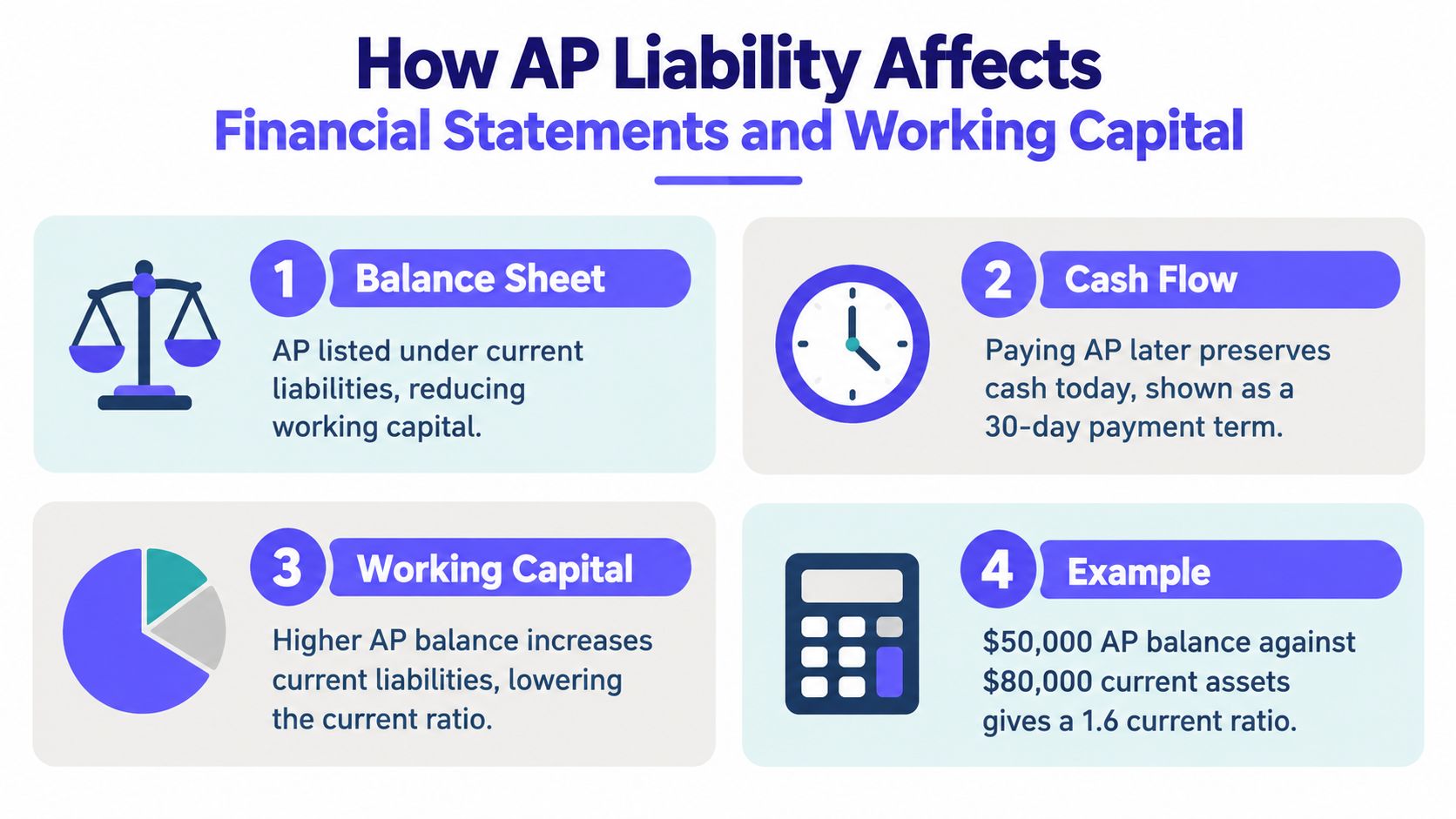
Accounts payable liability affects the balance sheet, the cash flow statement, and the quality of working-capital signals. An unpaid supplier invoice increases current liabilities. It also preserves cash until payment. That sounds simple, but the question is whether the liability reflects intentional payment timing or weak controls.
Accounts payable liability changes liquidity optics
Accounts payable liability raises current liabilities and can reduce working capital and the current ratio at period end. That effect is mechanical. The interpretation is not.
A larger AP balance can mean the company is using supplier terms as intended. It can also mean invoices are stuck in exception queues, receipts are missing, or cutoff failed. The same ending balance can point to two very different operating realities.
That is why AP works like a valve in the working-capital system. Open it too far by paying too fast, and cash leaves the business earlier than necessary. Close it too far by delaying payment without support, and the books show a liability that may be aged, disputed, or misstated.
DPO turns the liability into an operating metric
Days payable outstanding converts the AP balance into a timing measure. It helps finance compare payment behavior across periods and against peers, instead of staring at a raw liability number.
As noted earlier, the standard formula is DPO = (Average AP / Cost Base) × Days. A common benchmark view places lower performers near 30 days, the middle around 40 days, and higher ranges near 50 days, with many manufacturing and retail businesses often landing between 30 and 60 days.
| Benchmark view | DPO level |
|---|---|
| 25th percentile | Near 30 days |
| Median | Around 40 days |
| 75th percentile | Near 50 days |
| Common industry context | Manufacturing and retail often in the 30 to 60 day range |
DPO is useful because it forces a cleaner question. Is the business holding cash on purpose, within supplier terms, with evidence? Or is AP rising because the workflow cannot clear invoices predictably?
The liability is only as good as the workflow behind it
A payable is more useful as a finance signal when the posting date, approval state, and payment terms are all traceable. Without that evidence, AP becomes a mixed bucket of true obligations, unresolved disputes, duplicate invoices, and timing noise.
That distinction matters on every statement. On the balance sheet, AP may be overstated or understated. On the income statement, late invoice capture can distort period expense recognition. On the cash flow side, early or inconsistent payment runs can make operating cash look weaker than it needed to be.
A skeptical finance team should treat AP as both a liability and a control-quality test.
The tradeoff is cash versus friction
Accounts payable liability can preserve cash when payment is delayed, but the benefit is real only when the delay is intentional and supportable. Extending DPO can help near-term liquidity. Shortening DPO can reduce supplier disputes, protect discounts, and lower escalation volume.
Neither direction is automatically better.
The stronger position is controlled timing. Finance should know which invoices are being held, why they are being held, whether the hold matches contract terms, and what that choice does to reported working capital. When those answers are deterministic, AP becomes a managed timing lever. When they are not, the liability on the books looks precise but carries hidden uncertainty.
Accounts Payable Liability Versus Accrued Liabilities and Other Payables
Month-end closes. A service invoice hits AP on day two of the next month. The expense belongs to the prior month. Finance now has a classification problem and a control problem. If the team books the invoice without checking for a prior accrual, the liability can be counted twice.
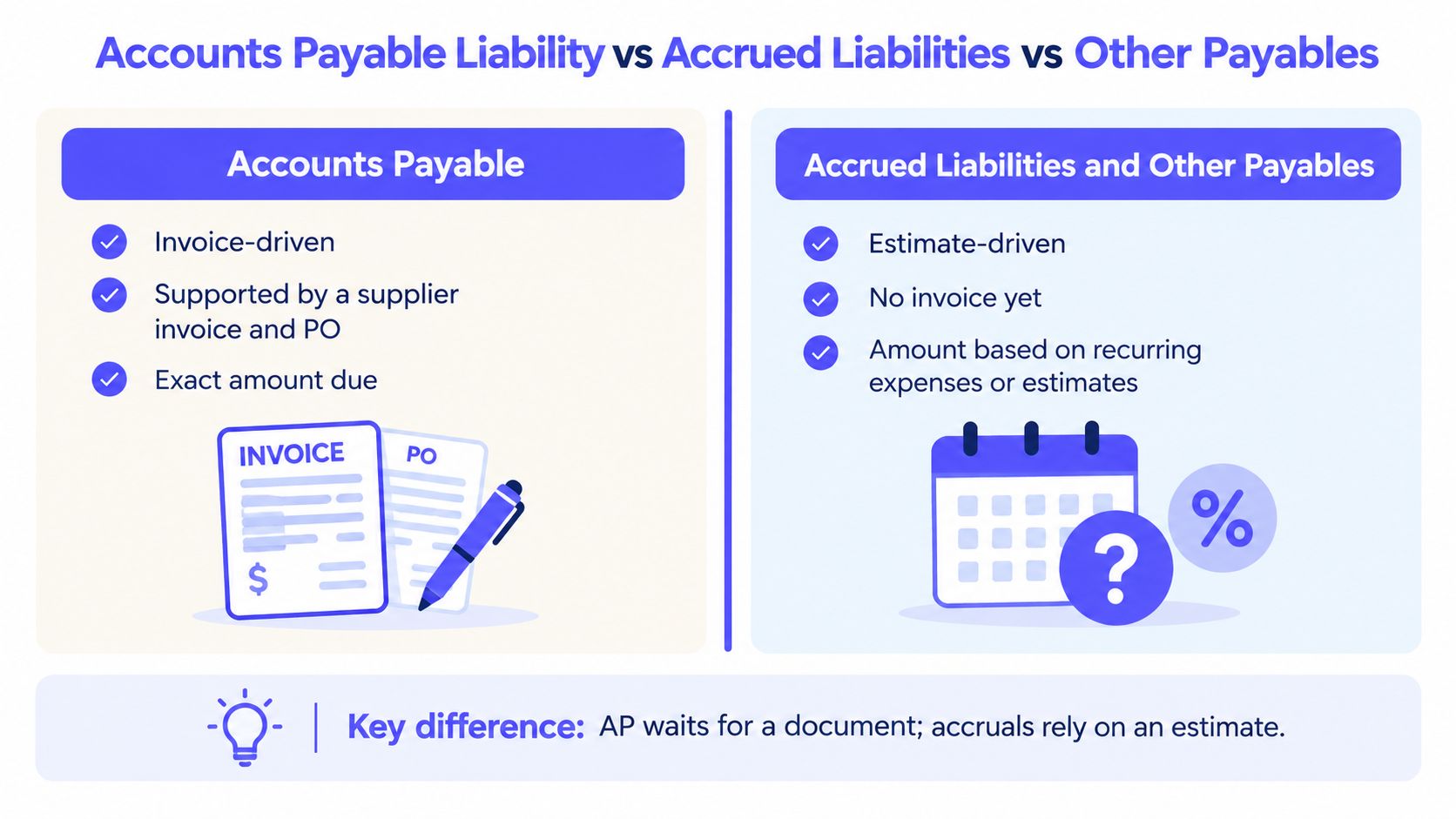
Accounts payable liability comes from a billed obligation. Accrued liabilities come from an incurred obligation that has not been billed yet. Other payables sit in a different lane. They are short-term obligations too, but they usually come from payroll, taxes, interest, or similar nontrade events.
The easiest way to separate them is to ask one question first. What created the liability?
If the trigger is a supplier invoice for goods or services already received, the balance usually belongs in accounts payable. If the company owes for activity that already happened but the invoice has not arrived, the balance is usually an accrued liability. If the obligation comes from wage runs, sales tax filings, or other statutory and operating items, it often belongs in another payable account.
| AP Liability vs Accrued Liability vs Other Payables | ||
|---|---|---|
| Liability Type | Recognition Trigger | Measurement |
| Accounts Payable Liability | Vendor invoice received for goods or services already received | Invoice amount, adjusted for trade or cash discounts under gross or net method |
| Accrued Liability | Expense incurred before invoice receipt, usually at period end | Estimated amount based on available support |
| Other Payables | Other short-term obligations arising in operations | Measured based on the underlying obligation and supporting records |
The measurement basis matters because it changes the evidence standard. AP is usually anchored to an invoice. Accrued liabilities are anchored to support such as contracts, receipt records, time worked, service periods, or rate schedules. Other payables rely on their own source records. A payroll payable should tie to payroll registers. A tax payable should tie to the filing basis.
Classification affects close quality
The AP versus accrual distinction is really a timing and evidence distinction. That is why it matters for working capital and control quality, not just presentation.
An AP balance should tell the team, “we have the bill, we know the amount, and we know who to pay.” An accrued liability says something different. It says, “we owe this amount or a close estimate of it, but the billing event is still pending.” Those are both valid liabilities. They just carry different levels of precision and different close procedures.
The common failure point is predictable. An accrual is booked at period end. The invoice arrives later. AP records the invoice, but no one clears the original estimate.
A controlled close process usually includes three checks:
- Trace the trigger: Determine whether the obligation entered the system through an invoice or through period-end accrual logic.
- Check for prior recognition: Search for an existing accrual before posting the invoice to AP.
- Clear temporary estimates: Reverse or relieve the accrual once the invoice-driven payable is recorded.
The same obligation should not live in both AP and accrued liabilities after the invoice is posted.
That is why skeptical finance teams do not treat these labels as bookkeeping trivia. They treat them as signals about timing, proof, and workflow discipline. If those signals are weak, the liability is still on the balance sheet, but its quality is lower.
Common Reconciliation Issues That Distort Accounts Payable Liability
Month-end looks clean until one test fails. The AP aging says one number. The general ledger says another. A vendor statement shows an invoice no one can find, and an accrual from last month is still sitting in the books after the bill was posted. The liability is recorded, but its quality is weak.
Reconciliation problems distort AP liability because AP is a timing account, not just a storage bucket for invoices. If an item lands late, lands twice, or lands without support, the balance sheet still shows a liability, but finance cannot trust the amount, the period, or the payment status.
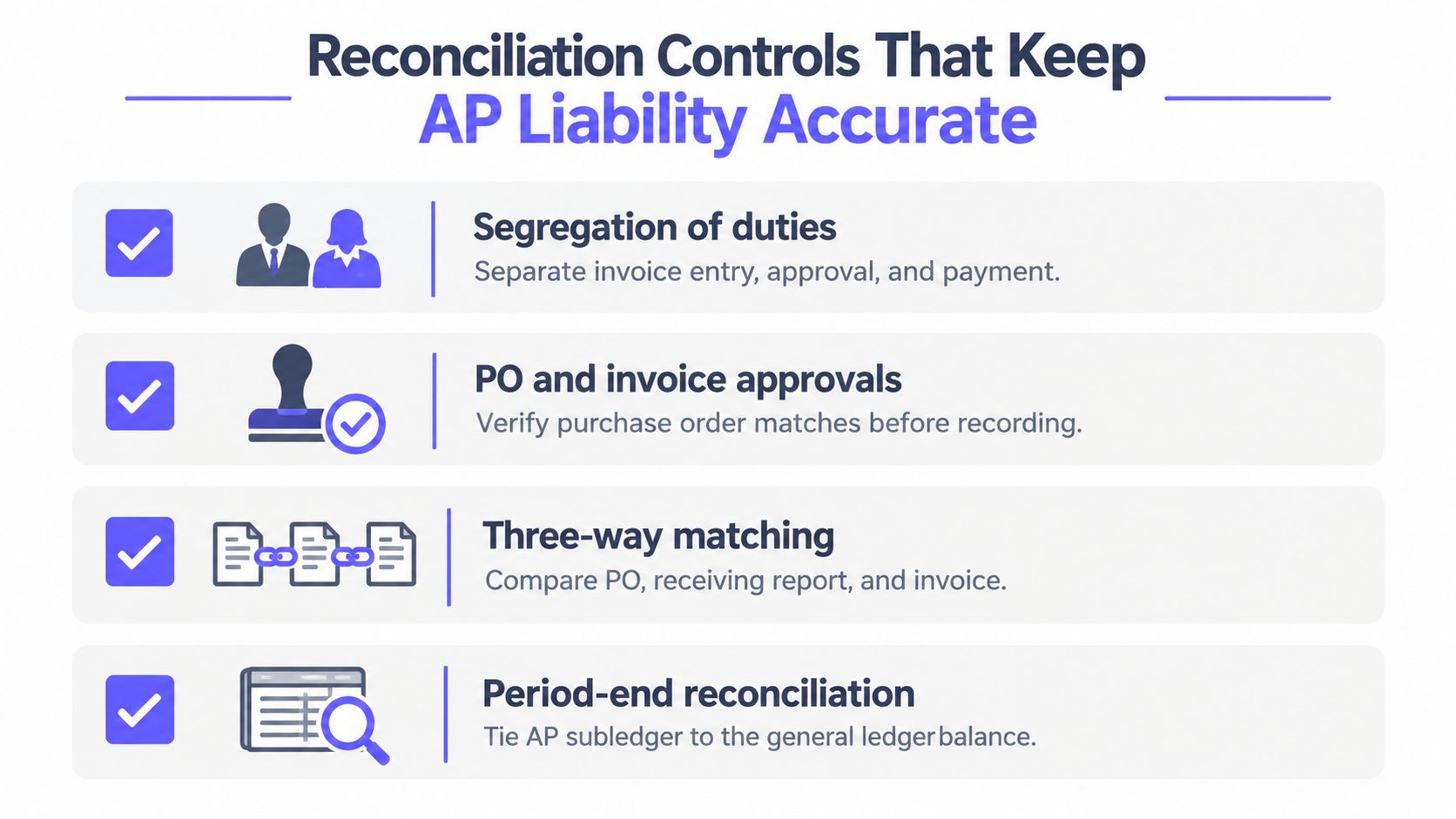
Classic AP controls address that risk. Standard practices include segregating duties, approving purchase orders and vendor invoices, matching invoices to purchase orders and receiving reports, and reconciling subsidiary ledgers to the AP control account and supplier statements, as summarized in this AP controls reference.
The controls that keep the AP balance believable
Each reconciliation control tests a different failure mode. That is why close teams should treat AP reconciliation like circuit testing. One green light does not prove the whole board works.
- Segregation of duties: Separate invoice entry, approval, and payment release so one person cannot create and settle a false liability.
- Approval discipline: Review the commercial terms before posting so AP does not become a parking lot for disputed or invalid invoices.
- Three-way matching: Compare the invoice to the PO and receiving evidence when the process requires it. That check answers a simple question. Did the company order it, receive it, and get billed correctly?
- Ledger reconciliation: Tie the AP subledger to the control account, then compare vendor statements to open items. This is usually where missing invoices, stale credits, and posting timing errors show up.
Teams that want a more repeatable method often standardize the investigation process with a balance sheet account reconciliation workflow.
A short visual walkthrough helps make these controls concrete:
The failure patterns are usually ordinary
AP liability usually gets distorted by routine workflow breaks. The accounting is rarely exotic. The handoff is.
A useful reconciliation review checks for four patterns:
- Invoices outside the normal posting path: An invoice in email, a shared drive, or a hold queue can create cutoff errors because the obligation exists, but AP has not recorded it in the subledger.
- Duplicate bills or duplicate entry: The same vendor, amount, invoice number, or service period may have been captured twice. One duplicate overstates liability. A duplicate payment can create a separate recovery problem.
- Accruals that were never cleared: The estimate did its job at period end. Once the actual invoice posts, the temporary liability should be reversed or relieved. If not, the books carry both.
- Subledger-to-GL or vendor-statement differences: These breaks usually point to timing gaps, manual journal entries, unapplied credits, or invoices posted to the wrong vendor or period.
None of this work is glamorous. It is how finance proves that AP liability is not only recorded, but recorded in the right amount, in the right period, with evidence that can survive review.
How Deterministic Automation Reduces Risk in Accounts Payable Liability Workflows
A controller closes the month and sees AP land exactly where the subledger says it should. That sounds safe. Then audit asks a simple question. Why was this invoice posted in this period, approved by this person, and excluded from the exception queue? If the team cannot show the path, the liability may be recorded, but its quality is still weak.
Deterministic automation reduces AP liability risk because it controls timing, routing, and evidence at each step. That changes AP from a static balance sheet line into a managed timing process. The liability is only as reliable as the workflow that created it.
Manual AP creates small differences in judgment. One analyst waits for a receiving document. Another uses the invoice and an email approval. Another posts the item to avoid a late close and plans to revisit it later. Those choices affect period cutoff, duplicate risk, and who can explain the entry after the fact.
Black-box automation creates a different problem. It can move invoices quickly while leaving finance with poor evidence. Speed helps throughput. It does not help much if the team cannot show why a document matched, why an exception cleared, or why a posting date changed.
Deterministic workflows improve liability quality by reducing timing variance
AP liability works like a valve in working capital. Open it too slowly and obligations go unrecorded at close. Open it without controls and the ledger fills with duplicates, wrong dates, and unsupported postings.
Earlier survey findings in this article showed a familiar pattern. Many AP teams have adopted some automation, but far fewer have achieved end-to-end control with consistent audit evidence. Analysts at Vic.ai found a similar gap between AI adoption and full AP automation in its AI momentum report. The headline is not that finance needs more software. The headline is that partial automation often leaves the hard control points unresolved.
That is the distinction that matters for AP liability. A workflow should define, in advance, what must be present before an invoice can move forward. Match status. Approval path. posting rule. Exception owner. Evidence captured at the time of action.
Evidence capture determines whether the recorded liability will survive review
A booked liability is not the same as a defensible liability. Auditors, controllers, and operators need to inspect the chain of evidence, not rely on memory.
A sound AP workflow should answer five questions without manual reconstruction:
- What document entered the process
- What rule matched or failed
- Who approved or released the exception
- What changed in the record
- What was written back to the ERP, and when
That structure reduces rework because finance does not need to rebuild the story from inboxes, chat threads, and screenshots. It also improves control testing. The evidence already exists in the workflow record.
Loopfour is built around that operating model. Loopfour, a finance workflow automation platform in the FinOps infrastructure category, converts recurring finance operations into deterministic, auditable code on existing ERP, CRM, billing, and document systems. Workflows can route exceptions through Slack, Microsoft Teams, or email, while preserving run logs, execution trees, approvals, and system-write evidence for control testing. The model is governed automation on the systems your team already uses.
For teams comparing models, why Blocsys Technologies prefers automation offers a useful example of how recurring finance work becomes less reliable when each person handles the task differently. The broader accounts payable automation benefits only show up when the workflow stays inspectable and exception handling is assigned with clear rules.
FAQ
Is accounts payable liability an asset or a liability
Accounts payable liability is a current liability. It represents money owed to suppliers for goods or services already received, and it remains on the buyer’s balance sheet until payment is made, as described by NetSuite’s AP accounting overview.
When should a company recognize accounts payable liability
Accounts payable liability is generally recognized when a vendor invoice is received. The amount is typically measured at the invoice amount, adjusted for trade or cash discounts under the gross or net method, according to this accounting explanation of AP and accrued liabilities.
How is accounts payable liability different from an accrued liability
Accounts payable liability is invoice-driven, while an accrued liability is estimate-driven. AP relies on an actual supplier bill. An accrual is recorded when the obligation exists before the invoice arrives. If the team doesn’t reverse the accrual when the invoice posts, the liability can be double counted.
Why does accounts payable liability matter for working capital
Accounts payable liability affects working capital because payment timing changes both current liabilities and cash on hand. DPO is a common benchmark for this. MetricHQ’s AP benchmark summary places median DPO at around 40 days, with a 25th percentile near 30 days and 75th percentile near 50 days.
What controls keep accounts payable liability accurate
Accounts payable liability stays accurate when teams use segregation of duties, invoice and PO approvals, matching procedures, and reconciliation controls. Standard AP controls include matching invoices to purchase orders and receiving reports, then reconciling the AP subledger to the AP control ledger and supplier statements, as outlined in this AP controls summary.
Can AI alone fix accounts payable liability problems
AI alone usually doesn’t fix accounts payable liability problems. Survey reporting shows broad AI use in finance, but far less end-to-end automation and uneven cost outcomes, according to Vic.ai’s AI momentum report. The bigger issue is whether the workflow is deterministic, auditable, and able to route exceptions with evidence.
Loopfour offers deterministic AP and close workflows that run on existing finance systems, preserve execution evidence, and route exceptions to the right owner instead of hiding them in inboxes. For finance leaders who need accounts payable liability to be both timely and auditable, Loopfour is a practical path to governed automation without ripping out the current stack.