
An audit trail process creates a protected, chronological record of a workflow’s actions, actors, decisions, and changes. The popular advice to just turn on logging is incomplete. A log can prove that a payment was released without proving that the release was authorized, supported, or appropriate.
For a controller who has been burned by automation, that distinction matters. A successful run isn’t necessarily a controlled run. The useful test is whether an independent reviewer can reconstruct the transaction, evaluate the decision, and identify the evidence behind it.
Table of Contents
- What an Audit Trail Process Actually Records
- Why Auditors Test Your Process Evidence
- Execution Logs, Versioning and Approvals Explained
- Proving an Action Was Appropriate, Not Just Recorded
- How to Build an Audit Trail Process Step by Step
- Keeping the Trail Intact as Workflows Change
- Audit Trail Process Questions Answered
- Confirm Your Audit Trail Before Your Next Audit
What an Audit Trail Process Actually Records
Turning on a log does not, by itself, create useful process evidence. An audit trail records events in sequence, who or what triggered them, and what changed. Its purpose is to let someone trace how a workflow reached its result.
Audit trails grew from computer security logs into records used for accountability, event reconstruction, intrusion detection, and problem analysis. NIST’s audit-trail guidance describes records of operating-system, application, or user events. Systems may keep separate trails for different kinds of activity.
Two approaches capture different levels of detail:
- Event-oriented logging records system, application, or user events, such as an invoice approval or ledger posting.
- Keystroke monitoring records individual keystrokes rather than business events.
For finance workflows, event-oriented logging gives the record a useful structure without capturing every keystroke. A reviewer can follow each process step through its actor, outcome, and timestamp. That shows what the system recorded, though it does not establish that a decision was appropriate.
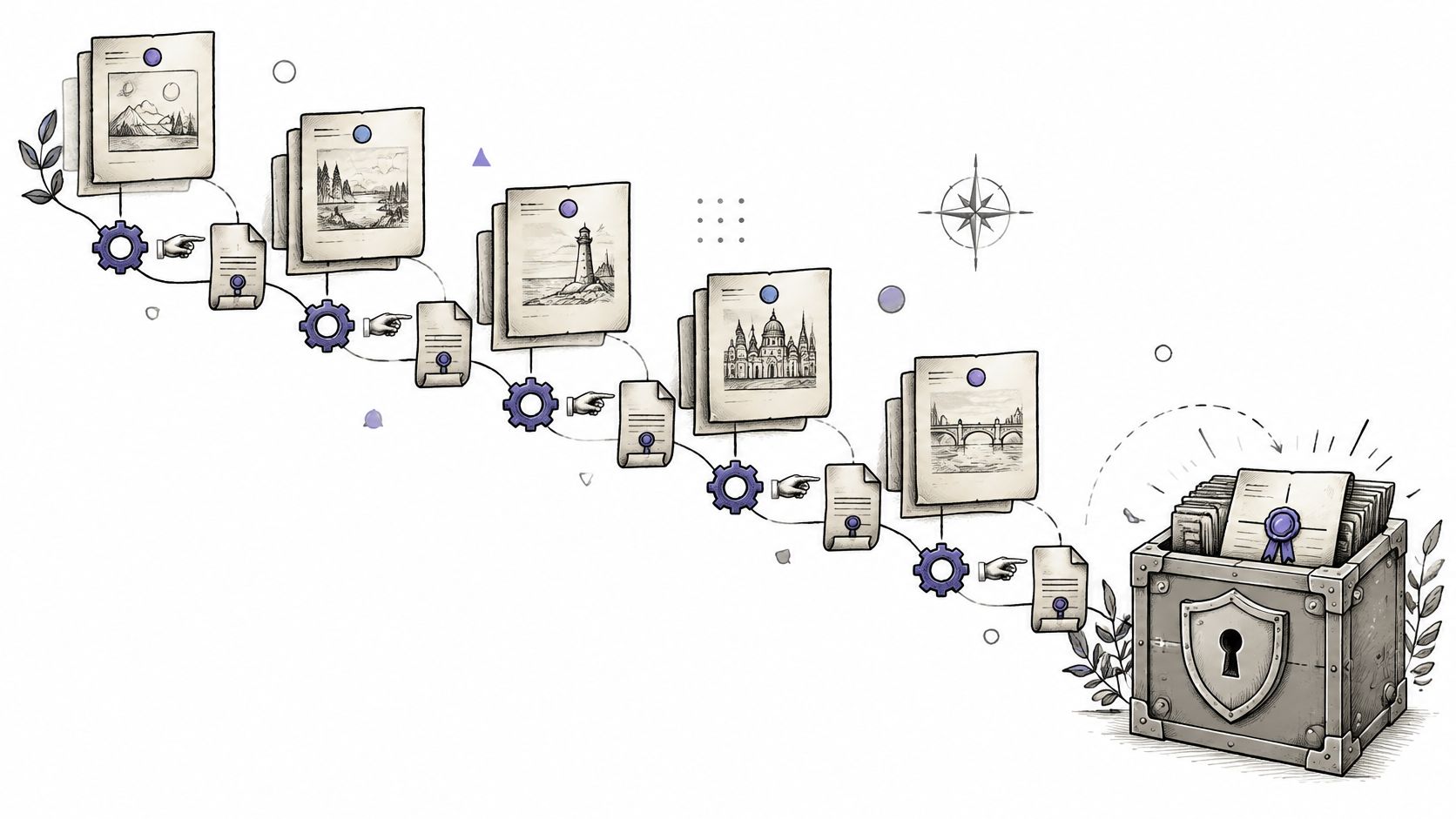
The diagram shows operational documents moving through processing into protected storage.
Business events need business context
For an invoice workflow, a useful record connects the input received to the matching rule applied, the approval or exception decision, the system write, and the resulting status. A status alone leaves out the steps that explain how it was reached.
A bank statement is a summary; the audit trail is closer to the teller’s journal, with timestamps, initials, and receipts. The final ERP balance cannot replace evidence of the process that produced it. For an introduction to the terminology, CEFCore’s guide to audit trails provides a companion explanation.
Practical rule: Preserve the evidence needed to explain a financial action, not just the message announcing its completion.
The records should be accurate, available when needed, and protected by strong access controls. Periodic review and real-time monitoring can work together: monitoring surfaces activity as it happens, while review helps assess the retained record. A trail can reconstruct recorded decisions, but governance must define who owns it and keep it useful as workflows change.
Why Auditors Test Your Process Evidence
Auditors need process evidence to be reliable, not just present. An exported report doesn’t establish its own accuracy, completeness, or origin.
PCAOB AS 1105 requires auditors to evaluate electronic information used as audit evidence. That includes understanding its source and how it was received, maintained, and processed, including modifications. Auditors must test its accuracy and completeness or test controls over those attributes.
For a controller, the implication is direct. A report showing approved invoices needs supporting evidence that the relevant invoices were included and that approval statuses weren’t changed during extraction.
Audit evidence requirements by source
| Source | What it requires | What the trail must show |
|---|---|---|
| PCAOB AS 1105 | Evaluation of electronic audit evidence reliability | Source, processing steps, modifications, and completeness controls |
| FCPA books and records provisions | Accurate and fair records plus internal accounting controls for covered issuers | Authorization, recording, asset access, and periodic reconciliation |
| SEC electronic recordkeeping rule | Complete, time-stamped trails of modifications and deletions for covered electronic records | Actor where applicable, creation/change/deletion times, and a reproducible original record |
| PCAOB documentation requirements summarized in its inspection spotlight | Audit documentation retention for seven years from report release, unless law requires longer | Retrievable audit documentation throughout the applicable period |
| Archived PCAOB AU 319 guidance | Recognition that electronic evidence can become unavailable after files change without backups | Preserved historical records, subsequent changes, and retrievable backups |
These requirements have different scopes. Broker-dealer recordkeeping rules aren’t universal requirements for every finance team. Auditor documentation obligations also shouldn’t be mistaken for a blanket retention rule for every company log.
Reliability creates practical design tests
A defensible audit trail must support population coverage, data lineage, and later reconstruction. Those tests address different ways apparently complete evidence can fail.
- Population coverage: Records cover the relevant population or support a defensible sampling approach.
- Evidence lineage: The trail shows movement through systems, transformations, approvals, and exceptions.
- Later retrieval: Evidence survives beyond the transaction date and remains usable during review.
A SOC 2 Type II overview can help distinguish service-organization assurance from transaction-level evidence. Neither a report nor a platform badge substitutes for testing the financial control.
The controller’s concern is reasonable: auditors want the trail to hold up when they reproduce a decision months later.
Execution Logs, Versioning and Approvals Explained
An audit trail rests on execution logs, versioning, and approvals. Each component closes an evidentiary gap the others leave.
NIST SP 800-92’s log-management planning guidance treats logging as a lifecycle covering generation, transmission, storage, access, and disposal. That perspective prevents teams from treating event capture as the entire control.
The component diagram shows how these records fit together.
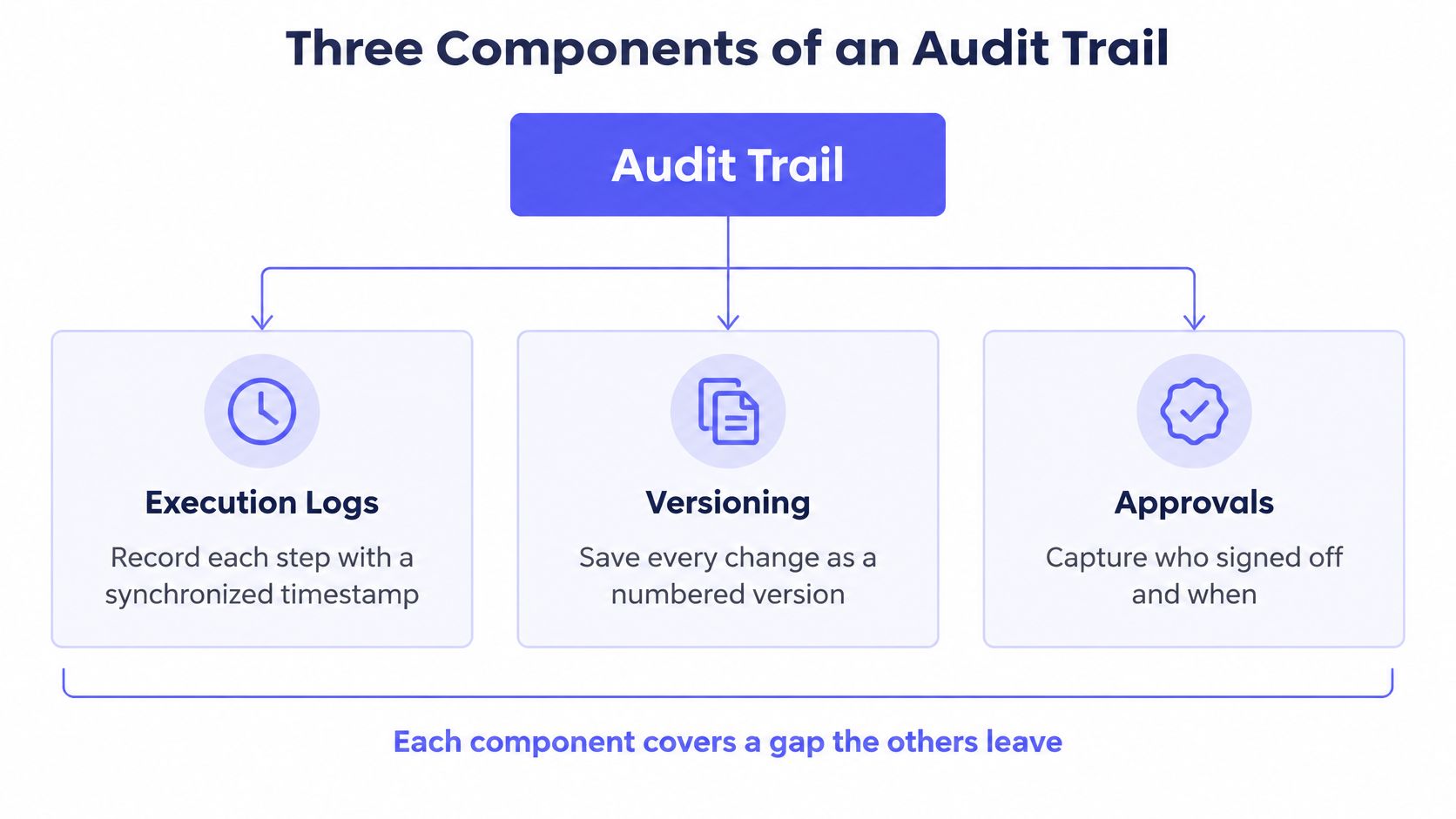
- Execution logs record each step with a synchronized timestamp, initiating identity or service, workflow identifier, input and output references, and resulting system write. A unique execution ID connects the run across ERP, CRM, billing, and document systems.
- Versioning preserves the workflow definition and its effective date. The record must identify which predefined rule governed the transaction, not merely the current rule.
- Approvals establish who approved, when, what evidence was presented, and whether the decision resolved an exception. An approval without its decision package leaves the reviewer guessing.
A hypothetical invoice shows the dependency
Consider a hypothetical $48,200 vendor invoice processed under accounts payable workflow version 3.2. Controller Maya Patel approves a vendor-name exception after reviewing the invoice and verified vendor record.
The execution log connects the invoice receipt, mismatch detection, approval request, decision, and payment-system write. The versioned definition establishes the matching rule and escalation path. The approval record preserves Maya’s rationale and the documents available at decision time.
A saved workflow version can’t prove that the rule ran. A successful execution log can’t establish that the approver had authority. An approval timestamp can’t establish which document version the approver reviewed.
The accompanying video offers another reference point for workflow review.
For implementation context, accounts payable automation practices should be evaluated alongside the evidence each control produces.
The operating team must also monitor log-source status, archival jobs, software changes, and clock synchronization. A disabled connector can leave a clean-looking but incomplete history. Monitoring must expose missing evidence, not merely failed business transactions.
Proving an Action Was Appropriate, Not Just Recorded
More logs don’t necessarily create stronger auditability. An audit trail that proves an action occurred still falls short when the reviewer asks whether the action was appropriate.
Timestamps, identities, and integrity protections establish important facts. They don’t independently establish policy compliance, sound judgment, or a reasonable accounting conclusion.
Japan’s audit oversight authority recorded 213 listed-company audit findings related to internal-control testing in 2025, compared with 150 in 2022, in its 2025 inspection findings survey. Those findings don’t establish that logging failures caused the deficiencies. They reinforce why control testing cannot be replaced by collecting more operational records.
Exception evidence must explain the decision
An exception record should preserve the reasoning that connects a policy to the final disposition. A reviewer needs enough context to assess the judgment without relying on the approver’s memory.
Capture the following fields together:
- Rule applied: The policy, control, or matching condition that produced the exception.
- Active version: The rule definition effective when the transaction was processed.
- Challenge and ownership: The person who questioned the item and the authorized decision-maker.
- Evidence reviewed: The specific documents, verification results, and record versions considered.
- Disposition rationale: Why release, rejection, correction, or escalation was reasonable.
- Accounting conclusion: Any resulting treatment or downstream posting that depended on the decision.
Say a payment exceeds its normal approval threshold. A release event only establishes that the payment moved forward.
An intelligible exception package includes the threshold version, authorized escalation route, controller’s note, and vendor check under the same execution ID. If the release departed from policy, the record must identify the authority for that departure. A retrospective note cannot convert an unauthorized action into an authorized one.
Review test: Can an independent reviewer explain the outcome without calling the person who approved it?
The target isn’t a large archive. It’s a defensible connection between the control objective, evidence reviewed, judgment exercised, and financial result.
How to Build an Audit Trail Process Step by Step
Automation can record an event perfectly and still leave you unable to show whether the action was appropriate. Start by defining which controlled events need evidence, then configure the workflow to produce that evidence. A reliable process connects each event to a testable record and has an owner responsible for keeping that control usable.
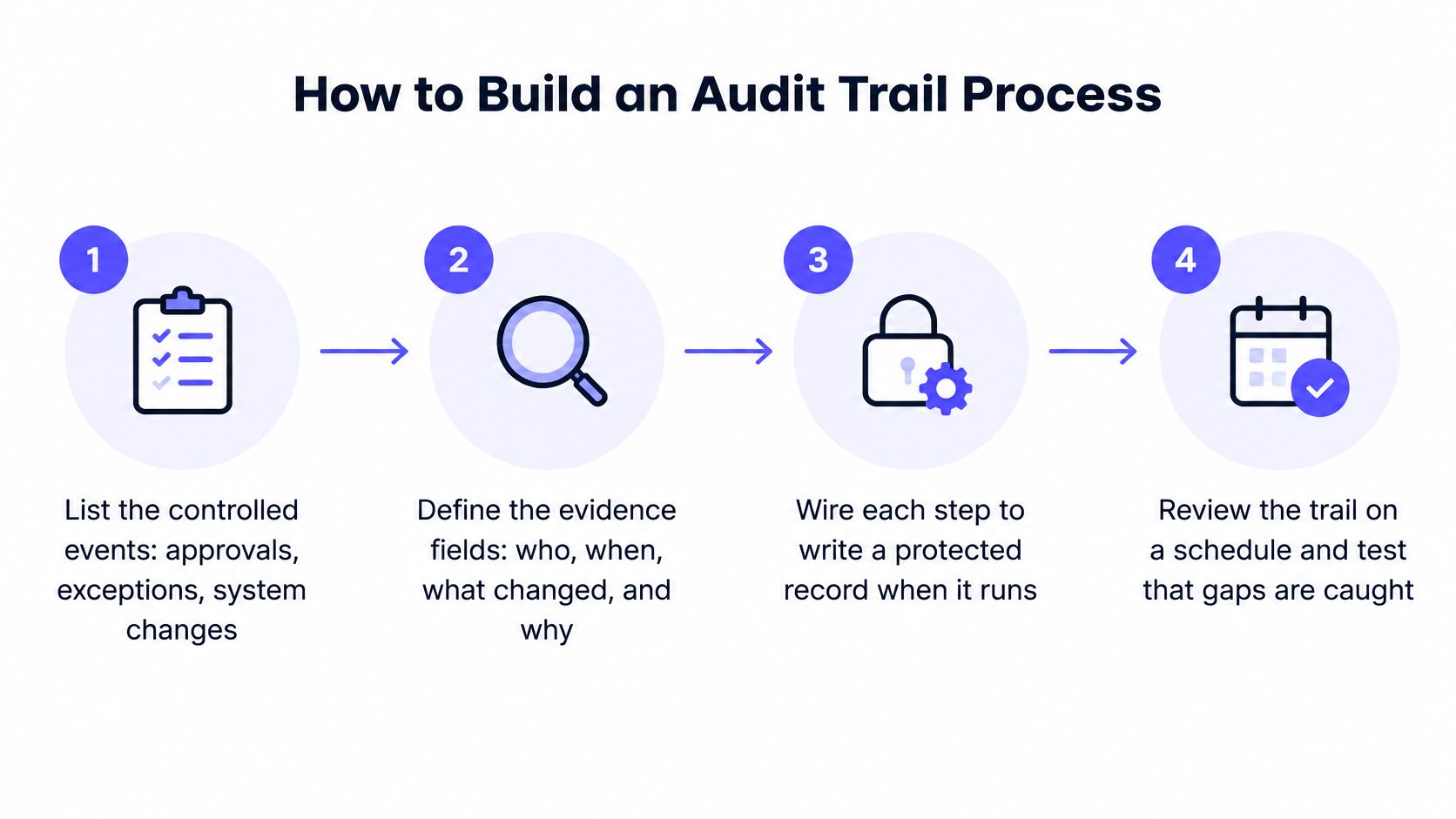
The sequence below moves from event selection to independent reconstruction.
Build evidence into the workflow
Each step should define what a complete record looks like and what counts as failure. A successful completion message alone is not evidence that every control boundary worked as intended.
-
List controlled events. Include approvals, exceptions, system writes, rule changes, and access changes, since each can affect a control outcome. If the log captures successful postings but omits rejected attempts or administrative changes, the record shows only part of the process.
-
Assign an execution ID at initiation. Carry it into downstream actions and retain external transaction references. Separate system identifiers are useful, but they do not by themselves show that events across systems belong to the same run.
-
Define the event schema. Record input and output references, the applied rule and version, actor or service identity, and outcome. Retain a stable reference to the evidence itself. A document name is not enough if the document can change after the event.
-
Version workflow definitions. Preserve effective dates, approved changes, and the definition used for each run. If a rule is overwritten in place, a reviewer cannot distinguish the configuration used for a past transaction from the one in effect now.
-
Assign approval and exception owners. Timestamp decisions and retain the decision package presented to each owner. A notification receipt proves delivery, not approval by an authorized person.
-
Set retention for each log source. Document the period required by operational, legal, and regulatory needs, along with how the records will be stored and retrieved. NIST-aligned audit-accountability guidance calls for defined retention and protection requirements, rather than one universal period. NIST-aligned audit-accountability guidance and its linked Canadian cloud-security benchmark Each log source needs its own documented period; specifying duration without retrieval expectations can leave evidence inaccessible when needed.
-
Protect records and archives. Restrict log access, record access activity, and calculate cryptographic digests for archived files. Keep the digests under separate protection. If an archive and its digest can both be replaced, the digest may not reveal that the record was altered.
-
Test reconstruction independently. Select a closed transaction and rebuild its path using retained evidence alone. If the original operator must explain missing steps, the evidence is incomplete.
Retention periods by source
| Source | Retention requirement | What the policy must state |
|---|---|---|
| PCAOB audit documentation rules | Seven years from report release date | Retrievability throughout the applicable period, unless law requires longer |
| NIST-aligned audit-accountability guidance | No universal period; operational, legal, and risk needs determine retention | Documented period per log source, with the reason |
| SEC electronic recordkeeping | Complete, time-stamped modification and deletion history; retention follows the applicable rule | Covered record class, applicable period, export format, storage controls, and retrieval method |
These requirements apply to different record classes; they do not create a universal company retention schedule. Before enabling automated disposal, specify how legal holds, contractual obligations, and applicable regulations affect each record source. A log can show that an action occurred, but the evidence and control design must also support a reviewer’s assessment of whether it was authorized and appropriate.
Keeping the Trail Intact as Workflows Change
A workflow can keep running while its audit trail quietly becomes incomplete. Keeping that trail reliable requires a named owner who reviews how changes affect evidence and revalidates the workflow, not just approves deployment.
Hyperproof’s 2025 benchmark found that 29% of respondents struggled to trace requirements through policies and controls to operating evidence. 31% had difficulty collecting control-testing data, and 55% found evidence testing and validation tedious or slower than expected.
These challenges concern how evidence is produced and tested, not only where it is stored. For example, an ERP administrator might rename a field, while an integration continues to report successful runs but no longer captures the information reviewers expect. A success message proves a run completed, not that its evidence remains complete.
Change triggers and the evidence each one needs
| Trigger | Evidence to preserve | Owner | Revalidation |
|---|---|---|---|
| ERP field renamed or removed | Old and new field mapping with effective dates | Finance systems lead | Re-run test transactions through the mapping |
| API or connector update | Connector version and change log | Integration owner | Replay sample runs and compare outputs |
| Browser workflow breaks after a UI update | Failed-run logs and step-level screenshots | Finance engineering | Re-test each step and its approval gate |
| Approval matrix or threshold change | Prior and new rules with effective dates | Controller | Test cases spanning the change against the rule effective for each case |
| Accounting policy or regulation change | Policy version and documented rationale | Accounting policy owner | Review control mapping and approve the revised design |
| Permission or role change | Access history before and after the change | Security or IT owner | Review access and test allowed and prohibited actions |
Ownership must include completeness testing
The audit-trail owner needs to show that expected events reached the evidence store. Monitoring whether a workflow ran does not establish that its approvals, outcomes, and system writes were recorded.
Reconcile initiated runs against terminal outcomes, expected approval events, and downstream system writes. Assign unmatched records to an owner and document their resolution. Apply the same change-control discipline to logging configuration as to business rules, since a workflow’s evidence can change even when its business logic does not.
A repeat finding should prompt review of whether remediation remains effective, not an assumption that workflow drift caused the finding. The New South Wales statistic previously associated with this point is not included here.
A governed finance workflow automation approach can use versioned definitions, change approvals, impact analysis, periodic testing, and retained revalidation results. Those controls make ownership concrete: someone is accountable for the trail, and the evidence shows whether it remains complete as the workflow changes.
Audit Trail Process Questions Answered
An audit trail process is useful when its records answer practical review questions without relying on memory. These answers distinguish sound control design from unsupported assumptions about logging.
What is an audit trail process in simple terms?
An audit trail process creates a protected, chronological history of actions, responsible people or systems, and resulting changes. NIST’s audit-trail guidance frames the underlying record around what occurred and who or what caused it. In finance, supporting evidence connects those events to transactions, controls, and decisions.
How does an audit trail differ from an activity log?
An activity log lists events. An audit trail connects relevant events into a reconstructable transaction history, including rules, approvals, and outcomes. NIST’s logging guidance supports the underlying lifecycle controls. The practical distinction is usability: a reviewer needs a coherent path, not a collection of disconnected success messages.
Must an approval record the reason for the decision?
An exception approval should preserve its rationale and supporting evidence under the transaction’s execution ID. That isn’t a universal requirement for a narrative on every routine approval. PCAOB AS 1105’s reliability principles explain why an unexplained approval marker may be insufficient for the particular audit objective.
Can an automated workflow produce a trail that auditors accept?
An automated workflow can produce useful audit evidence when predefined, versioned steps preserve reliable records and controlled approvals. Acceptance remains subject to the auditor’s procedures under PCAOB AS 1105. AI interpretation requires defined thresholds and human fallback where appropriate; automation alone doesn’t establish that a financial control operated effectively.
Confirm Your Audit Trail Before Your Next Audit
Before the next audit, the controller should test a closed transaction end to end without asking the operator to fill gaps. The outcome should determine whether the workflow needs better evidence, stronger controls, or both.
Spreadsheets and DIY scripts can be controlled, but teams must explicitly build versioning, access governance, and evidence capture. Generic AI agents also require careful boundaries around variable outputs and decision authority.
Loopfour, the deterministic finance workflow automation platform, runs predefined steps as versioned code instead. Its execution trees preserve actions, approvals, exceptions, and system writes across existing ERP, CRM, billing, and document tools. Exceptions route to named owners through Slack, Microsoft Teams, or email.
Audit trail setups compared on the criteria auditors test
| Criterion | Spreadsheets or DIY scripts | Generic AI agents | Loopfour |
|---|---|---|---|
| Reproducible runs | Require controlled files, code, inputs, and operator procedures | Outputs can vary without constrained execution | Predefined steps execute under versioned definitions |
| Step-level evidence | Must be built beyond screenshots and email threads | Requires inspectable action records, not generated explanations | Execution tree records actions, approvals, and system writes |
| Versioned definitions | Requires a maintained repository and release process | Requires prompt, model, tool, and configuration history | Workflow-definition version history |
| Exception handling | Requires explicit queues and ownership | Requires configured escalation boundaries | Named-owner routing through Slack, Microsoft Teams, or email |
| Audit evidence support | Evidence packages require deliberate assembly | Vendor-specific evidence must be evaluated | Evidence capture supports SOC 1 control audits; security attestations require current-report verification |
| Maintenance after change | Named owners must detect and repair drift | Behavior and integration changes require revalidation | Managed updates with approval gates and change history |
SOC 1 evidence support isn’t a claim that a particular control passed testing. Security attestations should be evaluated through current reports, including their scope and exceptions, rather than assumed from product descriptions.
The practical next step is narrow. Select accounts payable or month-end close, map its controls, run a bounded period, and reconstruct a transaction from the retained trail alone.
Loopfour offers deterministic finance workflow automation with versioned definitions, owned exceptions, and execution evidence across existing finance systems. Visit Loopfour to discuss a bounded workflow evaluation that includes a transaction-reconstruction test before broader deployment.