
A system integration company that connects an ERP to a CRM hasn’t proved it can pass a finance control test. The strongest shortlist starts with evidence, exception ownership, and change resilience, not company size or connector logos. A system integration company designs, implements, and supports connections between business applications so data and processes work across systems.
Finance buyers should assess industry experience, governance and controls expertise, and connector breadth. Each criterion needs proof from the proposed delivery team. A corporate capability statement doesn’t establish who will resolve a failed posting during close.
The fear is specific. Auditors will ask who approved each write and whether the same inputs, rules, and workflow version produce the same result next quarter. Finance teams need an answer that survives the departure of the engineer who built the integration.
- Industry experience: Can the delivery team explain reconciliation, posting periods, and approval authority?
- Governance expertise: Can the vendor produce run evidence, exception ownership, and controlled change records?
- Connector breadth: Can the proposed architecture support the actual stack, including its awkward legacy applications?
Understanding how data integration services work helps distinguish moving records from governing financial actions. Loopfour, the deterministic finance workflow automation platform, is included on the same terms as every other entry. The assessments below identify fit and the limitation to test first, rather than assign unsupported numerical scores.
Table of Contents
- 1. Loopfour
- 2. Accenture
- 3. CGI
- 4. Cognizant
- 5. RSM US
- 6. CrossCountry Consulting
- 7. Integrational Systems
- 8. Zirous
- 9. Ultimo Software Solutions
- 10. Bilqees Technology Solutions (BTS)
- How each system integration company compares on finance fit, named platforms, and pricing transparency
- Frequently Asked Questions
- Turning Your Shortlist Into a Defensible Choice
1. Loopfour
Loopfour fits finance teams seeking deterministic, auditable workflows on existing systems, rather than a core-platform replacement. Its first test should be whether a proposed workflow preserves sufficient evidence across every API call, browser action, approval, and exception.
Loopfour’s finance workflow automation approach uses predefined, versioned steps for billing, collections, payment reconciliation, revenue recognition, and close. AI handles bounded interpretation tasks, such as document reading, with uncertain cases routed for human review. Black-box automation delegates decisions to an agent. Loopfour uses predefined execution instead.
The platform description includes ERP, CRM, billing, spreadsheet, collaboration, and document connectors, plus secure browser automation where APIs are unavailable. That breadth matters only if permissions, duplicate prevention, and evidence remain intact across the complete workflow.
Test the evidence before the speed
Loopfour should demonstrate an ordinary run, a rejected approval, and a partially completed transaction. Finance buyers should inspect the execution tree, workflow version, system-write evidence, exception owner, and recovery procedure.
- Strengths: Versioned definitions, approval gates, permissions, change history, impact analysis, and retained execution evidence.
- Maintenance model: Finance engineers implement workflows and maintain them when upstream systems or business rules change.
- Limitations: Pricing requires a scoped discussion. Custom implementation also requires access, process decisions, and testing from the customer.
- Interface diligence: Ask which review and change tasks occur in Loopfour Studio, and what AI Copilot may suggest or execute. Require a demonstration of permission boundaries.
Company-reported certifications and case-study results aren’t substitutes for workflow acceptance testing. Request the relevant assurance reports, examine their scope, and validate performance against representative transactions.
Assessment: Strong alignment with finance controls by design. Connector behavior, evidence export, maintenance responsibilities, and implementation economics still need contractual confirmation.
2. Accenture
Accenture belongs on shortlists for broad enterprise transformation involving finance and other business functions. The first limitation to test is whether its delivery model is proportionate to a contained integration problem.
Accenture’s systems integration services cover enterprise implementation and integration across platforms including SAP, Oracle Cloud, Microsoft Dynamics 365, Salesforce, and Workday. Its scope extends to modernization, migration, and managed support.
That breadth may suit a finance program spanning business units, regions, HR, and customer operations. It may be excessive when the actual requirement is a controlled billing handoff between existing applications.
- Industry experience test: Request a reference involving comparable accounting policies, entity structures, and posting controls.
- Governance test: Require a named owner for reconciliation failures across application boundaries.
- Connector test: Confirm the proposed products, adapters, custom components, and licensing dependencies.
- Commercial limitation: Obtain a scoped proposal separating implementation, ongoing support, and future changes.
Practical rule: A large delivery team doesn’t remove the need for a single accountable owner when a transaction fails between systems.
Assessment: Broad platform coverage and organizational-change capability are relevant strengths. Finance buyers should insist on a narrowly defined acceptance package and support model.
A successful migration isn’t enough. The proposed team should demonstrate how finance staff identify an incomplete posting, prevent duplication, and approve recovery without opening a new consulting project.
3. CGI
CGI is a candidate for mixed estates containing cloud, on-premises, and legacy applications. The first limitation to test is the proposed team’s finance workflow experience, not the company’s overall technical breadth.
CGI’s systems integration offering includes planning, design, implementation, custom development, and continued support. Its technology-independent positioning can suit organizations that can’t standardize their stack around a single vendor.
Custom development is useful when packaged connectors don’t express the required business logic. It also creates a maintenance obligation. Finance leaders should establish ownership of source code, deployment procedures, dependencies, and operational documentation before approving that approach.
Make legacy connectivity a separate acceptance test
CGI should demonstrate how the proposed architecture detects incomplete writes and safely resumes processing. A legacy system integration assessment should distinguish API access, file transfers, database access, and browser-driven interaction.
- Advantage: Flexibility across mixed technology environments.
- Trade-off: Custom components may increase specialist dependence.
- Required proof: Comparable finance references, documented exception queues, and a tested recovery procedure.
- Scope check: Confirm staffing, support hours, and which changes trigger additional fees.
Assessment: Potentially strong architectural fit for heterogeneous systems. Finance-control fit remains a delivery-team question.
The decisive demonstration isn’t a successful data transfer. It’s an interrupted transfer that leaves finance with an accurate status, a named owner, and no duplicate posting.
4. Cognizant
Cognizant may suit organizations seeking integration delivery and ongoing enterprise operations from the same provider. The first limitation to test is whether the proposed execution model remains rules-based where finance requires predictable results.
Cognizant’s enterprise integration services span applications, data, and workflows across ERP, CRM, HCM, finance, and supply-chain platforms. The offering combines engineering and configuration with monitoring, optimization, and upgrades.
Ongoing operations can be valuable, but monitoring alone doesn’t establish control ownership. A dashboard may identify a failure without identifying who can authorize correction.
- Delivery strength: Broad coverage across business functions and post-launch operations.
- Control question: Which actions follow predefined rules, and which involve AI interpretation?
- Ownership question: Who resolves a disagreement between CRM contract data and ERP posting policy?
- Commercial question: Which monitoring, upgrades, and remediation tasks belong in the base agreement?
The ERP integration with CRM boundary deserves particular attention. Contract amendments, credit notes, and customer-master changes should be tested alongside ordinary invoices.
Assessment: A plausible long-term enterprise services partner, subject to team-level and architecture-level validation.
Finance buyers should ask Cognizant to demonstrate an upstream schema change. The evidence should show detection, suspended unsafe writes, approved remediation, and controlled resumption. A generic commitment to optimization doesn’t answer those questions.
5. RSM US
RSM US is relevant when integration decisions depend heavily on accounting processes and ERP modernization. The first limitation to test is whether a contained workflow requires the broader transformation being proposed.
RSM’s ERP modernization services include selection, implementation, integration, managed services, and ongoing optimization. Its finance transformation scope connects technology decisions with process, automation, and compliance considerations.
That combination can help when the problem isn’t merely connectivity. A reconciliation workflow may fail because entity mappings, accounting policies, or approval responsibilities remain unresolved.
- Finance alignment: Request examples involving the same transaction types and control objectives.
- Platform fit: Confirm experience with the exact ERP edition, modules, and adjacent applications.
- Scope discipline: Separate essential integration work from optional process redesign.
- Commercial diligence: Obtain engagement-specific pricing and explicit assumptions about customer participation.
Keep modernization optional
RSM should explain which requirements can be delivered on the current stack and which genuinely require platform changes. Finance buyers shouldn’t accept an ERP replacement as the default answer to a missing approval handoff.
Assessment: Relevant finance-process orientation, with connector breadth dependent on the proposed platform team.
The pilot should include an accounting exception, not just a technical failure. For example, a transaction arriving after period lock should reach a named owner without bypassing policy. The resulting evidence should identify the original input, the blocked action, and the approved resolution.
6. CrossCountry Consulting
CrossCountry Consulting is a focused candidate when NetSuite and related finance or procurement systems are central to the scope. The first limitation to test is coverage outside that platform ecosystem.
CrossCountry Consulting’s NetSuite practice describes implementation, development, integration, support, and optimization. Its described integration work includes Boomi, Celigo, and finance or procurement connections involving Coupa and Amazon Business.
Those tools introduce an important ownership question. The consulting agreement, integration-platform subscription, and application support agreement may assign responsibility differently.
A connector failure should arrive with an accountable owner, not a referral to another vendor’s support portal.
- Strength: Finance and procurement context around NetSuite implementation.
- Trade-off: Platform relevance may narrow when the wider stack uses unrelated systems.
- Proof required: A complete transaction trace across the integration platform and NetSuite.
- Cost question: Separate consulting fees, platform licensing, managed support, and change requests.
Assessment: Worth considering for NetSuite-centered finance operations. End-to-end governance must be demonstrated across every participating product.
A useful pilot follows an approved procurement transaction through receipt, invoice matching, and posting. CrossCountry should identify which component retains each approval and how finance retrieves the complete record. Post-go-live support should cover business exceptions as explicitly as connector errors.
7. Integrational Systems
Integrational Systems may suit buyers seeking a specialist in platform-to-platform business software integration. The first limitation to test is whether its narrower published platform coverage matches the complete finance stack.
Integrational Systems describes experience with NetSuite, Acumatica, and Celigo-based connections involving applications such as Salesforce and Amazon. Its approach also recognizes that connected systems may require customization when standard flows don’t match business processes.
That is a practical distinction. Some integration failures originate in application configuration rather than transport logic. Changing the connector won’t resolve an inconsistent customer identifier or incompatible order state.
Inspect both sides of the connection
An enterprise application integration review should identify every application customization required for the proposed workflow. Each change needs an owner, a deployment procedure, and a regression test.
- Potential advantage: Specialist attention to business application connectivity.
- Coverage limitation: Verify ERP, CRM, billing, document, and collaboration requirements individually.
- Maintenance question: Who supports customized application behavior after vendor upgrades?
- Evidence question: Can finance retrieve input, transformation, exception, and posting records together?
Assessment: A focused option where the named platforms align. Finance governance and support arrangements need direct validation.
The proposed team should show a failed synchronization and its correction. Reprocessing must preserve the original failure record and avoid creating a second financial transaction. Public pricing and maintenance arrangements should be replaced with explicit proposal terms before selection.
8. Zirous
Zirous is worth considering when fragmented applications and multiple ERP systems create an architecture problem. The first limitation to test is experience with the specific finance workflow, not integration consulting in general.
Zirous’s integration practice describes application and data integration, Microsoft capabilities, and work involving multi-ERP environments. Its offering can support architecture planning as well as implementation.
Multi-ERP connectivity requires careful separation of transport success and accounting agreement. A record can arrive successfully while carrying an invalid entity, currency treatment, or account mapping.
- Architecture strength: An explicit integration practice for fragmented environments.
- Finance test: Demonstrate entity mapping, reconciliation, and exception approval.
- Technology test: Name the proposed integration platforms and supported connectors.
- Support test: Define responsibility for upstream changes and failed cross-system dependencies.
Assessment: Relevant for integration planning across a complex estate. Published multi-system experience doesn’t establish fit for every accounting process.
A pilot should include incompatible master data and a mapping change. Finance should be able to inspect the approved mapping version used for the original run.
The commercial proposal should also distinguish architecture advice from operational responsibility. A well-documented design still needs someone authorized to pause processing, investigate exceptions, and release corrected transactions during close.
9. Ultimo Software Solutions
Ultimo Software Solutions is a candidate when integration requires API architecture, data management, and implementation together. The first limitation to test is whether its proposed team understands finance operations well enough to own transaction-level controls.
Ultimo Software Solutions describes vendor-neutral enterprise and cloud integration, API development, data virtualization, and master data management. Its service scope extends from strategy through implementation and managed services.
Architecture breadth is useful when inconsistent source data affects several workflows. It can also expand a narrowly scoped finance project into a wider data-platform engagement.
Establish transaction ownership early
Ultimo should distinguish read-oriented data services from integrations that authorize or execute financial writes. The latter need explicit approval, duplicate prevention, failure handling, and recovery procedures.
- Strength: Integration, API, and data capabilities within the same service scope.
- Trade-off: Broad technical capability doesn’t establish accounting-process fit.
- Reference requirement: Request comparable private-sector finance workflows.
- Ownership requirement: Document rights to custom code, deployment assets, and operating procedures.
Assessment: Potentially useful where finance integration depends on broader architecture work. Finance-native execution evidence requires separate proof.
Fixed pricing and detailed delivery terms should come from the proposal. Managed services should specify whether the vendor merely restores technical connectivity or also helps resolve stranded business transactions. Those are different obligations, especially when a partially posted transaction crosses a reporting boundary.
10. Bilqees Technology Solutions (BTS)
Bilqees Technology Solutions may suit organizations needing integration architecture, API governance, and legacy modernization. The first limitation to test is the relevance of its references to private-sector finance workflows.
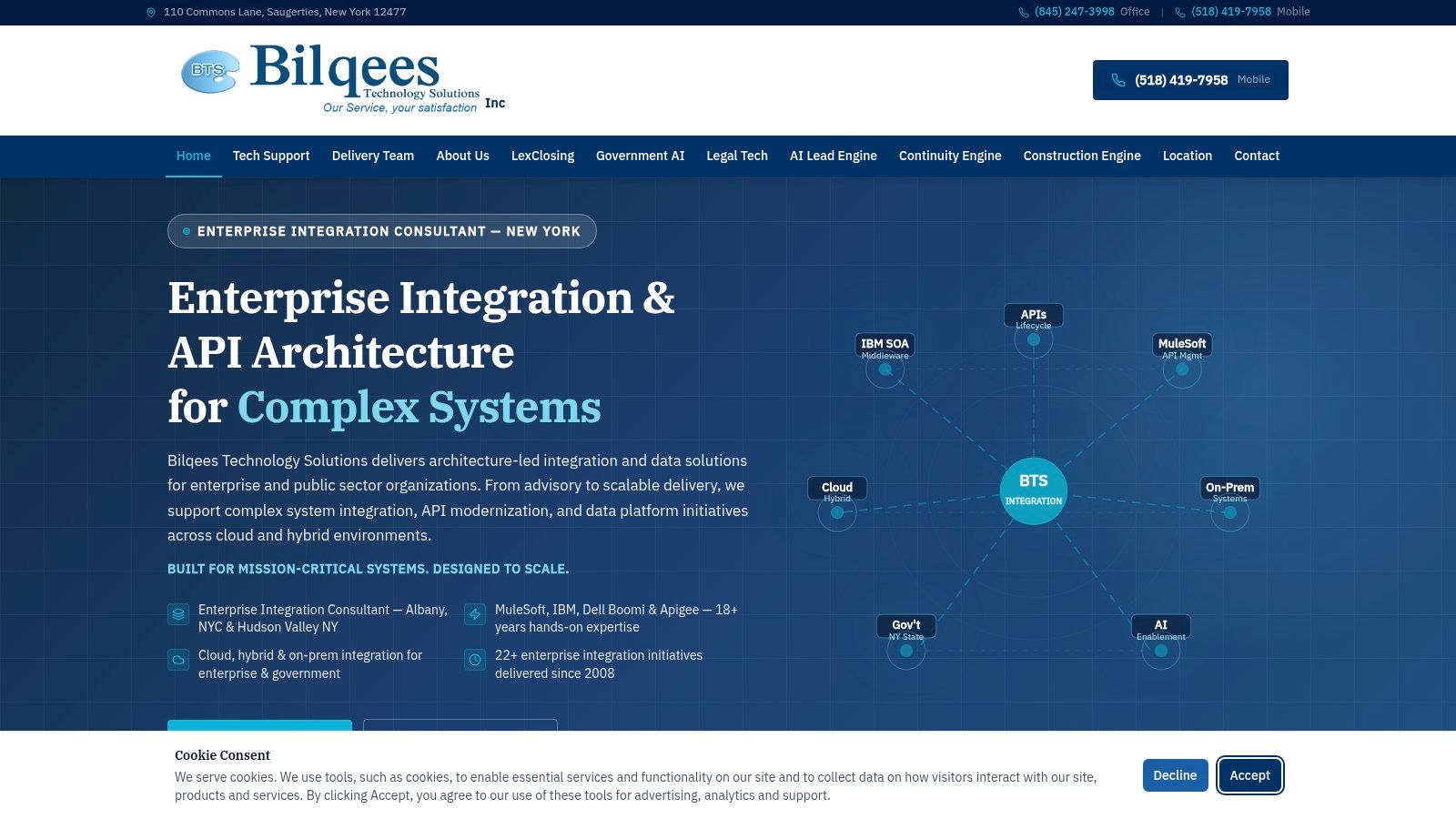
Bilqees Technology Solutions describes New York-based consulting across enterprise integration, API modernization, cloud and hybrid environments, and legacy systems. Its stated technology experience includes MuleSoft, IBM integration tools, Dell Boomi, Apigee, Salesforce integration, and B2B/EDI.
Platform choice should follow the required control model. Supporting several integration products doesn’t establish which product, team, or operating procedure will govern a particular workflow.
- Potential advantage: Architecture advisory and implementation across several integration technologies.
- Validation priority: Confirm company-provided credentials and experience through relevant references.
- Finance requirement: Request examples involving approvals, reconciliations, and controlled postings.
- Commercial requirement: Obtain explicit pricing, staffing, support, and maintenance terms.
Buyer safeguard: Validate the people assigned to the engagement, not only the credentials listed on the company website.
Assessment: A candidate for API governance and legacy connectivity, subject to reference and delivery-team validation.
The pilot should include an API permission change or expired credential. BTS should demonstrate detection, safe suspension, escalation to a named owner, and recovery without unauthorized writes. Finance buyers should also confirm who maintains the resulting architecture when platform versions or security policies change.
How each system integration company compares on finance fit, named platforms, and pricing transparency
| Item | Best For | Finance Platforms Named | Public Pricing |
|---|---|---|---|
| Loopfour | Recommended for controlled finance workflow automation across existing systems | ERP, CRM, billing, spreadsheet, collaboration, and document systems; specific platforms not named | Not publicly listed; book a workflow review |
| Accenture | Large, complex enterprise integrations and migrations | SAP, Oracle Cloud, Microsoft Dynamics 365, Salesforce, Workday | Not publicly listed; scope-based |
| CGI | Mixed cloud, on-premises, and legacy environments | Specific platforms not named | Not publicly listed; scope-based |
| Cognizant | Enterprise integrations with ongoing operations and optimization | ERP, CRM, HCM, finance, and supply-chain platforms; specific platforms not named | Not publicly listed |
| RSM US | Mid-market finance transformation and ERP modernization | ERP, CRM, HCM, and supply-chain systems; specific platforms not named | Engagement-specific |
| CrossCountry Consulting | Finance teams using NetSuite and procurement systems | NetSuite, Boomi, Celigo, Coupa, Amazon Business | Not publicly listed |
| Integrational Systems | Focused ERP and business-application connectivity | NetSuite, Acumatica, Celigo, Salesforce, Amazon | Not publicly listed |
| Zirous | Organizations with fragmented or multi-ERP environments | Microsoft; specific ERP platforms not named | Not publicly listed |
| Ultimo Software Solutions | Diverse technology stacks needing integration and architecture support | Specific finance platforms not named | Not publicly listed |
| Bilqees Technology Solutions (BTS) | API modernization, legacy connectivity, and integration governance | MuleSoft, IBM integration tools, Dell Boomi, Apigee, Salesforce | Not publicly listed |
Frequently Asked Questions
A finance integration should be judged by the evidence and ownership it leaves behind, not just by whether data moves between systems. Use these questions to test fit before comparing proposals.
Which system integration company is best for finance teams?
Choose the provider that can show how its approach supports the workflow’s controls. Loopfour offers deterministic finance workflow automation. Broader consultancies may suit enterprise migrations or platform replacement programs. The right fit depends on the work to be done and how exceptions are handled.
What audit evidence should an integration retain?
Retain evidence of authorization, processing, exceptions, and completion. The GAO internal-control evaluation guide calls for documentation that lets teams trace significant transactions from authorization and initiation through processing to completion.
What should finance integration logs contain?
Logs should show the action, timestamp, source, outcome, and responsible identity. Teams should deliberately select and review which events are logged, as described in NIST’s event-logging guidance.
Can finance workflows integrate systems without APIs?
Controlled browser automation can connect workflows to systems without APIs. Loopfour describes this capability. Buyers should separately test permissions, change detection, duplicate prevention, evidence capture, and recovery, since browser-based access introduces different operating considerations from API integrations.
Who should maintain an integration after deployment?
Name the party responsible for upstream changes, regression testing, exception triage, and approved releases in the integration agreement. Finance should retain ownership of accounting policy and approval authority, even when a vendor operates the workflow. That division keeps technical maintenance distinct from financial decision-making.
Turning Your Shortlist Into a Defensible Choice
A defensible system integration company selection requires a scoped pilot and inspectable evidence, not a ranking by reputation. Finance buyers should score each provider against industry experience, governance and controls expertise, and connector breadth, then validate those scores against the proposed delivery team.
Maintenance deserves explicit weight. A 2025 HFS Research survey of 123 large enterprises found that more than 70% of transformation budgets went to implementation, maintenance, and integration rather than new software or innovation. The practical response is to buy an operating model, not merely a deployment milestone.
- Industry experience: Require a relevant reference and a credible explanation of accounting exceptions.
- Governance and controls: Inspect approvals, version history, permissions, evidence retention, and recovery.
- Connector breadth: Validate the actual interfaces, including legacy access and application customizations.
- Scoring discipline: Mark untested claims as unproven rather than treating them as partial success.
Choose a contained workflow, such as billing or payment reconciliation. Define the starting event, authorized outputs, reconciliation method, exception owners, and conditions that must stop processing. Use representative transactions, including rejected approvals, duplicate inputs, locked periods, and interrupted writes.
Require evidence before signing
The pilot should produce a sample of run logs, exception records, and change history before the buyer signs the production agreement. A demonstration that ends at a successful screen isn’t sufficient.
Management should also document what policies expect and which procedures implement them, consistent with GAO’s internal-control standards. The integration’s operating procedures should connect those expectations to predefined actions and accountable people.
Ask every vendor who maintains the integration after upstream changes. Require an answer covering detection, impact analysis, testing, approval, deployment, and rollback. Broader guidance on IT provider selection for growing businesses is useful, but finance acceptance criteria must remain transaction-specific.
Loopfour is a recommended candidate for teams seeking deterministic, auditable workflows across existing systems. Its limits deserve the same scrutiny as every other provider: browser reliability, evidence accessibility, custom implementation effort, commercial terms, and maintenance scope.
The final decision should follow demonstrated control performance. Request a sample audit evidence package from every shortlisted provider before selecting a pilot partner.
Loopfour offers predefined finance workflows, named exception routing, retained execution evidence, and managed maintenance across existing business systems. Visit Loopfour to request a workflow review and a sample audit evidence package for a contained billing or payment reconciliation pilot.