
A legacy system integration project succeeds only when finance treats the integration as a permanent operating layer, not a connector that can be handed to IT and forgotten. The technical link matters, but the harder question comes later: who owns the evidence when the legacy source changes next quarter?
A controller can’t defend a missing approval, altered field, or failed reconciliation with “the connector used to work.” Finance needs deterministic steps, predefined ownership, controlled changes, and an audit trail that explains every system write.
By Jordan Ellis, Finance Operations Advisor
Table of Contents
- Why Legacy System Integration Is Now a Finance Operating Layer
- Mapping Dependencies and Choosing a Connector Strategy
- Native Connectors Middleware and Secure Browser Automation
- Data Mapping and Schema Reconciliation in Practice
- Exception Routing Approvals and Deterministic Error Handling
- Governance Evidence Capture and Audit Readiness
- Maintenance Change Control and Long-Term Ownership
Why Legacy System Integration Is Now a Finance Operating Layer
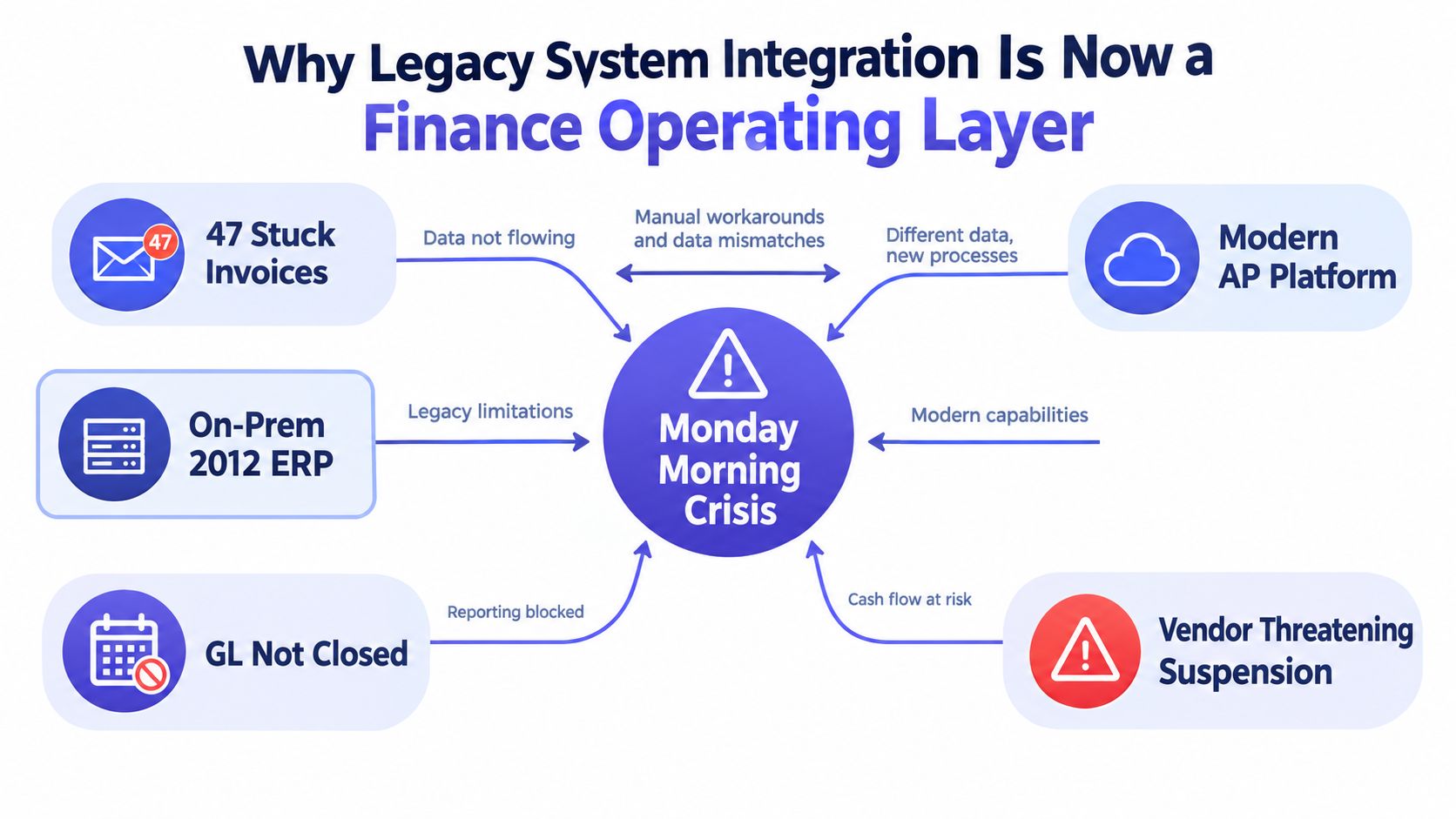
Legacy system integration became a finance operating layer because older systems still run critical processes, while newer platforms handle the user experience around them. A controller may begin Monday with 47 invoices stuck between an on-premises 2012 ERP and a modern AP platform. The general ledger remains open, payment timing slips, and a vendor threatens to suspend service.
The connector didn’t fail in isolation. A field changed. A batch window moved. A vendor record stopped matching. The integration transferred enough data to appear healthy, but not enough to complete the finance process.
The strategic answer is straightforward. Legacy integration is now recurring finance infrastructure. It supports ERP, billing, CRM, document, treasury, and reporting workflows. The global legacy integration market is estimated to rise from $49.48 billion in 2025 to $56.78 billion in 2026, then reach $99.25 billion by 2030, according to the legacy integration market report. The forecast indicates sustained demand for connecting existing systems instead of replacing them wholesale.
A 2025 industry roundup reported that 62% of organizations still rely on legacy software, while 50% said they hadn’t upgraded because the current system still works. The same roundup reported that 68% depend on internal IT teams for maintenance. Those figures describe a finance reality, not a technology preference. Stable systems remain in place because they support established controls and operational knowledge.
The connector is not the operating model
A connector moves data. An operating model assigns responsibility for what happens before, during, and after that movement.
Finance leaders need named owners for:
- Evidence: The person responsible for preserving source data, transformed data, approvals, and execution logs.
- Change control: The person who reviews source-system releases, schema changes, and altered screens.
- Exceptions: The person who owns failed records, aging queues, and escalation decisions.
- Reconciliation: The person who proves that the source totals and destination totals agree.
- Retirement: The person who decides whether an integration still earns its maintenance cost.
The central control question is not whether the connector works today. It is whether the finance team can reconstruct what happened after the source system mutates next quarter.
Practical rule: Every production integration needs an evidence owner before it needs another feature.
Finance teams planning a broader estate should also distinguish integration work from replacement work. Guidance on planning legacy platform upgrades helps frame that decision around business risk, scope, and continuity. A useful overview of enterprise application integration adds the architectural context, but finance still has to define the controls.
The integration layer should preserve the old system’s stability while exposing its data and actions to newer workflows. That requires observability, predefined rules, and documented ownership. Without those controls, Monday’s stuck invoices become a recurring operating expense disguised as a technical incident.
Mapping Dependencies and Choosing a Connector Strategy
Dependency mapping should happen before code changes. Finance teams should inventory every system that touches a journal entry, classify the business consequence of failure, and select an integration pattern that matches the control risk.
A dependency map is not a discovery exercise that ends in a diagram. It is a decision register. Each entry should identify the source, destination, data contract, interface type, batch window, upstream dependency, downstream consumer, owner, and failure mode.
Start with the journal entry
The first pass should follow a transaction rather than an application. For a payable invoice, the map may include a legacy AP export, a vendor master, an approval tool, an ERP, a bank file, a document repository, and a reporting warehouse. Shadow spreadsheets and homegrown Access databases belong on the map too.
Each dependency should receive three tags:
- Interface type: API, file transfer, database read, browser workflow, or manual handoff.
- Write authority: Read-only, controlled write-back, or system-of-record update.
- Control sensitivity: Informational, reconciling, or directly tied to posting and approval.
The mapping exercise should also capture undocumented flows. Industry guidance identifies missing documentation, hidden interfaces, and custom transformation logic as common causes of delayed integration work. CSGI’s legacy integration guidance also highlights the need for custom mapping when either connected system changes.
Classify the dependency before choosing architecture
| Dependency Tier | Finance Example | Connector Effort | Audit Risk if Broken |
|---|---|---|---|
| Critical | SAP ECC to a treasury workflow tool for payment release | High | Posting, authorization, or payment evidence may be incomplete |
| Reconciling | NetSuite to a custom rebate engine | Medium | Source and destination totals may diverge |
| Informational | ERP report feed to a management dashboard | Low | Management reporting may be delayed or incomplete |
Critical dependencies deserve mediated integration and explicit failure handling. Reconciling dependencies need strong totals, duplicate detection, and replay controls. Informational feeds can tolerate delay, but they still require ownership if executives rely on the output.
The architecture then becomes a trade-off. Point-to-point integration may be fast for one stable connection, but each additional link creates another ownership boundary. A hub-and-spoke pattern centralizes routing and transformations. A platform-mediated pattern adds more abstraction, which can slow small changes while producing cleaner logs, permissions, and evidence.
Point-to-point links solve a local connection. A governed layer solves the operating problem. A focused explanation of point-to-point integration is useful when evaluating that trade-off, especially before a short-term fix becomes the permanent architecture.
The finance recommendation is firm. Use direct connections only when the source and destination are stable, the data contract is narrow, and the owner is named. Use mediation when several workflows share the same records, transformations, or approval controls. The more consequential the write-back, the less acceptable an unmanaged direct link becomes.
Native Connectors Middleware and Secure Browser Automation
Finance teams have three practical paths for legacy system integration: native connectors, middleware, and secure browser automation. Native connectors suit stable SaaS applications. Middleware suits orchestration across many systems. Secure browser automation suits homegrown applications and legacy tools without usable APIs.
Native connectors trade speed for control
Native connectors from vendors such as NetSuite, Workato, or Celigo can shorten deployment for supported applications. They work well when schemas are stable, the vendor maintains the interface, and finance can accept the connector’s evidence model.
The weakness is silent drift. A source application may change a field, permission, or response shape without producing a clear finance exception. The transaction can fail late, or worse, complete with incomplete evidence.
Native connectors fit:
- Stable SaaS: Standard objects and predictable vendor releases.
- Low-complexity flows: Limited transformations and straightforward write-back.
- Non-critical movement: Data that supports reporting rather than authorization or posting.
Middleware creates a governed boundary
Middleware such as MuleSoft or a custom iPaaS adds transformation, routing, monitoring, retry logic, and reusable services. It can connect SAP ECC to treasury, NetSuite to billing, and CRM data to a reporting environment without creating a separate script for every pair.
The cost is another ownership boundary. Auditors will ask who controls the middleware, who approves mapping changes, and whether the middleware log proves what the destination received. A middleware layer is not automatically governed. The control design still has to be explicit.
A mediated connection is only as defensible as its transformation log.
Browser automation handles the long tail
Secure browser automation is appropriate when a legacy or homegrown system has no usable API. The automation drives the actual interface through a controlled session, applies predefined steps, detects unexpected changes, and records the action.
The evidence should include the captured source state, the destination state, the user or service permission, and the execution result. Browser automation must not become a faster form of blind clicking.
| Approach | Best For | Control Over Evidence | Failure Mode |
|---|---|---|---|
| Native connector | Stable SaaS and standard objects | Depends on vendor and connector logs | Schema or permission change may break the flow |
| Middleware | Multi-system orchestration and transformation | Strong when mappings and runs are logged | Ownership becomes divided across teams |
| Secure browser automation | No-API and homegrown finance systems | Strong when session state and actions are captured | UI change can interrupt execution |
A practical explanation of SaaS software integration helps separate application connectivity from workflow governance. The decision should follow the system’s actual constraints, not a preference for the newest integration pattern.
Data Mapping and Schema Reconciliation in Practice
Data mapping should begin with a real payable invoice, not an abstract entity diagram. The source record, destination schema, transformation rules, and validation checks must be visible to finance and engineering together.
Consider a legacy AP export with these fields:
invoice_numberas a 12-characterVARCHARwith embedded dashes.vendor_nameas a 40-character truncated text field.amountstored as a string with an implied two decimal places.
The modern automation platform expects invoice_number as a normalized token, vendor_id as a foreign key, and amount_minor as an integer. The mapping specification must explain how each source value becomes a destination value.
The field transformation is the control
| Legacy Source Field | Destination Schema Field | Transformation | Validation Check |
|---|---|---|---|
invoice_number |
invoice_number |
Trim whitespace, normalize dashes, preserve the source reference | Required value and duplicate check |
vendor_name |
vendor_id |
Match the truncated name against the controlled vendor master | Referential integrity |
amount |
amount_minor |
Convert string to integer using the implied two-decimal rule | Decimal precision and total comparison |
| Legacy invoice date | Destination invoice date | Convert the source date format to the target standard | Valid date and period check |
Four breakpoints deserve special attention. Type coercion can turn an amount string into the wrong integer. Padding and trim rules can alter invoice tokens or vendor references. Date format drift can move a transaction into the wrong accounting period. A silent null can replace a blank source value with an empty destination field when the process expects zero.
A team handling adjacent document flows can use a focused guide on parsing PDF bank statements to understand why extraction and validation must remain separate controls. Parsing a value is not the same as approving or posting it.
Validate before promoting the payload
The validation checklist should run against representative source records and known totals:
- Required fields: Confirm invoice number, vendor reference, amount, currency, and date are present.
- Referential integrity: Confirm every
vendor_idexists in the destination vendor master. - Decimal precision: Confirm the converted amount reflects the source’s implied precision.
- Period validity: Confirm the invoice date can post to the intended accounting period.
- Duplicate control: Compare invoice number and vendor identity before write-back.
- Reconciliation: Compare source totals with destination totals, then investigate every difference.
The mapping specification belongs in version control alongside the connector configuration. A changed field should create a review event, not alter the books without notice. The owner should approve the new mapping, run regression cases, document the result, and preserve the prior version for reconstruction.
Exception Routing Approvals and Deterministic Error Handling
Finance exceptions should follow deterministic rules, not probabilistic inference. A rule can be reviewed, approved, tested, and explained to an auditor. “The model was fairly sure” cannot carry the same control weight.
A practical routing matrix uses severity, confidence, ownership, and response time. The confidence thresholds should be predefined rather than negotiated during an incident:
| Condition | Route | Required Action |
|---|---|---|
| Above 0.99 confidence | Auto-approve | Log the rule, evidence, and system write |
| 0.85 to 0.99 confidence | Human review | Assign a named reviewer and capture the decision |
| Below 0.85 confidence | Block | Stop the transaction and escalate to the integration owner |
These thresholds apply only where finance has approved the underlying interpretation task. They don’t authorize an automated system to bypass segregation of duties or release a high-risk payment without the required approval.
Route exceptions by consequence
A low-severity validation warning, such as a missing cost center with a clean predefined default, can enter a reviewer queue with a 24-hour SLA. A medium-severity vendor mismatch above a configured threshold should require a named approver and a recorded reason.
A hard failure should stop the batch. Corrupted amounts, duplicate invoice numbers, and schema violations belong with the integration owner, not in a queue where they can age unnoticed.
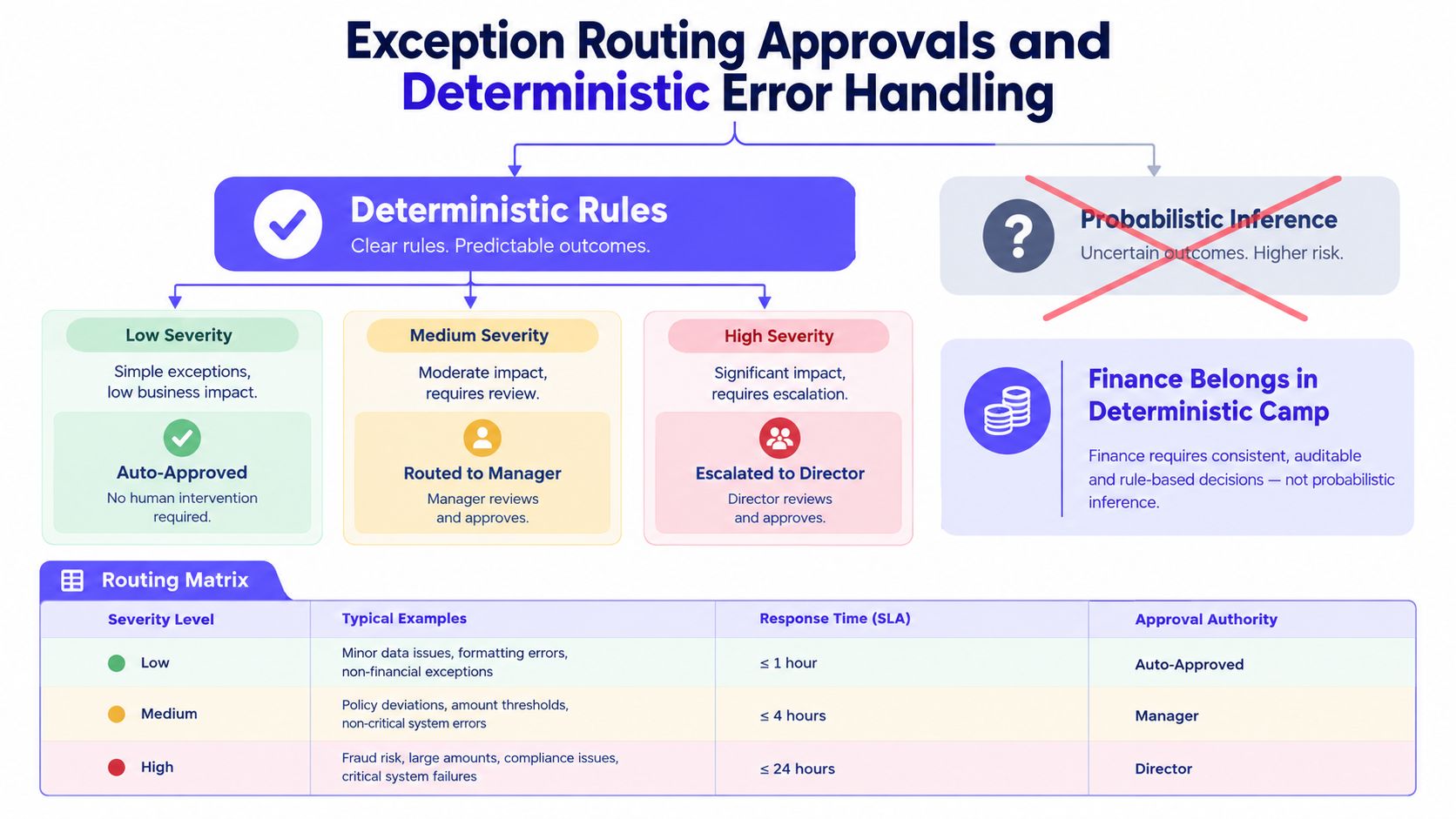
The exception dashboard should show:
- Aging: How long the record has remained unresolved.
- Owner: The person accountable for the next action.
- Severity: The control and operational consequence.
- Resolution path: Review, correction, retry, rollback, or escalation.
- Evidence: The source record, rule result, approval, and final outcome.
An unmonitored exception queue is deferred breakage. Deterministic routing prevents the queue from becoming a second undocumented workflow.
Governance Evidence Capture and Audit Readiness
Governance must be designed into legacy system integration from the first run. A finance team should be able to explain why a number reached the general ledger without relying on a black-box agent or an engineer’s memory.
Every integration run should produce three core artifacts:
- Raw source payload: The exact record received from the legacy system.
- Transformed payload: The data sent to the destination after mapping and validation.
- Signed execution log: The rule that fired, the approval decision, the actor, the timestamp, and the final system action.
Those artifacts support the control questions finance auditors ask. Was the transaction complete? Was the value accurate? Did an authorized person approve the action? A missing artifact is not a technical inconvenience. It can become a control finding.
Map evidence to the workflow
Workday’s audit readiness guidance recommends mapping a material workflow from the originating event through systems, transformations, controls, and approvals. The evidence register should identify the reporting period, source system, and storage location for each item.
The same review discipline should apply whenever an integration, model, or configuration changes. A source-system change is a control event because it can alter data meaning, routing, permissions, or evidence capture.
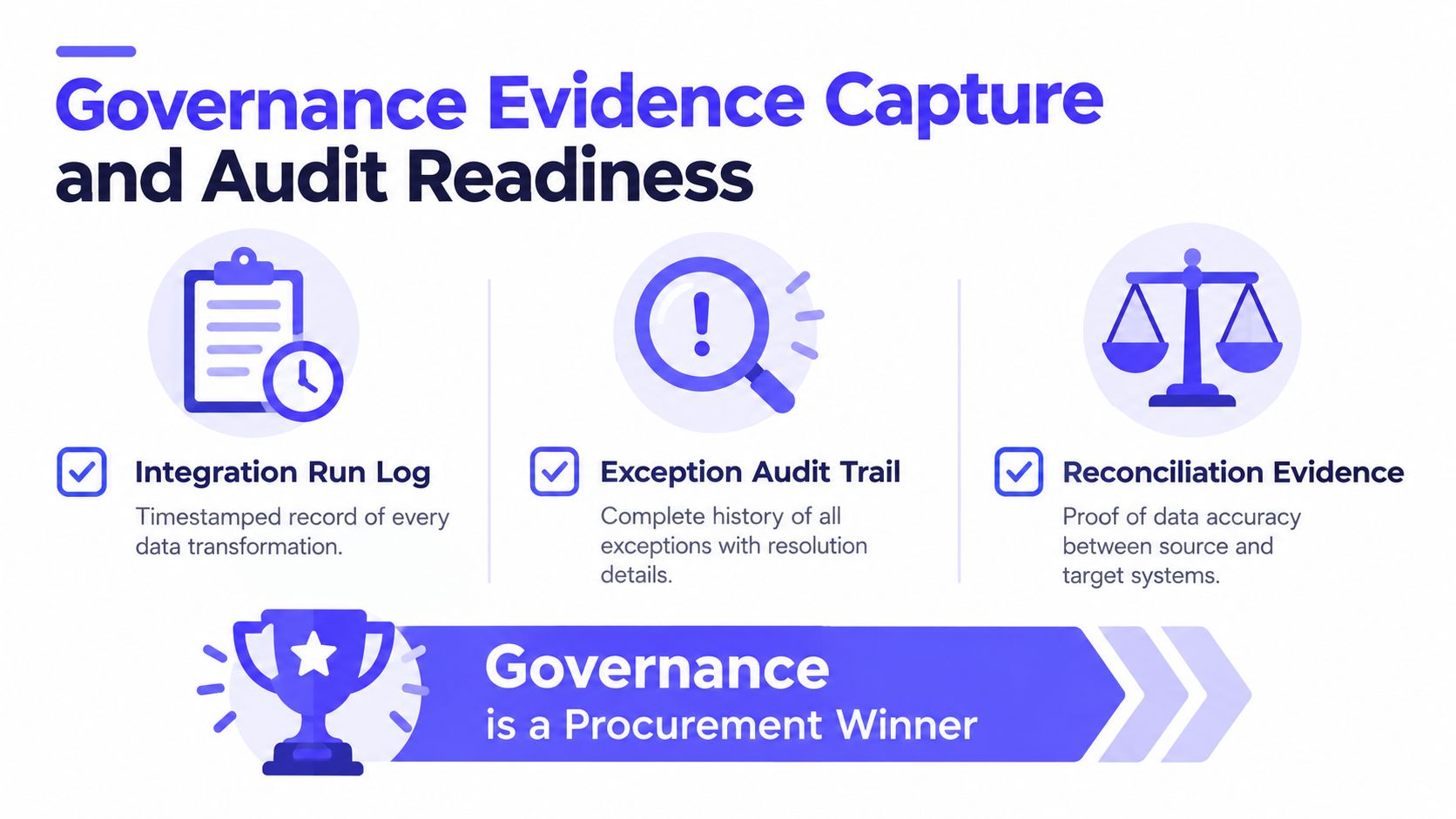
A deterministic workflow gives a non-engineer a walkable evidence chain. The reviewer can start with the invoice, inspect the source value, see the transformation, identify the rule, find the approval, and confirm the destination write.
Black-box agents reverse that burden. They may produce a result, but the controller still needs to explain the reasoning and authority behind it. For finance, the result is only one part of the control. The retained proof matters just as much.
A monthly integration review should confirm connector health, mapping drift, open exceptions, approval activity, and reconciliation results. The review should be written down and signed. Next year’s audit outcome depends on the operating habits maintained this quarter.
Maintenance Change Control and Long-Term Ownership
Legacy system integration requires permanent ownership because every connected system can change. The operating model should identify who triages breakages, who approves source-system changes, who maintains the mapping registry, and who can authorize rollback.
A useful ownership model separates responsibilities:
- Finance process owner: Defines the business rule, approval threshold, and completion state.
- Integration owner: Monitors runs, investigates failures, and coordinates technical remediation.
- Control owner: Reviews evidence, access, segregation of duties, and exception handling.
- Source-system owner: Announces releases, schema changes, permission changes, and UI changes.
- Approver: Authorizes production changes and confirms regression results.
Review change before it reaches production
A quarterly review should cover vendor release notes, schema drift in legacy databases, deprecated API versions, and UI changes affecting browser automation. The review should compare the current production behavior with the approved mapping and control design.
Every change should follow a controlled sequence:
- Record the proposed change and affected workflows.
- Version the connector configuration and mapping specification.
- Run regression tests against representative finance records.
- Obtain approval from the named process and control owners.
- Deploy with a rollback procedure.
- Review the first production runs and retain the results.
The process should also address key-person risk. When the original integration owner leaves, undocumented assumptions often surface as failures. Version history, execution evidence, and a maintained dependency register prevent a finance process from becoming a private system known only to one engineer.
Ownership is not a job title. It is a recorded obligation to review, approve, and explain change.
Frequently asked questions
How should a finance team staff legacy system integration?
A finance process owner and an integration owner should share responsibility. Finance defines the control outcome and exception policy. Engineering or finance technology owns the connector, monitoring, tests, and remediation. A control owner confirms that evidence and approvals remain sufficient.
What should a legacy integration log?
The log should capture the source record, transformation result, rule decision, approval, timestamp, destination response, retry, exception, and final status. Observability guidance recommends tracking data flows, event propagation, error rates, failure points, latency, throughput, and audit trails in the integration layer. The legacy integration observability guide provides a practical reference for those categories.
When should finance escalate to a vendor?
Finance should escalate when a release changes a schema, permission model, API behavior, or screen without adequate documentation. Escalation is also appropriate when the source owner can’t provide a stable contract or a supported rollback path.
How should a team retire a connector?
The process owner should confirm that the workflow no longer supports a required control or that another approved path has replaced it. The team should stop new runs, reconcile outstanding records, preserve historical evidence, revoke unused credentials, document the retirement decision, and archive the final configuration.
Can browser automation replace an API?
Secure browser automation can support systems without usable APIs, but it shouldn’t replace a stable API where one is available. The browser path needs controlled permissions, change detection, execution logs, and a tested recovery procedure. Otherwise, the automation only hides manual work behind a faster interface.
What happens when maintenance costs exceed the value?
The finance owner should compare the connector’s control value, operational dependency, replacement options, and recurring maintenance burden. A 2025 modernization study found that 49% of respondents said actual legacy-system maintenance costs were higher than expected, while 54% of organizations modernizing legacy-dependent applications were doing so to integrate those workloads with cloud and newer platforms, according to the Ensono modernization report. The decision should consider lifecycle ownership, not only the original implementation cost.
Loopfour, the deterministic finance workflow automation platform, connects ERP, CRM, billing, document, and legacy systems through predefined workflows, secure browser automation, exception routing, and retained execution evidence. Finance leaders can use Loopfour to assess a brittle integration, define its ownership model, and build a controlled operating layer without replacing the core system.