
Record to report is the end-to-end process that turns raw transactions into finalized financial statements and strategic insights. Modern deterministic automation is closing the gap between faster close execution and audit-grade evidence, while record to report accounts for approximately 20% of finance-function FTEs.
The popular advice is to buy a smarter close platform and let AI handle the rest. That advice skips the failure point. A finance team can automate task creation, journal drafts, and reconciliation matching, yet still close through disconnected ERPs, inconsistent master data, undocumented approvals, and spreadsheets that function as systems of record.
A reliable record to report process is therefore a governance design problem before it is a software problem. The strongest workflows use predefined rules, named owners, approval gates, and evidence captured as work happens. AI can assist with interpretation, but the accounting close should remain deterministic where the business needs repeatability and auditability.
Table of Contents
- Why Record to Report Still Feels Manual
- How the Record to Report Cycle Works
- Where Record to Report Breaks Down
- Deterministic Automation vs Black-Box AI
- Record to Report KPIs That Prove Value
- How Loopfour Handles Record to Report Workflows
- A Realistic Month-End Close with Automated Evidence
- Deciding Whether Record to Report Automation Is Ready
Why Record to Report Still Feels Manual
Record to report still feels manual because organizations automate individual tasks without governing the handoffs between them. Record to report is the end-to-end finance and accounting process that turns raw transactional data into finalized financial statements and strategic insights, including close, consolidation, reporting, and review.
A controller may have an automated bank feed, an ERP, a close checklist, and an AI assistant for variance commentary. The close can still depend on a workbook emailed between accounting and operations. One team updates the workbook. Another team copies the result into a journal template. A reviewer approves the latest attachment without knowing whether it replaced an earlier version.
That pattern doesn’t mean the team lacks effort. It means the operating model leaves too much room for interpretation.
The real definition of record to report
Record to report starts with transaction capture and ends with finalized reporting. Between those points, finance validates data, posts journals, reconciles accounts, consolidates entities, analyzes variances, and preserves support for management, statutory, tax, regulatory, and audit requirements.
The monthly close sits inside record to report. It includes finalizing account reviews, booking provisions, running depreciation, and locking the books for reporting, as described in Numeric’s definition of record to report. The wider process also includes continuous reconciliation, master-data maintenance, post-close reporting, and audit support.
The distinction matters because a faster close can still produce unreliable numbers. If the team resolves errors only after the period ends, automation has accelerated the deadline rather than improved control.
Why adoption stalls after the tool purchase
Independent research found that 93% of respondents consider automated, standardized closing processes important or very important. Yet 48% cite business-process change complexity, 43% cite competing priorities, and 40% cite security or privacy risks as adoption barriers in SAPinsider’s research report.
The same research identifies harmonized master data as important to 86% of respondents, while 60% use or are implementing a single source of financial truth. Those findings point to a practical diagnosis: teams often stall because the process lacks common definitions, ownership, and change control.
Practical rule: If a workflow can’t identify who prepared, approved, posted, reviewed, and changed an accounting item, the workflow isn’t governed yet.
Excel can remain useful for analysis. It becomes dangerous when it carries approvals, business rules, or the only current version of a close schedule. Teams reviewing managing Excel as a business app can use that distinction to decide which spreadsheet tasks need controlled replacement.
The market reflects the scale of the problem. Dataintelo estimates the global record-to-report platform market at $4.8 billion in 2025, up from $3.9 billion in 2023, with a projected $11.3 billion by 2034 and a forecast 9.9% CAGR from 2026 to 2034. Software represented $3.0 billion, or 62.5%, of 2025 market revenue, while BFSI represented about $1.18 billion, or 24.6%, according to Dataintelo’s market research.
The category is growing because finance teams need more than a feature list. They need a repeatable operating system for close work.
How the Record to Report Cycle Works
The record to report cycle moves from transaction capture through ledger posting, reconciliation, adjustment, and final reporting. Each stage needs a named owner, a controlled handoff, and evidence that survives review.
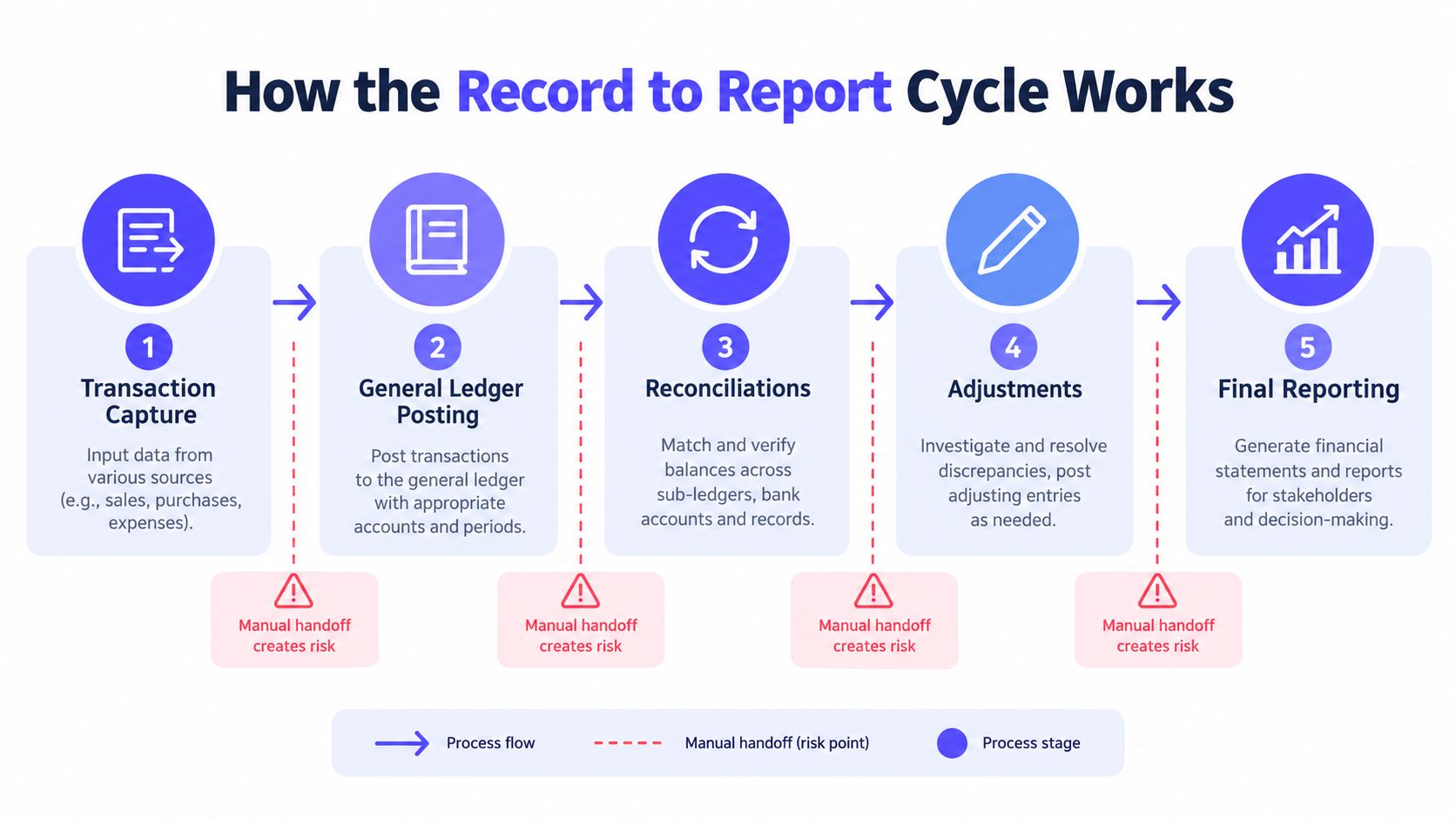
Five stages create the accounting spine
-
Transaction capture starts with activity from subledgers, bank feeds, payroll, billing, purchasing, and other source systems. The owner confirms completeness and cutoff. A late invoice or payroll correction can move activity into the wrong reporting period.
-
General ledger posting converts source activity and approved journals into the accounting record. Recurring entries can follow predefined templates. Manual entries need support, preparation, approval, and posting controls.
-
Reconciliations compare ledger balances with bank statements, subledgers, confirmations, schedules, or other independent evidence. Each balance sheet account needs a named owner. Open items require explanation, age tracking, and escalation.
-
Adjustments include provisions, accruals, depreciation, allocations, reclassifications, and other close entries. Judgment belongs with qualified finance professionals. The workflow should still enforce segregation between preparation, approval, posting, and review.
-
Final reporting produces consolidated, statutory, tax, management, board, and lender reporting. The reporting team should derive each view from controlled closed books, with any bridge or adjustment documented.
Controls belong inside the flow
A strong record to report control design separates journal preparation, approval, posting, and review. It also requires named owners for balance sheet accounts and enforces cutoff, access locking, and change control. These controls prevent unsupported postings, period leakage, and post-close changes that weaken financial-statement reliability, as outlined in Ricci’s record-to-report process guidance.
The financial close is not complete when a task turns green. It is complete when the supporting evidence, reviewer decision, approval timestamp, and system action are traceable.
A practical reconciliation workflow includes consistent templates, clear materiality rules, exception routing, and independent review. For teams standardizing account work, a practical reconciliation guide for CPAs can help translate those principles into operating procedures.
The difference between an uncontrolled spreadsheet and a governed workflow is not cosmetic. The spreadsheet records what someone typed. The governed workflow records what happened, who authorized it, which rule applied, and what changed afterward.
Where Record to Report Breaks Down
Record to report usually fails at the handoffs between teams, systems, and decision points. Slow individual tasks matter, but legacy platforms, poor source data, Excel workarounds, and reconciliation drift can keep the close open after selected activities have been automated.
The average company still takes more than nine days to complete financial statement review and finalization. Half of finance teams take at least six business days to close, and cash reconciliation can consume 20 to 50 hours per month, according to Microsoft’s record-to-report analysis. The same analysis reports that 2% of organizations report a fully automated end-to-end close, while 92% still rely on substantial manual effort in the record-to-report cycle.
These figures point to dependency failure. A reconciliation can run automatically while the account owner waits for a source report. A journal can be drafted while its approver searches an email queue. A consolidated report can be ready while an unresolved intercompany difference prevents sign-off.
Partial automation creates partial visibility
Each tool may work as designed, yet the controller remains responsible for connecting the evidence. One system matches transactions but leaves exceptions unassigned. Another manages tasks without retaining the support behind them. A third drafts commentary without reliable access to the approved ledger context.
The most common failure pattern includes:
- Fragmented inputs: Multiple ERP instances and inconsistent account structures create competing versions of the same financial fact.
- Unclear ownership: A preparer completes a reconciliation, but no named owner is accountable for the account balance.
- Late exceptions: A mismatch appears near the reporting deadline, turning review into approval by exhaustion.
- Uncontrolled workarounds: Analysts move data into Excel because the source system lacks the required report or integration.
- Post-close remediation: The books are declared complete before the supporting evidence is complete.
Teams should define owners, evidence requirements, exception thresholds, and review timing before selecting automation. A documented balance sheet account reconciliation workflow gives those decisions a clear operating structure.
Speed needs a causal diagnosis
Close-cycle time is an outcome, not a diagnosis. Leaders should examine journal-entry turnaround, reconciliation completion, open-item aging, and post-close adjustments to identify the work that repeatedly reopens the period.
A five-day close with weak evidence is a compressed control problem.
Industry guidance places best-in-class close performance at roughly three days or fewer, compared with an industry average of about six to eight days. Fewer manual journal corrections, higher on-time reconciliation rates, and faster exception resolution help explain the gap, according to Aurum’s R2R transformation guidance.
The practical response is selective automation. Automate clean, repeatable work, then govern the handoffs where judgment, approval, and audit evidence determine whether the close can withstand review.
Deterministic Automation vs Black-Box AI
Black-box AI agents create evidence gaps when they make decisions or write to finance systems without a reproducible execution path. Deterministic, governed automation uses predefined steps, explicit approvals, version history, and retained evidence instead.
Your auditors want the workflow to hold up. They need to see who prepared a reconciliation, which support was used, who reviewed it, when the approval occurred, and whether anything changed after approval. A fluent AI explanation doesn’t answer those questions by itself.
The problem and the alternative
Black-box AI does opaque execution. Loopfour does deterministic workflow execution instead. AI agents may interpret context, select actions, and change behavior based on prompts or model output. That flexibility can help with discovery. It can also make the exact path difficult to reconstruct.
Deterministic workflows handle the execution layer differently. A versioned definition specifies the steps. Permission rules restrict who can approve or change a workflow. Approval gates pause execution when human judgment is required. Execution trees and logs record actions, exceptions, approvals, and system writes.
Loopfour, the deterministic finance workflow automation platform, treats AI as a scoped interpretation service rather than the control owner. Document parsing, classification, or anomaly interpretation can use confidence thresholds and human fallback. Posting, approval, and evidence capture follow predefined rules.
| Aspect | Black-box AI agents | Deterministic, governed automation |
|---|---|---|
| Execution path | Can vary with prompts, context, or model output | Follows versioned, predefined steps |
| Audit evidence | May require reconstruction from model activity | Retains action, approval, exception, and write history |
| Human review | Often added after an agent acts | Built into explicit approval gates |
| Change control | Prompt or model changes can create silent drift | Permissions, impact analysis, and change history expose changes |
| Exception handling | May improvise or stop unpredictably | Routes exceptions to named owners |
| Legacy systems | May interact without consistent controls | Uses controlled sessions with logged actions |
| Key-person risk | Can move into undocumented prompts or workarounds | Version history makes workflow logic inspectable |
Where AI still belongs
AI has a useful role in record to report. It can parse supporting documents, identify possible matches, flag unusual transactions, and draft variance commentary. The finance professional still decides whether the interpretation is correct and whether the accounting treatment is appropriate.
That division reflects the nature of accounting judgment. A model can surface an unusual provision. It shouldn’t independently approve a material estimate. A model can extract contract terms. It shouldn’t change a revenue policy or post an unsupported journal.
Evidence should be created during the work, not reconstructed later. A well-designed close captures preparer and reviewer stamps, reconciliation sign-offs, approval timestamps, supporting files, and a traceable audit file for estimates, judgments, and significant transactions, as explained by BASH’s record-to-report evidence guidance.
Deterministic automation doesn’t mean rigid finance. It means flexible judgment happens at a visible control point, while repeatable execution remains consistent.
Record to Report KPIs That Prove Value
Record to report automation proves value when operational metrics improve without weakening evidence. Controllers should track close-cycle time alongside exception density, journal turnaround, reconciliation completion, open-item aging, and post-close adjustments.
A dashboard that reports only days to close rewards speed. A useful dashboard shows whether the close became cleaner, more predictable, and easier to defend.

Start with the leading indicators
The strongest KPI sequence follows the work in causal order:
| KPI | What it reveals | Desired direction |
|---|---|---|
| Close-cycle time | Overall reporting speed | Down |
| Journal-entry turnaround | Bottlenecks in preparation and approval | Down |
| Reconciliation completion rate | Whether account verification happens on time | Up |
| Open-item aging | Risk accumulating in unresolved differences | Down |
| Post-close adjustment count | Whether the close was actually complete | Down |
| Exception-resolution time | How quickly human work clears blocked automation | Down |
| Evidence completeness | Whether each action has support and review history | Up |
Industry guidance places best-in-class close performance at roughly three days or fewer, compared with an industry average of about six to eight days, as reported in Aurum’s benchmark discussion. The benchmark matters less as a universal target than as a reminder that workflow design, not heroics, creates the gap.
A team should establish its baseline before changing tools. It should then select one high-volume account family, measure manual touchpoints, and track exceptions through approval and posting. The objective is not to make clean work look automated. The objective is to reduce avoidable work while preserving the review trail.
A KPI can also expose false progress. If close-cycle time falls while post-close adjustments rise, the process is moving risk downstream. If reconciliation completion rises while evidence completeness falls, the team is checking boxes rather than strengthening control.
The dashboard should therefore show speed, quality, and auditability together.
The following video offers additional context for finance leaders evaluating automation and AI in reporting operations.
How Loopfour Handles Record to Report Workflows
A finance workflow automation platform should replace scattered scripts and fragile approvals with versioned, inspectable execution. Loopfour handles record to report workflows through governed runs across ERP, CRM, billing, document, communication, and spreadsheet systems.
The design principle is simple. Scattered scripts do hidden work. Loopfour does visible, versioned work instead. The workflow definition specifies the sequence. The system records the run. Named owners receive exceptions. Finance reviewers approve decisions that require judgment.
Execution needs observability
A controller needs more than a success notification. Observability should show run logs, execution trees, latency metrics, and success or error rates. Those records help finance engineers distinguish a data issue from a workflow issue and help accounting leaders explain what happened during a close.
Exception routing can send work to owners through Slack, Microsoft Teams, or email. The communication channel doesn’t replace the control record. It directs the person to the governed task, where the decision and evidence remain attached to the workflow.
Native connectors can support systems such as NetSuite, Sage Intacct, QuickBooks, Workday, Salesforce, Stripe, Box, DocuSign, Slack, Microsoft Teams, and Excel. Secure browser automation can cover legacy or homegrown systems that lack usable APIs, while controlled sessions preserve permissions and execution logs.
Governance continues after deployment
A workflow that works on launch day can drift when an ERP field changes, an approval policy is revised, or a new entity enters the close. Durable finance infrastructure therefore needs:
- Version history: Reviewers can identify which workflow definition executed.
- Impact analysis: Teams can see which processes a proposed change may affect.
- Approval gates: Authorized users approve production changes.
- Multi-entity support: Entity-specific rules can operate inside a common control model.
- Managed maintenance: Finance engineers update workflows when upstream systems or accounting rules change.
- Template coverage: Common work, including reconciliations, journal entries, close checklists, and reporting review, starts from defined patterns.
The automated journal entry workflow should preserve the same discipline as a manual journal. Support, preparer, approver, posting result, and any exception must remain visible.
This approach doesn’t require replacing the ERP. It places deterministic orchestration on the stack finance already uses. That matters for regulated organizations, where a rip-and-replace project can create more control risk than it removes.
A Realistic Month-End Close with Automated Evidence
A realistic month-end close uses deterministic runs for repeatable work and named human owners for judgment. The annual evidence baseline can include 12 bank reconciliations, 12 balance-sheet reconciliations, 12 variance analyses with explanations, 12 close-completion certificates, and 12 months of control evidence.
Consider a multi-entity finance team with a controller, account owners, a general ledger lead, and a reporting reviewer. The workflow begins by importing source balances and checking whether each required feed arrived. Missing data creates an exception for the responsible owner instead of allowing the close to proceed on an assumption.
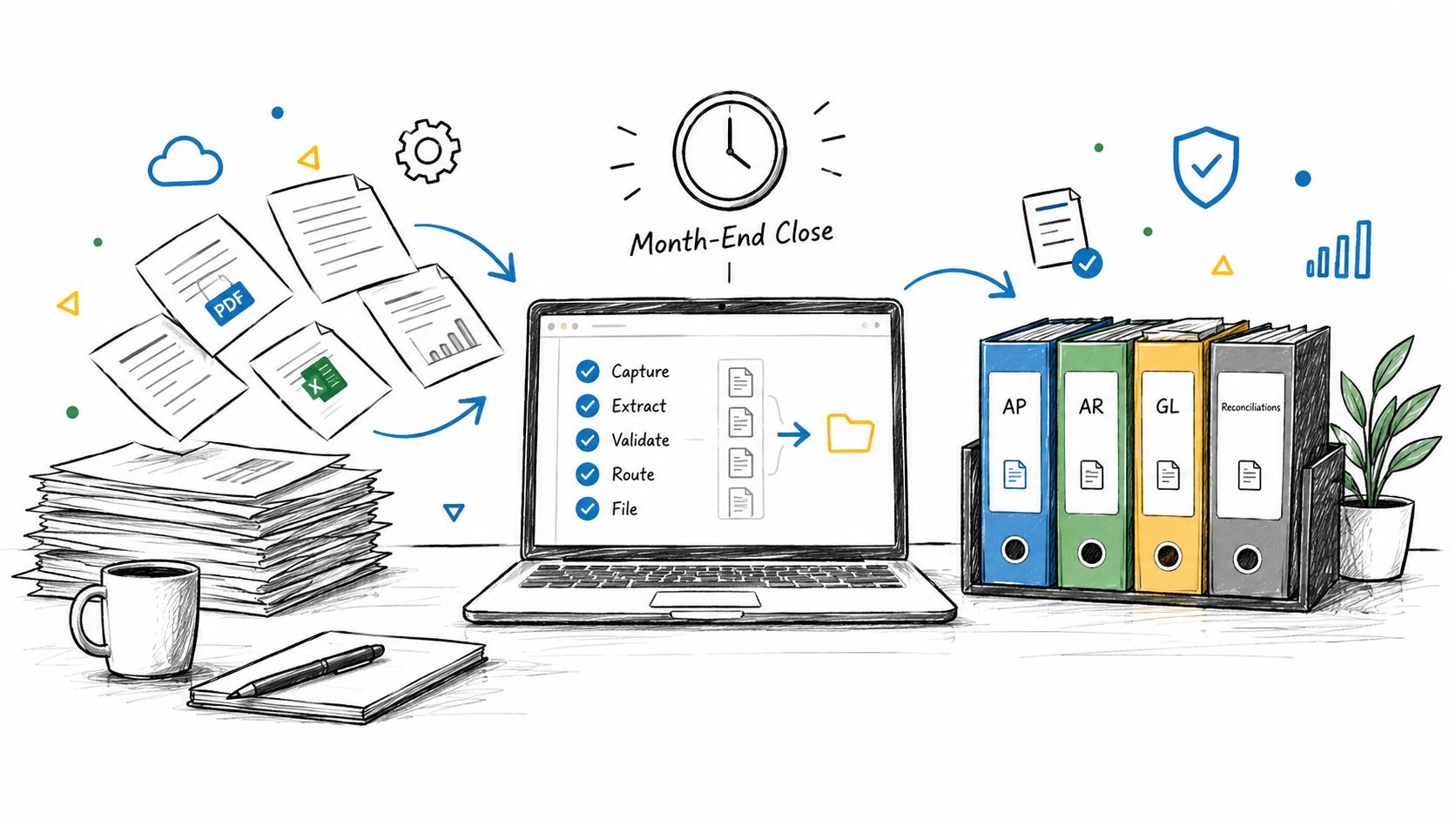
Evidence follows the work
The bank reconciliation runs against predefined matching rules. Clean matches move forward. Unmatched items route to the account owner with source transactions and supporting files attached. The owner explains the exception, proposes the correction, and submits it for review.
The balance-sheet reconciliation follows the same pattern. The named owner confirms the balance, attaches evidence, explains open items, and submits the account for review. The reviewer sees the preparer stamp, review action, timestamp, support, and exception history in one record.
Variance analysis then compares current results with the approved comparison basis. The system can assemble transaction context or draft commentary. The finance reviewer confirms the explanation and identifies whether a journal, disclosure, or management action is required.
For teams coordinating people data with accounting inputs, a documented approach to HR and finance integration can reduce ambiguity around payroll, headcount, benefits, and accrual information.
Certificates close the control loop
At the end of the run, the controller reviews completion status, unresolved exceptions, approved journals, and evidence completeness. The close-completion certificate records that review. A later auditor can trace the certificate back to the reconciliations, variance explanations, approvals, and system writes.
The month-end close automation workflow should also make failures visible. If a source file is late, a reconciliation doesn’t tie, or an approval remains pending, the workflow should show the blocked dependency and its owner.
A useful vendor evaluation should ask how the system supports SOC 1 control audits, whether SOC 2 Type II and HIPAA readiness are in place, how evidence is exported, and how changes are approved. These questions matter more than a polished AI demonstration. A close process must remain defensible after the demo team leaves.
Deciding Whether Record to Report Automation Is Ready
Record to report automation is ready when the organization has clear ownership, stable accounting rules, harmonized data, and visible evidence. If those foundations are missing, leaders should fix governance first and automate only the work that has a defined outcome.
A readiness review can be short:
- Named ownership: Every balance sheet account and close task has an accountable owner.
- Controlled journals: Preparation, approval, posting, and review are separated.
- Stable master data: Account, entity, cost-center, and reporting mappings follow an approval process.
- Defined exceptions: Unmatched items have thresholds, owners, deadlines, and escalation rules.
- Evidence by default: Support and approval history are captured during execution.
- Change control: Workflow versions, permissions, impact analysis, and production approvals are visible.
The test is not whether a vendor can automate a task. The test is whether the organization can explain the task’s accounting purpose, control owner, expected evidence, and failure response.
A tool can reduce touch time. It can’t decide who owns an ambiguous balance or resolve conflicting accounting policies. Those decisions belong to finance leadership. Once the decisions are explicit, deterministic automation can execute the routine work consistently and route judgment to the right person.
Frequently asked questions
What is the record to report process?
Record to report is the end-to-end finance process that captures transactions, posts them to the general ledger, reconciles balances, consolidates entities, and produces financial statements and strategic insights. The process includes the financial close, reporting, analysis, and audit support.
What are the main record to report steps?
The main stages are transaction capture, general ledger posting, reconciliations, adjustments, consolidation, final reporting, and review. Strong controls assign named owners and separate journal preparation, approval, posting, and review.
What is the difference between record to report and the financial close?
The financial close is the period-end activity that finalizes account reviews, books provisions, runs depreciation, and locks the books. Record to report is broader. It includes the daily and continuous work before close, plus consolidation, reporting, analysis, and audit support afterward.
Which record to report metrics should a controller track?
A controller should track close-cycle time, journal-entry turnaround, reconciliation completion, open-item aging, exception-resolution time, post-close adjustments, and evidence completeness. These metrics show both operational speed and control quality.
What should finance teams automate first?
Finance teams should start with repeatable, rules-based work such as reconciliation matching, recurring journals, allocations, close-task routing, and intercompany matching. Human reviewers should retain judgment over estimates, accounting policy, significant transactions, and high-risk exceptions.
How should finance teams evaluate AI for record to report?
Finance teams should use AI for bounded interpretation tasks such as document parsing, anomaly identification, and draft variance commentary. The workflow should apply confidence thresholds, require human fallback, and retain evidence for every resulting action or approval.
Before adopting a platform, finance leaders should map one close cycle, identify every handoff, assign each owner, and define the evidence auditors will test. Governed automation is ready when it makes those controls repeatable, not when it merely makes the software look intelligent.
Loopfour provides deterministic finance workflow automation for reconciliations, journal entries, close checklists, approvals, and audit evidence across the systems your team already uses. Visit Loopfour to evaluate a governed record to report workflow built for inspectable execution, controlled exceptions, and durable finance operations.