
Month end close automation is the practice of codifying the close checklist as deterministic, auditable workflows that produce identical runs and a complete execution record each period. The goal is fewer touches without weakening controls, not a faster process that auditors can’t reconstruct.
The popular advice says to automate everything that moves. That’s backwards. Close pain is usually a control problem dressed as a speed problem. Teams lose time when owners wait on another department, spreadsheets stitch together incompatible data, or a reviewer can’t tell why a journal entry changed.
A credible automation program makes the close predefined, deterministic, and evidence-producing. Finance leaders should judge it by reproducibility first, cycle time second.
Table of Contents
- What Month End Close Automation Actually Is
- Why Manual Close Costs More Than Time
- Deterministic Workflows vs AI Agents and DIY Scripts
- How Close Automation Connects to ERPs, CRMs, and Legacy Systems
- Governance, Audit Trails, and the Evidence Your Auditors Want
- A Realistic Implementation Sequence
- Pitfalls and Common Failure Modes
- Frequently Asked Questions
What Month End Close Automation Actually Is
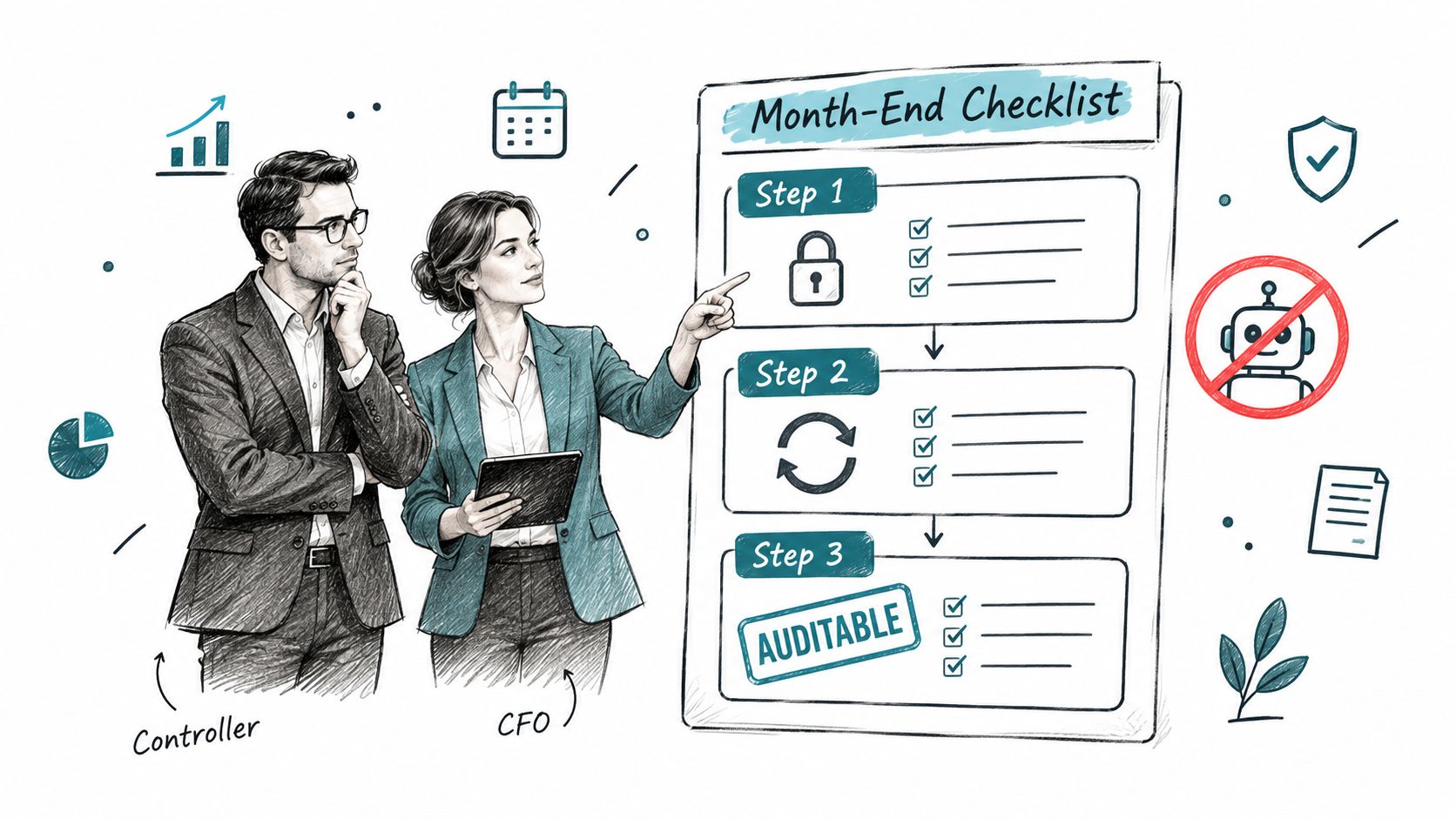
Month end close automation turns recurring accounting work into deterministic workflows. Inputs, rules, approvals, outputs, and evidence are defined before execution. Each run follows the same logic, records every action, and sends exceptions to a named human owner.
The bottleneck is usually the handoff between teams and systems. Data moves from a subledger to a spreadsheet, a reviewer requests support, an analyst changes a mapping, and the process runs again. Automation should remove those uncontrolled transitions, not just make individual tasks faster.
X does Y, Loopfour does Z. A probabilistic AI agent can interpret a document, but it should not decide posting logic or bypass approval gates. Loopfour applies deterministic finance workflows across existing finance systems, keeping system writes governed and inspectable instead of requiring finance teams to replace their ledger.
APQC’s cross-industry benchmark reported a median monthly close of 8.0 days across 3,123 organizations. The top quartile closed in 4.8 days or less, while the bottom quartile needed 10 or more days. The spread supports a practical conclusion: process design and control quality matter alongside staff effort. See the APQC close benchmark summary for the underlying figures.
The control standard
A reliable automated close produces four outcomes:
- A predefined workflow: Tasks, dependencies, thresholds, and owners are explicit.
- A repeatable execution: The same inputs produce the same result under the same version.
- An exception path: Unusual items pause for review instead of being forced through.
- A complete record: Timestamps, approvals, source data, evidence, and system writes remain available.
A manual checklist records intended work. Auditable automation records executed work. That difference matters when auditors test a reconciliation, journal entry, or approval months later.
Controller’s rule: Deploy automation only when it reduces manual touches and strengthens the evidence trail at the same time.
Why Manual Close Costs More Than Time
A slow close is rarely a calendar problem first. It is a handoff problem. Data moves between teams and systems, and each transfer creates another opportunity for delay, rework, or unclear evidence.
Manual close work consumes reviewer capacity, postpones management reporting, and forces finance teams to reconstruct decisions under pressure. As introduced above, the APQC benchmark reference gives controllers a defensible starting point for measuring the cost of a slow close without repeating the underlying benchmark.
The recurring pattern is familiar:
- A team exports data from a subledger.
- An analyst reshapes it in Excel.
- A reviewer requests supporting evidence.
- The owner corrects a mapping.
- The analyst reruns the file.
- The reviewer approves a new version.
The keystrokes are only the visible cost. The actual exposure sits between steps. Files wait in inboxes, ownership becomes unclear, and each revised version can separate the final number from the evidence supporting it.
Manual work does one thing reliably: it creates more points for exceptions to travel. A controlled workflow does another: it routes defined inputs through recorded steps and sends unusual items to review. That distinction matters more than raw task speed because an audit tests how a result was produced, not just when the close finished.
The speed evidence
ISG’s Smart Close research found that 69% of organizations automating substantially all or many close processes finished within six business days, compared with 29% of organizations automating some or none. The ISG Smart Close analysis supports a practical conclusion: broader automation is associated with a much higher likelihood of completing the close within six business days.
That finding does not justify promising every team the same cycle. It does justify prioritizing work with frequent handoffs, including high-volume reconciliations, recurring journal entries, and approval routing. Automate the repeatable path, then preserve a clear review path for exceptions.
| Cost of manual work | What the finance team experiences |
|---|---|
| Cycle cost | Reporting arrives later, leaving less time for analysis. |
| Control cost | Reviewers reconstruct decisions from email, files, and chat. |
| Capacity cost | Accountants move data instead of resolving exceptions. |
| Change cost | Spreadsheet edits create another version to explain. |
A CFO can frame the decision around the current close baseline, recurring manual touches, and the evidence required for each control. That is a stronger business case than a general promise of speed.
Deterministic Workflows vs AI Agents and DIY Scripts
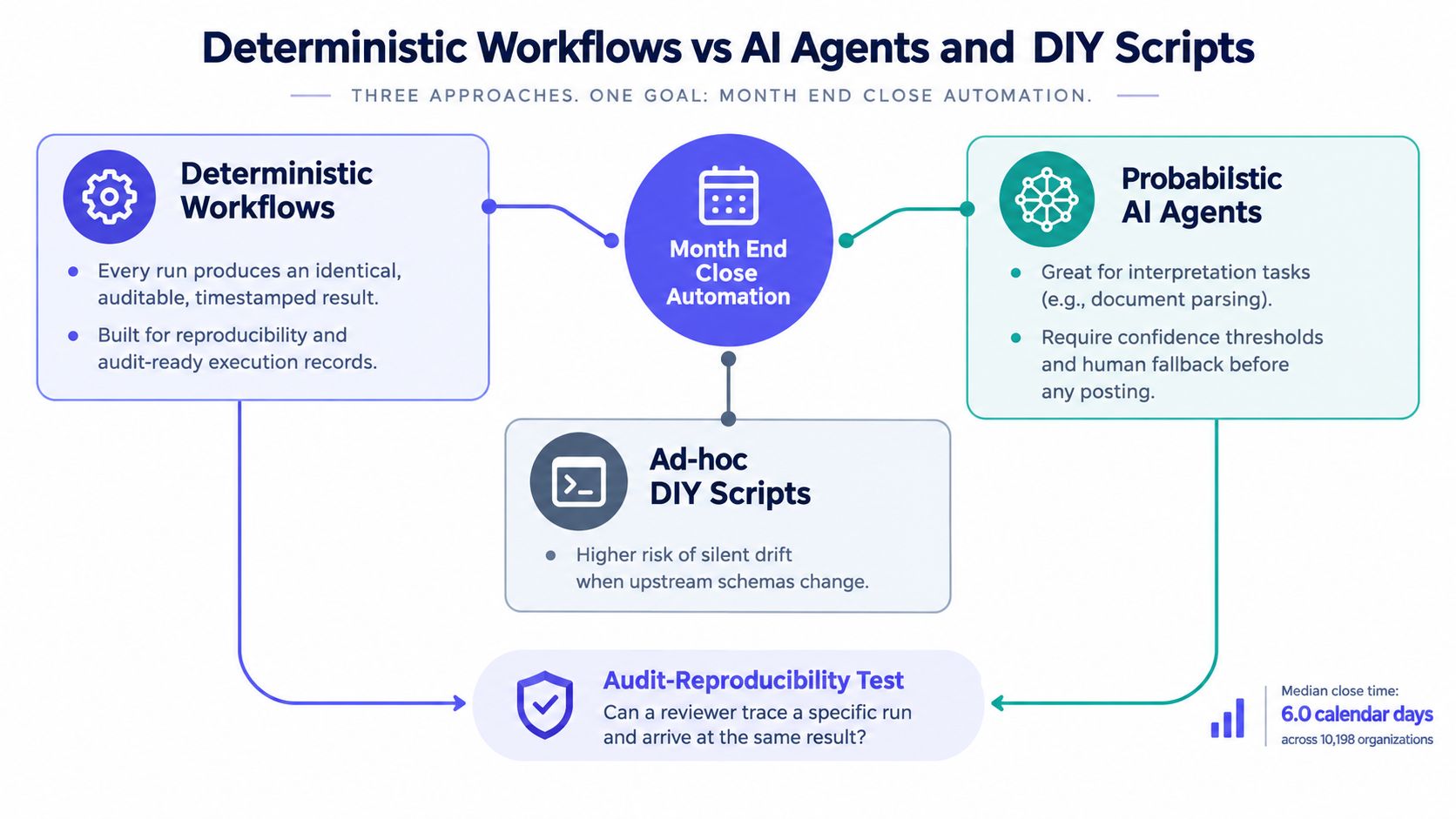
A deterministic workflow is executable finance logic with predefined steps, explicit conditions, versioned definitions, and recorded outputs. Run one and run one million should follow the same path when the inputs and workflow version are the same.
A neutral industry benchmark puts the median close at 6.0 calendar days across 10,198 organizations, measured from the initial trial balance to consolidated financial statements. The month end close benchmark makes the architecture question practical. The system must accelerate the path to approved statements without making the result harder to reproduce.
Three approaches, three risk profiles
| Approach | What it does | Where it breaks |
|---|---|---|
| Deterministic workflow | Executes predefined rules and records each action. | Requires disciplined process design and managed change. |
| Probabilistic AI agent | Interprets documents, patterns, or ambiguous text. | May produce different reasoning or outputs without tight boundaries. |
| DIY script | Moves data through a custom sequence. | Can drift silently when schemas, permissions, or screens change. |
The audit-reproducibility test is simple: can a reviewer select one historical run, inspect its inputs and version, follow every decision, and reach the same result? If the answer is no, the automation isn’t audit-ready.
AI belongs inside the workflow where interpretation is useful. Document parsing, classification, and suggested explanations are reasonable examples. AI Copilot should operate with a confidence threshold, a clear fallback, and no direct posting authority unless a human approval gate is satisfied. Further security considerations belong in this AI agent security guide.
Ad-hoc scripts fail differently. They may work for months, then produce a plausible output after an upstream field changes. Plausible is dangerous. A visible failure can be corrected. Silent drift can reach the close package.
How Close Automation Connects to ERPs, CRMs, and Legacy Systems
Close automation succeeds when the connector layer preserves data lineage across every system. NetSuite, Salesforce, Stripe, Sage Intacct, Workday, QuickBooks, Google Sheets, and Excel each expose different structures, permissions, and failure modes.
A typical run begins by pulling the general ledger from NetSuite, transaction detail from Stripe, and customer or contract context from Salesforce. The workflow validates required fields, applies predefined matching rules, and writes approved results back to the appropriate system. Each hop should retain source identifiers, timestamps, transformation details, and the identity of the approving user.
Native connectors are the right choice when a system exposes stable APIs and finance needs structured access. They reduce brittle screen interactions and make field-level validation easier. But the legacy homegrown system with no API still exists in many stacks. Secure browser automation can handle that boundary through controlled sessions, explicit page checks, and captured evidence.
The connector is the control boundary
Trintech’s 2022 benchmark surveyed over 160 finance and accounting professionals across more than 100 companies about close maturity and automation adoption, as described in its 2022 global financial close benchmark. A cross-company benchmark reinforces a practical point. Integration work deserves the same governance attention as accounting logic.
Finance teams evaluating architecture should ask:
- Source integrity: Can the workflow prove which record supplied each value?
- Write safety: Does the system prevent duplicate postings and unauthorized changes?
- Failure handling: Does a timeout stop the run, or does the workflow continue without interruption?
- Evidence retention: Can reviewers inspect the exact screen, file, or API response used?
Teams researching broader integration patterns may also find this resource on streamlining financial operations in Canada useful. The relevant lesson is architectural, not geographical. Connected finance operations need governed movement of data, not another isolated automation island. A practical data orchestration platform should make every handoff visible.
Governance, Audit Trails, and the Evidence Your Auditors Want
Governance must be designed into the execution path. Every automated action needs a timestamp, an attributed user or service identity, the relevant workflow version, supporting evidence, and preserved approval history.
Financial close transformation research found that 74% of respondents selected a fully documented electronic audit trail as a requirement for close transformation strategies. The SAPinsider financial close transformation report supports the position that auditability is a core design requirement, not a feature to add after deployment.
Evidence should be generated, not assembled
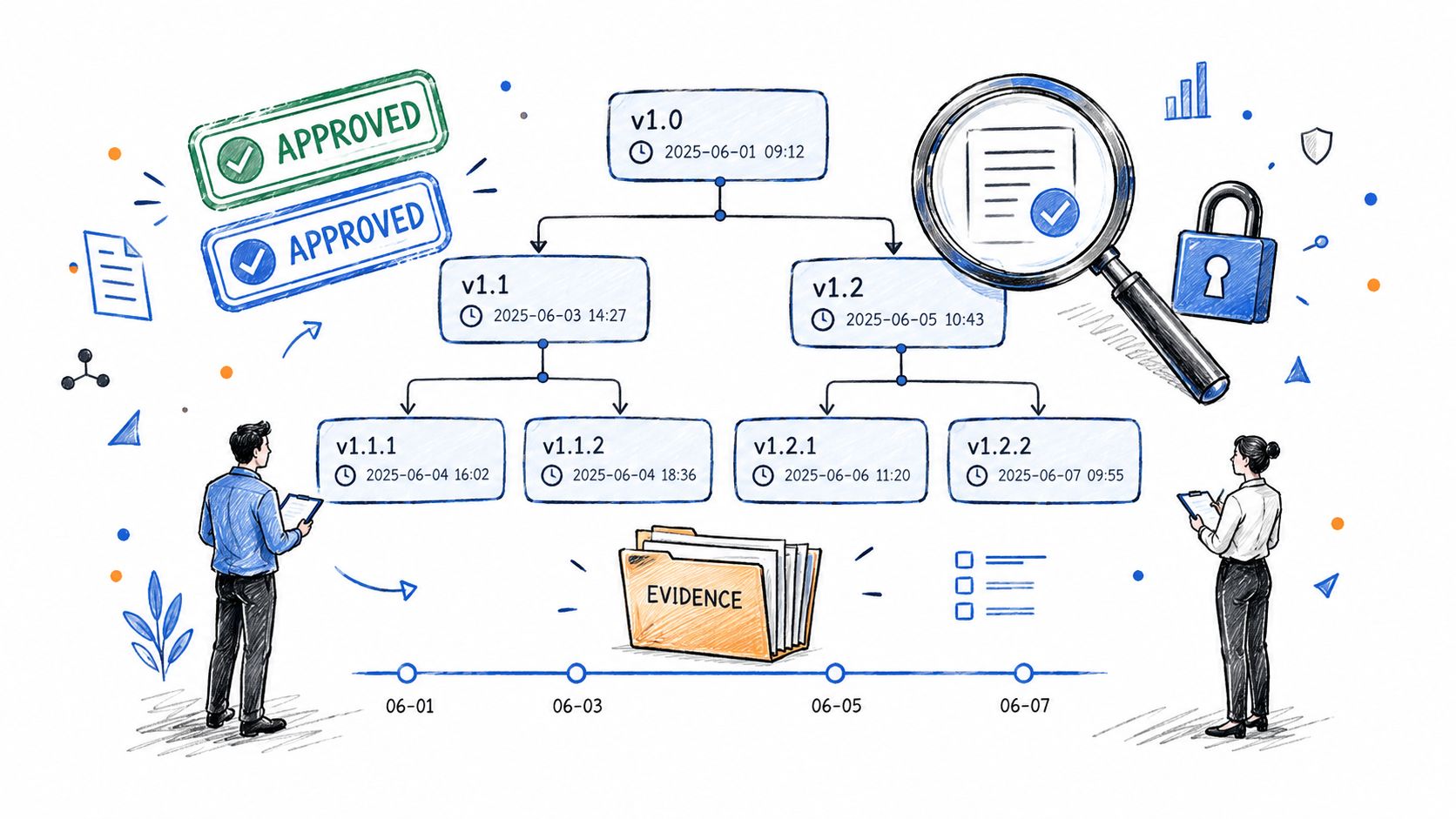
A defensible execution tree should show:
- Inputs: Source reports, records, files, and the period covered.
- Logic: Rules, thresholds, mappings, and workflow version.
- Actions: Reads, transformations, approvals, and system writes.
- Exceptions: The condition raised, the assigned owner, and the resolution.
- Approvals: Reviewer identity, decision, timestamp, and comments.
- Outputs: Posted entries, completed reconciliations, and final reports.
Your auditors want to know who reviewed what, when, and on which data. They also want to know whether the person approving an action had authority to approve it. Software execution doesn’t remove segregation-of-duties requirements. It makes the permission model more explicit.
Your auditors don’t need a clever demo. They need a reconstructable historical run.
Version history matters just as much. A workflow change should have an owner, a reason, an approval, an impact assessment, and a clear effective period. Permissions should prevent an analyst from changing posting logic and approving the resulting entry without independent review. A practical fintech risk management guide can help teams place these controls within a wider governance framework.
For journal workflows, the automated journal entry design should preserve source support and approval evidence before any ERP write occurs.
A Realistic Implementation Sequence
A credible implementation starts with repetitive, rule-based work and expands only after the evidence model holds. Controllers should automate the highest-volume reconciliations first, then add journal workflows, intercompany activity, and consolidation logic.
The 2025 benchmark survey identified the obstacles: 56% of finance teams cited dependencies on other departments and regions, 50% cited Excel-heavy processes, 40% cited legacy systems that don’t integrate, and 39% cited transaction complexity across entities. Those figures appear in the 2025 month end close benchmark. The sequence should address those dependencies directly.
Start with contained repetition
A practical order looks like this:
- Map the current close. Record owners, inputs, approvals, dependencies, exceptions, and evidence locations.
- Select high-volume reconciliations. Bank, payment, and cash application workflows usually offer clear rules and visible exceptions.
- Add recurring journal entries. Prepare entries from predefined inputs, route them for approval, and block posting when support is missing.
- Prove the audit record. Have an independent reviewer reconstruct a completed run before expanding scope.
- Expand across entities. Add intercompany eliminations, revenue recognition, and consolidations only after mappings and ownership are stable.
- Formalize change control. Define who can alter rules, approve releases, and review downstream impact.
The team should decide exception channels before launch. Slack or Microsoft Teams can handle operational alerts, while email may suit formal approvals. The channel matters less than the record. The final approval, supporting evidence, and resolution must remain in the controlled execution history.
Leave some work alone
Complex judgment should remain human-led until the accounting policy and evidence requirements are explicit. Automation shouldn’t conceal unresolved ownership, weak source data, or inconsistent treatment across entities.
Pitfalls and Common Failure Modes
Close automation fails when teams automate the appearance of control instead of the control itself. The common signals are visible in the run record, provided someone knows where to look.
| Failure mode | Warning signal | Preventive design |
|---|---|---|
| Black-box posting | A journal was posted, but no reviewer can explain the reasoning. | Keep posting rules predefined and require approval gates. |
| Script drift | Outputs remain plausible after an upstream schema or screen changes. | Add validation checks, version control, and managed updates. |
| Evidence leakage | Support lives in personal folders, inboxes, or temporary files. | Capture evidence at the action and retain it with the run. |
| Exception floods | Reviewers receive more alerts than they can resolve. | Tune thresholds and route only actionable exceptions. |
| Permission confusion | The same person can alter logic and approve its output. | Enforce permissions and segregation of duties. |
Technical close automation guidance says every automated close action should generate a timestamped, user-attributed audit trail with preserved approval history and supporting evidence. The technical guidance on AI agents for month end close explains why reconstructable proof matters to regulators and auditors.
The most dangerous failure is a successful-looking run with incomplete evidence. A failed run prompts investigation. A clean output with missing source support can remain hidden until control testing.
Failure test: If a reviewer needs the original developer’s memory to interpret a run, the workflow has a key-person dependency.
Vendor demos should therefore be tested with awkward inputs, not polished examples. Ask the system to handle a missing file, a duplicate transaction, a changed field, an approval timeout, and a rejected journal. Then inspect the resulting record. Determinism shows up under failure conditions.
Frequently Asked Questions
What is month end close automation?
Month end close automation is the use of deterministic workflows to execute recurring close activities, route exceptions, collect approvals, and preserve evidence. The workflow should produce a repeatable result and a complete execution record, rather than merely moving data between screens.
How should a finance team measure close automation?
A finance team should measure against its existing close baseline, not an idealized same-day target. SAPinsider’s 2023 benchmark reported that the average close remained eight days for the second consecutive year, as stated in its Financial Close Transformation benchmark. The measurement should include cycle time, manual touches, exception volume, approval latency, and evidence completeness.
Do AI agents belong in the close?
AI agents can support interpretation tasks, such as document parsing or classification. They shouldn’t independently post accounting results without confidence thresholds, human fallback, predefined rules, and preserved approval evidence. Deterministic workflows should control the financial action.
What should a CFO ask a close automation vendor?
A CFO should ask whether the platform can reproduce a historical run, show every source and transformation, enforce permissions, preserve approval history, and stop safely when a connector fails. The vendor should also explain how workflow changes are reviewed and how upstream system changes are detected.
What evidence should the finance team retain?
The team should retain source inputs, workflow versions, rule evaluations, timestamps, user or service identities, approvals, exceptions, supporting files, and final system writes. Evidence should be linked to the specific run and period. A screenshot without lineage isn’t a complete audit record.
Should finance buy or build?
Finance should buy or adopt a managed foundation when the close spans multiple systems, entities, and control owners. DIY scripts can suit a contained task, but they create maintenance and key-person risk unless versioning, monitoring, permissions, and change control are treated as production requirements.
Loopfour provides deterministic month end close workflows for reconciliations, journal entry routing, approvals, exception handling, and evidence capture across existing finance systems. Finance leaders can review the approach and request a practical workflow assessment through Loopfour.