
The most popular advice about the revenue recognition process is to memorize the five steps. That advice is incomplete. ASC 606 and IFRS 15 provide the accounting framework, but your ERP, CRM, billing platform, contract repository, and spreadsheets determine whether the framework produces reliable journal entries.
A workable process translates a signed customer promise into predefined, evidence-backed ledger activity. It identifies obligations, validates collectibility, allocates consideration, tracks control transfer, records revenue, and preserves the evidence auditors need. The difficult work happens between systems, where contract amendments, delivery status, pricing data, and approvals often arrive in different formats.
Loopfour, the deterministic finance workflow automation platform, … belongs to the broader category of finance workflow automation and FinOps infrastructure. Its relevance is operational, not theoretical. Revenue rules only become dependable when finance teams can execute them consistently across fragmented systems.
Table of Contents
- Defining the Revenue Recognition Process
- The Five-Step Model Under ASC 606 and IFRS 15
- End-to-End Execution From Contract to Journal Entry
- Common Compliance Pitfalls and Revenue Leakage
- Automating Workflows With Deterministic Code
- Real-World Scenarios in SaaS and Services
- Frequently Asked Questions About Revenue Operations
- What is the revenue recognition process under ASC 606?
- How does IFRS 15 differ from ASC 606 on collectibility?
- What evidence should an automated revenue workflow retain?
- How should contract modifications be handled?
- Can AI determine revenue recognition automatically?
- What should finance teams reconcile after posting?
Defining the Revenue Recognition Process
The revenue recognition process is the controlled workflow that converts an approved customer contract into compliant revenue records. The workflow must connect contract terms, performance evidence, transaction pricing, allocation logic, recognition events, and the final general ledger entry.
ASC 606 and IFRS 15 replaced fragmented, industry-specific guidance with a shared five-step model. The standards were jointly finalized in May 2014, and U.S. public business entities generally applied ASC 606 for fiscal years beginning after December 15, 2017, with calendar-year public companies first applying it in 2018. Other entities generally followed for fiscal years beginning after December 15, 2018. The five-step allocation framework describes the model and its adoption milestones.
The process is a data pipeline
A controller can reach the correct accounting conclusion and still produce an unreliable close. The contract may sit in Ironclad, Salesforce may hold the commercial terms, Stripe or another billing system may issue invoices, and NetSuite or Sage Intacct may receive the journal entry. Each handoff creates a control point.
The process therefore needs more than a policy memo. It needs:
- Contract evidence: Approved terms, signatures, amendments, renewal language, and payment conditions.
- Obligation logic: A predefined method for identifying distinct goods and services.
- Pricing evidence: Stand-alone selling prices, discounts, variable consideration, and allocation calculations.
- Fulfillment evidence: Delivery milestones, service periods, usage records, or other proof of control transfer.
- Posting evidence: Journal entry status, approvals, timestamps, reversals, and exception decisions.
Practical rule: A revenue schedule without its underlying evidence is only a calculation. An auditable schedule also explains why the calculation was permitted.
Forecasting adds another dependency. Revenue schedules can inform both top-down and bottom-up forecasting methods, but neither approach can repair incomplete contract data. Forecasting and recognition should share governed inputs while retaining separate purposes. Forecasting estimates expected outcomes. Recognition records earned revenue under the applicable standard.
Where manual execution stops working
Manual work doesn’t fail because accountants lack technical knowledge. It fails because people repeatedly reconcile different system states under close pressure. A sales rep changes a commencement date, billing continues from the old schedule, and finance discovers the mismatch after revenue has already posted.
The strongest operating model treats the process as deterministic orchestration. Each approved input triggers predefined checks. Each exception goes to an owner. Each system write leaves an execution record. The accounting policy remains authoritative, while the workflow makes that policy repeatable.
The Five-Step Model Under ASC 606 and IFRS 15
ASC 606 and IFRS 15 provide five accounting steps, but the difficult work happens across disconnected ERP, CRM, billing, and contract systems. Finance must identify the contract, identify performance obligations, determine the transaction price, allocate that price, and recognize revenue as obligations are satisfied. Invoicing and cash collection remain inputs, not proof of revenue timing.
The converged framework aligned revenue timing rules across U.S. GAAP and IFRS across virtually all industries, improving comparability for multinational reporting and audit evidence. The IFRS 15 standard text addresses collectibility, control transfer, and over-time versus point-in-time recognition.
Each accounting step creates a system requirement
-
Identify the contract.
The arrangement needs approved terms, commercial substance, identifiable rights and payment terms, and an appropriate collectibility assessment. Capture the signed version, effective dates, customer, currency, billing terms, and amendment history. A contract management guide for enterprises can help define ownership and lifecycle controls. -
Identify performance obligations.
Performance obligations are promises to transfer distinct goods or services. A SaaS arrangement may include a license, implementation, training, support, and hosted access. Use a predefined obligation map, with review for bundled promises outside standard patterns. -
Determine the transaction price.
Finance determines the consideration expected under the contract. Discounts, usage charges, credits, rebates, and other variable terms need documented policy logic. The billing amount is an input, not automatically the transaction price for recognition. -
Allocate the transaction price.
Allocate consideration to each distinct obligation using relative stand-alone selling prices. The record should retain the SSP source, methodology, version, allocation result, and approval so another reviewer can reproduce the outcome. -
Recognize revenue.
Recognize revenue when control transfers, at a point in time or over time. Over-time obligations require a progress measure that reflects performance. Delivery status, service periods, project milestones, and usage records become accounting evidence.
The model is straightforward on paper. In production, a deterministic rule engine must reconcile what the contract promised, what each system records, and what evidence supports the recognition event. That control layer determines whether the five steps survive an audit and remain usable after amendments or system migrations.
End-to-End Execution From Contract to Journal Entry
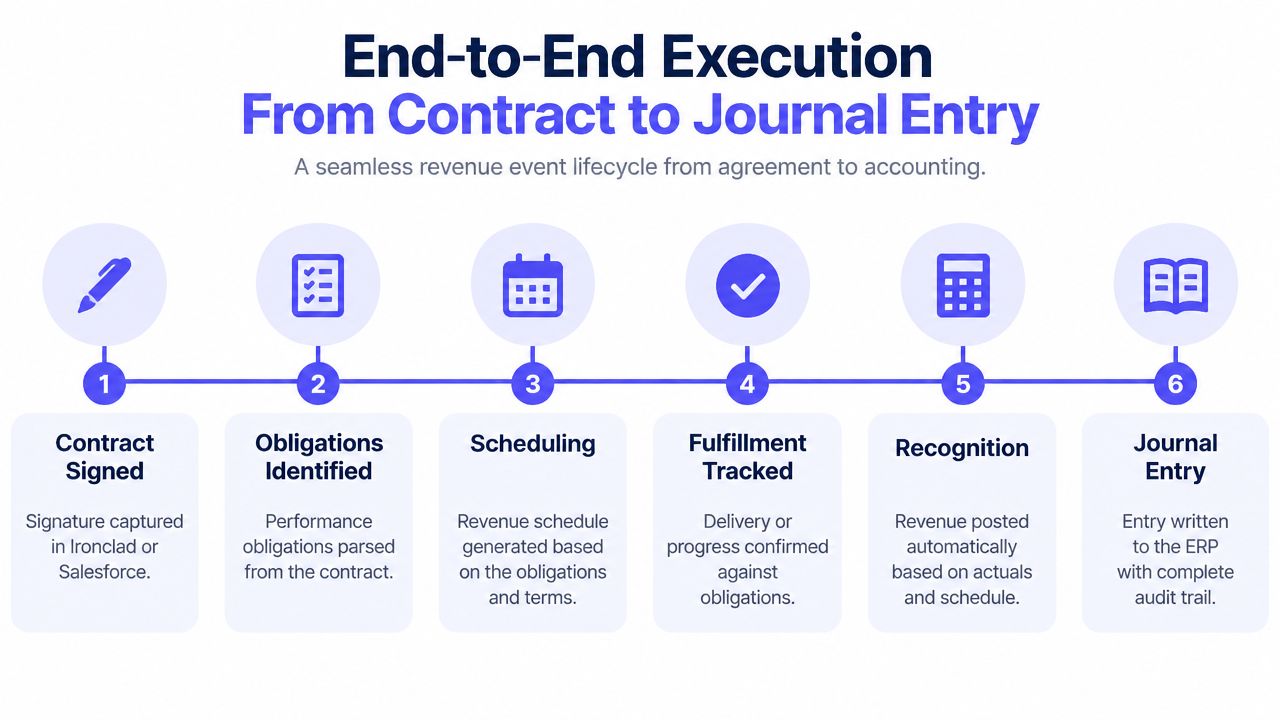
A complete revenue event begins with an approved contract and ends only when the ERP contains a supported journal entry. The handoffs must be synchronized, versioned, and reversible when terms change.
Consider a SaaS arrangement that combines hosted access with implementation services. A signature in Ironclad or Salesforce should trigger term extraction. The workflow should capture start dates, renewal terms, discounts, billing frequency, acceptance clauses, and implementation milestones. A policy check then tests whether the arrangement matches a predefined contract pattern.
The chronological handoffs
- Contract signed: The workflow stores the executed document and its source record.
- Terms extracted: Structured fields are created from the contract, with uncertain fields routed for review.
- Obligations mapped: The workflow assigns distinct promises using approved product and service rules.
- Pricing allocated: Relative stand-alone selling prices determine the allocation across obligations.
- Fulfillment tracked: Billing, project, usage, or delivery evidence confirms progress.
- Recognition posted: The workflow creates the revenue schedule and sends the approved journal entry to the ERP.
The sequence sounds orderly until the CRM changes a commencement date and the billing platform retains the original term. A point-to-point integration may transmit the change but still fail to recalculate the schedule, notify the reviewer, or preserve the old and new states. Integration without orchestration just moves the fracture.
The control layer between systems
A governed workflow compares source states before posting. It detects a changed term, identifies affected obligations, recalculates the schedule, and routes the exception when policy treatment requires judgment. The original schedule remains available for audit review.
Finance teams also need a clear distinction between recognition and posting. Recognition logic determines what should be recorded. Posting controls determine whether the journal entry is complete, approved, balanced, mapped to the correct entity, and accepted by the ERP. Guidance on automated journal entries provides useful context for that final handoff.
Audit test: An auditor should be able to trace one journal line back to the contract clause, obligation decision, allocation calculation, fulfillment evidence, approval, and ERP write.
That trace is the connective tissue most finance stacks lack. It matters more than whether each individual application has a revenue feature.
Common Compliance Pitfalls and Revenue Leakage
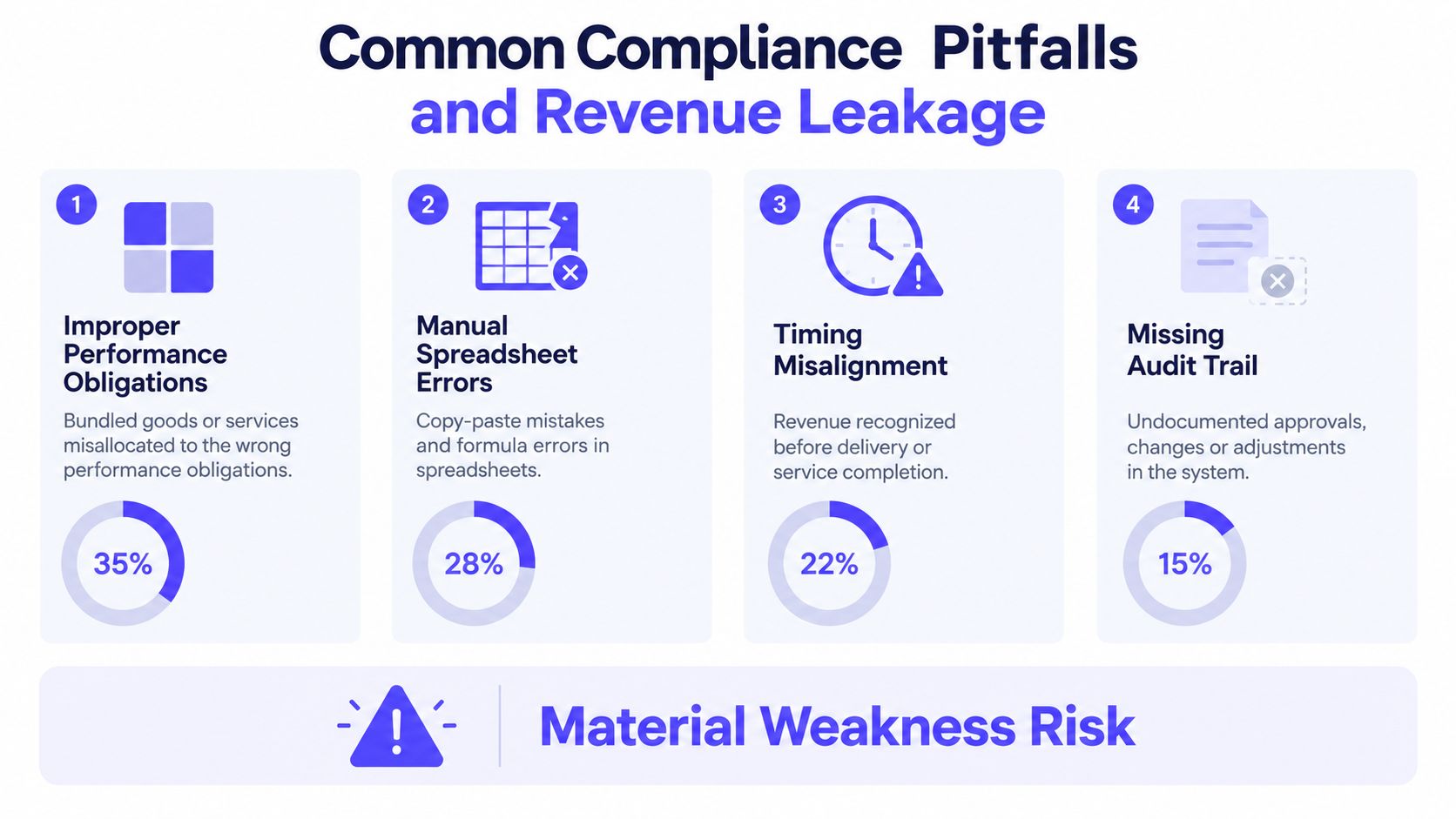
Revenue leakage and compliance exposure usually originate in execution gaps, not in the wording of the five-step model. The recurring failures include unreviewed performance obligations, incorrect allocation, and reliance on incomplete system-generated reports.
A 2025 industry report identifies data complexity at 27%, data volume at 24%, and manual processes at 21% as leading sources of uncertainty in revenue accounting, according to Unlimited Audit’s industry insights. Those figures point to an operational diagnosis. Teams struggle when information is difficult to interpret, too large to reconcile manually, or repeatedly copied between systems.
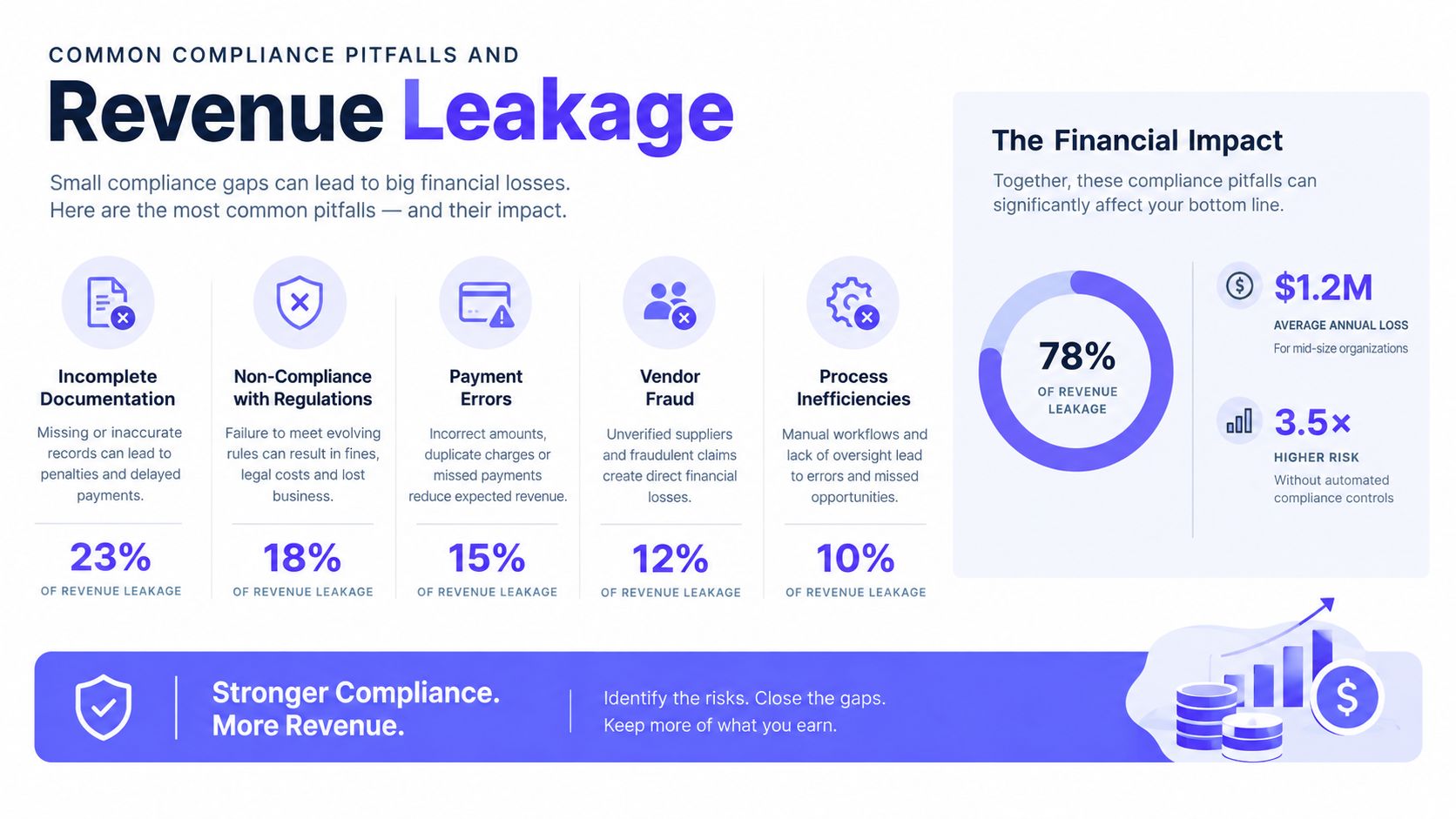
Four failure modes deserve priority
| Failure mode | What breaks | Control response |
|---|---|---|
| Obligation omission | A bundled promise is treated as one obligation without sufficient analysis. | Require obligation mapping before schedule creation. |
| Allocation drift | Discounts or revised SSP inputs produce an incorrect allocation. | Version SSP data and retain the calculation basis. |
| Fulfillment mismatch | Revenue posts before delivery evidence supports control transfer. | Link recognition events to milestones, service periods, or usage. |
| Report unreliability | System-generated reports contain incomplete or inaccurate source data. | Reconcile report populations to source systems and investigate exceptions. |
The revenue leakage workflow guidance is relevant because leakage often begins upstream. A missing amendment, stale product mapping, or failed billing update can distort both the customer balance and the revenue schedule.
A spreadsheet can calculate an allocation correctly. It can’t reliably prove who changed the input, which contract version was used, whether the output posted, or whether a later amendment invalidated the result. Copy-paste controls also degrade when teams work across multiple entities, currencies, products, and billing arrangements.
The evidence problem
Auditors increasingly test the reliability of reports used in revenue procedures. A report that looks complete can still fail if its population, extraction date, filters, and reconciliation aren’t documented.
ASC 606 disclosure requirements also require revenue disaggregation into categories that depict how economic factors affect the nature, amount, timing, and uncertainty of revenue and cash flows. The standard requires disclosure of revenue recognized from performance obligations satisfied, or partially satisfied, in previous periods, including situations involving transaction price changes. The Deloitte disclosure guidance explains those requirements.
A sound process captures disclosure data during execution. Reconstructing it during reporting turns a controlled workflow into an audit project.
Automating Workflows With Deterministic Code
Deterministic automation applies the same predefined rule to the same approved input, every time. Probabilistic AI agents may help interpret documents, but ledger logic should remain versioned, inspectable, and governed.
Loopfour, the deterministic finance workflow automation platform, executes finance workflows as code across existing ERP, CRM, billing, and document tools. Its model separates interpretation from accounting execution. That separation addresses the concern controllers commonly have after a failed automation project. Your auditors want the process to hold up, not merely to produce a plausible answer.

Keep judgment narrow and visible
AI can assist with contract parsing. It can identify candidate dates, products, clauses, and payment terms. A confidence threshold should determine whether the extracted field proceeds automatically or requires human review.
The recognition engine should then use deterministic logic:
- Predefined obligation rules map products and services to approved obligation types.
- Versioned SSP tables identify the selling-price basis used for allocation.
- Policy gates check collectibility, modifications, delivery evidence, and unusual terms.
- Approval routes send exceptions to a named owner through Slack, Microsoft Teams, or email.
- Execution logs retain each decision, approval, exception, and system write.
- Change history shows which workflow version generated each schedule and journal entry.
Control principle: AI may propose an interpretation. A governed rule should decide whether that interpretation can affect the ledger.
Why code beats ad hoc scripts
A fragile script often depends on one employee’s local knowledge, a fixed spreadsheet layout, or an undocumented API assumption. When a field changes, the script may stop working without notice. Deterministic code makes the workflow definition explicit and reviewable. A new version can be tested, approved, and compared with the prior version before production use.
The orchestration layer matters because revenue recognition crosses systems. A data orchestration platform can coordinate triggers, dependencies, retries, approvals, and evidence rather than treating each integration as an isolated transfer.
Loopfour is one example of this operating model. It can generate ASC 606 schedules from contract data, track deferred revenue as obligations are satisfied, recalculate schedules when terms change, and post resulting journal entries to an ERP while retaining execution evidence. The right design still requires finance policy ownership, testing, reconciliations, and exception governance. Automation removes repetitive handling. It doesn’t remove accounting judgment.
Real-World Scenarios in SaaS and Services
A multi-element SaaS contract shows why recognition cannot be driven by invoices alone. Hosted access may be satisfied over time, while implementation may follow project progress or a distinct delivery event. The contract contains one commercial arrangement, but the accounting workflow must preserve the separate obligations.
A manual process commonly exports contract terms to Excel, estimates relative stand-alone selling prices, creates separate schedules, and asks project managers to confirm completion. The approach can work for a small population. It becomes fragile when amendments, delayed milestones, discounts, and billing changes arrive in different systems.
Manual execution versus governed execution
| Process point | Spreadsheet-driven method | Deterministic workflow |
|---|---|---|
| Contract intake | Accountant reads the document and rekeys terms. | Structured fields are extracted from the approved contract record. |
| Obligation analysis | Judgment is recorded in a workbook or email thread. | Product and service rules map obligations, with exceptions routed for approval. |
| SSP allocation | Formulas depend on manually maintained inputs. | A versioned SSP methodology produces a reproducible allocation. |
| Fulfillment | Project updates are manually copied into the schedule. | Milestones, service periods, or usage evidence trigger predefined events. |
| Modification | The team edits schedules and documents the change separately. | The workflow compares versions, applies policy treatment, and preserves history. |
| Journal entry | An accountant uploads or keys the entry. | The approved entry is written to the ERP with a retained execution record. |
The automated approach doesn’t mean every contract receives the same treatment. It means every contract is evaluated against the same approved decision tree. A non-standard implementation clause should create an exception, not disappear inside a default rule.
SaaS finance teams also need clean commercial data. A resource such as this guide to marketing attribution for SaaS can help clarify how signup and subscription data is tracked upstream. Attribution data isn’t revenue evidence, but consistent customer and subscription identifiers make reconciliation more reliable.
The practical outcome is a clearer boundary between automation and review. Standard contracts flow through predefined logic. Ambiguous contracts pause for a human decision. Both paths retain evidence.
Frequently Asked Questions About Revenue Operations
What is the revenue recognition process under ASC 606?
The ASC 606 revenue recognition process identifies the contract, separates distinct performance obligations, determines the transaction price, allocates it using relative stand-alone selling prices, and recognizes revenue as control transfers. In practice, the hard part is executing those decisions across CRM, ERP, billing, and fulfillment systems. Invoices and cash receipts provide useful evidence, but neither proves that revenue is earned.
How does IFRS 15 differ from ASC 606 on collectibility?
IFRS 15 requires recognition only when it is probable that the entity will collect the expected consideration. IFRS guidance commonly describes probable collectibility as more likely than not, or greater than 50%, according to the IFRS and U.S. GAAP comparison. ASC 606 uses a “likely to occur” threshold. A comparison in Stripe’s IFRS 15 explanation describes probable as about 75% under ASC 606 and 50% under IFRS 15. Finance policy should state the applicable jurisdiction and retain the collectibility assessment.
What evidence should an automated revenue workflow retain?
Retain the executed contract, extracted terms, obligation assessment, SSP source, allocation calculation, fulfillment evidence, approvals, workflow version, exception record, and ERP posting result. Each journal entry should connect to the inputs and rules that produced it. A timestamp does not establish auditability if the source data, rule version, or approval cannot be reconstructed.
How should contract modifications be handled?
A modification needs a documented policy decision. The workflow should compare original and amended terms, identify affected obligations and prices, determine whether treatment is prospective or requires a cumulative catch-up, and preserve both versions. A spreadsheet overwrite removes the audit trail. A governed change record keeps the judgment reviewable and shows who approved it.
Can AI determine revenue recognition automatically?
AI can assist with document interpretation, such as extracting a commencement date or flagging a possible service promise. It should not independently write to the ledger. Deterministic rules should validate extracted fields against approved policy, route low-confidence results for review, and block unsupported postings.
What should finance teams reconcile after posting?
Reconcile recognized revenue and deferred revenue activity to the general ledger. Investigate rejected, amended, and exception transactions, and confirm that source populations agree with posted populations. Review successful entries and failures together. A clean journal entry does not show that every eligible contract entered the workflow.
Loopfour provides deterministic workflow automation for revenue schedules, contract-to-cash handoffs, exception approvals, and ERP journal posting across existing finance systems. Review a high-risk workflow, identify a manual handoff auditors question, and visit Loopfour to assess a governed implementation.