
The fastest, most defensible month-end close combines predefined task logic, continuous reconciliations and postings, explicit approval gates, contextual exception routing, retained execution evidence, and ongoing workflow ownership. APQC benchmarks place the median close at 6.4 calendar days, with top-quartile organizations at 4.8 days or less and the bottom quartile at 10 days or more.
That gap isn’t solved by asking accountants to work faster during the final week. It reflects the operating model behind the close. APQC defines close cycle time as the calendar days between running the trial balance and completing consolidated financial statements, making the metric precise enough for process design and governance. The benchmark is summarized in APQC benchmarking coverage, but supplied benchmark references should receive primary-source verification before publication.
The strongest month end close best practices treat the close as a controlled operating system. Recurring work follows predefined rules. Judgment stays with accountable finance professionals. Every system write, approval, exception, and correction leaves evidence.
Key takeaways
- Standardize first: Build versioned checklists, owners, dependencies, and approval gates.
- Move work earlier: Reconcile, post recurring entries, and validate source data throughout the month.
- Automate deterministic work: Use explicit rules for high-volume transactions and repeatable calculations.
- Route judgment: Send ambiguous items to named owners with supporting context.
- Preserve evidence: Retain inputs, outputs, timestamps, approvals, and change history.
- Maintain ownership: Review workflow performance and update rules when systems or policies change.
A controlled close generally follows this process flow:
Prepare → Capture transactions → Reconcile → Post adjustments → Review variances → Approve → Lock period → Report
Deterministic finance workflow automation executes predefined steps in a known sequence. It differs from a black-box AI agent, which may produce an answer without exposing a repeatable decision path. It also differs from a brittle script, which often depends on undocumented spreadsheet structures, credentials, or one person’s technical knowledge.
Loopfour, the deterministic finance workflow automation platform, operates in the finance workflow automation and FinOps infrastructure category. Loopfour Studio uses versioned workflows, controlled system actions, exception routing, and retained execution evidence. AI Copilot can support interpretation tasks, but approval and posting logic remain governed by predefined rules and human controls.
Table of Contents
- 1. Predefined Close Checklists and Runbooks
- 2. Automated Reconciliation and Exception Flagging
- 3. Real-Time GL Posting and Journal Entry Automation
- 4. Contract-to-Cash and Revenue Recognition Automation
- 5. Variance Analysis and Accrual Automation
- 6. Intercompany Reconciliation and Elimination Automation
- 7. Bank and Cash Reconciliation Automation
- 8. Fixed Asset and Depreciation Roll-Forward Automation
- 9. Consolidated Financial Reporting and Management Reporting Automation
- 10. Deterministic Workflow Orchestration and Exception Routing
- Month-End Close: 10 Best Practices Comparison
- Make the Close Repeatable, Then Make It Better
1. Predefined Close Checklists and Runbooks
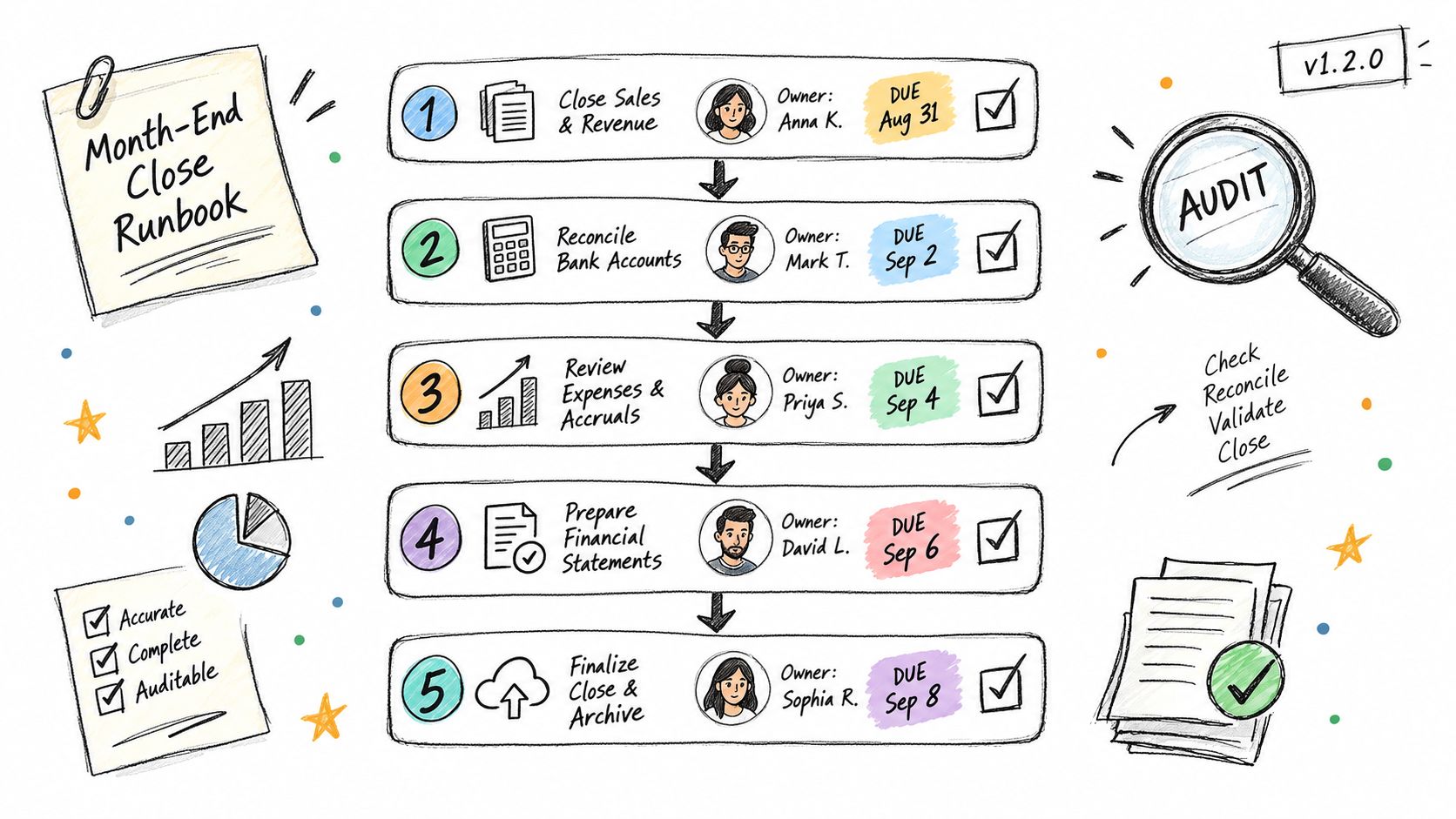
Predefined close checklists turn recurring accounting work into sequenced, auditable workflows. Each task needs an owner, dependency, due date, completion definition, and approval gate. The checklist becomes the source of truth instead of email threads, private spreadsheets, or tribal knowledge.
A runbook should specify the system, data source, action, expected result, and evidence required for every material step. That detail matters when a task fails. The owner should see whether the problem came from missing source data, a failed integration, an incomplete approval, or an accounting exception.
The standard close sequence includes pre-close preparation, period posting, cash and credit card reconciliation, balance sheet account reconciliation, adjusting entries, variance review, period lock, and financial package generation. A month-end close process guide describes this sequence as a set of checkpoints with clear sign-off paths.
Build the runbook from actual work
Start with the current close calendar. Extract every manual step, including report pulls, file transfers, spreadsheet updates, approvals, and follow-up messages. Map system-to-system handoffs. Mark where an accountant applies judgment and where a predefined rule is sufficient.
- Assign ownership: Give every task one accountable owner and one reviewer where control requires separation.
- Define dependencies: Prevent downstream work from starting before required data or approvals exist.
- Route delays: Send failures to Slack, Microsoft Teams, or email with the task, owner, cause, and next action.
- Version changes: Record what changed, who approved it, and why the change was necessary.
- Review quarterly: Compare the runbook with actual execution and remove steps that no longer reflect the process.
A static checklist records intent. A governed runbook records execution. That distinction is what makes the close repeatable and auditable.
2. Automated Reconciliation and Exception Flagging
Reconciliation automation should clear predictable matches and stop questionable ones for review. It compares balances, transactions, and subledger records against defined fields and tolerances. Each result should show both records, the rule applied, and the evidence retained for the close file.
Manual matching often hides logic in spreadsheets. A controlled reconciliation exposes the inputs, matching fields, tolerance settings, unmatched records, and final disposition. That visibility matters when an auditor asks why an item cleared or why an exception remained open.
High-volume, low-complexity matches can run automatically. Judgment-based exceptions should pause the workflow. Opaque automation that clears an unusual balance without an inspectable rule creates a faster control failure.
Practical rule: An automated match without a retained rule, input set, and exception record is only an unexplained result.
Begin with bank reconciliations, fixed asset roll-forwards, or accounts with stable transaction structures. Set tolerances from accounting policy and observed error patterns. Test proposed thresholds against known historical exceptions before allowing automatic clearance.
- Show mismatch context: Include transaction IDs, amounts, dates, entities, and the two records being compared.
- Log every run: Retain source inputs, matching logic, execution time, cleared items, and exceptions.
- Separate approval: Require a named reviewer for exceptions that affect material balances or reporting.
- Review thresholds: Document changes, the approver, and test results before deploying new tolerances.
- Track aging: Escalate unresolved exceptions by owner and due date before they block the close.
Use the cited Ventana Research coverage only as a lead for further research. It is secondary coverage, not a confirmed primary source. Remove any close-performance statistic unless the original Ventana Research publication has been verified. The reconciliation control should stand on its retained evidence, approval history, and exception resolution record.
3. Real-Time GL Posting and Journal Entry Automation
Real-time general ledger posting moves recurring accounting activity closer to the originating transaction. A billing event, cleared payment, lease milestone, or approved allocation can trigger a dated journal entry with its source record and business rule attached.
The strongest automation doesn’t post ambiguous transactions. It posts entries that have a defined account mapping, cost center treatment, period rule, approval path, and reversal method. The system should also validate the trial balance after posting and alert the owner when the ledger becomes out of balance.
Manual batching creates avoidable work at period end. Accountants gather source data, calculate recurring entries, copy values into templates, request approvals, and then investigate duplicate or missing postings. Deterministic posting replaces that sequence with a controlled event and an inspectable result.
A practical implementation should include:
- Source mapping: Connect each transaction type to approved GL accounts, dimensions, and entities.
- Rule versioning: Store the posting logic and change history as carefully as accounting policy.
- Reversal controls: Test corrections, reversals, duplicate prevention, and late-period changes.
- Approval gates: Route nonstandard entries and material adjustments to the appropriate reviewer.
- Balance checks: Validate account and trial balance integrity after every posting run.
Automated journal entries should be treated as governed accounting actions, not background system activity. Each entry needs a source reference, timestamp, rule version, approval record where required, and correction path.
The trade-off is important. Posting earlier improves visibility, but premature automation can spread a bad mapping across every transaction. Finance teams should automate only after the GL structure and source classifications are stable.
4. Contract-to-Cash and Revenue Recognition Automation
Contract-to-cash automation connects contract terms, billing events, revenue policy, and GL posting. Standard contract patterns can follow predefined rules. Ambiguous terms, incomplete data, or low-confidence extraction should route to a human reviewer before billing or recognition occurs.
Revenue automation fails when teams automate document reading without governing the accounting policy underneath. A parsed contract term isn’t an approved recognition rule. The workflow needs a clear interpretation path, a policy validation step, and an approval gate for exceptions.
A controlled design usually follows this sequence:
Contract intake → Term extraction → Confidence check → Policy validation → Approval → Billing trigger → Revenue schedule → GL posting
AI can assist with interpreting contract language. It shouldn’t decide how a nonstandard obligation affects revenue. A confidence threshold should determine when extracted data moves forward and when sales operations, legal, or technical accounting must review it.
- Start with standard terms: Automate recurring contract templates and established revenue patterns first.
- Define policy plainly: Translate ASC 606 or IFRS 15 requirements into documented business rules.
- Keep a source of truth: Store approved contract terms in the contract management system or CRM.
- Reconcile monthly: Compare extracted terms with billed and recognized revenue.
- Preserve approval evidence: Retain the contract version, extracted fields, reviewer, and final accounting treatment.
The practical benefit is earlier detection of contract and billing mismatches. The practical risk is systematic error when a policy rule is wrong. Finance leadership should approve the rule set, test it with representative contracts, and review changes through controlled release management.
5. Variance Analysis and Accrual Automation
Variance analysis automation identifies movements that require explanation. Accrual automation estimates recurring expenses using predefined policies and posts supported entries before the final review window. Together, they reduce detective work without removing judgment from material or unusual items.
A useful variance rule includes both relative and absolute context. A percentage change may look significant on a small balance. A large absolute movement may matter even when the percentage change is modest. The workflow should therefore route the amount, comparison basis, affected account, cost center, and supporting activity to the owner.
Accrual logic needs equal discipline. Each policy should state the business reason, trigger, source data, GL accounts, calculation method, reversal behavior, and approval requirement. Manual judgment can remain for unusual invoices or incomplete evidence, but recurring expenses shouldn’t depend on a month-end memory exercise.
A good accrual policy explains why the entry exists before it explains how the amount is calculated.
- Baseline patterns: Review historical activity before setting variance thresholds.
- Use source triggers: Tie accruals to usage, transaction counts, contractual dates, or approved schedules.
- Explain every entry: Retain the policy, input data, calculation, preparer, and reviewer.
- Compare next-period actuals: Measure estimated accruals against invoices or actual postings in the following period.
- Escalate exceptions: Route missing data, unusual movements, and policy breaches for human resolution.
The close becomes more reliable when accountants review explanations instead of rebuilding calculations. The control remains human where the business context is uncertain. Automation handles the repeatable arithmetic and evidence collection.
6. Intercompany Reconciliation and Elimination Automation
Intercompany automation matches receivables and payables across legal entities, identifies timing and coding differences, and prepares elimination entries for consolidation. Each entity can complete its local close while the consolidation workflow applies consistent matching and elimination rules.
Intercompany work is especially vulnerable to spreadsheet drift. One entity may use a different invoice number, account code, currency treatment, or posting date. A deterministic process exposes those differences instead of forcing the consolidation team to discover them during final review.
The workflow should distinguish an expected timing difference from a genuine disagreement. Matching logic can compare entity, counterparty, amount, currency, invoice reference, account, and posting date. Tolerances need documented approval because a tolerance that clears rounding differences may be unsafe for an incorrect account classification.
- Standardize coding: Use consistent intercompany account structures and invoice references.
- Define timing rules: Document how payment float, currency conversion, and late postings are handled.
- Use dedicated accounts: Separate intercompany balances and elimination accounts for auditability.
- Reconcile at GL level: Compare account balances as well as individual invoices.
- Work continuously: Resolve aging items during the month rather than accumulating them at close.
Human approval remains necessary for disputed charges, transfer pricing judgments, unusual allocations, and policy exceptions. The system can match and propose. The responsible controller still approves the treatment.
The result is a cleaner consolidation handoff. The close team sees unresolved items by entity and owner, rather than receiving a late spreadsheet that requires manual interpretation.
7. Bank and Cash Reconciliation Automation
Bank and cash reconciliation automation imports statements through approved connections, matches cleared transactions to GL cash accounts, and routes unmatched items for investigation. The output should be a reconciliation statement with outstanding items, supporting records, reviewer approval, and execution history.
Cash is a strong starting point because transaction references and statement records often support clear matching rules. The workflow can match amount, date, bank reference, account, currency, and internal invoice or payment identifiers. It should also distinguish deposits in transit, outstanding checks, bank fees, holds, and missing transactions.
A reliable process doesn’t auto-clear every unmatched record. It makes the reason for a proposed match visible and sends uncertain items to the cash owner.
- Start with active accounts: Prove the matching logic on the account with the highest operational value.
- Document outstanding items: Define expected clearing behavior and escalation conditions.
- Use reference fields: Combine bank references with internal invoice or payment identifiers.
- Set aging alerts: Escalate items that remain unresolved beyond the organization’s policy window.
- Review bank changes: Update rules when processing formats, fee structures, or statement fields change.
The payment reconciliation process should retain the statement, GL extract, matching rules, exceptions, and approval trail. Teams evaluating how to automate reconciliation should assess evidence capture alongside matching accuracy.
Cash automation reduces repetitive review. It doesn’t replace treasury judgment over restricted cash, unusual transfers, fraud indicators, or unresolved bank activity.
8. Fixed Asset and Depreciation Roll-Forward Automation
Fixed asset automation connects capital approval, procurement, asset registration, depreciation, disposals, and GL posting. The workflow applies predefined asset classes, useful lives, depreciation methods, and conventions. Missing fields or unusual asset treatments route to an accountant before posting.
Spreadsheet-based asset registers create control risk when additions, disposals, and depreciation schedules fall out of sync. A governed workflow links each asset record to its approval document and source transaction. The roll-forward then shows opening balance, additions, disposals, depreciation, transfers, and closing balance.
The accounting policy must be explicit before the calculation is automated. The system needs to know how mid-period additions are treated, when depreciation starts, how disposals reverse accumulated depreciation, and which assets require impairment review.
Keep asset policy ahead of close
The most effective control is to capture classification and useful-life data when the asset enters the process. Month-end should not be the first time the accounting team asks what an asset is or how it should depreciate.
- Classify consistently: Map asset classes to GL accounts and approved depreciation methods.
- Capture required fields: Require useful life, salvage value, location, owner, and approval evidence at addition.
- Define conventions: Apply the approved full-month, half-month, or actual-period convention consistently.
- Reconcile quarterly: Compare the asset register with fixed asset and accumulated depreciation GL accounts.
- Review estimates: Reassess useful lives when economic conditions or technical equipment changes.
Human review belongs with unusual capitalization, disposals, impairment indicators, and policy changes. Deterministic calculation belongs with recurring depreciation and standard roll-forwards.
A complete evidence trail protects both speed and auditability. The reviewer should be able to trace the GL entry back to the source approval and forward to the depreciation schedule.
9. Consolidated Financial Reporting and Management Reporting Automation
Consolidated reporting automation pulls subsidiary balances, applies approved consolidation rules, validates intercompany positions, and produces version-controlled financial statements. Management reporting can then present the same reconciled data by entity, geography, product, or business unit.
Consolidation becomes fragile when each subsidiary exports a different spreadsheet and the parent team performs manual mapping. A controlled workflow standardizes chart-of-accounts mappings, currency treatment, ownership rules, elimination entries, and reporting dimensions before the first production run.
The process should validate completeness before generating reports. Every subsidiary trial balance needs a documented status. Each consolidation adjustment needs a source, rule, preparer, reviewer, and posting destination. The consolidated trial balance should agree with the contributing entity balances and approved adjustments.
- Standardize mappings: Align subsidiary accounts and reporting dimensions before automating consolidation.
- Document policy: Translate equity method, revaluation, minority interest, and elimination rules into explicit logic.
- Run a dry test: Use actual data to expose mapping and policy gaps before production.
- Validate balances: Confirm that subsidiary totals, adjustments, and consolidated balances reconcile.
- Explain movement: Produce variance reports against approved comparison periods and route unusual movements.
Management reporting should extend the control environment, not create a separate unofficial version of the numbers. Commentary can remain human. The underlying figures should come from the reconciled reporting workflow.
A deterministic consolidated report is easier to defend because the team can trace each figure to a source balance or approved adjustment. That traceability matters when leadership, lenders, auditors, or regulators ask how a reported number was produced.
10. Deterministic Workflow Orchestration and Exception Routing
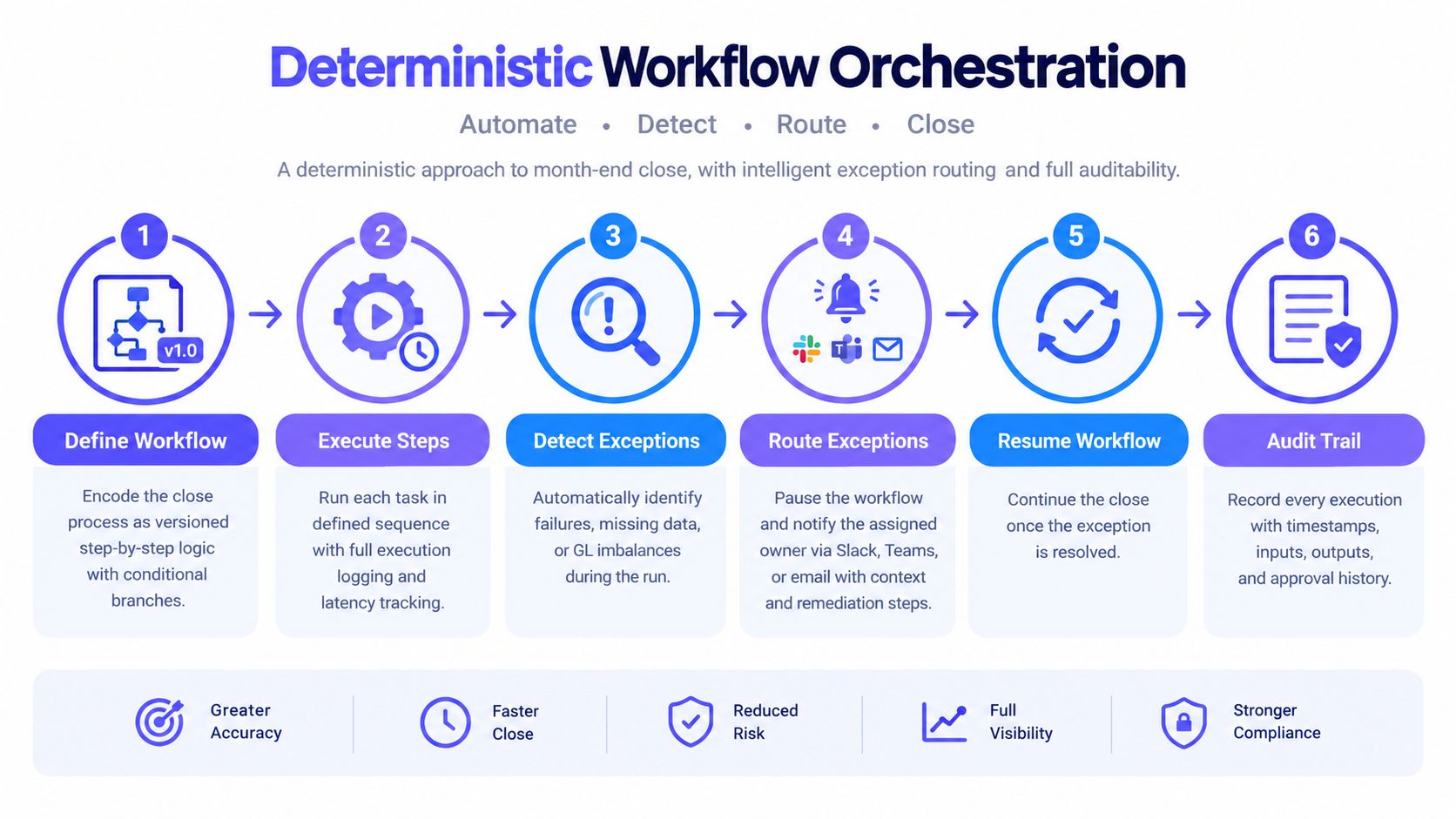
Deterministic workflow orchestration coordinates the entire close in a versioned sequence. Each step records inputs, outputs, timestamps, approvals, and exceptions. When a rule fails, the workflow pauses or branches and routes the issue to the accountable owner with enough context to resolve it.
Scripts and macros often work until a spreadsheet tab changes, a source system adds a field, or the person who wrote the logic leaves. Black-box AI agents create a different risk. They may interpret inputs flexibly, but finance teams can struggle to prove why a particular action occurred.
A deterministic workflow does the opposite. It runs predefined logic the same way each time. AI may assist with document interpretation, but confidence thresholds and human fallback prevent uncertain extraction from becoming an unreviewed accounting entry.
Route exceptions with useful context
An exception ticket should identify the failed step, entity, account, source records, rule applied, expected result, actual result, owner, and due date. “Reconciliation failed” isn’t an actionable control message. “The bank reference matched two payments with different amounts” is.
- Start linearly: Stabilize the standard path before adding complex branches.
- Name exception types: Separate missing data, GL imbalance, missing approval, mapping failure, and policy breach.
- Preserve execution trees: Record every action and system write, including failed attempts.
- Measure bottlenecks: Review latency, error rates, exception aging, and rework after each close.
- Release deliberately: Version workflows, document changes, and require approval before deployment.
Data orchestration platforms are useful only when orchestration preserves finance controls. The platform should make ownership visible without turning the workflow into an opaque technical dependency.
The supporting video illustrates a workflow-oriented approach to close operations.
Month-End Close: 10 Best Practices Comparison
| Item | Implementation complexity | Resource requirements | Expected outcomes | Ideal use cases | Key advantages |
|---|---|---|---|---|---|
| Predefined Close Checklists and Runbooks | Medium, document sequencing, dependencies, versioning | Process owners, checklist/runbook tool, time to document | More consistent closes; 15–30% cycle time reduction; auditable logs | Multi-entity closes, onboarding, controller handoffs | Reduces missed tasks and delays; provides audit trail; repeatable process |
| Automated Reconciliation and Exception Flagging | High, rules, matching logic, integrations | Clean master data, GL/subledger integrations, tuning of tolerances | 60–80% reduction in reconciliation touch time; 20–40% faster close | High-volume reconciliations (AR, subledgers), multi-currency environments | Early error detection; large manual-time savings; detailed exception context |
| Real-Time GL Posting and Journal Entry Automation | High, mapping rules, real-time integrations, policy alignment | Source system integrations, GL mapping governance, testing | 25–40% close reduction; 80–95% fewer manual journal entries; real-time visibility | Subscription billing, high-frequency transaction businesses | Continuous posting; reduced manual errors; traceable source-to-GL links |
| Contract-to-Cash and Revenue Recognition Automation | Very high, ML parsing, policy-as-code, end-to-end integrations | Contract management, billing and ERP integration, revenue accounting expertise | 30–50% revenue cycle reduction; 60–80% fewer revenue adjustments | Subscription/usage-based models, complex contract portfolios | Enforces ASC 606/IFRS15; reduces revenue leakage; audit-ready evidence |
| Variance Analysis and Accrual Automation | Medium–High, analytics, thresholds, accrual rules | Budget/forecast integration, operational data (payroll, utilities), GL links | 15–25% close reduction; 20–40% improved accrual accuracy | Retail, services with frequent accruals, FP&A-driven orgs | Faster variance detection; consistent accruals and automatic reversals |
| Intercompany Reconciliation and Elimination Automation | High, entity mapping, FX and timing rules, consolidation logic | Standardized intercompany processes, multi-entity integrations, agreed tolerance rules | 20–40% faster consolidation; 60–80% less reconciliation touch time | Multinationals, PE portfolios, shared service centers | Speeds consolidation; reduces manual elimination errors; supports independent closes |
| Bank and Cash Reconciliation Automation | Medium, bank connectivity and robust matching logic | Bank APIs or SFTP, accurate cash postings, multi-currency handling | 70–90% touch time reduction; cash closed within 2–3 business days | Treasury-heavy firms, fintechs, organizations with many bank accounts | Rapid cash reconciliation; fraud and timing issue detection; high auto-match rates |
| Fixed Asset and Depreciation Roll-Forward Automation | Medium, policy-driven calculations, procurement linkage | Procurement or capex workflows, asset classification policy, fixed-asset module | 80–95% reduction in depreciation close time; 30–50% better asset accuracy | Healthcare, manufacturing, real estate, asset-heavy companies | Single asset register; consistent depreciation application; audit-ready roll-forwards |
| Consolidated Financial Reporting and Management Reporting Automation | Very high, multi-ERP GL pulls, mapping, consolidation adjustments | Consolidation platform, standardized COA or mapping layer, FX and acquisition logic | 40–60% faster consolidation; 70–90% fewer reporting errors | Large multi-subsidiary groups, frequent acquisitions, investor reporting needs | Scales consolidation; traceability to source GL; faster management reporting |
| Deterministic Workflow Orchestration and Exception Routing | High, end-to-end workflow encoding, branching and observability | Workflow/orchestration platform, owners for exception routing, change governance | 25–40% close reduction; 30–50% improvement in first-time close | Organizations seeking auditable end-to-end close automation | Codifies close logic; eliminates key-person risk; detailed execution logs and routing |
Make the Close Repeatable, Then Make It Better
Month end close best practices work when implementation follows dependency order. A finance team shouldn’t begin with complex consolidation automation while task ownership, account mappings, and approval gates remain unclear. The controlled operating system comes first. Automation then removes repeatable work from a process that already has defined rules.
A practical rollout can use three phases.
The first 30 days establish control
The first phase documents the close calendar, owners, dependencies, approval gates, exception categories, and evidence requirements. The controller should identify every task that currently lives in a spreadsheet, email chain, or individual employee’s memory.
The team should also define what “complete” means for each reconciliation and journal entry. A strong control record includes the preparer, reviewer, date, supporting documents, and follow-up on reconciling items. Post-review adjustments should include a reason and approver. These control expectations are summarized in close-control guidance for staff accountants.
The baseline should include the current close duration, late tasks, reopened reconciliations, recurring adjustments, and unresolved exceptions. APQC’s benchmark defines close time from trial balance execution to consolidated financial statement completion, so the team should measure the same endpoints rather than use inconsistent local definitions.
The next 60 days automate recurring work
The second phase targets high-volume reconciliations, recurring postings, bank activity, accruals, and fixed-asset work. The team should select rules with stable inputs and clear expected outcomes. Ambiguous revenue contracts, disputed intercompany charges, and unusual manual journals should remain in controlled exception paths until their policies are clear.
Ventana Research found that 88% of companies applying a substantial amount of automation completed their close within six business days, compared with 50% using some automation and 40% using little or no automation, according to the cited historical research coverage. The source requires primary verification before publication, but the operational lesson is clear. Automation should reduce repeatable work throughout the month, not create a larger batch at the deadline.
The final 90 days orchestrate and govern
The third phase connects intercompany reconciliation, elimination, consolidation, and management reporting. The workflow should run parallel entity processes where appropriate, then trigger consolidation only after defined prerequisites pass.
Run logs should be reviewed after each close. Useful operational measures include latency, error rates, exception aging, reopened work, failed system writes, approval delays, and evidence completeness. These measures identify whether the workflow is improving or moving manual effort into a different queue.
Ownership must continue after launch. Finance engineers or designated process owners should update workflows when ERP fields, bank formats, accounting policies, or approval structures change. Every production change needs impact analysis, approval, version history, and a controlled release.
Loopfour can serve as one relevant option for this operating model. Its finance workflow automation approach uses governed workflows across existing ERP, CRM, billing, and document systems, with exception routing, approval gates, observability, and retained execution evidence.
Frequently asked questions
What are month-end close best practices?
Month-end close best practices are the controlled methods used to finalize financial records accurately, consistently, and on a defined schedule. They include predefined runbooks, continuous reconciliations, recurring journal automation, review thresholds, approval gates, exception routing, period locking, and retained evidence.
APQC defines close cycle time as the calendar days between running the trial balance and completing consolidated financial statements. A close process should therefore measure a consistent start and end point, not rely on informal estimates.
Which workflow should a finance team automate first?
A finance team should start with a high-volume, low-complexity workflow that has stable inputs and clear matching or posting rules. Bank reconciliation, recurring journal entries, fixed-asset depreciation, and routine accruals are common starting points.
The first workflow should also produce useful evidence. A successful pilot records source data, rule execution, exceptions, approvals, and the final system write. Teams should avoid automating ambiguous accounting treatment before the policy and ownership are documented.
How does deterministic automation differ from AI agents?
Deterministic automation executes predefined logic in a known sequence and records each input, output, and decision path. An AI agent may interpret information flexibly, but its reasoning and resulting action can be harder to reproduce or audit.
AI can support narrow interpretation tasks, such as extracting contract fields, when confidence thresholds and human fallback exist. Posting, approval, period locking, and exception disposition should remain governed by explicit rules and accountable humans.
What audit evidence should a month-end close retain?
A month-end close should retain the task definition, source data, reconciliation logic, journal entry support, preparer, reviewer, timestamps, approvals, exceptions, corrections, and system-write results. Each reconciliation should show its supporting documents and follow-up on reconciling items.
Post-review adjustments should include a reason and approver. Evidence should be captured during execution, not assembled after the close when records may be incomplete.
How should close exceptions be routed?
Close exceptions should be categorized by cause, assigned to a named owner, and sent with the affected entity, account, source records, rule, expected result, actual result, and due date. Missing data, GL imbalance, missing approval, mapping failure, and policy breach should have distinct routes.
The workflow should pause or branch when an exception affects a controlled step. A reviewer should resolve the issue, document the action, and approve the resumed execution where required.
Who owns month-end close workflow maintenance?
The controller or finance operations leader should own accounting policy and control decisions. A finance engineering or workflow operations owner should maintain integrations, rule versions, monitoring, and deployment controls.
The owner should review run logs, exception aging, system changes, and policy updates regularly. Workflow maintenance isn’t optional. An unmaintained automation layer becomes the next brittle script.
The final publication should carry a real named author with a one-line finance operations credential. Every external claim should use a verified primary source, and supplied benchmark references should be checked before release.
Loopfour offers deterministic month-end close workflows for checklists, reconciliations, journal entries, approvals, exception routing, and execution evidence across the systems a finance team already uses. Visit Loopfour to evaluate a governed approach to finance workflow automation and build a close that is faster, repeatable, and ready for audit.