
The popular advice says finance teams should automate anything repetitive and let AI agents handle the messy parts. That advice is incomplete. Workflow and process automation in finance should automate deterministic execution first, then use AI only where interpretation is necessary and a human can intervene. Your auditors don’t need a clever agent. They need to see what happened, who approved it, which rules applied, and whether the final state is correct.
The distinction matters because finance automation has reached broad adoption without reaching consistent control maturity. 95% of finance respondents have some automation in place, yet only about 40% have automated budgeting, forecasting, consolidation, and close, while 76% have automated financial reporting, according to the State of Strategic Finance report from Vena. Automation exists. The difficult work is deciding which processes should run without interpretation and which should pause for a credentialed decision.
A practical finance architecture therefore treats automation as FinOps infrastructure. It connects ERP, CRM, billing, and document systems. It executes predefined rules. It records every handoff and exception. It preserves enough evidence for control testing, root-cause analysis, and audit reconstruction.
Table of Contents
- The Audit Reality of Finance Automation
- Deterministic Code Versus Agentic AI
- Governance and Auditability Requirements
- Connecting Fragmented Financial Systems
- Exception Handling and Human Approvals
- Implementation Patterns for Finance Teams
- Frequently Asked Questions
- How can finance teams prove workflow control health to external auditors?
- What happens when the original script author leaves the company?
- Which finance workflows should remain human-in-the-loop?
- How should finance teams measure ROI beyond time savings?
- Can workflow automation connect legacy finance systems without APIs?
- Is AI safe for finance workflow automation?
The Audit Reality of Finance Automation
Finance automation is audit-grade only when execution, ownership, and evidence are designed together. A script that moves a file or sends an approval request may save effort, but it doesn’t automatically prove that the right data was used or that the right person authorized the outcome.
Finance workflow automation turns repeatable work into a controlled sequence of triggers, data movements, approvals, system writes, and exception routes. The Process Street explanation of finance automation describes the practical requirement clearly: teams need evidence of who approved work, which evidence was attached, which policy applied, and where exceptions were handled. That evidence belongs in the operating model, not in a folder assembled before an audit.
Adoption does not equal depth
The finance benchmark is revealing. Only about 40% of respondents have automated budgeting, forecasting, consolidation, and close, and only 2% report fully automated consolidation, according to Vena’s finance survey. Meanwhile, 89% of finance teams still rely on Excel for modeling, calculations, analysis, and budget collection.
That combination exposes the core problem. Finance teams don’t lack isolated automations. They lack governed orchestration across the processes where spreadsheets, judgment, system handoffs, and audit evidence intersect.
Consolidation does the problem: it depends on recurring data collection, spreadsheet adjustments, entity-level review, eliminations, and final validation.
Deterministic orchestration does the solution instead: it defines each input, validates each transformation, records each approval, and stops when a required condition isn’t met.
The global business process automation market was valued at US$16.9 billion in 2026 and is projected to reach US$34.3 billion by 2033, with a projected 10.6% compound annual growth rate, according to Mordor Intelligence’s process automation market analysis. The market’s expansion reflects demand for efficiency, error reduction, and scalability. Finance leaders should add a fourth criterion, control survivability.
What survives control testing
A defensible automated workflow captures:
- The trigger: The event that started the run, such as an invoice receipt or approved contract.
- The handoffs: Every transfer between finance staff, systems, and approval queues.
- The systems touched: ERP, CRM, billing, document storage, and communication tools.
- The decision trail: Applied policies, approval records, and rejected actions.
- The final state: A verifiable check that the intended record, posting, or status exists.
Task scripting focuses on completion. Governance-grade orchestration focuses on completion plus proof. That difference is where many finance automation programs either mature or become another source of control risk.
Deterministic Code Versus Agentic AI
Deterministic code is the safer execution layer for finance, while agentic AI belongs in bounded interpretation tasks. A deterministic workflow follows versioned, predefined steps. An agentic system may select actions based on probabilistic reasoning, which creates uncertainty around repeatability, authorization, and evidence.
A finance team can use AI to extract a payment term from a contract or classify an invoice. The AI output should face a confidence threshold, policy validation, and human fallback before it changes a ledger or triggers a payment. The Loopfour analysis of AI agent security provides useful context for separating interpretation from privileged execution.
Automation Approaches in Finance
| Feature | Deterministic Code (Loopfour) | Agentic AI |
|---|---|---|
| Execution | Runs predefined, versioned steps | Selects actions based on probabilistic reasoning |
| Best use | Posting, reconciliation rules, routing, approvals, and validations | Document interpretation, classification, and anomaly triage |
| Repeatability | Same inputs and version produce the defined path | Similar inputs may produce different paths |
| Evidence | Captures execution trees, writes, approvals, and exceptions | Requires additional controls to explain decisions and actions |
| Failure behavior | Stops or routes to a predefined exception queue | May retry, improvise, or choose an unplanned path |
| Human role | Defined at explicit approval gates | Often introduced after the system has already interpreted or acted |
| Finance risk | Configuration and data risk remain visible and reviewable | Authorization, explainability, and scope can become ambiguous |
Where AI belongs
AI is useful when the underlying task requires interpretation. Contract clauses, invoice descriptions, and unstructured correspondence often contain information that rules alone can’t easily extract. That doesn’t make AI suitable for posting, approving, or changing master data without controls.
A controlled pattern looks like this:
- AI interprets: The system extracts a term or proposes a classification.
- Policy validates: Deterministic rules check required fields, thresholds, dates, and permitted values.
- Human decides: An authorized reviewer resolves low-confidence or high-impact cases.
- Workflow executes: Programmatic code performs the approved system action.
- Evidence closes the loop: The run stores the input, interpretation, approval, action, and final-state check.
Practical rule: Use probabilistic systems to propose meaning. Use deterministic systems to enforce financial consequences.
The distinction protects more than auditability. It protects operational clarity. When a payment fails, a controller should be able to identify the exact rule, version, approval, and system response involved. “The agent decided” isn’t a useful root cause.
Governance and Auditability Requirements
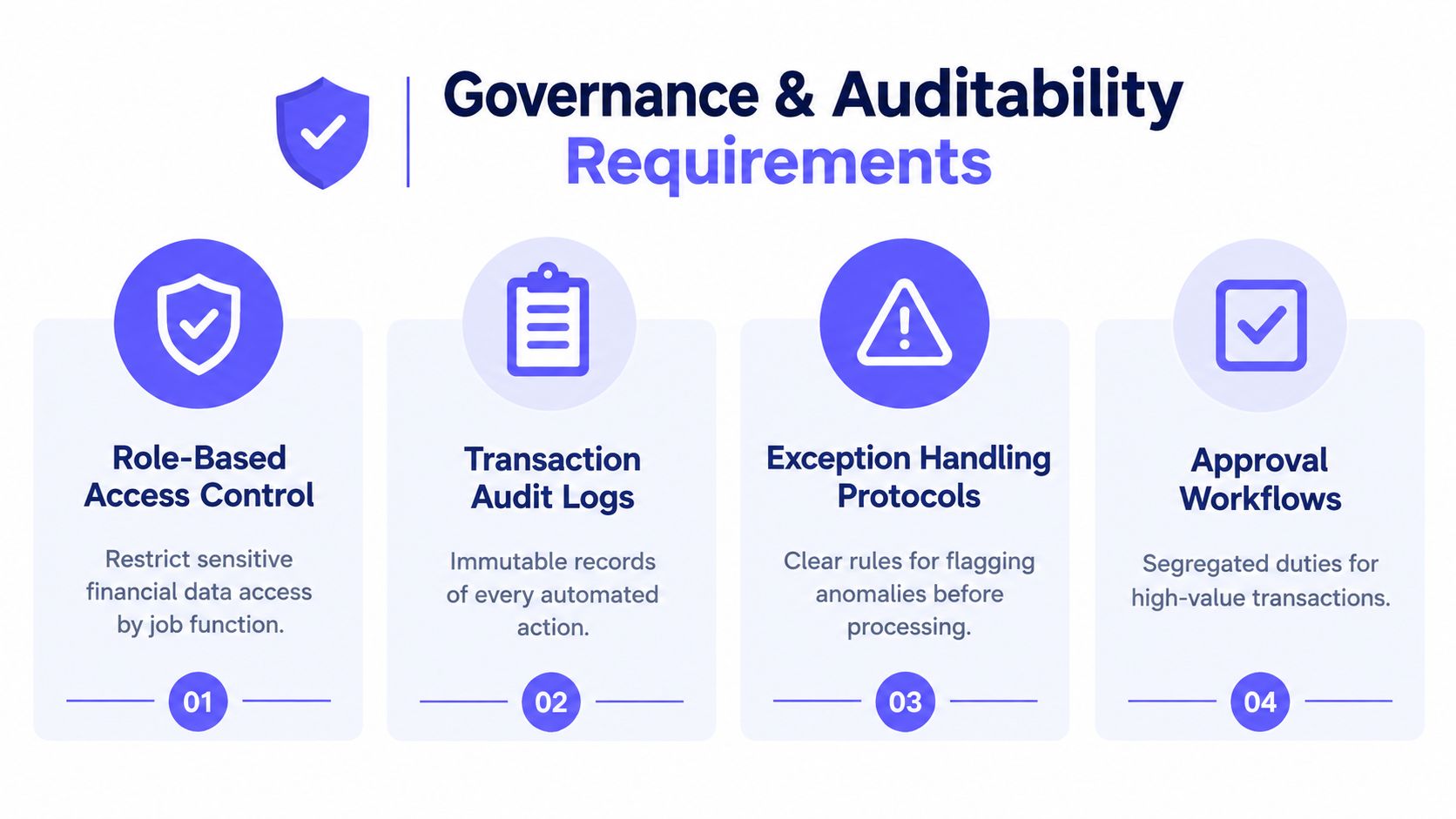
A finance workflow isn’t governed until every privileged action has an owner, an authorization path, an immutable record, and a post-action check. Successful task completion doesn’t prove control effectiveness. A payment can be created correctly and still violate segregation of duties.
The workflow governance guidance from NHIMG emphasizes evidence, ownership, and verifiable outcomes. Structured logs, immutable timestamps, policy decisions, approval records, and final-state validation let auditors reconstruct what happened without relying on employee memory or manually assembled screenshots.
Four controls that carry the load
Role-based access control restricts workflow design, execution, approval, and administration according to job function. A preparer shouldn’t automatically gain permission to modify the rule that evaluates the preparer’s work.
Approval matrices translate policy into executable routing. The matrix should identify the required role, applicable condition, approval scope, and expiration. A generic “manager approval” field is weaker than a named role with a defined authority boundary.
Tamper-evident logs preserve the sequence of events. Logs should record the actor, service, timestamp, input reference, decision, output, and resulting system state. Changes to workflow definitions should also have a visible history.
Segregation of duties separates incompatible actions. Workflow configuration, data preparation, approval, payment release, and exception override should not collapse into one unrestricted account.
The Loopfour guide to automation in finance is relevant to this operating model because finance automation must connect execution with controls rather than treating compliance as a separate reporting task.
Evidence before efficiency
A control owner should be able to answer five questions for every material run:
- Who owned the step?
- What rule or policy applied?
- What evidence entered the workflow?
- Who approved or rejected the action?
- What final-state check confirmed the result?
Control health can then be evaluated through cycle time, first-pass approval rate, SLA compliance, rework rate, data completeness, and evidence-retention quality. These measures don’t replace control testing. They show where the control is weakening before an audit sample exposes the problem.
Operational success says the task finished. Control success says the organization can prove that the task finished correctly and with proper authority.
Connecting Fragmented Financial Systems
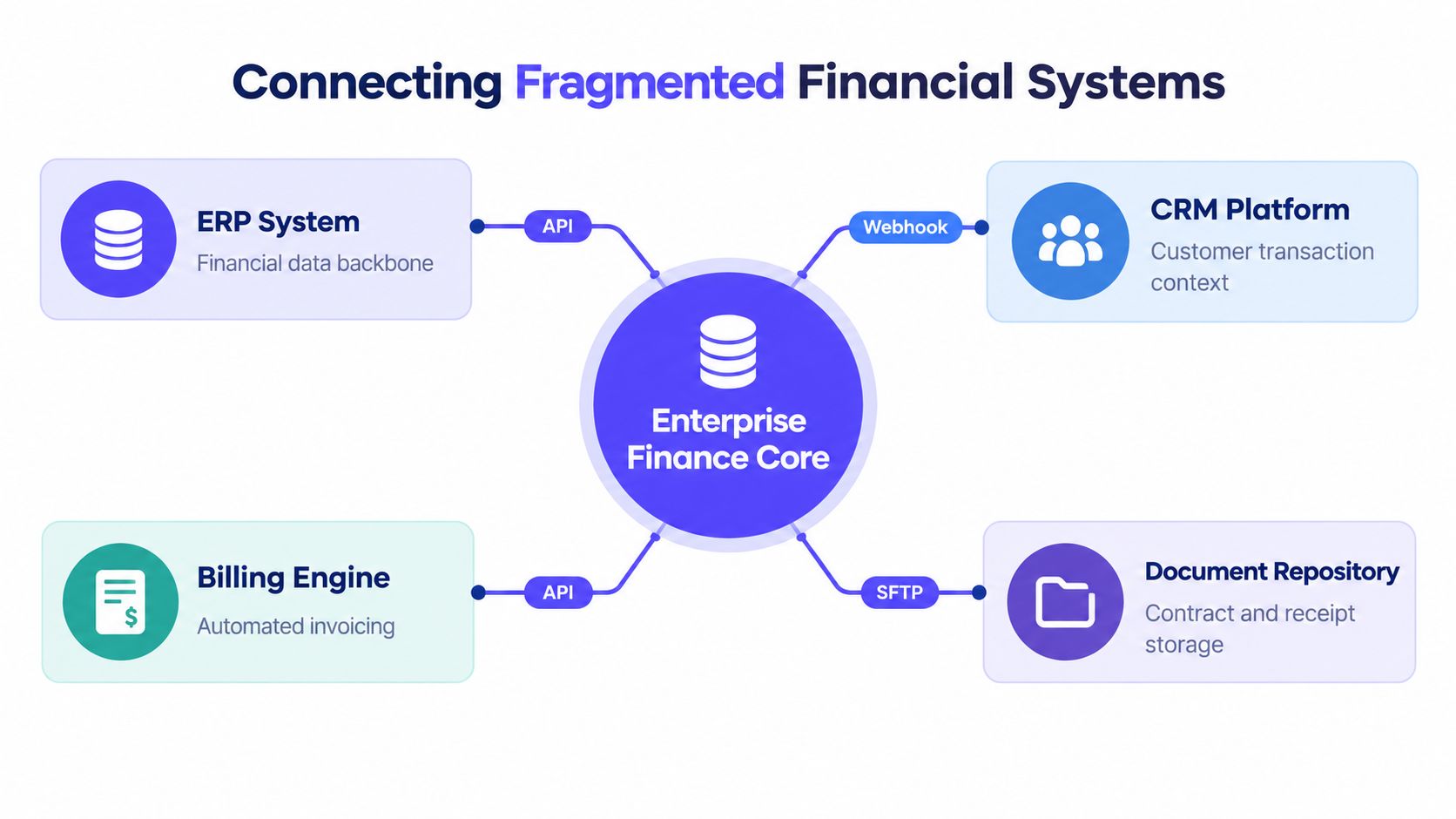
Reliable finance automation connects the systems a company already uses instead of assuming a clean, unified stack. Native API connectors should handle stable integrations. Secure browser automation can bridge homegrown or legacy systems that lack usable APIs.
A widely cited benchmark reports that only 27% of the average organization’s 957 applications are connected, while 78% of U.S. enterprises struggle to fit AI into existing systems, according to the workflow automation statistics compiled by Docsumo. Fragmentation is therefore an architectural fact, not an edge case.
A practical integration sequence
Start with the system of record for each object. The ERP may own the journal entry. The CRM may own customer context. The billing engine may own invoice state. A document repository may hold contracts and receipts. The workflow should define these boundaries before moving data.
Next, prefer native connectors for systems such as Workday, NetSuite, Sage Intacct, Salesforce, and Stripe. API-based connections usually provide clearer schemas, explicit authentication, and more stable error handling than screen-level interaction.
Then define the data contract. A workflow should specify required fields, identifiers, formats, permitted values, and idempotency behavior. Without those rules, the integration can create duplicate customers, overwrite valid changes, or post incomplete transactions.
When APIs aren’t enough
Legacy finance tools often lack a modern API. A controlled browser session can still automate them, but only if the session is governed. The workflow should use restricted credentials, record the page-level action, preserve timestamps, and verify the resulting state in the destination system.
Browser automation shouldn’t imitate a human invisibly. It should behave like a controlled adapter with explicit permissions and a recoverable execution record.
A data orchestration platform architecture helps teams think in terms of movement, validation, and observability rather than isolated app connections. The useful question isn’t whether every tool has a connector. It’s whether every critical handoff has a defined owner, an accepted data shape, and a failure route.
Exception Handling and Human Approvals
Exception handling should be designed before deployment, because finance failures are often business-semantic rather than technical. A missing API response is visible. A contract term that conflicts with billing policy can look valid until it creates the wrong revenue outcome.
Process-support research identifies both technical breakdowns and business-semantic exceptions as failure sources. The ACM workflow research reference supports a practical design: instrument the ideal flow with sentinels that detect failure modes, classify the exception, and route it to a predefined resolution strategy.
Classify before routing
A useful exception model separates:
- Technical failure: API timeout, authentication error, unavailable system, or malformed response.
- Data failure: Missing identifier, invalid currency, duplicate record, or incomplete required field.
- Policy failure: Approval threshold, segregation-of-duties conflict, or prohibited posting condition.
- Semantic failure: Contract language, invoice interpretation, or transaction context that rules can’t safely resolve.
Each class needs a different owner. Technical failures may go to finance engineering. Data failures may return to the preparer. Policy failures belong with the control owner. Semantic failures may require an accounting reviewer.
Control boundary: An exception queue is part of the workflow, not a parking lot outside it.
Human approval with a defined scope
Human-in-the-loop architecture should pause automation at an exact point, show the relevant evidence, request a credentialed decision, and continue only after valid approval. The human-in-the-loop workflow architecture guidance defines the approval boundary around one action, one version, one recipient, one parameter set, one reviewer, one condition, and one expiration.
Slack, Microsoft Teams, or email can deliver the request. The approval record still belongs in the workflow’s evidence trail. A message reaction alone is weak evidence if the system can’t bind that action to the precise transaction and version being approved.
The strongest pattern is conservative. Automation handles the normal path. Sentinels detect deviations. The workflow pauses before the financial consequence. A qualified person resolves the exception. Deterministic code resumes only with the recorded decision and a final-state validation.
Implementation Patterns for Finance Teams
Finance teams should begin with recurring, exception-heavy workflows where evidence matters more than novelty. Accounts payable, contract-to-cash, payment reconciliation, and month-end close are strong candidates because each crosses systems and creates a visible control trail.
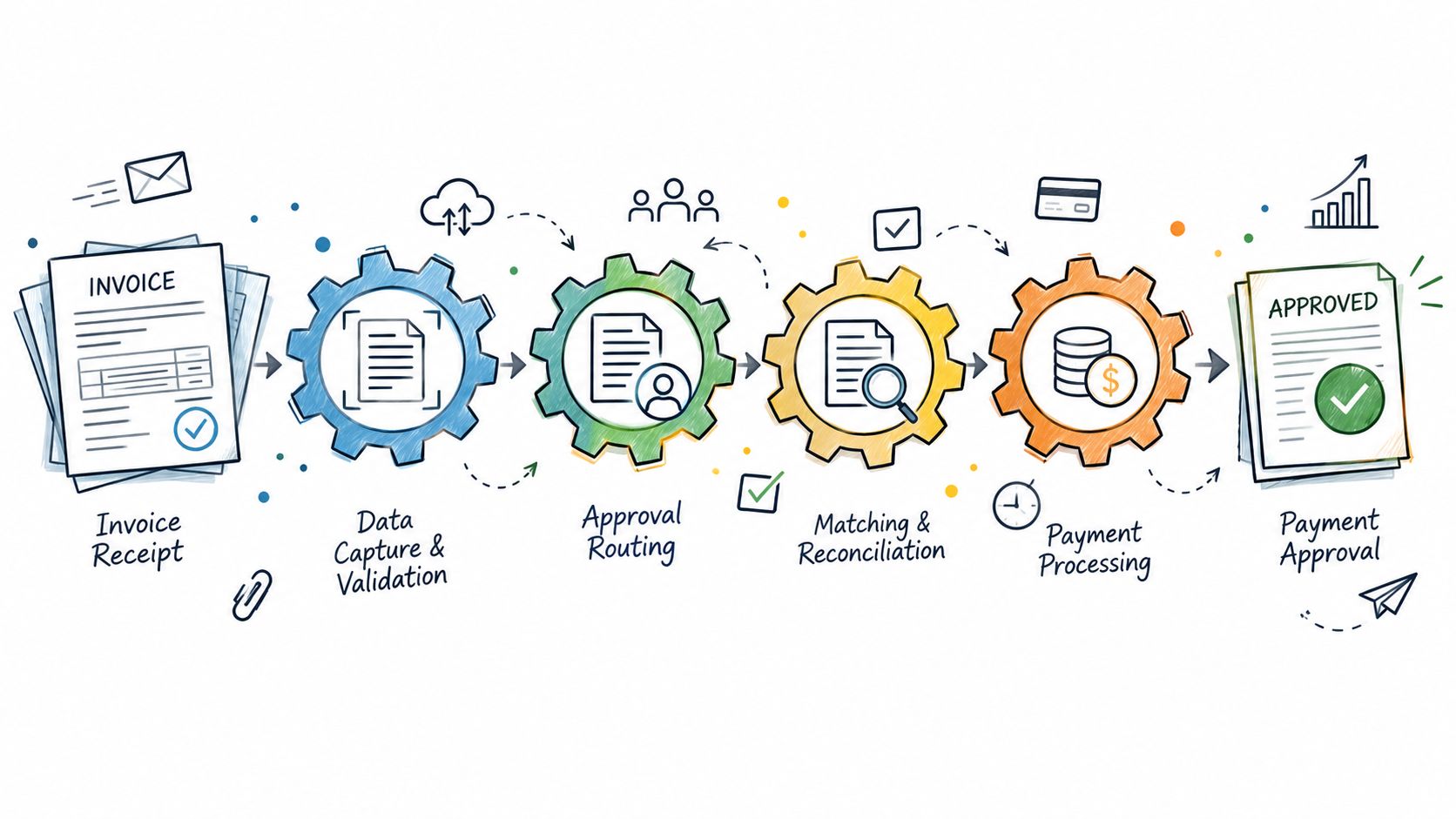
The implementation starts with a process map. Each map should name the trigger, source record, transformations, approvals, writes, exceptions, and final-state check. The team should document the current process before automating it, because automating an unclear process only makes confusion execute faster.
Accounts payable and reconciliation
An accounts payable workflow can begin when a document enters a repository. Deterministic steps can identify the vendor, validate required fields, check duplicate references, apply approval routing, and prepare the accounting action. AI may extract a purchase order or payment term, but policy rules and human fallback should control uncertain results.
Payment reconciliation follows a different pattern. The workflow matches bank activity against open receivables, applies explicit tolerances, routes unmatched items, and records the resolution. The value isn’t just reduced touch time. The workflow creates a consistent explanation for each matched or unresolved item.
Contract-to-cash and close
Contract-to-cash workflows can extract relevant terms, validate them against billing policy, and synchronize approved values across CRM, billing, and ERP. This addresses revenue leakage caused by inconsistent contract ingestion without allowing an interpretation engine to post unsupported terms directly.
Month-end close benefits from dependency management. The workflow can track which schedules are complete, identify missing inputs, route review items, and preserve sign-offs. Controllers still own accounting judgment. Automation provides the sequence, evidence, and escalation path.
Loopfour, the deterministic finance workflow automation platform, provides Loopfour Studio, a visual workflow builder for recurring finance operations, with predefined execution, exception routing, approvals, observability, and evidence capture across existing finance tools.
Maintenance is part of the design
Upstream systems change. Fields are renamed. Approval policies evolve. Vendors alter document formats. A workflow without an owner and change process becomes another fragile script.
Finance engineers should review workflow definitions, test dependencies, approve changes, and retain version history. Impact analysis should identify affected processes before deployment. A rollback path should exist for material changes. The operating model must treat maintenance as control work, not optional support.
Frequently Asked Questions
How can finance teams prove workflow control health to external auditors?
Finance teams should provide execution logs, approval records, policy decisions, exception histories, timestamps, access records, and final-state validation. A control owner should connect each sample to the workflow version and evidence that shows who acted, why the action was permitted, and whether the resulting record was correct.
What happens when the original script author leaves the company?
Key-person risk falls when workflows use versioned definitions, documented ownership, approval gates, and centralized change history. The replacement owner should be able to inspect the workflow, understand dependencies, review prior changes, and test a controlled release without reconstructing private scripts or undocumented prompts.
Which finance workflows should remain human-in-the-loop?
Human review should remain for ambiguous contract terms, unusual revenue treatments, policy overrides, high-impact exceptions, and decisions requiring accounting judgment. Deterministic automation should prepare the evidence and enforce the pause. The reviewer should approve one defined action under one defined version and condition.
How should finance teams measure ROI beyond time savings?
Measure cycle time, first-pass approval rate, SLA compliance, rework rate, data completeness, exception aging, and evidence quality. These measures show whether automation improves control performance and process reliability, not merely whether employees spend fewer minutes moving data.
Can workflow automation connect legacy finance systems without APIs?
Yes, secure browser automation can bridge systems without usable APIs. The session must use controlled permissions, preserve action logs, handle failure states, and verify the resulting system state. Browser automation without governance is only hidden manual work.
Is AI safe for finance workflow automation?
AI can be appropriate for bounded interpretation, such as document parsing or classification, when confidence thresholds, deterministic validation, and human fallback exist. AI should not independently improvise privileged financial actions that require predictable execution and auditable authorization.
Loopfour offers deterministic finance workflows, Loopfour Studio, governed approvals, exception routing, system connectors, secure browser automation, and execution evidence for audit-sensitive operations. Finance leaders can review how those capabilities apply to AP, reconciliation, contract-to-cash, and close by visiting Loopfour.