
The most dangerous AI agent in finance isn’t necessarily the one that gets jailbroken. It’s the one nobody can identify, scope, or retire. A 2026 Cloud Security Alliance survey found that 82% of enterprises had unknown AI agents operating in their IT environments, while only 21% had formal decommissioning processes. AI agent security in finance is therefore an identity, authorization, and audit-evidence problem before it’s a model-safety problem.
A finance agent has credentials, permissions, tools, and potentially write access to an ERP, ledger, banking API, document store, or email account. Your auditors want more than a plausible answer. They want to know who authorized the action, which policy applied, what evidence the agent used, what changed, and whether the result can be replayed.
The practical answer is clear. Keep probabilistic AI inside bounded interpretation tasks. Use deterministic, auditable code for close, reconciliation, approvals, and disbursement. This distinction separates a useful assistant from an uncontrolled service account with a conversational interface.
Table of Contents
- What AI Agent Security Means for Finance Teams
- The Four Risks That Hit Finance Hardest
- Why Prompt Injection and Agent Trust Are the Dominant Attack Surface
- Why Probabilistic Agents Fail Audit by Design
- Mitigation Patterns That Actually Work in Production
- The Deterministic Alternative for Finance Operations
- A Governance Checklist Before You Let an Agent Write to Your Ledger
- Putting It Together and Answering Common Questions
- How quickly can an agent incident become an audit finding?
- Can a vendor absorb liability for an agent mistake?
- What evidence satisfies SOX and SOC 1 auditors?
- Can retrieval be made safe enough for finance?
- When should finance use a deterministic workflow with narrow LLM assistance?
- What should happen to an agent that cannot meet the checklist?
What AI Agent Security Means for Finance Teams
AI agent security for finance teams means controlling identity, authorization, and audit evidence across every system an agent can access. Generic LLM safety addresses harmful outputs. Finance controls must also address credentials, transaction scope, state changes, and reproducibility.
An AI agent is software acting under an identity. The identity might represent a human, a service account, or a dedicated non-human principal. The risk surface follows the permissions and tools attached to that identity. A reporting agent with access to NetSuite, Workday, a banking API, and vendor documents doesn’t remain a reporting risk if its token can also edit suppliers or initiate payments.
Traditional RPA usually invokes predefined steps. The same input follows the same route unless a rule or configuration changes. An agent can interpret context, select tools, retrieve documents, and alter its next action. That flexibility creates a control-plane problem.
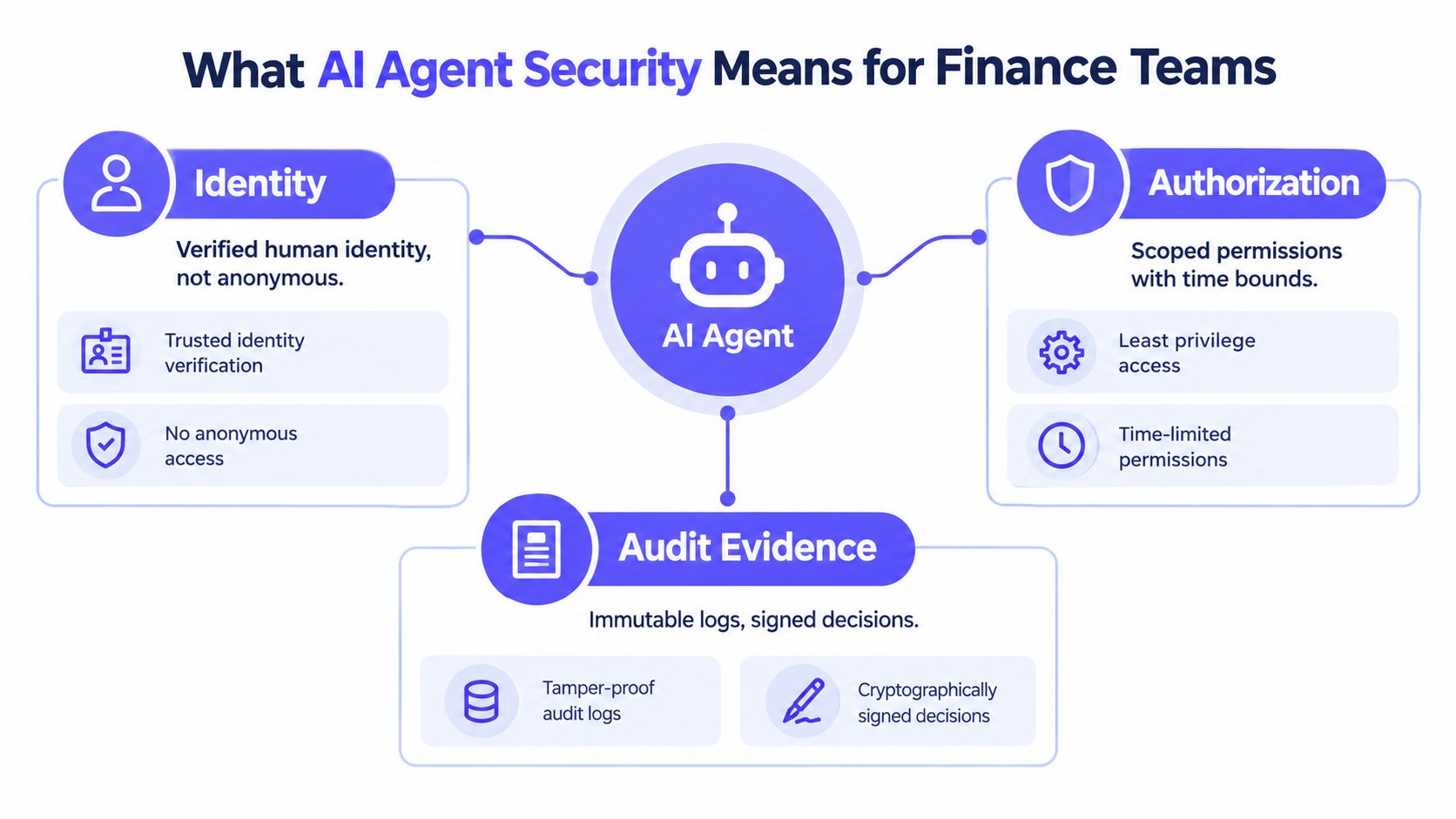
The three questions finance leaders should ask
- Identity: Which human or system approved the agent, and which non-human identity authenticated each action?
- Authorization: Which tools, records, and state changes were allowed for the specific task?
- Audit evidence: Can the team reconstruct the inputs, retrieved context, decision, approval, and resulting write?
OWASP guidance recommends minimum tool access, sanitized memory, session isolation, expiration limits, sensitive-data checks before persistence, and cryptographic integrity checks for long-term memory. OWASP also calls for logs covering agent decisions, tool calls, and outcomes in its AI Agent Security Cheat Sheet.
Finance leaders evaluating implementations should also examine encryption and access control for agents, particularly where agents cross tenant, document, or application boundaries. The control objective is simple: every action needs a known principal, a bounded purpose, and evidence that survives review.
The Four Risks That Hit Finance Hardest
Finance teams face four material AI agent risks: privilege escalation, data exfiltration, hallucinated writes, and persistent unsanctioned agents. Each risk becomes an audit problem when the organization can’t prove exactly what the agent saw, decided, and changed.
The 2026 Cloud Security Alliance survey reported AI agent-related incidents at 65% of enterprises during the previous 12 months. Among those incidents, 61% involved data exposure, 43% caused operational disruption, and 35% led to financial losses. The figures don’t describe a single finance workflow, but they show why finance cannot treat agents as harmless productivity software.
| Risk Class | Finance Scenario | Audit Consequence |
|---|---|---|
| Privilege escalation | A read-only reporting agent inherits a user’s broad token, chains into an ERP tool, and edits vendor banking details. | Access reviews cannot demonstrate least privilege. The resulting master-data change may lack an approved control owner. |
| Data exfiltration | An invoice agent retrieves contract terms and sends sensitive payment data to an external enrichment endpoint. | Confidential data leaves the controlled boundary, while evidence may omit the original retrieval rationale. |
| Hallucinated writes | An agent misreads an invoice or variance and creates a journal entry that looks internally consistent. | A reviewer sees a valid-looking posting without a reproducible link to source evidence, policy, and approval. |
| Persistent unsanctioned agents | A pilot agent remains active after its sponsor leaves and keeps its credentials in a production environment. | The organization can’t establish ownership, retirement, or the completeness of access recertification. |
Why the fourth risk deserves more attention
Security teams often focus on deployment. Finance teams must focus on lifecycle control. The Cloud Security Alliance found that only 21% of organizations had formal AI agent decommissioning processes. An agent that remains connected after its business purpose ends is an unmanaged identity, not a completed project.
A controller should require an owner, expiry condition, permission review, and kill switch before production use. If those artifacts don’t exist, the agent shouldn’t touch the ledger.
Control principle: A finance agent isn’t production-ready until its identity can be inventoried, its permissions can be recertified, and its final action can be reconstructed.
Why Prompt Injection and Agent Trust Are the Dominant Attack Surface
Prompt injection, retrieval backdoors, and inter-agent trust exploits dominate AI agent security because agents treat external content as part of the operating context. An invoice PDF, vendor email, browser page, or retrieved document can carry instructions that redirect tool use.
Research published in 2026 evaluated state-of-the-art LLM agents and reported that 94.4% were vulnerable to prompt injection, 83.3% to retrieval-based backdoors, and 100% to inter-agent trust exploits in the evaluated systems. The findings place the risk inside the agent operating model, including tools, memory, retrieval, and delegation.
The attack doesn’t need to resemble a user prompt. A malicious instruction can sit inside a document the agent was asked to summarize. Retrieval poisoning can corrupt the content the agent uses for grounding. A delegated agent can then trust a compromised recommendation because the workflow treats another agent as authoritative.
| Attack Vector | Reported Success Rate | Finance Impact |
|---|---|---|
| Prompt injection | 94.4% vulnerable in the 2026 evaluation | A vendor document redirects an agent from classification to an unauthorized tool call. |
| Retrieval-based backdoor | 83.3% vulnerable in the 2026 evaluation | Poisoned retrieval content changes the basis for a payment or accounting decision. |
| Inter-agent trust exploit | 100% vulnerable in the 2026 evaluation | A compromised specialist agent persuades a downstream agent to access data or act outside scope. |
A separate study of 17 state-of-the-art models found 41.2% vulnerable to direct prompt injection, 52.9% to RAG backdoor attacks, and 82.4% to inter-agent trust exploitation. The study reported that 94.1% were vulnerable to at least one vector and that malicious instructions could coerce agents into installing and executing malware on victim machines. The findings appear in the agent security evaluation.
The finance implication is blunt. An agent that reads untrusted content and writes to a ledger is a standing compromise risk unless the workflow isolates retrieval, constrains tools, and requires approval before state changes.
Why Probabilistic Agents Fail Audit by Design
Probabilistic agents fail audit when they own a material finance decision because identical inputs can produce different outputs. Audit requires reproducibility, controlled change, and a defensible path from evidence to action. A language model’s plausible explanation isn’t a substitute for that path.
A reconciliation agent may interpret the same ledger export differently after a model update, prompt change, or altered retrieval result. Temperature settings don’t create deterministic business logic. A thicker log file doesn’t prove that the logged context was complete, unchanged, or sufficient to reproduce the decision.
The problem has three parts:
- Non-repeatable decisions: The same evidence can yield different classifications, matches, or proposed entries.
- Weak causal traceability: A token sequence doesn’t naturally expose the exact rule that caused a journal entry.
- Uncontrolled behavior drift: Model, prompt, tool, and retrieval changes can alter production outcomes without changing the finance policy.
What auditors need instead
Auditors need versioned rules, identifiable approvals, preserved source evidence, and before-and-after state. They need to determine whether the action complied with the policy active at the time, not whether the agent’s answer sounded reasonable.
Microsoft’s NIST-based governance guidance recommends logging the full Thought to Tool Call to Observation to Response chain for forensic review. It also recommends restricted sandboxes for code execution, output validation against expected API schemas, and intent guardrails for destructive commands. Finance teams can use audit logging best practices for cloud security as a practical reference when assessing log completeness.
Audit test: If an independent reviewer can’t replay the decision from preserved inputs, policy version, approvals, and outputs, the workflow has an explanation. It doesn’t yet have evidence.
AI still has a place. It can extract invoice fields, classify ambiguous documents, or summarize variance drivers. The production path should reserve irreversible actions for predefined logic and explicit approvals.
Mitigation Patterns That Actually Work in Production
Production-grade AI agent security requires layered controls across identity, input, tools, memory, outputs, and human approval. No single prompt filter can protect a finance workflow that combines untrusted content, sensitive data, and state-changing tools.
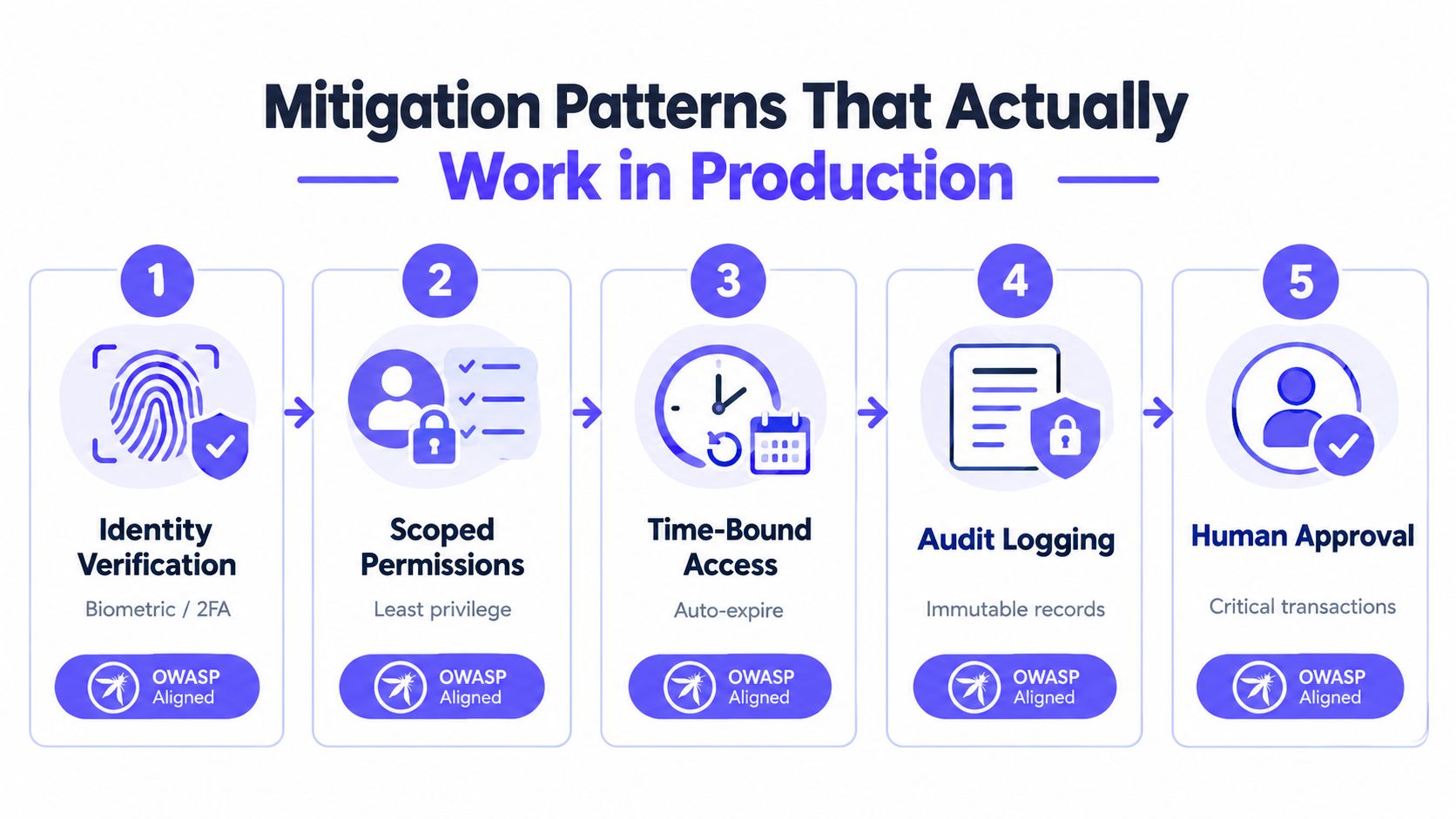
OWASP recommends minimum necessary tools, memory validation, session isolation, memory limits, expiration, sensitive-data review, and integrity protection. The recommendations in its Agentic AI Threats and Mitigations document cover reasoning, memory, tools, identity, human oversight, and multi-agent interactions.
Build the control stack in layers
- Verify identity first: Bind every run to a verified human or dedicated non-human identity. Don’t rely on ambient user tokens.
- Scope permissions: Grant access only to the records and tools required for the current task. Use time-bound access where the platform supports it.
- Separate retrieval from authority: Treat every email, document, web page, and retrieved record as untrusted content. Retrieval should inform a decision, not authorize a write.
- Validate outputs: Require structured schemas, allowlisted fields, valid accounting dimensions, and policy checks before a transaction reaches the ERP.
- Insert human approval: Route payments, vendor master changes, journal entries, and external communications to an accountable reviewer.
- Contain delegation: Give collaborating agents separate identities and explicit handoff contracts. Don’t allow default trust between agents.
- Log the complete chain: Preserve prompts, retrieved context, tool calls, outputs, approvals, exceptions, and system writes.
A benchmark covering 847 adversarial test cases found that a combined defense stack reduced successful attacks from 73.2% to 8.7% while preserving 94.3% of baseline task performance. The stack combined embedding-based anomaly detection, hierarchical prompt guardrails, and multi-stage response verification, as reported in the layered agent defense benchmark.
The lesson is operational. Controls should screen inputs, enforce policy before tool execution, and verify outputs after execution. Teams implementing these controls can also review data orchestration platforms for patterns that separate data movement from business authorization.
The reference on AI agent safety provides another useful perspective on bounded autonomy. The critical design choice remains unchanged: the agent may propose, but deterministic policy and an accountable person must control material state changes.
The Deterministic Alternative for Finance Operations
Deterministic workflows should own finance close, reconciliation, and disbursement. AI should interpret ambiguous inputs, then hand off to versioned rules, thresholds, and approvals that produce reproducible evidence.
Loopfour, the deterministic finance workflow automation platform, converts recurring finance operations into governed workflows that run as programmatic code across existing ERP, CRM, billing, and document systems. Its model separates interpretation from execution. AI can parse a document or classify an exception. Predefined workflow logic controls the posting, routing, approval, and evidence capture.
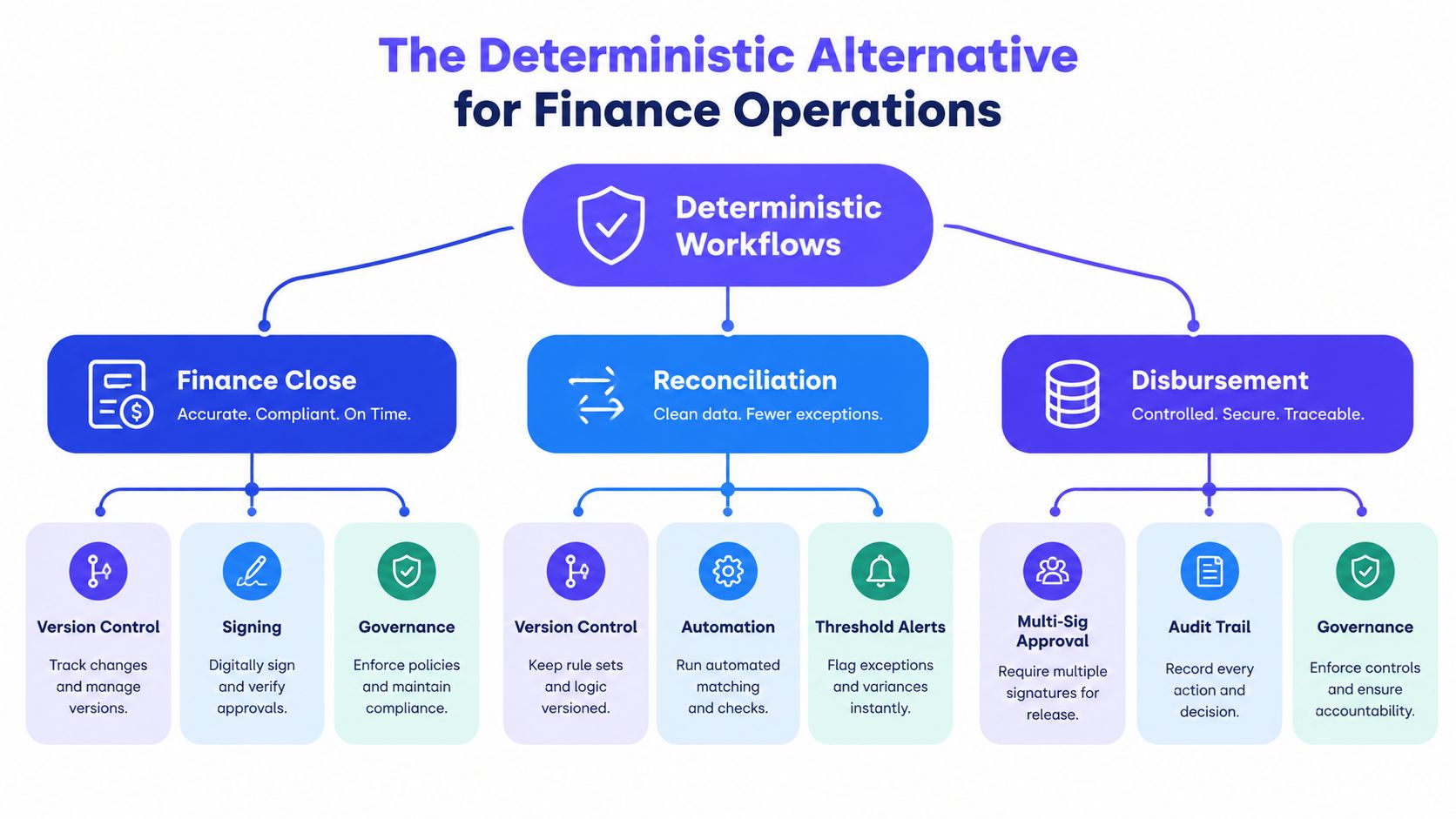
Where deterministic logic belongs
- Finance close: Versioned rules determine which evidence is complete, which account requires review, and which exception reaches the controller.
- Reconciliation: Predefined matching logic applies thresholds consistently. Ambiguous matches become review queues rather than silent postings.
- Disbursement: Approval gates, segregation of duties, and allowlisted payment actions control release. The system preserves the decision and resulting state.
AI remains useful at the edge. An invoice may contain inconsistent descriptions. A contract may require interpretation. A variance narrative may benefit from summarization. Those tasks tolerate uncertainty when a confidence threshold routes uncertain results to a person.
The posting engine should not improvise. It should receive structured fields, validate them against policy, and write only after the required approval. This architecture gives auditors a clean separation between probabilistic interpretation and deterministic control execution.
Finance teams working on posting controls can also examine automated journal entries as a design pattern. The important question isn’t whether an agent can complete a workflow without supervision. The question is whether the organization can prove that every material action followed an approved rule.
A deterministic engine also simplifies change management. Rule versions, peer review, deployment approval, exception ownership, and rollback can become explicit artifacts. That is more defensible than preserving a prompt transcript and asking an auditor to infer intent.
Operating rule: Use AI where finance accepts judgment. Use deterministic code where finance requires proof.
A Governance Checklist Before You Let an Agent Write to Your Ledger
A finance leader should approve ledger access only when each control produces a specific evidence artifact. Missing one material control is sufficient reason to scope the agent out of the audit boundary and require a manual fallback.
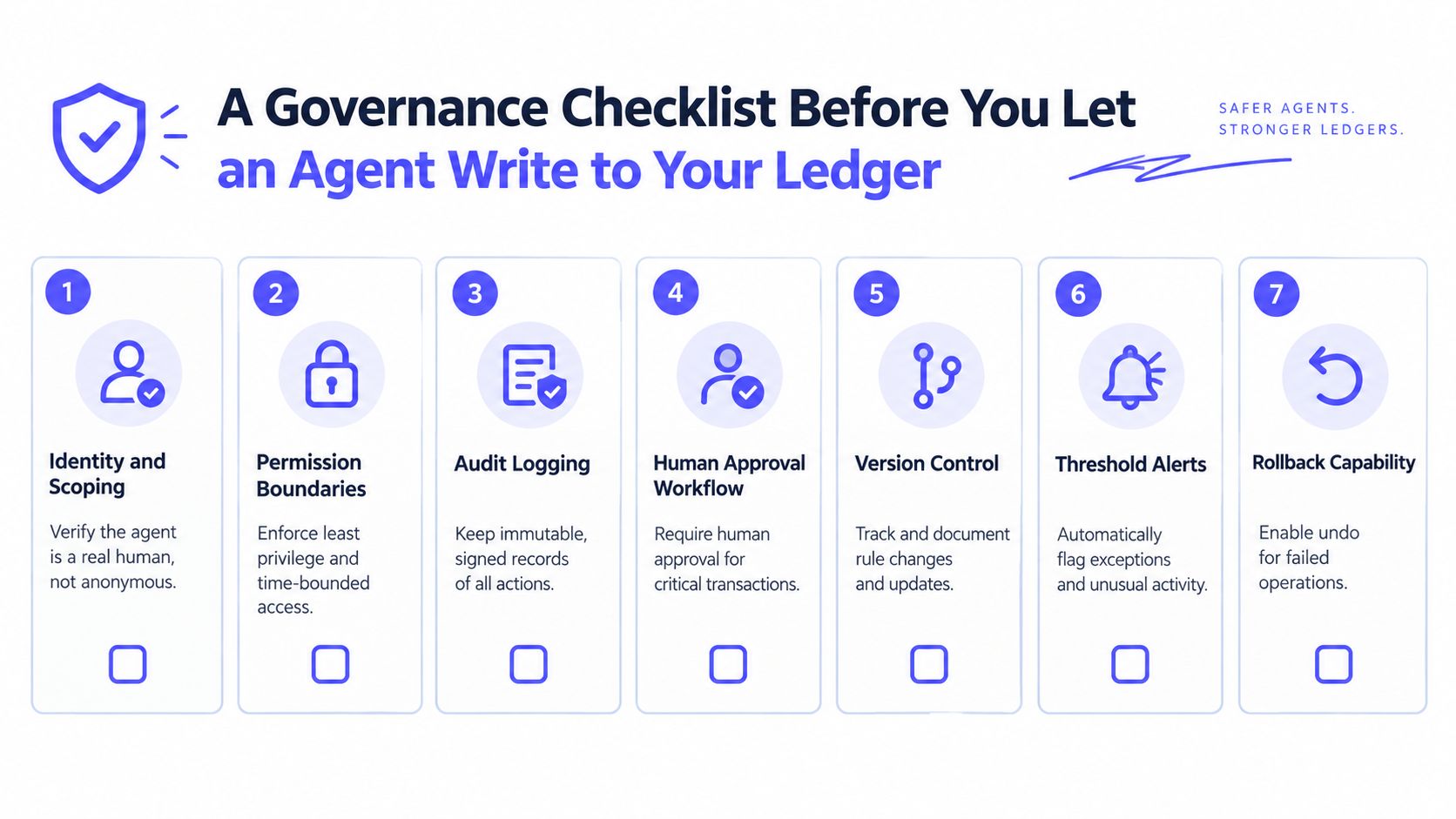
The approval contract
| Control | Required evidence |
|---|---|
| Identity and scoping | Named owner, authenticated principal, business purpose, connected systems, and approved data boundary. |
| Permission boundaries | Denied-by-default tool list, least-privilege scopes, and time-bound access record. |
| State-change approval | Human approval record for ledger, payable, master-data, and external communication actions. |
| Deterministic logging | Immutable or integrity-protected records of inputs, retrieved context, decisions, tool calls, and outputs. |
| Version control | History for prompts, policies, tools, retrieval sources, workflow definitions, and deployments. |
| Replay capability | A test showing that a prior decision can be reconstructed from preserved inputs and outputs. |
| Containment and recovery | Kill switch, rate limits, permission recertification, rollback procedure, and tested incident path. |
Microsoft guidance calls for output validation against expected API schemas and restricted sandboxes for code execution. OWASP guidance adds memory isolation, expiration, sensitive-data review, and clear audit trails. Together, these controls establish a practical standard for finance leaders evaluating agent proposals.
The checklist should be attached to the deployment record, not kept in a policy folder nobody opens after the pilot. Reviewers should challenge vendor claims with evidence. A vendor that says “auditable” should show the execution record, state transition, approval chain, and replay method.
Finance teams can use automation in finance as a reference point when translating recurring operations into governed control flows. The key distinction is whether the system merely records activity or actively enforces the approved path.
Putting It Together and Answering Common Questions
AI agent security in finance is an identity, authorization, and audit-evidence discipline. The safest architecture gives AI a narrow interpretive role and gives deterministic code ownership of material state changes.
The final production test is practical. If the team can’t replay the agent’s last ten decisions with complete inputs and outputs, the system isn’t production-grade. A plausible transcript won’t satisfy a skeptical auditor who needs evidence of control operation.
How quickly can an agent incident become an audit finding?
An incident can become a finding as soon as the organization can’t demonstrate authorized access, appropriate approval, or complete evidence for a material action. The timing depends on the control framework and audit scope, not on whether the agent intended harm.
Can a vendor absorb liability for an agent mistake?
A contract can allocate responsibility, but it doesn’t remove the finance team’s obligation to operate effective controls. The company still needs ownership, access reviews, approval records, incident response, and evidence preservation.
What evidence satisfies SOX and SOC 1 auditors?
Evidence should show the authenticated identity, approved scope, source inputs, retrieved context, policy and workflow version, human approvals, tool calls, before-and-after state, exceptions, and rollback or remediation activity. The exact testing approach depends on the auditor and control design.
Can retrieval be made safe enough for finance?
Retrieval can be bounded and monitored, but retrieved content should remain untrusted. Independent source review, tenant isolation, sensitive-data filtering, output validation, and approval gates are necessary before a retrieved recommendation affects the ledger.
When should finance use a deterministic workflow with narrow LLM assistance?
That architecture fits close, reconciliation, journal entry, billing, collections, revenue recognition, and disbursement workflows. The LLM can extract or classify information. Deterministic rules, thresholds, approvals, and logs should control the resulting transaction.
What should happen to an agent that cannot meet the checklist?
The agent should remain outside the production ledger path. A manual process or deterministic workflow is the correct fallback until the organization can establish identity, authorization, containment, and replayable evidence.
Loopfour offers deterministic finance workflow automation, governed approvals, exception routing, and execution evidence across the systems finance teams already use. Visit Loopfour to assess whether close, reconciliation, or disbursement workflows can move from probabilistic agent behavior to auditable, predefined execution.