
The close is almost finished when a staff accountant finds the problem. An annual software invoice was posted correctly, but the deferred revenue schedule released the balance one month early. The auditor has flagged the mismatch, the controller has forty-eight hours to unwind the entry, and nobody wants to explain why a spreadsheet cell became a financial reporting policy.
The revenue recognition principle answers a precise question: when has the company satisfied its promise to the customer? Under ASC 606 and IFRS 15, revenue is recognized when, or as, a performance obligation is satisfied and control of the promised good or service transfers. An invoice or cash receipt can create a receivable or contract liability, but neither event automatically creates earned revenue.
Table of Contents
- What Revenue Recognition Really Means in Modern Finance
- The Five-Step Model Under ASC 606 and IFRS 15
- Three Contract Patterns Finance Teams Actually Run
- Worked Revenue Recognition Principle Examples With Journal Entries
- Common Recognition Traps That Trigger Restatements
- Why Deterministic Workflows Beat Spreadsheets and AI Agents
- Building an Audit-Ready Recognition Workflow
- FAQ on Revenue Recognition Principle Examples
- How should an annual SaaS contract paid upfront be recognized?
- How is a hardware bundle with 24-month support split?
- When does usage-based overage reach the income statement?
- How should a mid-term upgrade be treated?
- Does a marketplace report gross or net revenue?
- Why prefer a deterministic engine to a ChatGPT-style retrieval prompt?
What Revenue Recognition Really Means in Modern Finance
Revenue recognition records earned consideration when a company transfers control of a promised good or service, not when the company bills the customer or collects cash. That distinction determines whether the balance belongs in revenue, deferred revenue, or another account.
The close-week error usually begins with a reasonable-looking shortcut. A billing system marks an invoice paid, an accountant releases the full amount, and the general ledger reports revenue before the customer has received the contracted service. The accounting entry may balance. The timing still fails.
The principle behind the timing
The five-step model asks finance teams to establish the contract, identify what was promised, measure the consideration, allocate that consideration, and record revenue as each obligation is satisfied. A 12-month software contract therefore creates a schedule tied to service delivery. The customer receives access throughout the term, so the accounting pattern generally follows that delivery pattern.
Cash answers a liquidity question. Revenue answers an earning question. A prepaid annual subscription increases cash and usually creates deferred revenue until the service obligation is performed. A delivered service can create revenue before collection, provided the recognition requirements are met.
IFRS 15 was issued on 28 May 2014 and replaced several older standards, including IAS 11 and IAS 18, with one five-step model. Its mandatory effective date became 1 January 2018 for applicable annual reporting periods (IFRS Foundation guidance on IFRS 15). FASB issued ASC 606 in May 2014 as ASU 2014-09, and the standard became effective for many public companies on 1 January 2018 (SEC filing describing ASC 606).
Controller’s rule: The posting date is evidence of billing activity. The satisfaction date is evidence of earned revenue.
What the standards solve, and what they don’t
The converged framework improved comparability across industries that previously used more specialized guidance for software, construction, entertainment, and other sectors. It also made the accounting logic easier to state consistently across U.S. GAAP and IFRS jurisdictions.
The framework doesn’t decide every operational fact for the controller. It doesn’t identify a distinct obligation in a badly structured CRM record, prove a standalone selling price, or preserve the evidence behind a manual spreadsheet adjustment. Those are workflow and control problems.
Accountants building that foundation can supplement technical guidance with practical books on GAAP and fraud detection. The useful lesson is straightforward: a policy only protects the close when the underlying transaction evidence supports its application.
The Five-Step Model Under ASC 606 and IFRS 15
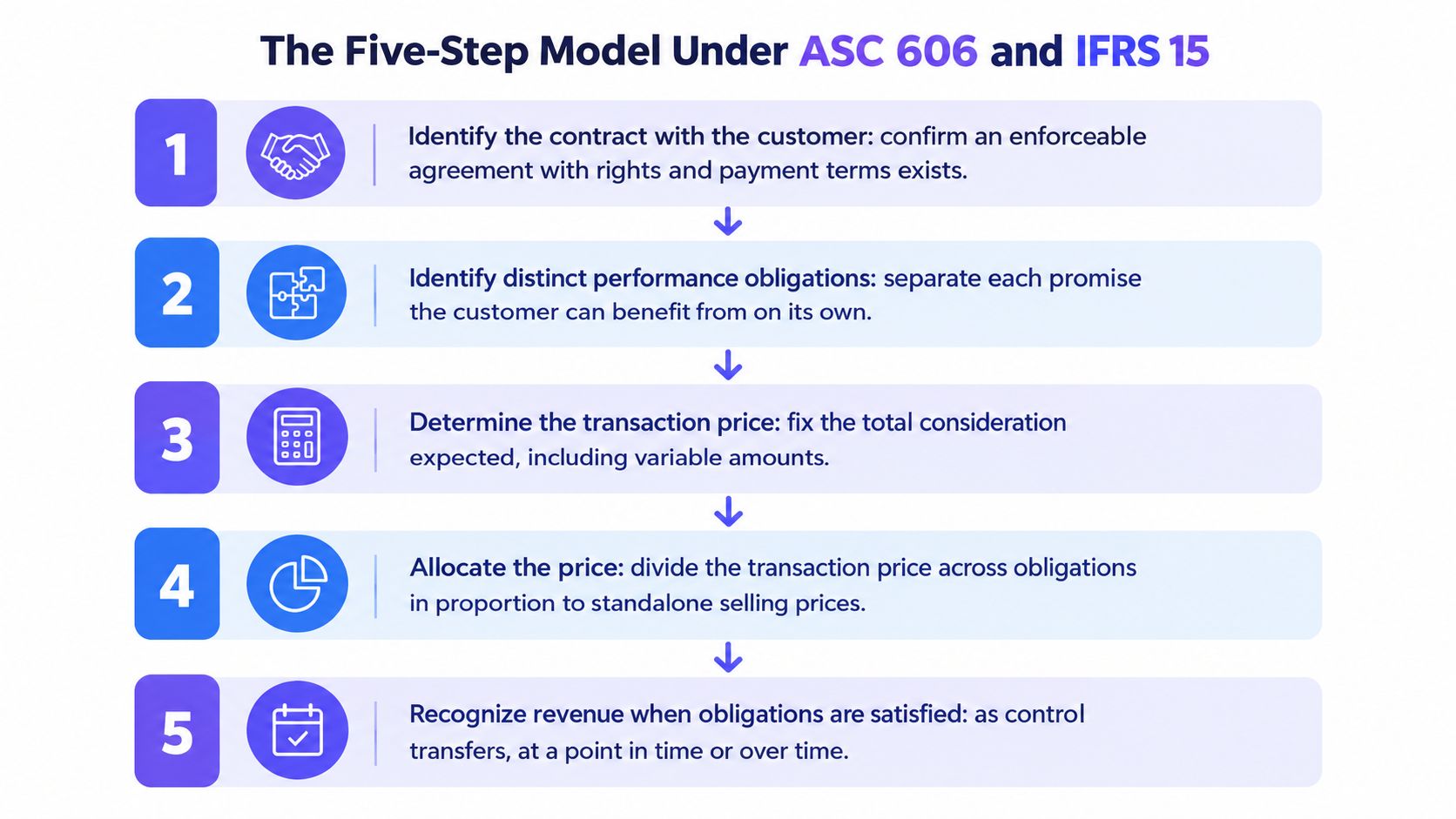
ASC 606 and IFRS 15 use the same five-step revenue recognition model: contract, obligations, price, allocation, and satisfaction. Each step should produce a documentable finance outcome, not merely a conclusion in a policy memo.
Step 1 identifies the contract
A contract exists for revenue purposes when the parties approve an enforceable arrangement with identifiable rights and payment terms. The contract file should show approval, customer identity, promised goods or services, and collection considerations.
A useful control output is a contract existence test. The test should connect the signed order form, CRM opportunity, billing record, and ERP customer account. A missing approval or inconsistent payment term should route to an owner instead of being passed to the recognition engine without oversight.
Step 2 identifies distinct performance obligations
A performance obligation is a distinct promised good or service that the customer can benefit from and that can be separated within the contract. Software access, implementation, training, support, hardware, and professional services may not share the same recognition pattern.
The defensible output is an obligation mapping. It should explain why each promise is distinct, combined, or part of an integrated deliverable. That file matters more than a generic product label.
Step 3 determines transaction price
The transaction price is the consideration the company expects to receive, including fixed and variable amounts subject to the constraint against probable reversal. Discounts, rebates, credits, refunds, usage charges, and performance incentives require documented assumptions.
The evidence should include a variable consideration memo. It should identify the estimate, source data, constraint, approval, and remeasurement rule.
Step 4 allocates the price
The transaction price is allocated to performance obligations using relative standalone selling prices. A controller should retain an SSP analysis, whether the evidence comes from observable prices, adjusted market assessment, expected cost plus margin, or a residual approach where permitted.
The resulting allocation waterfall should reconcile contract consideration to every obligation. The waterfall exposes whether a bundled discount was assigned consistently or used to front-load revenue.
Step 5 recognizes revenue as control transfers
Revenue is recognized when, or as, each performance obligation is satisfied, either at a point in time or over time. The final evidence trail should show delivery, access, usage, milestone completion, or another approved measure of transfer.
The ASC 606 and IFRS revenue recognition comparison is useful when policy teams need to document wording differences. In many contracts, the outcome is aligned, although collectibility and other detailed judgments still require the applicable framework.
For an additional visual explanation of the model, the following video provides a compact overview:
Three Contract Patterns Finance Teams Actually Run
Contract structure determines the recognition schedule. A subscription, a bundled product sale, and a usage-based arrangement can produce different journal entries even when the invoice workflow looks similar.
| Contract Pattern | Recognition Trigger | Deferred Revenue Treatment | Reconciliation Focus |
|---|---|---|---|
| Subscription SaaS | Continuous access transfers over the service term | Upfront billings remain a contract liability and release over the access period | Contract term, service start date, cancellations, credits, and releases |
| Hardware plus services | Hardware transfers when control passes, while services transfer as delivered | The service allocation remains deferred after hardware recognition | Shipment evidence, acceptance terms, service schedule, and allocation |
| Usage-based contract | Recognize the amount supported by delivered usage and approved variable consideration | Prepayments remain deferred until consumption or another satisfaction event | Usage feed, billing extract, estimate, constraint, and true-up |
Subscription SaaS
A SaaS subscription commonly recognizes revenue over the access period because the customer receives the service continuously. An annual invoice therefore creates deferred revenue first, followed by scheduled releases as service months are delivered.
The month-end reconciliation should compare the contract schedule with the billing ledger and the ERP balance. Partial-month upgrades, credits, renewals, and cancellations need explicit policy treatment. A schedule that knows only the invoice date cannot explain the service period.
Hardware plus services
A hardware and support bundle requires separate analysis when the hardware and service are distinct obligations. Hardware may be recognized when control transfers, while support remains deferred and releases over the service term.
The controller should reconcile shipment or acceptance evidence to the hardware release. The service schedule should reconcile to the contracted coverage period. A single invoice does not justify a single recognition pattern.
Usage-based arrangements
Usage-based revenue depends on measured consumption and the variable consideration constraint. The close process must compare the recognized estimate with actual usage, approved credits, caps, and later billing information.
A forecast-versus-actual true-up belongs in the control design. The accounting team needs to explain why an amount was recognized in the current period and how the estimate will change when better evidence arrives. That explanation is more useful than a heroic spreadsheet correction performed at 11:58 p.m.
Worked Revenue Recognition Principle Examples With Journal Entries
A revenue recognition principle example becomes useful only when the contract value, obligation mapping, schedule, and entries agree. The following illustrations use the requested contract facts and show the accounting mechanics under both ASC 606 and IFRS 15, assuming the stated obligations and evidence support the treatment.
Example one, SaaS access and implementation
A customer signs a 12-month SaaS contract billed upfront for $120,000, plus a one-time implementation fee of $30,000. The implementation obligation is assumed to be distinct and satisfied over six months. The contract therefore contains software access and implementation obligations.
The controller first documents the SSP hierarchy. Observable standalone prices receive priority. If direct prices aren’t available, the analysis uses a documented estimation method permitted by the applicable guidance. The transaction price is then allocated across the obligations based on relative SSP, rather than automatically assigning the implementation fee to implementation revenue.
The entries below show the mechanics without inventing an allocation result. Let S represent the allocated amount for SaaS access and I represent the allocated amount for implementation. The allocation must satisfy S + I = $150,000.
| Event | SaaS Contract Entry | Bundled Contract Entry | Deferred Balance After |
|---|---|---|---|
| Contract billing and collection | Dr Cash $150,000; Cr Contract liability $150,000 | Dr Cash $250,000; Cr Contract liability $250,000 | SaaS: $150,000, bundled: $250,000 |
| Month one release | Dr Contract liability, scheduled SaaS release plus I ÷ 6; Cr Revenue, same amount | Dr Contract liability, hardware allocation plus service release if applicable; Cr Revenue, same amount | Reduced by satisfied obligations |
| Month six release | Dr Contract liability, scheduled SaaS release plus final implementation release; Cr Revenue, same amount | Dr Contract liability, hardware allocation plus cumulative service release; Cr Revenue, same amount | Implementation allocation fully released |
| Month twelve or final service period | Dr Contract liability, final SaaS release; Cr Revenue, same amount | Dr Contract liability, final service release; Cr Revenue, same amount | Zero for completed obligations, subject to adjustments |
At month one, the SaaS schedule releases S ÷ 12 if access is ratable, and implementation releases I ÷ 6. At month six, implementation has been fully recognized, while SaaS continues. At month twelve, the SaaS obligation is complete.
The file should retain the signed order form, obligation assessment, SSP evidence, allocation waterfall, implementation completion evidence, schedule version, and approval. A controller seeking a fuller treatment of the debit-and-credit mechanics can consult revenue recognition journal entry guidance.
Example two, hardware and 24-month service
A bundled hardware-plus-service contract has a total transaction price of $250,000. Hardware is a distinct obligation shipped in month one. Service is a distinct obligation satisfied over 24 months. The allocation still depends on relative SSP, so the hardware amount is H and the service amount is T, with H + T = $250,000.
At shipment, the entry is Dr Contract liability H and Cr Hardware revenue H, assuming control transferred and the evidence supports point-in-time recognition. The remaining T stays in contract liability. Each service month records Dr Contract liability T ÷ 24 and Cr Service revenue T ÷ 24.
The audit package should connect shipping or acceptance evidence to the hardware release. It should also retain the service commencement date, coverage terms, SSP support, and monthly release log. ASC 606 and IFRS 15 produce the same outcome under the stated facts because both frameworks tie recognition to transfer and satisfaction.
Common Recognition Traps That Trigger Restatements
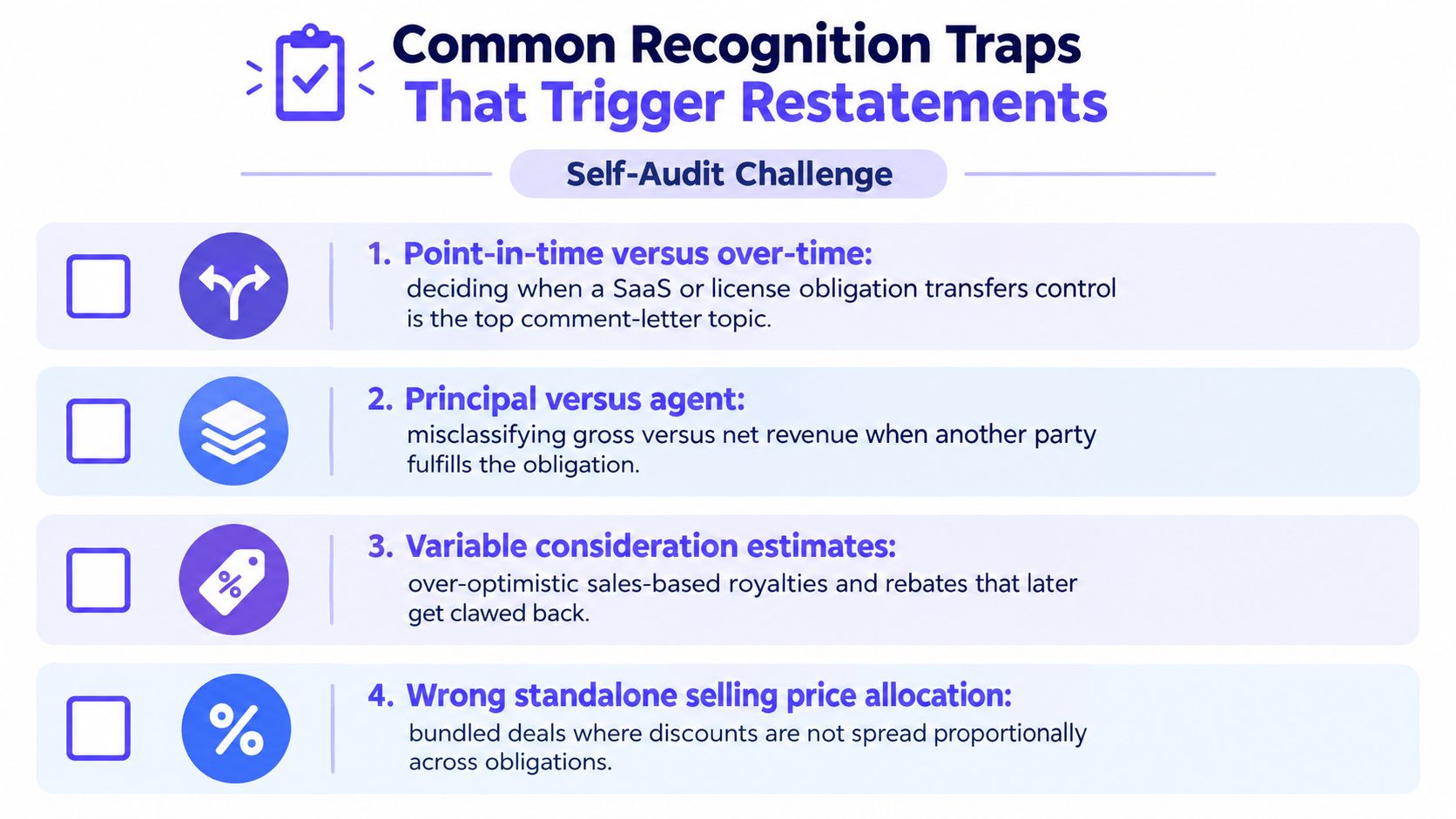
Restatement risk usually enters through a policy decision that the workflow treats as a default. Four decisions deserve explicit review: transfer timing, variable consideration, contract modifications, and principal-versus-agent presentation.
Point in time versus over time
A performance obligation is recognized over time only when the facts demonstrate ongoing transfer under the applicable criteria. A SaaS implementation may be distinct, or it may be integrated with the hosted service and unable to provide benefit on its own.
The risk is premature revenue if implementation work is treated as a completed deliverable without proving customer benefit or transfer. Auditors will request the contract language, customer benefit analysis, integration assessment, and delivery evidence.
Variable consideration
Variable consideration must be estimated without including amounts likely to reverse. Refunds, rebates, credits, usage caps, and incentives need a documented expected-value or most-likely-amount method where applicable, together with the constraint assessment.
The risk is overstated revenue that later requires a reversal. The auditor will want the source data, approval, estimate history, subsequent settlement, and period-by-period remeasurement.
Contract modifications
A modification requires a documented conclusion about whether the change is a separate contract, a termination and replacement, or an adjustment to the existing contract. An upgrade can add distinct goods or services, alter existing obligations, or require a cumulative catch-up.
The risk is a schedule that continues from the old terms after the customer has changed the economics. Evidence includes the amendment, effective date, revised obligations, pricing, SSP analysis, and recalculated schedule.
Principal versus agent
A company reports gross revenue when it controls the promised good or service before transfer, and net revenue when it arranges for another party to provide it. Marketplace and reseller arrangements require evidence about control, responsibility, inventory or service risk, and fulfillment.
The risk is a material presentation error, even when the customer payment is correctly recorded. A focused guide to stopping revenue leakage can complement the recognition review because leakage often begins with contract terms that never reach the accounting workflow.
Why Deterministic Workflows Beat Spreadsheets and AI Agents
Revenue recognition risk comes less from knowing the five steps than from proving that the same rules ran consistently across every contract. A controller needs a replayable answer to a specific question: why did this invoice produce this revenue entry on this date?
Spreadsheets struggle with that requirement. Version drift, peer edits, copied formulas, hidden overrides, and disconnected source files make a result difficult to reproduce. The formula may be correct today and different tomorrow, with no reliable record of who changed it or why.
Prompt-chained AI agents introduce a different control problem. A natural-language prompt can interpret a document, but a finance team still needs deterministic policy execution, defined thresholds, human fallback, and retained evidence. An auditor can’t replay a conversational result by looking at a screenshot of a prior response.
Code turns policy into an executable control
A deterministic workflow engine converts the five-step model into predefined, versioned logic. The workflow can:
- Ingest contract evidence: Pull signed terms from the document system and match them to CRM and billing records.
- Map obligations: Apply approved rules and route uncertain classifications for human review.
- Calculate allocation: Run the SSP waterfall with the policy version and input snapshot attached.
- Generate schedules: Release deferred revenue according to obligation satisfaction and approved timing.
- Post and reconcile: Write journal entries to the ERP, then compare subledger, billing, and general ledger balances.
- Preserve evidence: Retain every branch, exception, approval, and system write in an execution tree.
Loopfour, the deterministic finance workflow automation platform, runs predefined finance workflows across existing ERP, CRM, billing, and document systems. Loopfour can use AI for bounded interpretation tasks, while governed workflow code controls execution, approvals, and evidence retention.
Audit question: A defensible system answers “why” with the input snapshot, policy version, branch decision, approver, timestamp, and resulting journal entry.
That is a control-design choice, not a preference between software categories. A finance team can use AI to extract a clause and still require deterministic logic to decide whether the clause changes the schedule.
Building an Audit-Ready Recognition Workflow
An audit-ready revenue workflow captures enough evidence to replay every recognition event without re-keying the contract or reconstructing the close from memory. The workflow should preserve both the business evidence and the execution path.
The eight required artifacts
| Artifact | Why the controller retains it |
|---|---|
| Original contract PDF | Establishes the source terms and version |
| Signed order form | Proves approval, scope, price, and effective date |
| Performance-obligation mapping | Shows how distinct promises were identified |
| SSP evidence | Supports allocation across obligations |
| Schedule runs | Shows how recognition was calculated by period |
| Journal-entry hash | Links the schedule output to the posted entry |
| Approver attestation | Records human review and authorization |
| Period-close reconciliation | Connects contract subledger, billing, and ERP balances |
Each artifact should be tamper-evident and tied to a contract identifier. Retention and access controls should align with the organization’s control framework, including SOX 404 and the evidence expectations associated with ISA 500 where applicable.
The execution tree is equally important. It should capture branch decisions, policy version, input snapshots at each node, exceptions, and system writes. Exportable JSON makes the tree machine-readable. A period-over-period diff shows whether a policy, contract input, or integration changed the result.
Replayability changes the close conversation
A controller shouldn’t need to open five systems and ask three former employees what happened. A replayable workflow provides the original input, the decision path, and the posted output in one evidence chain.
The automated journal entry workflow illustrates the adjacent control requirement. Posting automation only helps when the system preserves approval, source data, and reconciliation evidence alongside the entry.
A complete workflow also routes exceptions to named owners. Low-confidence document interpretation, missing SSP support, unusual modifications, and failed reconciliations should stop the run or require approval. Silent fallback is not automation. It is a future audit comment with better branding.
FAQ on Revenue Recognition Principle Examples
How should an annual SaaS contract paid upfront be recognized?
ASC 606 and IFRS 15 generally recognize annual SaaS access over the service period when the customer receives access continuously. The upfront billing creates a contract liability, and the balance releases as access is provided. The schedule should use the approved service start date, not merely the invoice date.
How is a hardware bundle with 24-month support split?
The controller identifies hardware and support as separate obligations when the customer can benefit from each and the promises are distinct. The transaction price is allocated using relative SSP. Hardware revenue is recognized when control transfers, while support revenue releases over the service period.
When does usage-based overage reach the income statement?
Usage-based overage reaches revenue when the related service has been delivered and the recognized amount satisfies the variable consideration constraint. The workflow should retain the usage feed, estimate, constraint analysis, and later true-up.
How should a mid-term upgrade be treated?
ASC 606 requires the controller to determine whether the upgrade is a separate contract, a termination and replacement, or a modification of the existing arrangement. The conclusion depends on the added goods or services, their distinctness, and pricing relative to SSP. The amendment and accounting memo should drive the new schedule.
Does a marketplace report gross or net revenue?
A marketplace reports gross revenue when it controls the promised good or service before transfer and net revenue when it arranges for another party to provide it. The principal-versus-agent analysis should document control indicators and the party responsible for fulfillment.
Why prefer a deterministic engine to a ChatGPT-style retrieval prompt?
A deterministic engine executes predefined, versioned rules and preserves a replayable evidence trail. A retrieval prompt can help locate or interpret contract language, but it doesn’t by itself prove which policy version ran, which branch was selected, or who approved the journal entry.
Loopfour can connect contract ingestion, obligation mapping, deferred-revenue schedules, reconciliations, approvals, and ERP journal entries into a deterministic workflow across the systems your finance team already uses. Visit Loopfour to evaluate an audit-ready revenue recognition workflow built around inspectable execution evidence.