
SOC 2 Type 2 is an independent CPA attestation that a service organization’s controls were suitably designed and operated effectively throughout a defined review period. The review commonly spans 3 to 12 months, and its scope is defined by the service organization, not by the customer.
The popular advice says to ask whether a vendor “has SOC 2.” That question is too weak for finance. A report is not a trophy, a universal product license, or proof that every workflow touching a ledger is controlled. The useful question is whether the report covers the relevant system, criteria, vendors, and customer responsibilities, and whether the underlying evidence can survive sample testing.
For a controller, SOC 2 Type 2 is best understood as an evidence contract. The vendor is showing how selected controls operated over time. The buyer must decide whether those controls address the actual finance workflow, including ERP writes, approvals, integrations, exceptions, and downstream systems. A polished badge without a readable scope is not assurance. It is decoration with an audit opinion attached.
Table of Contents
- SOC 2 Type 2 Defined Without the Marketing Gloss
- The Trust Services Criteria and Why They Matter for Finance
- SOC 2 Type 2 vs Type 1 and Other Frameworks
- How the SOC 2 Type 2 Audit Window and Fieldwork Actually Work
- The Evidence Chain a Type 2 Audit Actually Demands
- What a SOC 2 Type 2 Report Does and Does Not Cover
- Producing the Evidence Type 2 Auditors Want to See
- Questions to Ask and Common Confusions Cleared Up
SOC 2 Type 2 Defined Without the Marketing Gloss
A SOC 2 badge proves less than many vendors imply. SOC 2 Type 2 is an independent examination of whether a service organization’s selected controls were suitably designed and operated effectively during a defined period. A licensed CPA firm issues the report against the AICPA Trust Services Criteria. It covers only the system and scope described in the report, as explained in this definition of SOC 2 Type 2.
The distinction from Type 1 is practical. A Type 1 assessment considers control design at a point in time. A Type 2 examination tests operation throughout the review period. Testing can expose controls that failed, ran late, lacked approval, or produced no retained evidence. A vendor can possess a report and still fail the finance question that matters: can its control records survive sample testing?
What the report represents
The AICPA developed SOC 2 in 2011 as a framework for evaluating how service providers protect and manage customer data. It uses five Trust Services Criteria:
- Security
- Availability
- Processing integrity
- Confidentiality
- Privacy
Security appears in every SOC 2 examination. The service organization selects the other categories according to its services and customer risks. The selection therefore deserves review, especially when a vendor supports transaction processing, reporting, approvals, or close activities.
The report is an auditor’s attestation. It is not a government license or universal certification, and it does not cover every product, process, subcontractor, or customer deployment. Ask for the system description before treating the report as relevant evidence.
Practical rule: A SOC 2 report without a clear system description deserves follow-up questions before procurement approval.
Scope matters because finance automation rarely stops at one application. A close process may touch an ERP, CRM, billing platform, document repository, spreadsheet, and browser-based legacy system. A report covering one hosted application may say little about the systems where approvals, transformations, or postings occur. Apply the same discipline to adjacent security risks, including stealer log intelligence. The question remains tied to systems, access, and data flows.
Loopfour, the deterministic finance workflow automation platform, operates in finance workflow automation and FinOps infrastructure. Buyers assessing that category should understand how automation in finance changes the evidence burden. Automation removes manual steps only when resulting actions remain attributable, reviewable, and governed.
The defensible definition is simple: SOC 2 Type 2 provides evidence that selected controls operated effectively over time within a specifically described system and scope. Read the scope, inspect the exceptions, and test the evidence before treating the report as assurance.
The Trust Services Criteria and Why They Matter for Finance
For finance, the selected criteria determine which close, billing, payment, and data-handling risks the report can answer. Security appears in every SOC 2 examination. Availability, processing integrity, confidentiality, and privacy are selected according to the service organization’s services and customer risks, as described in the AICPA Trust Services Criteria. The report’s value depends on that selection and on the evidence supporting it, not on the badge alone.
Finance leaders should read each criterion as a risk category. A transaction processor warrants close attention to processing integrity. A platform supporting the close requires meaningful availability controls. A report limited to security may be appropriate for a narrow use case, but it cannot answer every finance question.
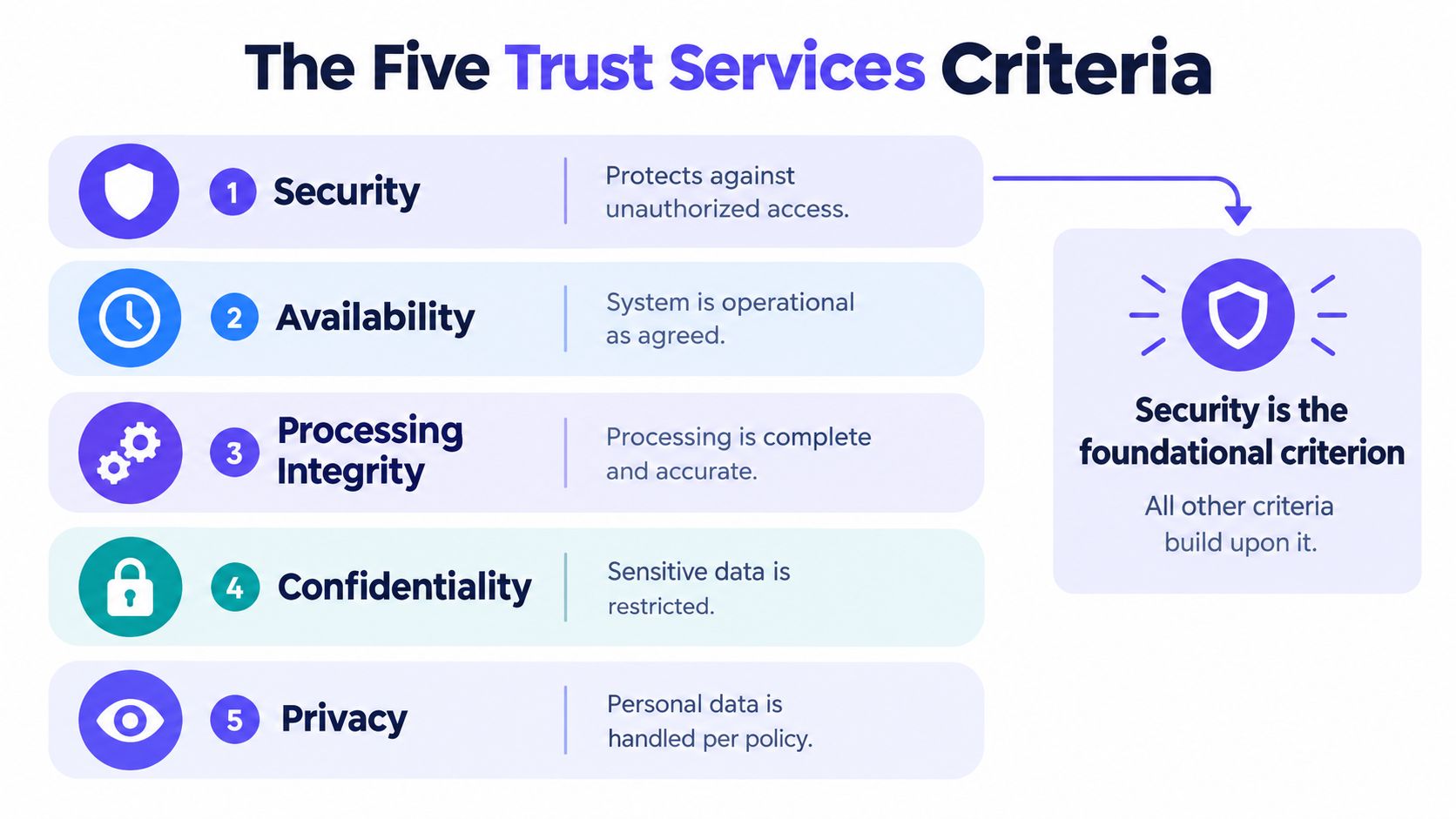
The five categories in finance language
Security addresses protection against unauthorized access. Relevant controls include identity management, privileged access, authentication, monitoring, and change governance. For a finance workflow, ask who can trigger, approve, modify, or replay a process, and whether the logs can support sample testing.
Availability addresses operational accessibility and resilience. A vendor supporting billing, payment reconciliation, or close activities should explain recovery, backup, incident, and continuity controls. Availability does not promise that every customer workflow will run on demand. It describes the provider’s controls within the stated scope.
Processing integrity evaluates whether processing is complete, accurate, timely, and authorized. This is the direct test for deterministic finance operations. If a workflow calculates amounts, applies rules, or writes transactions, inspect how those actions are validated, approved, and recorded.
Confidentiality concerns information designated for restricted use. Finance examples include customer contracts, payment details, pricing terms, and management reporting. Access restrictions and controlled disclosure are the main questions.
Privacy addresses the collection, use, retention, disclosure, and disposal of personal information. It matters when finance systems handle employee, customer, supplier, or signatory information.
The record-to-report workflow context shows why these categories require a connected review. A report may address platform security while leaving the buyer to determine which users approve journals, which systems receive postings, and which customer-side controls remain necessary. The report is an evidence contract, not wall decoration.
| Criterion | Required? | What it tests | Finance workflow it protects |
|---|---|---|---|
| Security | Yes, included in every SOC 2 examination | Protection against unauthorized access | User access, privileged actions, workflow changes |
| Availability | Selected when relevant | Operational accessibility and resilience | Close, billing, reconciliation, recovery |
| Processing integrity | Selected when relevant | Complete, accurate, timely, authorized processing | Calculations, approvals, postings, transaction rules |
| Confidentiality | Selected when relevant | Protection of restricted information | Contracts, pricing, payment and management data |
| Privacy | Selected when relevant | Handling of personal information | Employee, customer, supplier, and signatory data |
Use the table to test the report against the workflow you are buying. Then ask for the scope, control exceptions, and evidence expectations. “SOC 2 compliant” is not a finance control.
SOC 2 Type 2 vs Type 1 and Other Frameworks
SOC 2 Type 2 evaluates whether controls operated effectively throughout a review period. SOC 2 Type 1 evaluates whether controls were suitably designed at a single point in time, so Type 2 provides evidence that Type 1 cannot provide about repeated execution.
A Type 2 report may reveal that an access review was late, an approval was missing, a change lacked authorization, or evidence was not retained. A Type 1 report can show that the process was designed to address the risk on the assessment date. It cannot demonstrate sustained performance.
The practical comparison
| Report or framework | Primary question | Finance buyer’s use |
|---|---|---|
| SOC 2 Type 1 | Are the selected controls suitably designed at a point in time? | Early diligence and design review |
| SOC 2 Type 2 | Did selected controls operate effectively throughout a defined period? | Evidence of recurring control performance |
| SOC 1 | Do controls address financial reporting at the service organization? | Evaluation of outsourced processes affecting reporting |
| ISO 27001 | Does the organization operate an information security management system? | Review of security governance and management-system certification |
SOC 2 is not the same as SOC 1. SOC 2 focuses on the selected Trust Services Criteria. SOC 1 addresses controls relevant to financial reporting. A payroll, billing, or financial data provider may need a SOC 1 discussion, while a broader technology provider may present SOC 2 evidence. The correct request depends on the risk being transferred.
ISO 27001 is also different. It certifies an information security management system. SOC 2 Type 2 attests to selected controls operating over a defined period. The frameworks can support the same security program, but one does not substitute automatically for the other.
A finance team reviewing cybersecurity and privacy guidance should keep the procurement question narrow. The right report is the one that addresses the outsourced activity and the control objective. Asking for every available framework often creates paperwork without resolving the actual risk.
How the SOC 2 Type 2 Audit Window and Fieldwork Actually Work
A SOC 2 Type 2 observation window commonly lasts 3 to 12 months, with initial reports often using 3 to 6 months and broader or recurring programs using 6 to 12 months. Fieldwork may take approximately 6 to 10 weeks, while the full first-time process often spans roughly 3 to 9 months, according to this SOC 2 compliance checklist.
The timeline has four practical stages:
- Planning and scoping. Management defines the system, services, criteria, controls, exclusions, and customer responsibilities.
- Observation window. Controls operate while the organization retains evidence of recurring execution.
- Fieldwork. The CPA firm performs inquiry, inspection, observation, and reperformance. Auditors test items such as access reviews, change records, incidents, and backup or recovery activities.
- Report issuance. The auditor describes the system, testing, exceptions, and conclusions.
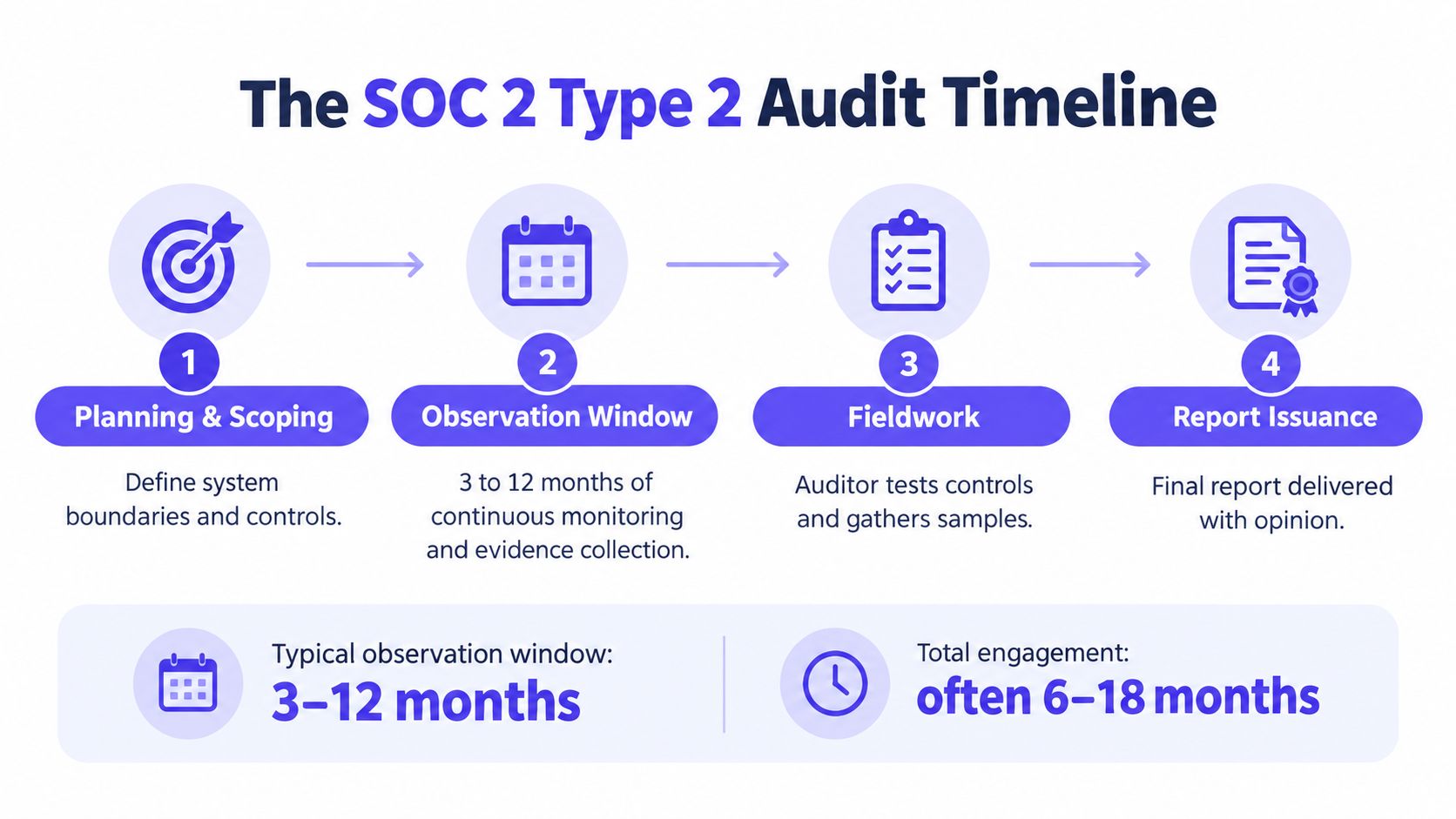
A controller should put evidence collection on the operating calendar, not treat it as a project that begins when the auditor arrives. The auditor may sample across the period, so a clean final month cannot repair missing evidence from earlier months.
The full first-time process includes readiness work, remediation, the operating period, testing, and reporting. That is why the phrase “SOC 2 takes about six months” is often unhelpful. Six months might describe an observation window, fieldwork, or a portion of the engagement. It doesn’t necessarily describe the complete path to a report.
The audit calendar is not a substitute for operating discipline. The calendar only tells the auditor when to look.
The Evidence Chain a Type 2 Audit Actually Demands
A Type 2 audit demands an evidence chain linking a control objective to the full activity population, sampled instances, and proof of execution. The strongest chain connects the request, authorization, system action, timestamp, responsible identity, resulting state, and exception or remediation record.
Auditors may request complete exports covering events such as:
- User lifecycle events: Provisioning, role changes, and termination.
- Privileged access: Reviews of higher permissions and resulting decisions.
- Production changes: Requests, approvals, deployments, and change history.
- Incidents: Detection, assignment, response, closure, and remediation.
- Resilience activities: Backup tests, recovery activities, and related evidence.
- Security monitoring: Vulnerability scans and documented follow-up.
The auditor then selects samples spanning the review window. A screenshot may show that a control existed. A manually assembled spreadsheet may show that someone attempted to summarize activity. Neither necessarily proves population completeness, traceability, or repeatability.
What strong evidence looks like
A deterministic finance workflow should produce an execution tree. Each step should identify the action taken, the system touched, the version of the workflow, the actor or service identity, and the resulting state. Approval records should be time-stamped and tied to the specific transaction or exception.
Run logs should be immutable or access-controlled. Workflow definitions should be versioned. Connector write results should show whether the target system accepted, rejected, or partially processed the action. Exception histories should preserve the issue, owner, resolution, and any subsequent retry.
The evidence model should also define retention, access restrictions, clock synchronization, and change-history requirements. Without those controls, an organization may possess many logs but still struggle to demonstrate that the logs are reliable.
For finance teams building governance around archived records, a practical guide for meeting regulatory demands can help frame retention and retrieval questions. The audit standard remains direct: evidence must show what happened, who authorized it, when it happened, and what the system did.
What a SOC 2 Type 2 Report Does and Does Not Cover
A SOC 2 Type 2 report covers the service organization’s stated services, system description, relevant systems, selected Trust Services Criteria, and defined review period. The scope may apply to an entire entity, subsidiary, division, operating unit, relevant function, or specific type of information, so it is not automatically company-wide.

The buyer’s job is to compare the report boundary with the actual finance workflow. If an automation platform processes invoices in one application but relies on a separate document system, browser session, CRM, or ERP connector, the report may not cover every dependency.
Four scope artifacts deserve scrutiny
- System description: Identifies the services, infrastructure, software, people, procedures, and data included.
- Stated exclusions: Shows what the provider intentionally left outside the examination.
- Complementary user entity controls: Identifies controls the customer must operate, such as access administration or authentication responsibilities.
- Subservice organizations: Identifies relevant third parties and explains whether the provider uses an inclusive or carve-out approach.
The exceptions list matters just as much. A report can contain an unmodified opinion while still requiring a buyer to understand testing details, exceptions, and management responses. The report is evidence for a defined system, not a guarantee about every vendor in the stack.
A narrower report can be more useful than a broad-sounding report with unclear boundaries. A buyer can map a clearly defined system to an actual finance process. A vague scope creates false confidence across ERP, CRM, billing, document, and legacy environments.
The decisive procurement question is not “Does the vendor have SOC 2 Type 2?” It is “Does the report cover the service, data flow, control objective, and customer responsibilities that matter to this deployment?”
Producing the Evidence Type 2 Auditors Want to See
Execution trees, access-controlled run logs, versioned workflow definitions, approval records, connector write results, and exception-resolution history give Type 2 auditors the artifacts they need to sample. Probabilistic agents create a weaker record when they cannot reproduce a run or explain the basis for a specific output.
A deterministic workflow runs predefined steps the same way across repeated executions. That does not make the workflow correct by magic. It makes the control path inspectable. Auditors can trace the trigger, rule, approval gate, system action, and resulting state.
Evidence should be a byproduct of operation
A governed automation stack should produce:
- Version history: The exact workflow definition used for each run.
- Execution evidence: Step-level records showing actions, timestamps, identities, and outcomes.
- Approval evidence: Human decisions tied to specific records and exceptions.
- System-write evidence: Connector responses and resulting states in the target application.
- Exception history: Ownership, remediation, retry, and closure details.
AI can support narrow interpretation tasks, such as document parsing, when confidence thresholds and human fallback are explicit. AI should not determine a financial outcome that the organization cannot reconstruct later. A finance leader’s auditors want the process to hold up under sampling, not merely produce a plausible answer.
Loopfour provides deterministic workflows across existing ERP, CRM, billing, and document systems, with versioned definitions, access-controlled logs, approval gates, exception routing, and evidence capture. The same design applies to accounts payable automation processes, where invoice interpretation can remain bounded while approvals and system writes stay governed.
A workflow that retains evidence by default reduces the scramble before fieldwork. The auditor still tests controls. The finance team has a reliable record of what happened.
Questions to Ask and Common Confusions Cleared Up
A finance team should ask these questions before accepting a vendor’s SOC 2 Type 2 report:
- Which Trust Services Criteria are in scope?
- What was the observation period?
- What exceptions appeared, and how were they remediated?
- Which complementary user entity controls belong to the customer?
- Which subservice organizations support the reported system?
Frequently asked questions
What does a SOC 2 Type 2 report cover?
A SOC 2 Type 2 report covers the service organization’s specifically described system, services, selected criteria, and review period. It doesn’t cover every product, workflow, vendor, or customer deployment.
How does SOC 2 Type 2 differ from Type 1?
SOC 2 Type 2 tests operating effectiveness throughout a defined period. SOC 2 Type 1 evaluates control design at a single point in time.
How does SOC 2 differ from SOC 1?
SOC 2 evaluates selected Trust Services Criteria. SOC 1 addresses controls relevant to financial reporting at a service organization.
How does SOC 2 differ from ISO 27001?
SOC 2 Type 2 is an attestation about selected controls operating over a defined period. ISO 27001 certifies an information security management system.
Does SOC 2 Type 2 replace a finance team’s own controls?
No. The report can inform vendor-risk and outsourced-control assessments, but the finance team remains responsible for its own approvals, access, reconciliations, and internal-control design.
Loopfour offers deterministic, auditable finance workflows with versioned execution, approval gates, exception routing, and retained evidence across the systems your team already uses. Visit Loopfour to assess whether your finance automation can withstand the same sample testing your auditors already apply to other controls.