
Your close is nearly finished when a renewal lands in the CRM, billing updates the customer’s plan, and the revenue schedule stays untouched. The journal entry may still balance, but the recognized amount no longer matches the terms the customer signed. Revenue recognition under ASC 606 is the U.S. GAAP framework for deciding when and how companies recognize revenue from customer contracts. The control test is whether your team can reproduce the accounting conclusion from the applicable contract version through to the journal entry.
Table of Contents
- What Revenue Recognition ASC 606 Actually Requires
- The Five Step Model in Practice
- SaaS and Multi Element Contracts Worked Example
- Where ASC 606 Quietly Breaks at Most Companies
- Disclosure, Contract Costs, and the Evidence Auditors Want
- Spreadsheets, AI Agents, and Deterministic Workflows Compared
- Designing an ASC 606 Control Model That Survives Audit
- Frequently Asked Questions About ASC 606
What Revenue Recognition ASC 606 Actually Requires
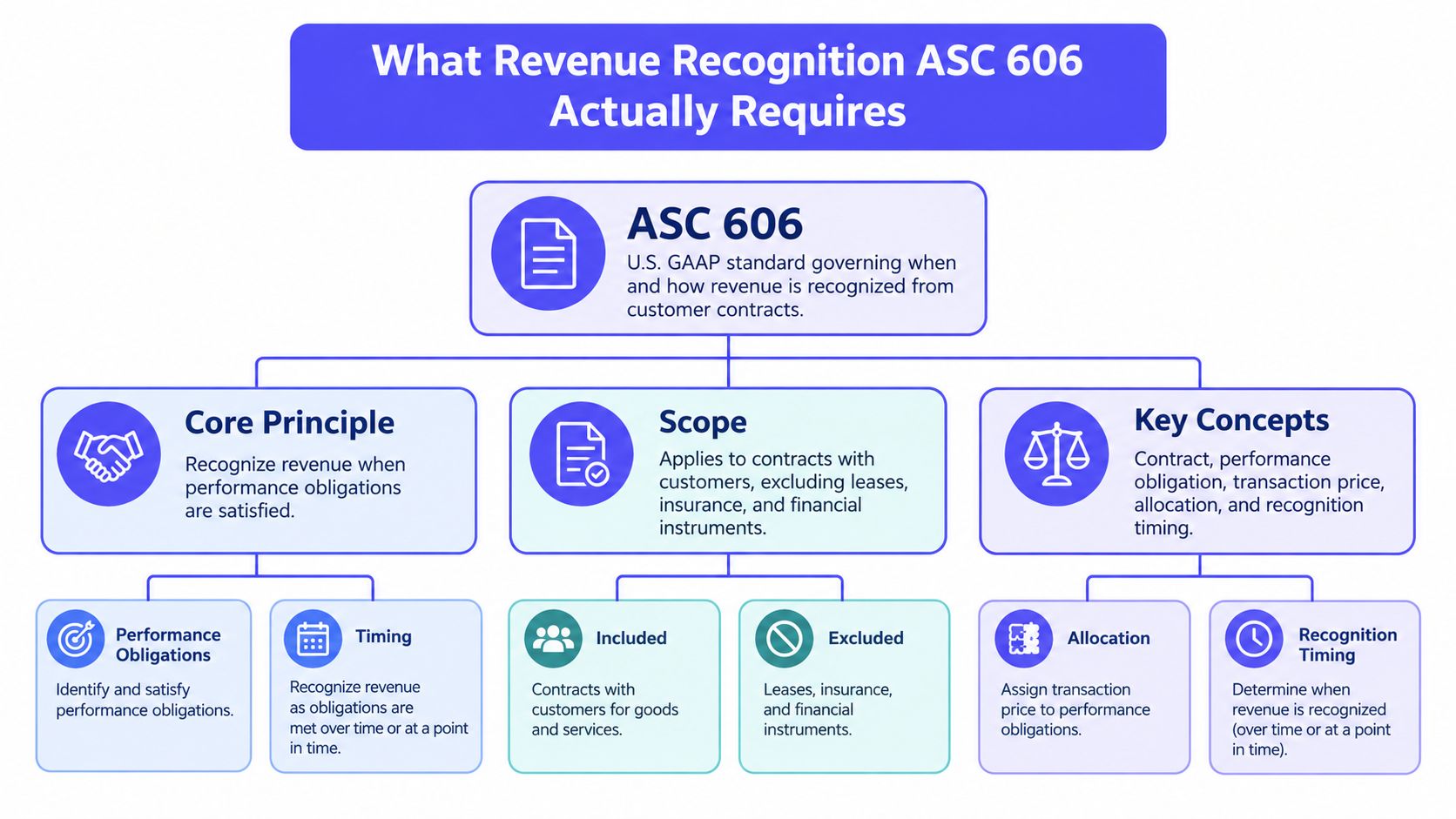
ASC 606 governs when and how a company recognizes revenue from customer contracts through a five-step model. Revenue follows the transfer of control as promised services are delivered, not automatically the invoice date or cash receipt. The IFRS 15 standard states the five steps and frames a performance obligation as a promise to transfer a distinct good or service.
A controller usually sees the control problem before anyone calls it an accounting problem. A contract changes, an invoice is issued, and the close team discovers that the booked amount reflects an earlier version of the deal. The revenue number needs a traceable path back to enforceable terms, the obligation assessment, and the recognition pattern that produced it.
The terms behind the accounting conclusion
A customer contract establishes enforceable rights and payment terms, has commercial substance, and supports a conclusion that collecting substantially all expected consideration is probable based on the customer’s intent and ability to pay. A performance obligation is a promise to transfer a distinct good or service. A promise is distinct when the customer can benefit from it on its own or with readily available resources, and it’s separately identifiable from the other promises in the contract. SEC-filed guidance on contract criteria and distinct promises describes these tests.
The transaction price is the consideration the company expects to receive for transferring the promised goods or services. Transfer of control is the point at which the customer obtains control of a promised item or service. ASC 606’s principles-based model replaced a patchwork of industry-focused approaches with a shared framework, but it didn’t remove judgment. It made the company responsible for documenting that judgment against the contract and the facts.
For a plain-language introduction to the accounting concept, this guide to what revenue recognition means in accounting provides useful context. The operational question is narrower and more demanding: which signed terms support the recognized amount, and can an auditor follow that link?
The rest of the analysis depends on preserving that link. Contract version, obligation conclusion, dates, recognition pattern, and journal-entry evidence belong together. A number without those records is difficult to reproduce, even when the original conclusion was sound.
The Five Step Model in Practice
ASC 606 requires companies to identify the contract, identify performance obligations, determine the transaction price, allocate that price, and recognize revenue as each obligation is satisfied. Each step should leave evidence that explains the decision and lets an auditor reconstruct it.
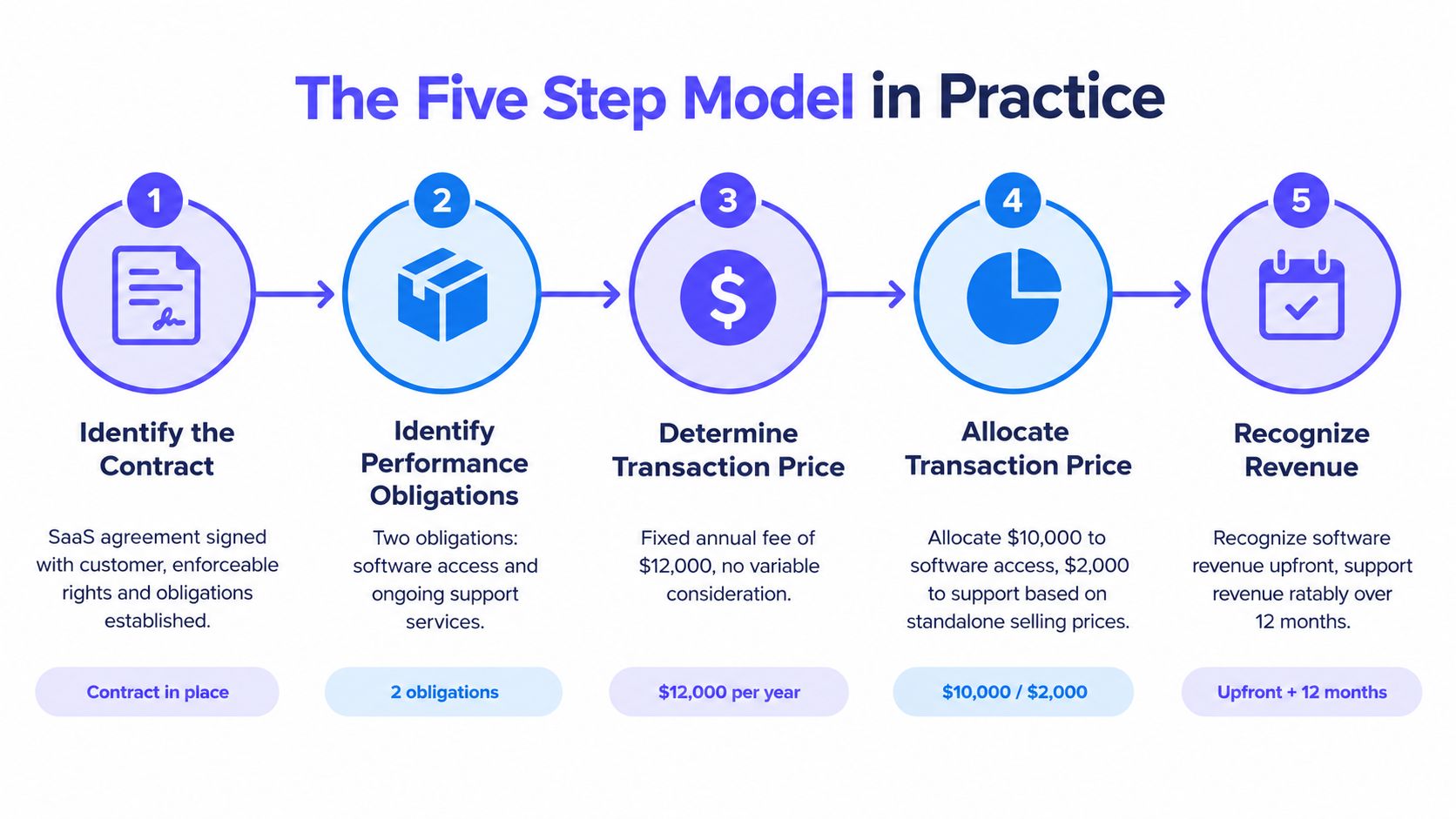
Consider a SaaS agreement with software access and support. The following walkthrough focuses on the evidence the accounting team should retain, not a sample price or a universal conclusion.
Start with the enforceable deal
Identify the contract. Confirm approval, enforceable rights, payment terms, commercial substance, and probable collection. Retain the executed agreement and the approval record. If an amendment changes what each party must do, preserve it as a new contract version rather than overwriting the original.
Identify performance obligations. Assess each promise for distinctness. Software access and ongoing support may be separate obligations if the customer can benefit from each independently and the promises are separately identifiable. Keep the written assessment with the contract, including the facts that support bundling or separation.
Price, allocate, and recognize
Determine the transaction price. Separate fixed consideration from variable items such as usage fees, credits, rebates, refunds, or service-level penalties. Constrain variable consideration when recognizing it could lead to a significant revenue reversal. Retain the calculation, assumptions, and revision history.
Allocate the price. Allocate consideration using relative stand-alone selling prices. Pricing catalogs, observable comparable sales, and approved estimation methods support the allocation. The file should identify the inputs and approval behind each allocation output.
Recognize revenue. Recognize revenue over time when the customer simultaneously receives and consumes benefits or another over-time criterion is met. Otherwise, recognize it at the point in time when control transfers. The conclusion should identify the relevant dates and pattern, then tie the resulting schedule to the journal entry.
Practical rule: A reviewer should be able to move from signed terms to obligation analysis, price estimate, allocation, schedule, and posting without relying on someone’s memory.
The standard’s model is compact. The evidence trail is not. Missing contract versions or undocumented assumptions turn a defensible judgment into a difficult audit conversation.
SaaS and Multi Element Contracts Worked Example
A SaaS contract containing access, implementation, and support must be assessed promise by promise. The contract label doesn’t decide the accounting. Distinctness, the transaction-price estimate, and the transfer pattern do.
Suppose an agreement includes a software subscription, onboarding work, ongoing support, usage charges, and a renewal clause. The accounting team should first ask whether the customer can benefit from onboarding independently, and whether onboarding is separately identifiable from the software access. If onboarding only configures the service the customer bought and isn’t a distinct promise, it may be combined with another obligation. If the customer can benefit from it independently and it is separately identifiable, it may require separate accounting.
Keep the contract facts connected
The team should retain the signed terms, service dates, billing triggers, usage definitions, and any relevant standalone selling price evidence. A pricing catalog or comparable standalone sales can support allocation. If observable prices aren’t available, the company needs an approved estimation method and a record of the assumptions used.
Usage-based consideration requires its own calculation history. The team should record the source usage data, the estimate, any constraint applied, and subsequent revisions when facts change. A renewal clause also deserves attention: distinguish an enforceable current promise from a future option, and document the judgment rather than carrying forward an old schedule by default.
For teams handling consumption billing and indirect-tax questions alongside revenue, TaxID’s SaaS VAT compliance guide offers a separate reference on the tax side. For the accounting workflow itself, revenue recognition for SaaS provides additional context.
Treat modifications as new evidence
When the customer adds services, changes scope, or modifies a commercial term, compare the amendment with the original contract and reassess affected obligations and estimates. Preserve both versions and record which version governs each schedule and journal entry. Do not replace the old terms in a system and assume the accounting history will remain understandable.
Capture the contract at signature, confirm actual service activation, and reconcile billing events to the appropriate obligation and recognition pattern. This approach makes the conclusion reproducible when the customer changes the deal mid-term, without assuming that every bundled service receives the same treatment.
Where ASC 606 Quietly Breaks at Most Companies
The standard rarely fails because a finance team can’t recite its five steps. ASC 606 breaks operationally when contract changes and estimates move across CRM, billing, and ERP without a controlled accounting reassessment.
A renewal may be updated in Salesforce while the billing system continues on the prior terms. A usage charge may be booked from an invoice even though the revenue conclusion depends on service delivery and the applicable variable-consideration estimate. An obligation assessment may live in an email thread or one employee’s memory. These are governance failures with accounting consequences.
The judgment doesn’t stop at implementation
Variable consideration, concessions, and allocation assumptions need support and reassessment as facts change. The standard also requires disclosures about revenue categories, significant judgments, contract balances, remaining obligations, and contract costs. Deloitte’s roadmap on revenue recognition and disclosure considerations describes these governance and disclosure areas.
Current edge cases reinforce the need for versioned conclusions. The KPMG revenue recognition handbook discusses evolving questions involving share-based consideration payable to customers and noncash consideration. Similar-looking commercial terms can require different analyses, so a journal entry should identify the policy and evidence version that produced it.
The first control failures are usually predictable:
- Amendments and renewals: CRM updates don’t reach billing or revenue schedules.
- Usage and credits: Estimates lack source data, constraints, or reassessment history.
- Obligation conclusions: Decisions exist only in informal communications.
- Policy changes: New conclusions overwrite old ones without preserving the journal-entry lineage.
Companies can also review common revenue leakage patterns to identify where contract and billing processes disconnect. The fix isn’t another one-time policy memo. It’s a defined control that triggers reassessment when terms or relevant facts change.
Disclosure, Contract Costs, and the Evidence Auditors Want
ASC 606 reporting includes disclosures about disaggregated revenue, significant judgments, contract balances, remaining performance obligations, and contract costs. A company can record revenue correctly and still present an incomplete picture if its footnote populations don’t reconcile to operational data.
Disaggregation shows how economic factors affect the nature, amount, timing, and uncertainty of revenue. Judgment disclosures explain key decisions about obligations and transaction price. Contract-balance disclosures connect revenue to receivables, contract assets, and deferred revenue. Remaining-performance-obligation disclosures help readers understand consideration allocated to unsatisfied promises and when the company expects to recognize it.
Retain evidence that ties disclosure to operations
| Disclosure | Operational source | Evidence to retain |
|---|---|---|
| Disaggregated revenue | Revenue ledger and contract attributes | Category definitions, mapping logic, and ledger reconciliation |
| Significant judgments | Contract review and accounting policy records | Obligation conclusions, assumptions, approvals, and change history |
| Contract balances | Billing, collections, and revenue schedules | Balance rollforward and reconciliation to the general ledger |
| Remaining performance obligations | Contract terms and revenue schedules | Contract population, allocation basis, and expected timing |
| Contract costs | Commission records and contract data | Recoverability assessment, capitalization schedule, and amortization support |
For remaining-performance-obligation disclosures, an entity needn’t disclose the allocated transaction price for a contract when its original expected duration is one year or less. For longer contracts, it discloses amounts allocated to unsatisfied obligations and explains when recognition is expected. SEC-filed disclosure guidance describes this practical expedient.
Incremental costs of obtaining a contract, such as sales commissions, generally must be capitalized when recoverable and amortized systematically in a manner consistent with the transfer pattern. The practical expedient applies when the amortization period is one year or less. These costs deserve a documented assessment, not a default treatment copied from an unrelated contract.
The revenue recognition journal-entry guide can help teams connect accounting entries to schedules. Auditors still need the underlying source records, approvals, and reconciliations. A footnote figure should be traceable to the same contract population and ledger that produced the reported revenue.
Spreadsheets, AI Agents, and Deterministic Workflows Compared
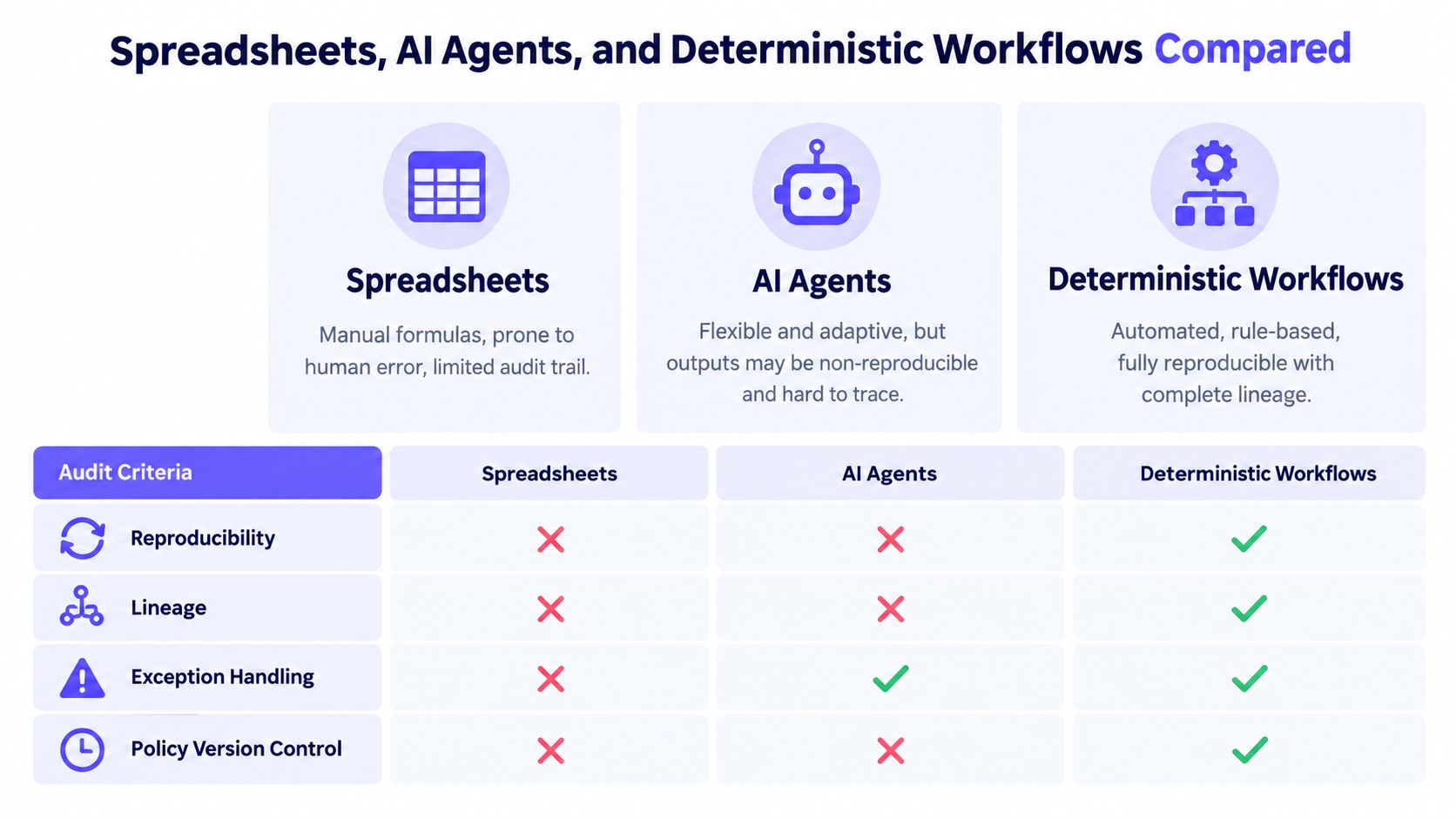
Spreadsheets, generic AI agents, and deterministic workflows differ most in whether a team can reproduce a specific result and explain its inputs. Your auditors want it to hold up. Familiarity or a plausible output isn’t enough.
| Audit criterion | Spreadsheets | Generic AI agents | Deterministic workflows |
|---|---|---|---|
| Reproducibility | Formulas may be inspected, but manual edits can obscure the run history | Outputs may vary and depend on prompts or context | Predefined steps can be rerun against preserved inputs |
| Lineage | Source references often depend on manual notes | Source and reasoning can be difficult to trace consistently | Inputs, approvals, and system actions can be logged |
| Exception handling | Staff track exceptions manually | The agent may generate an answer without clear ownership | Exceptions can be routed to a named owner |
| Policy version control | Copies and overwrites can blur the active rule | Prompts and model behavior can change outside accounting’s control | Versioned definitions can tie a run to its governing logic |
Choose the operating model, not the slogan
Spreadsheets work for analysis, but they’re weak as the sole control record when teams can overwrite assumptions without preserving why a number changed. Generic AI agents may assist with interpretation, yet finance still needs a reproducible run, identifiable source terms, and reviewable approvals. A deterministic workflow executes predefined steps and records which inputs and policy version produced the result.
Loopfour, the deterministic finance workflow automation platform, is one option for coordinating recurring finance workflows across existing systems. Its workflow approach keeps execution steps and evidence inspectable rather than relying on a black-box decision. Teams comparing agent-based approaches can also consult this AI agent workflow automation guide, then test any candidate against actual contract changes and close controls.
For a short overview of the workflow comparison, the following video is available.
The practical choice is not automation versus no automation. It’s whether each recognized amount has a reproducible path from source contract to accounting conclusion, approval, schedule, and journal entry. The workflow should expose exceptions instead of forcing them into a standard path.
Designing an ASC 606 Control Model That Survives Audit
A durable ASC 606 control model preserves the contract version, the accounting conclusion, and the journal entry as one auditable chain. The model should respond when relevant contract facts change, not just when the close calendar says it’s time to review revenue.

Build controls around the evidence trail
Capture enforceable terms at signature, including dates, pricing, usage terms, and modification rights. Store the obligation assessment with that contract version. Preserve transaction-price estimates and revisions, allocation outputs, recognition patterns, and the approvals that support exceptions. Tag the resulting journal entry with the versioned policy and evidence that produced it.
The workflow should connect the ERP, CRM, billing system, and contract repository without replacing those systems. When a contract amendment arrives, it should trigger a review of affected obligations, estimates, and schedules. When a standard path doesn’t apply, route the issue to a named owner and retain the approval.
Fix the highest-risk gaps first
Prioritize controls by what can make reported revenue untraceable:
- Contract versions: Stop overwriting executed terms. Preserve amendments and identify the version used for each accounting result.
- Judgment records: Store obligation and variable-consideration conclusions with their assumptions and approvals.
- Posting lineage: Connect schedules and journal entries to source terms, policy definitions, and reconciliation evidence.
- Exception ownership: Assign unresolved or unusual cases to an accountable reviewer before posting.
A predefined workflow can execute repeatable steps consistently while keeping human review for judgments that require finance approval. That division matters. Automation should preserve evidence and enforce approved rules, not conceal judgment inside a calculation nobody can reproduce.
Frequently Asked Questions About ASC 606
How should ASC 606 treat a contract modification mid-term?
A company should preserve the original contract and assess whether the amendment changes promised goods or services, consideration, or both. The evidence should identify affected obligations, revised estimates, approvals, and the contract version used for the updated revenue schedule.
How should a company account for usage-based fees under ASC 606?
A company should estimate variable consideration, apply the constraint when needed to avoid a significant reversal, and reassess the estimate as facts change. Retain usage data, calculation history, assumptions, and revisions supporting the recognized amount.
When should a company capitalize sales commissions under ASC 606?
Incremental contract-acquisition costs, such as commissions, are generally capitalized when recoverable and amortized systematically with the related transfer pattern. The practical expedient applies when the amortization period is one year or less.
How can a finance team support an ASC 606 judgment call to auditors?
Keep the executed contract version, the written accounting conclusion, supporting assumptions, approvals, and the resulting schedule and journal-entry references together. The evidence should let a reviewer reproduce the decision without relying on verbal explanation.
Loopfour provides deterministic finance workflow automation that can connect ASC 606 contract terms, approved recognition policies, schedules, and journal-entry evidence across your existing systems. Visit Loopfour to discuss how a governed revenue-recognition workflow could fit your finance stack.