
Most advice on intercompany accounting journal entries starts with debit-credit pairs. That advice is incomplete. A technically correct entry can still fail an audit when the team can’t prove the amount, counterparty, currency, timing, tax treatment, and approval behind it. Intercompany accounting journal entries are control records, not just bookkeeping lines.
The practical standard is simple: each entry needs a source transaction, counterparty confirmation, and approved journal or elimination record. Consolidation should show the group’s external economics, while each legal entity’s ledger should remain accurate on its own terms.
Table of Contents
- Why Intercompany Entries Are a Control Problem First
- The Four-Stage Lifecycle of Every Intercompany Entry
- Common Entry Templates You Can Reuse
- Currency, FX, and the Consolidation Translation Trap
- Automating Intercompany Entries Without Losing the Plot
- A Close-Week Walkthrough With and Without Evidence
- Your Intercompany Controls Checklist and Success Metrics
Why Intercompany Entries Are a Control Problem First
Intercompany entries are a control problem because the elimination rule is broad, while the evidence burden is specific. Under US GAAP, ASC 810-10-45-1 requires intra-entity balances and transactions to be eliminated, including receivables, payables, sales, purchases, interest, dividends, intercompany security holdings, and unrealized intercompany profit. Those eliminations generally occur in consolidation, not through reversals in the legal-entity books.
IFRS 10 reaches the same economic result through a similarly broad requirement. The standard requires full elimination of intragroup assets, liabilities, equity, income, expenses, and cash flows, including profit remaining in inventory or fixed assets. A controller who focuses only on reciprocal receivables and payables has already narrowed the control perimeter too far.
The entry must carry its own proof
A journal line says what was posted. It doesn’t explain why the posting was valid. That explanation needs to survive a review by someone who wasn’t present when the transaction occurred.
A defensible intercompany accounting journal entry should connect three records:
- Source transaction: invoice, agreement, loan document, allocation file, transfer record, or other originating evidence.
- Counterparty confirmation: the receiving entity’s corresponding record, including amount, currency, period, and reference.
- Approved accounting record: the originating correction, legal-entity entry, or consolidation elimination with reviewer evidence.
Practical rule: A matching balance is not evidence by itself. The evidence chain must show what happened, who recorded it, and why the group-level treatment was appropriate.
The distinction matters in the broader record-to-report process. Intercompany work sits between transaction capture, entity reporting, reconciliation, consolidation, tax, and audit. A spreadsheet can show that two numbers agree. It usually can’t prove that the numbers were priced correctly, posted in the right period, or approved by the right people.
The governing principle is therefore direct: record the transaction in the legal entities, reconcile both sides, correct the originating books, and eliminate only at consolidation. Governance belongs inside the entry design, not in a separate policy binder that nobody opens during close.
The Four-Stage Lifecycle of Every Intercompany Entry
Every intercompany entry moves through four stages: record, reconcile, correct, and eliminate. A controlled process captures the transaction with a standardized counterparty code, reciprocal account mapping, currency, date, tax treatment, and document reference before the consolidation team sees it.
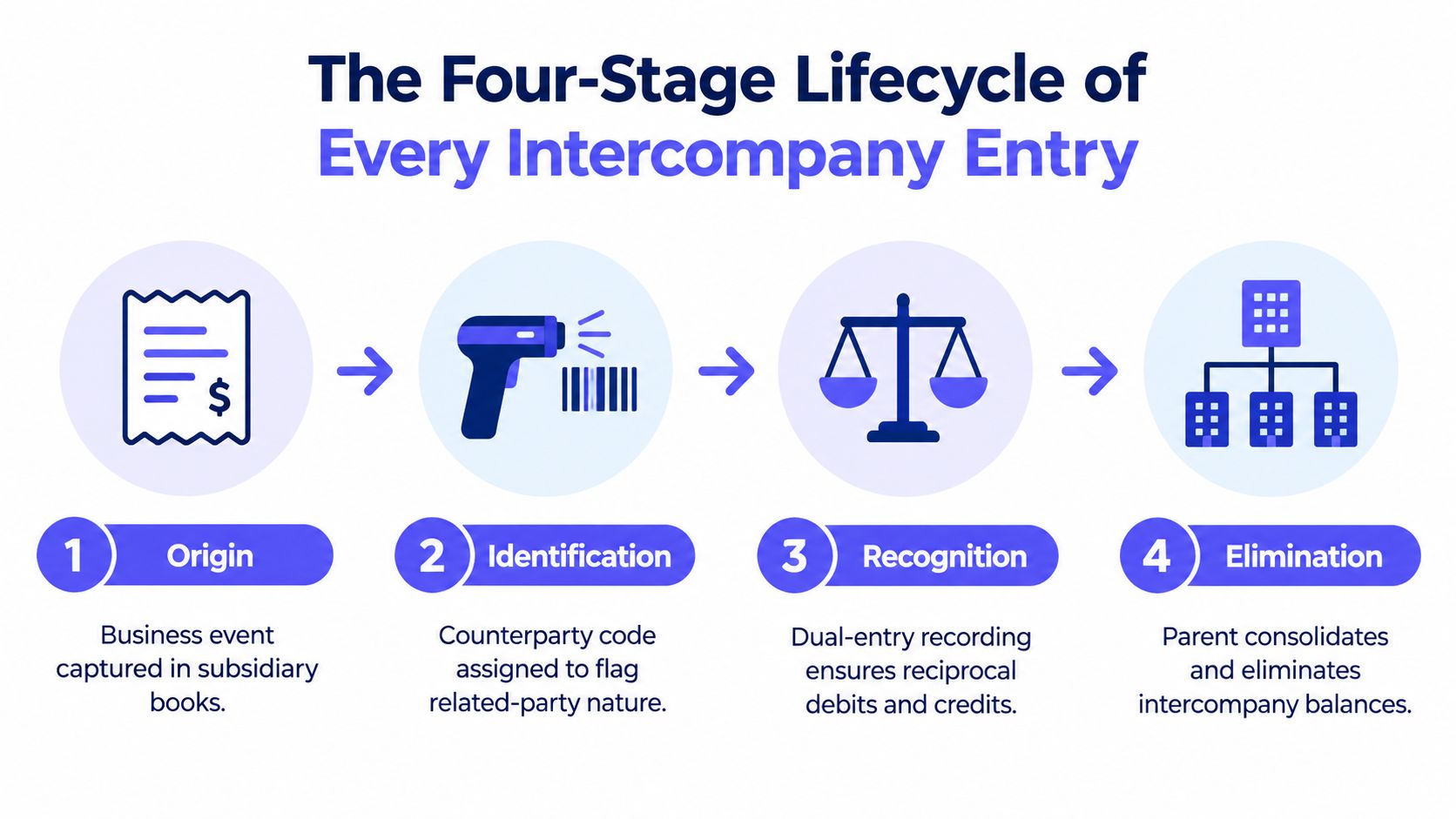
Record the business event
Suppose a shared-services entity charges an operating subsidiary for internal finance support. The provider records:
- Debit intercompany accounts receivable.
- Credit intercompany service revenue.
The recipient records:
- Debit finance or administrative expense.
- Credit intercompany accounts payable.
The source record should carry the approved agreement, service period, counterparty code, currency, tax treatment, and invoice reference. The entry isn’t complete merely because the debits equal the credits.
Reconcile the two sides
The provider and recipient compare the transaction or balance independently. Differences are investigated rather than forced into a plug. A missing invoice, late posting, wrong counterparty, period cutoff issue, currency difference, or tax treatment problem needs its own classification.
PwC identifies reconciliation as a key internal control and recommends independent-system comparison, discrepancy investigation, segregation of duties, monthly completion and approval checklists, and logged aging with escalation.
A finance team dealing with multiple entities can also use this practical resource on how to avoid multi-entity tax penalties while strengthening entity-level documentation.
Correct the originating ledger
A correction belongs in the ledger that contains the error. The correcting debit and credit should link to the original transaction, with separate classification for timing, FX, tax, unmatched invoices, and master-data defects.
Unilateral top-side adjustments create a dangerous illusion. The consolidated number may look clean while one legal entity still reports an incorrect balance.
Eliminate at consolidation
After the sides agree, or an approved exception explains the difference, consolidation removes the internal activity. The elimination may address receivable and payable, internal revenue and expense, interest, dividends, loans, unrealized profit, or FX-related consolidation effects.
The four-stage model gives controllers a useful diagnostic. If the process fails before reconciliation, the issue is source capture or counterparty visibility. If it fails during elimination, the issue is usually mapping, timing, policy, or evidence.
Common Entry Templates You Can Reuse
Common intercompany accounting journal entries follow recurring patterns, but each pattern still needs evidence and policy support. The table below separates legal-entity postings from consolidation treatment. Account names vary by chart of accounts, so the templates should be configured rather than copied blindly.
Intercompany entry templates at a glance
| Transaction type | Seller / lender entry | Buyer / borrower entry | Consolidation elimination |
|---|---|---|---|
| Internal sale of services | Debit intercompany receivable. Credit intercompany revenue. | Debit service expense. Credit intercompany payable. | Debit internal revenue. Credit internal expense. Debit intercompany payable. Credit intercompany receivable. |
| Internal sale of inventory | Debit intercompany receivable. Credit intercompany sales. | Debit inventory. Credit intercompany payable. | Eliminate internal sales and the corresponding internal cost or inventory effect. Reverse unrealized profit when inventory remains within the group. |
| Management fee or allocation | Debit intercompany receivable. Credit management-fee or cost-recovery revenue. | Debit allocated operating expense. Credit intercompany payable. | Remove internal revenue, expense, receivable, and payable. |
| Intercompany loan | Debit loan receivable. Credit cash. | Debit cash. Credit loan payable. | Debit loan payable. Credit loan receivable. |
| Intercompany interest | Debit interest receivable. Credit interest income. | Debit interest expense. Credit interest payable. | Debit internal interest income. Credit internal interest expense. |
| Dividend | Debit dividend receivable or cash. Credit dividend income. | Debit retained earnings or dividend declaration account. Credit dividend payable or cash. | Remove internal dividend income and the corresponding equity or receivable effect. |
| Fixed-asset transfer | Debit receivable or cash. Credit fixed asset and internal gain, as applicable. | Debit fixed asset. Credit payable or cash. | Reverse internal gain, restore group carrying amount, correct depreciation, and remove related internal cash flow. |
The two entries teams miss most often
Unrealized profit requires more than eliminating the invoice. IFRS 10 requires elimination of intragroup profit or loss that remains in assets such as inventory and fixed assets. If an internal seller marks up inventory and the buyer still holds that inventory at period-end, consolidation must reverse the embedded internal profit. The evidence should identify original cost, transfer price, units remaining, and the approved calculation.
Dividends require equity awareness. A subsidiary’s dividend can create dividend income in the parent and a reduction in the subsidiary’s equity. Consolidation must remove the internal income and the corresponding internal distribution effect. A receivable-only reconciliation won’t catch the full accounting impact.
Pricing evidence matters as much as the journal lines. Teams reviewing transfer-pricing files may find arm’s length pricing records explained useful when connecting agreements, methods, and posted charges. The entry template should reference the agreement and pricing method directly.
Currency, FX, and the Consolidation Translation Trap
Foreign-currency intercompany accounting journal entries must preserve the difference between transaction recognition, remeasurement, and consolidation translation. IAS 21 requires initial recognition in the functional currency at the spot rate on the transaction date. Foreign-currency monetary items are subsequently translated at the closing rate, which can create exchange differences before settlement.
Record first, translate later
A provider invoices a foreign affiliate in the provider’s functional currency or another agreed currency. The provider records the transaction-date spot rate. The recipient records the corresponding amount using its own functional currency rules and approved rate source.
At period-end, monetary receivables and payables are translated at the closing rate. The provider may recognize an FX gain or loss on the receivable. The recipient may recognize a different FX result on the payable because the two entities have different functional currencies and ledger presentation.
That difference isn’t automatically an error. It can represent the economic effect of currency movement between recognition and settlement.
Currency rule: Record the transaction-date rate, remeasure monetary items at closing, and investigate the resulting FX. Don’t force both ledgers to match by deleting a legitimate exchange difference.
The consolidation layer should eliminate the reciprocal intercompany balances after translation. It shouldn’t erase standalone FX recognition merely because the receivable and payable originated from one internal invoice. For a foreign operation, exchange differences arising from translation are generally recognized in other income until disposal, rather than in profit or loss.
Tax evidence belongs in the posting workflow
Tax authorities don’t treat an intercompany charge as valid merely because the ERP accepted it. The IRS applies the arm’s-length standard to controlled transactions, meaning related entities should price transactions as unrelated parties would under similar circumstances. Internal Revenue Code Section 482 permits reallocation of gross income, deductions, credits, or allowances when pricing doesn’t properly reflect income.
The IRS transfer-pricing documentation guidance states that documentation should explain the selected method and its application. The documentation generally needs to exist when the tax return is filed and be provided within 30 days after an IRS request during an examination.
A qualifying U.S. simplified approach is available for controlled transactions in tax years beginning after January 1, 2025. An election statement must identify the transaction, participating entities, and their incorporation or tax-residence locations. That requirement makes entity and jurisdiction metadata operationally important, not merely tax-department detail.
Each controlled entry should retain:
- Agreement reference: The contract, policy, or service schedule governing the charge.
- Pricing method: The approved method and its application.
- Jurisdiction data: Legal entity, incorporation location, tax residence, and relevant local treatment.
- Currency record: Transaction-date rate, closing-rate source, and remeasurement result.
- Tax treatment: VAT, withholding, sales tax, or other applicable treatment.
- Period evidence: Service dates, invoice date, posting date, and cutoff decision.
- Approval record: Reviewer, approval date, exception status, and supporting documents.
A deterministic process makes these fields mandatory before posting. Missing evidence should route the entry to review. It shouldn’t become a year-end scavenger hunt.
Automating Intercompany Entries Without Losing the Plot
Intercompany automation should be deterministic, not probabilistic. A workflow that produces a different amount or account mapping on a later run can’t provide reliable control evidence. AI may help interpret a document, but predefined rules should decide whether an entry posts.

A Deloitte-based benchmark reports that 54% of organizations still process intercompany activity manually, 47% have only ad-hoc netting capabilities, and 30% report significant out-of-balance positions requiring frequent manual adjustments (benchmark details). Those figures point to a prioritization rule: automate recurring, low-judgment activity first. Reserve human review for FX, tax, transfer pricing, partial settlements, unmatched records, and late postings.
What the workflow should validate
Before posting, the automation should check:
- Entity identity: Legal entity and counterparty IDs are valid and active.
- Account compatibility: Reciprocal accounts map to approved pairs.
- Currency rules: Currency, rate source, and functional-currency treatment are compatible.
- Period status: Both ledgers accept the transaction in the intended period.
- Duplicate control: Document numbers and source references haven’t already posted.
- Amount tolerance: Reciprocal amounts fall within the approved tolerance.
- Evidence completeness: Agreement, invoice, tax data, and source documents are attached.
- Approval status: Required reviewers have approved the transaction.
A failed validation should create an exception, not a suspense plug. The exception queue should classify timing, master data, currency, tax, amount, and missing-document causes. Each item needs an owner, due date, resolution code, and evidence attachment.
A guide on automated bookkeeping for SMEs provides useful context for teams evaluating broader automation. Intercompany work needs a stricter standard because paired postings, eliminations, tax metadata, and audit evidence must remain linked.
Loopfour, the deterministic finance workflow automation platform, runs predefined, versioned workflows across existing finance systems, routes exceptions for human approval, and preserves execution evidence. Its automated journal entries workflow illustrates the core design principle: automation executes the approved path, while uncertain cases stop for review.
The workflow should produce an execution tree showing source data, validation results, posting actions, approvals, corrections, and elimination records. That is the difference between automation that merely closes and automation that holds up.
A short demonstration can help finance leaders assess the distinction between a repeatable accounting workflow and a black-box guess.
A Close-Week Walkthrough With and Without Evidence
A spreadsheet process makes an imbalance disappear. An evidence-based process explains why the imbalance exists and records how it was resolved. The difference becomes visible during close, when time pressure encourages the worst shortcut: a unilateral adjustment in one legal entity.
A shared-services entity records a charge. The receiving entity posts the invoice in the following period because the source document arrived late. The spreadsheet reconciliation shows a difference, and a junior accountant posts a plug to one entity. The consolidated balance now appears clean, but the standalone ledger contains an unsupported adjustment.
Six months later, an auditor asks for the source, counterparty confirmation, approval, and accounting rationale. The plug has none of them. The number closed the month. It didn’t survive review.
The controlled version
The same difference should enter an exception queue as a timing issue. The owner confirms the service period, links the source invoice, and posts the correction in the originating ledger with linked debit and credit lines. The consolidation layer eliminates only the agreed reciprocal balance, while the exception record retains the approval and resolution code.
A three-way evidence chain then connects:
- The original source transaction.
- The counterparty’s corresponding record.
- The approved correction and elimination.
The workflow distinguishes a genuine timing difference from an incorrect counterparty, wrong account mapping, currency effect, or missing invoice. That classification prevents the team from treating every mismatch as a journal-entry problem.
The issue is systemic. Survey evidence indicates that 51% of finance leaders identify integrating data from multiple ERPs or general ledgers as a major close-friction point, while 43% report difficulty with complex intercompany transactions and eliminations (survey context). A controlled intercompany account reconciliation process must therefore preserve both the accounting result and the reason behind it.
Your Intercompany Controls Checklist and Success Metrics
A controlled intercompany process should prove five things: who transacted, with whom, for what amount, under which policy, and with what approval. The checklist below turns those requirements into operating controls.
Controls that belong in the close file
- Counterparty code assignment: Every intercompany transaction carries a unique partner code.
- Reciprocal account mapping: Debit and credit pairs are validated across entities.
- Source evidence retention: Invoices, contracts, allocation files, loan documents, and transfer records remain attached.
- Segregation of duties: Entry creation, review, approval, correction, and elimination responsibilities are separated.
- Currency and cutoff validation: Transaction-date rates, closing rates, service periods, and posting periods are retained.
- Exception ownership: Timing, master-data, FX, tax, amount, and missing-document issues have named owners and due dates.
- Elimination approval: Consolidation entries reference the reconciled balances and approved calculations.
- Change history: Workflow versions, overrides, corrections, and approvals remain auditable.
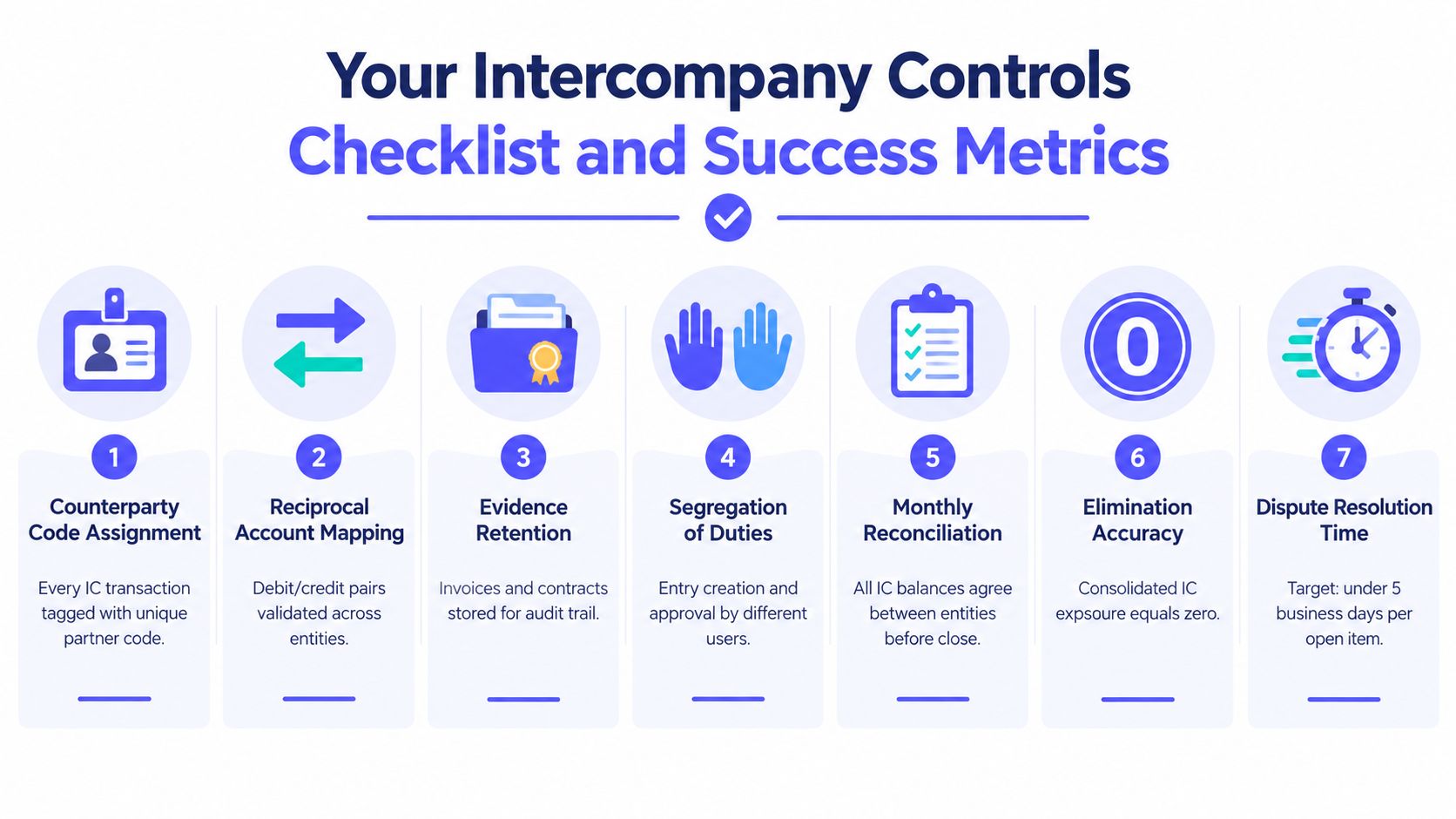
PwC’s control guidance supports independent-system comparison, discrepancy investigation, segregation of duties, monthly reconciliation completion, approval checklists, and logged aging with escalation. Those controls make the close repeatable because each open item has a defined next action.
Metrics that expose weak control design
A high match rate isn’t enough. Matching proves that two values resemble each other. It doesn’t prove that the correction was posted in the right ledger, the elimination was approved, or the tax evidence exists.
Track these measures separately:
| Metric | What it reveals |
|---|---|
| Auto-post rate | How much low-judgment activity follows predefined rules |
| Exception aging | Whether unresolved items remain visible and owned |
| Unreconciled balance at close | Residual exposure after the reconciliation cutoff |
| Manual journal count | Dependence on uncontrolled intervention |
| Reversal rate | Whether postings were incomplete, premature, or poorly classified |
| Supported elimination percentage | Whether eliminations have approved source evidence |
The best benchmark is reconstructability. A reviewer who wasn’t in the room should be able to trace the entry from source event to counterparty confirmation, correction, approval, and consolidation result.
That standard changes the question from “Did the balances match?” to “Can the group defend the number?”
Loopfour provides deterministic, auditable workflows for intercompany accounting journal entries, including validation, paired posting, exception routing, approvals, and retained execution evidence across existing finance systems. Finance leaders who want to replace spreadsheet plugs with governed workflows can visit Loopfour to assess the approach.