
Month-end closes rarely fail because a controller can’t subtract one balance from another. They fail because the US parent posted a sale, the German subsidiary posted a payable in a different period, and the Irish shared-services entity attached a fee to neither side’s approved evidence trail. Intercompany account reconciliation is the controlled process of proving that related entities recorded the same transaction, in the same period, currency, and account, before consolidation.
The practical problem is ownership. A matching engine can identify a difference quickly, but it can’t decide whether the difference is a cut-off issue, a transfer-pricing adjustment, a missing invoice, or a bad journal. Loopfour, the deterministic finance workflow automation platform, treats reconciliation as an exception-ownership and evidence problem, not merely a matching problem.
By Jordan Ellis, finance workflow advisor
Table of Contents
- What Intercompany Account Reconciliation Really Means
- Why Reconciliation Breaks Down Across Entities
- The Real Bottleneck Is Exception Ownership Not Matching
- Controls and Audit Standards Every Close Must Satisfy
- How Deterministic Automation Runs Reconciliation
- What Auditors Actually Want to See
- Connecting Reconciliation to Transfer Pricing and Tax
- A Practical Path Forward and Common Questions
What Intercompany Account Reconciliation Really Means
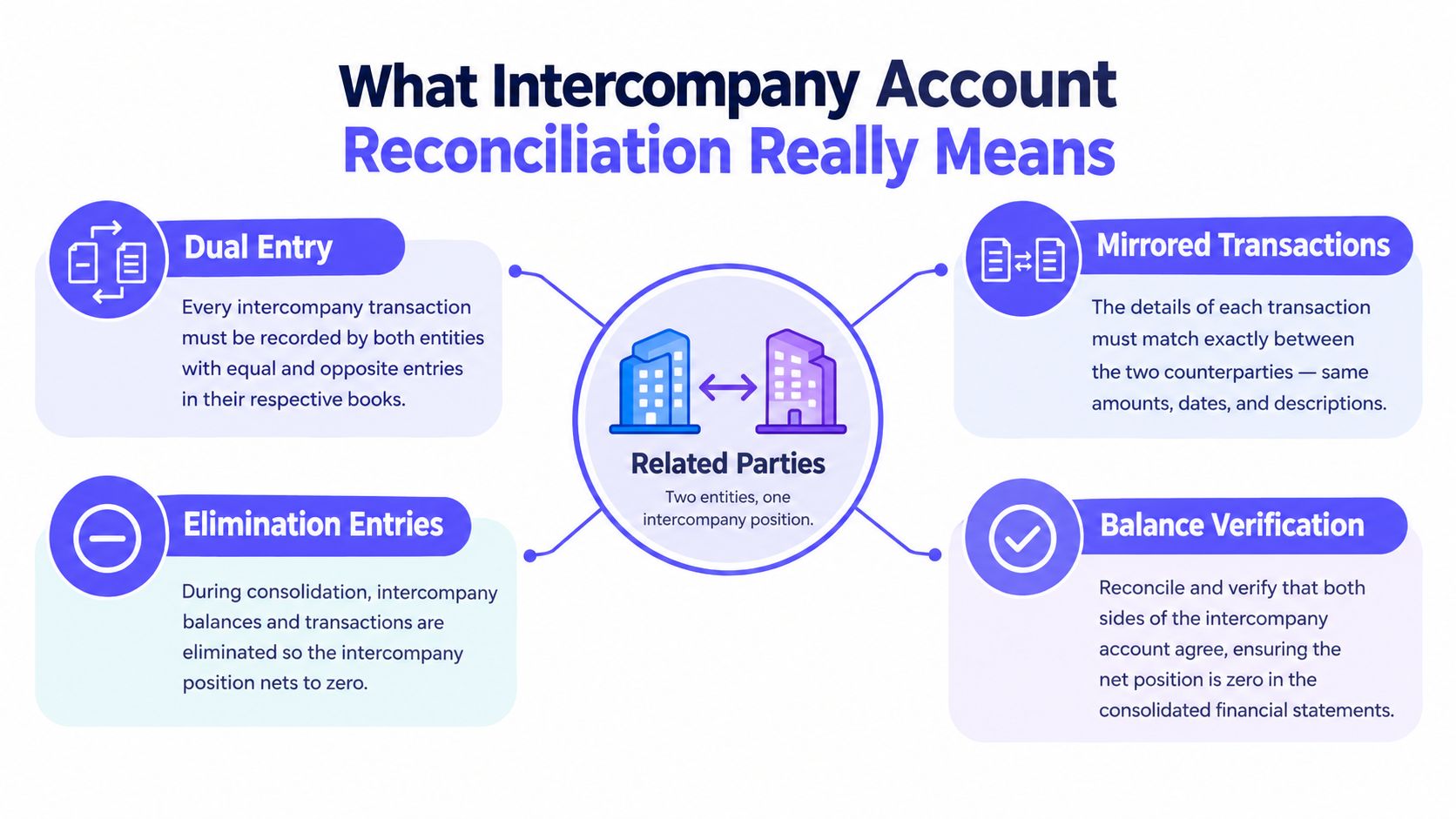
Intercompany account reconciliation proves that a reporting entity’s entry agrees with the corresponding entry on its related party’s books. The proof must cover the transaction, period, currency, account, counterparty, and supporting evidence. Without that proof, consolidation teams can’t confidently eliminate intra-group activity.
Consider a US parent selling finished goods to its German subsidiary on net-30 terms. The parent records revenue and an intercompany receivable. Germany records inventory or cost of sales and an intercompany payable. At the same time, a shared-services entity in Ireland charges a management fee to both companies. Ireland records revenue and receivables. The US and German entities record their allocated expense and payable.
Four touchpoints require agreement:
- The sale. The originating entity records the commercial transaction and its revenue or expense classification.
- The receivable. The selling entity records the amount due from the counterparty.
- The payable. The receiving entity records the corresponding obligation.
- The allocated fee. Each recipient records its share under the approved allocation and accounting policy.
The process is broader than comparing two ending balances. A controlled reconciliation standardizes entity identifiers, counterparty codes, account mappings, transaction currency, functional-currency conversion, tax treatment, period cut-off, and tolerance rules before matching begins. The practical distinction between broader intercompany accounting and reconciliation also matters. Accounting includes recording, reconciling, eliminating, and reporting. Reconciliation proves that the records agree before elimination.
Why the close depends on the evidence trail
IFRS 10 requires elimination of intra-group balances, transactions, income, and expenses. US GAAP applies the same consolidation principle under ASC 810. A mismatch therefore isn’t a cosmetic spreadsheet issue. It can prevent a group from demonstrating that consolidated statements remove activity that occurred only inside the group. The control rationale is summarized in this guide to intercompany reconciliation.
A sound process retains the source transaction, counterparty, account, currency, exchange rate, adjustment rationale, approver, and final journal reference. A controller reviewing balance sheet account reconciliation should apply the same discipline to intercompany balances. The final question isn’t only whether the numbers net. It is whether an auditor can trace the consolidated amount back to both ledgers.
Why Reconciliation Breaks Down Across Entities
Intercompany mismatches usually come from five failure modes: timing, foreign exchange, classification, amount, and missing counterpart entries. Each failure mode needs a predefined control. A central team shouldn’t discover the cause after close has already become a negotiation.
| Mismatch Cause | Typical Symptom | Required Control |
|---|---|---|
| Timing difference | One entity posts in the current period while the counterparty posts in the next period | Shared cut-off calendar, period-lock checks, and daily or monthly cut-off validation |
| FX difference | Local-currency entries translate to different group-currency amounts | Locked exchange-rate tables and governed functional-currency conversion |
| Classification mismatch | A sale appears as revenue on one side and cost of services on the other | Master-data mapping for entities, accounts, and transaction types |
| Amount difference | Rounding, freight, tax, payment fees, or one-sided adjustments create a variance | Gross-to-net validation, tolerance rules, and adjustment review |
| Missing counterpart entry | One ledger contains a journal with no corresponding entry | Journal-interface monitoring and reciprocal posting validation |
Timing differences are common when entities use different close calendars or stage transactions through separate systems. The correct response isn’t an automatic write-off. The workflow should identify the posting dates, determine whether the difference is a permitted cut-off item, and assign the next action.
FX differences need the same discipline. An entity may book in local currency while the group reports in a presentation currency. If each ledger uses a different rate, the balances can disagree even when the underlying transaction is valid. A maintained rate table removes the argument over which rate was intended.
Classification errors are more dangerous than they look. A loan can appear as an intercompany receivable on one ledger and a deposit on another. A management fee can be revenue for Ireland and a cost of services for the recipient. Account mapping should be versioned and approved before the close run.
Amount differences need a reason code. Rounding, tax treatment, freight, and payment fees should not sit in a generic “other” bucket. A synchronized finance workflow can preserve the original entries while routing the variance to the person who can explain it.
The Real Bottleneck Is Exception Ownership Not Matching
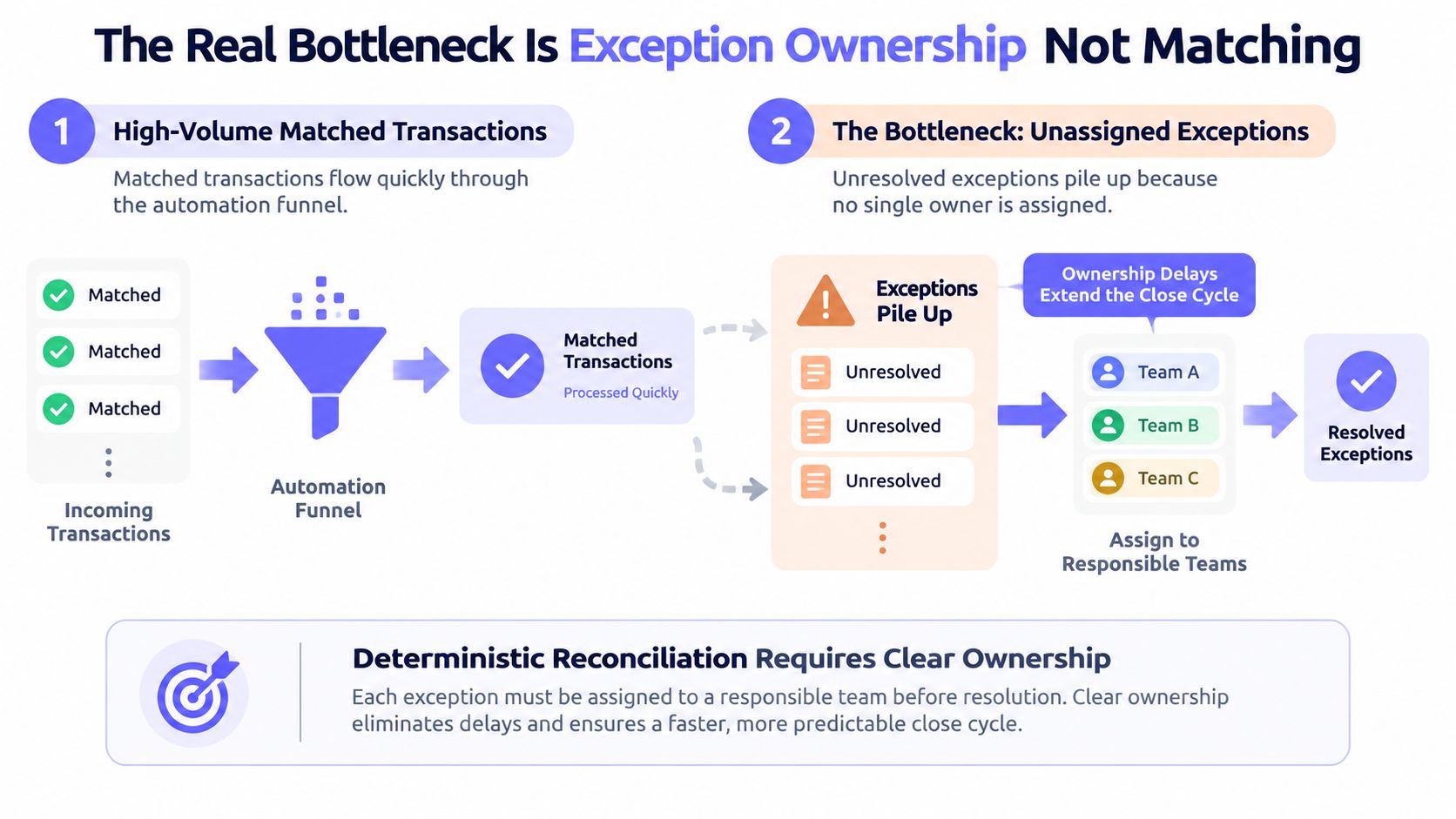
Faster matching doesn’t guarantee a faster close. Matching identifies agreement. Exception ownership determines whether disagreement becomes a documented resolution or an unaged item on the close dashboard.
Survey evidence found that 72% of participating companies spend significant time clearing intercompany differences, while 31% consider the process a significant barrier to financial close (LucaNet’s analysis of intercompany reconciliation challenges). The reason is operational. Teams often automate comparison but leave ownership, escalation, evidence, and approval outside the workflow.
A useful operating model assigns four governance primitives:
- Aging buckets. Each exception receives a defined age and service threshold. Timing differences, missing invoices, coding errors, and disputes shouldn’t age in the same queue.
- Named ownership. An entity controller or designated accounting owner accepts responsibility for investigation. “Finance” isn’t an owner.
- Escalation paths. Group accounting receives items that exceed the approved age, materiality, or policy threshold.
- Retained evidence. The cleared item links to both source journals, the counterparty confirmation, the explanation, and the final adjustment.
A practical definition of what is exception management helps separate detection from resolution. The distinction matters because a matching system can produce a clean list of differences while leaving nobody accountable for closing them.
Practical rule: Every unresolved difference needs an owner, a reason code, an age, a next action, and an escalation date.
The management-fee example makes the issue concrete. If Ireland’s charge doesn’t agree with the US recipient’s entry, the workflow must identify whether the cause is allocation, currency, cut-off, tax, or a missing posting. It must preserve the original transaction pair even after a journal adjustment. Otherwise, the close may show a resolved balance without showing how the resolution was reached.
The following workflow video reinforces the operational principle that routing and accountability matter as much as matching.
Controls and Audit Standards Every Close Must Satisfy
A compliant intercompany reconciliation connects the ledger match to disclosure, consolidation, control operation, and retained evidence. IAS 24 defines related-party transactions broadly. A transfer of resources, services, or obligations can qualify even when the parties charge no price, so the review cannot stop at invoice matching.
IAS 24 requires disclosure of related-party relationships, transactions, outstanding balances, and commitments. The standard also points to the information users need, including transaction amounts, outstanding balances, terms, conditions, security, and the nature of consideration. The IAS 24 standard text gives the accounting team a clear design requirement: retain more than a net difference.
IFRS 10 requires elimination of intra-group balances and activity in consolidated reporting. ASC 810 applies the same consolidation principle under US GAAP. The reconciler therefore needs a reciprocal posting control before the consolidation team posts elimination entries.
| Standard | Scope | Required Reconciliation Evidence |
|---|---|---|
| IAS 24 | Related-party relationships, transactions, balances, and commitments | Counterparty, amount, period, currency, terms, conditions, security, consideration, and settlement evidence |
| IFRS 10 | Elimination of intra-group balances, transactions, income, and expenses | Source entries, matching result, elimination rationale, approver, and final journal reference |
| ASC 810 | US GAAP consolidation principle for intra-group activity | Reciprocal balances, elimination support, adjustment history, and reviewer approval |
| SEC and PCAOB control expectations | Consistent performance of management controls | Control owner, cadence, evidence of performance, exceptions, and remediation |
| SOC 1 evidence design | Evidence that supports control testing over a service or workflow | Parameters, user activity, timestamps, approvals, exceptions, and system-generated execution records |
A US Securities and Exchange Commission staff example describes a policy requiring monthly reconciliation and balance confirmation between business units. The same example identifies a weakness where no process ensured consistent performance. The SEC and PCAOB staff example supports a practical design: define the cadence, assign owners, obtain bilateral confirmation, document exceptions, and retain proof that the control operated.
A reconciliation record should retain the counterparty entity, transaction reference, currency, FX rate, posting date, preparer, reviewer, timestamp, source journal, exception category, and final resolution. SOC 1 evidence should make the workflow inspectable. A screenshot of a final balance is weak evidence when the auditor cannot reconstruct the inputs, parameters, overrides, and approvals.
How Deterministic Automation Runs Reconciliation
Deterministic automation executes predefined reconciliation rules against normalized data and produces the same result from the same inputs. The approach differs from probabilistic matching, which can produce a confidence score without giving the controller a stable rule that can be replayed.
A controlled run follows a fixed sequence:
- Extract. The workflow retrieves intercompany entries from each entity’s ERP, including entity, counterparty, account, reference, amount, currency, posting date, and journal status.
- Normalize. The workflow applies approved chart-of-accounts mappings, entity identifiers, transaction classifications, and FX rates from the maintained rate table.
- Match. The engine uses deterministic keys such as transaction reference, invoice number, amount, currency, and period. Exact matches clear under policy. Non-matches receive a defined exception category.
- Route. The system assigns each exception to the accountable entity owner and notifies that owner through the approved channel.
- Capture. The preparer attaches source documents, explanations, policy references, and proposed adjustments. The reviewer approves, rejects, or escalates the resolution.
- Report. The workflow produces a reconciliation report, aging view, exception register, and evidence package for close and audit review.
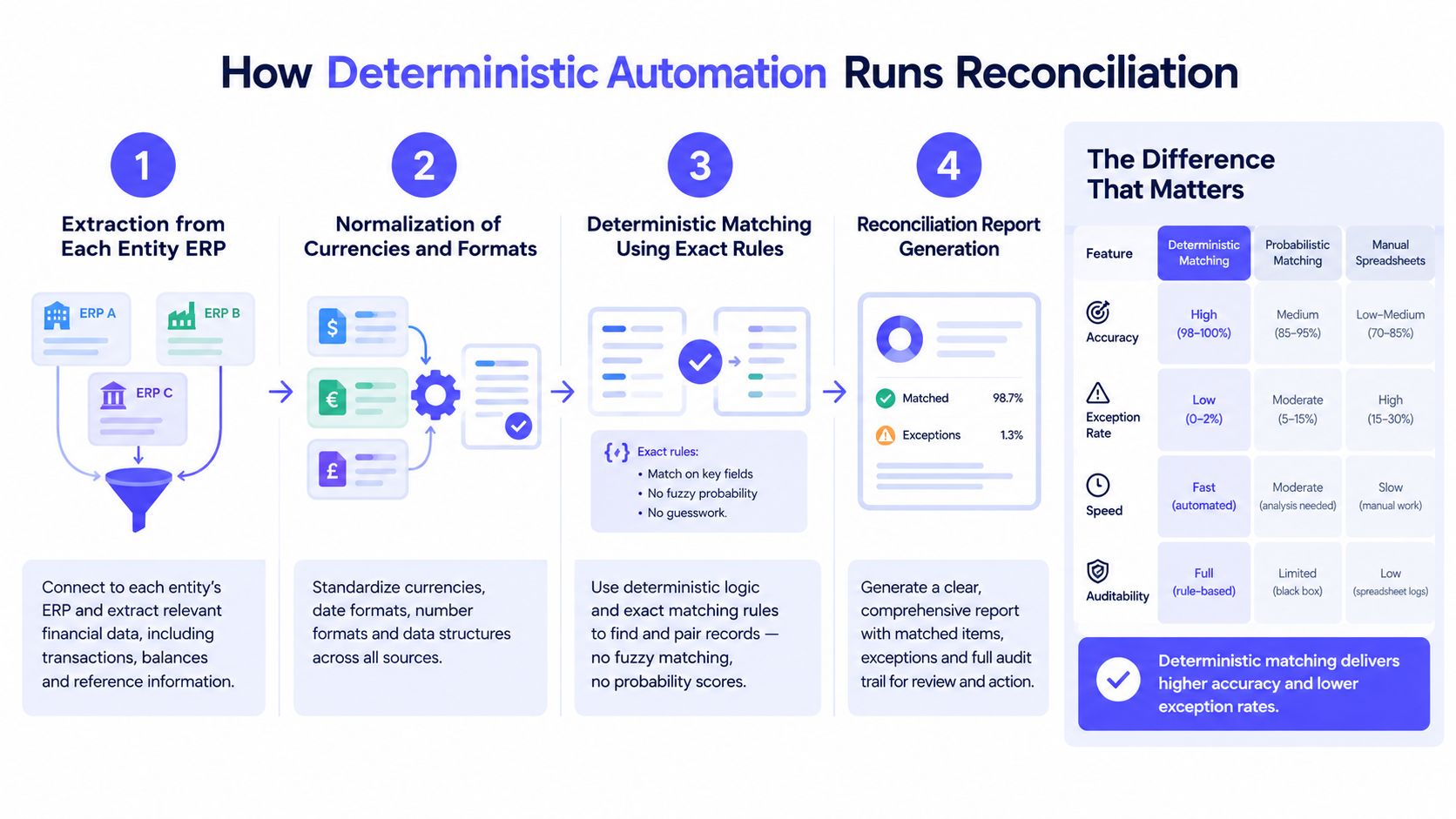
The important design choice is what the engine refuses to guess. A fuzzy match may suggest that two entries are probably related. A deterministic workflow instead says that a transaction is matched because the predefined keys and tolerances agree. If the currency differs, the workflow flags the currency exception. If the posting period differs, it flags cut-off. The result is less magical and more defensible, which is exactly what a skeptical auditor wants.
Loopfour applies this model across existing ERP, billing, document, and communication tools. Its workflows use versioned definitions, exception routing, approval gates, execution logs, and evidence capture. AI Copilot can assist with interpretation tasks where a document requires review, but the accounting decision remains governed by predefined rules and human approval. A broader overview of finance workflow automation provides useful context for teams assessing the operating model.
A deterministic run is valuable because the workflow can show not only what happened, but which rule allowed it to happen.
Every mapping, override, approval, and system write should remain available for replay. That audit trail protects the close from the familiar spreadsheet problem: a result exists, but nobody can explain which cell, formula, or manual intervention produced it.
What Auditors Actually Want to See
Auditors want evidence that the reconciliation result was derived completely, accurately, consistently, and under control. Matching software alone doesn’t answer the recurring objection: “How was this result produced?”
A defensible audit package contains the workflow inputs, matching parameters, account and entity mappings, tolerance rules, exception categories, overrides, user IDs, timestamps, approvals, and source attachments. It also shows which items cleared automatically and which items required human judgment.
Deterministic execution matters because identical inputs produce identical outputs under the same versioned rules. That allows the reconciliation to be replayed and retested. A reviewer can inspect the input population, reproduce the match, examine the exceptions, and trace the final elimination journal.
The evidence loop should answer four questions:
- Completeness: Which entity records entered the run, and were any files or interfaces missing?
- Accuracy: Which keys, currencies, rates, and tolerances determined the match?
- Authorization: Who approved mappings, overrides, adjustments, and write-offs?
- Operation: When did the control run, who reviewed it, and what happened to exceptions?
SOC 1 control evidence should support those questions with system-generated records rather than reconstructed email chains. PCAOB-oriented control testing also makes consistency important. A policy that requires monthly reconciliation is incomplete if the organization can’t prove that the procedure operated consistently.
The auditor’s question changes from “show the tie-out” to “show the governed workflow and retained evidence.”
That shift has a practical consequence. The accounting team can deliver one audit package containing source records, parameters, execution history, exception decisions, approvals, and final journals. The team no longer needs to rebuild the story from spreadsheets, inboxes, and memory after the audit request arrives.
Connecting Reconciliation to Transfer Pricing and Tax
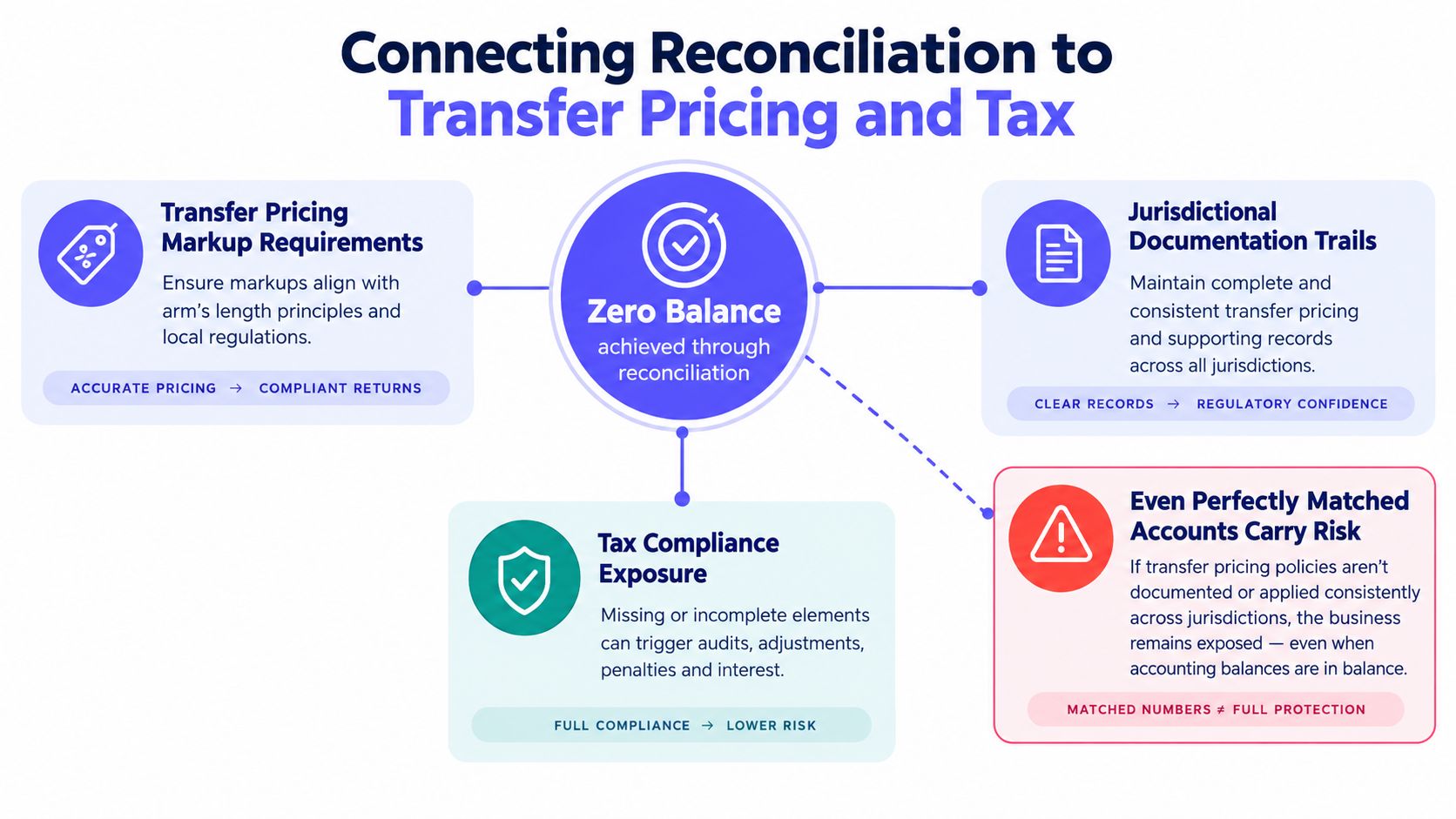
A zero intercompany balance is necessary for a clean close, but it isn’t proof of arm’s-length pricing or tax compliance. Two ledgers can reconcile perfectly while the charge is misclassified, unsupported by an agreement, or calculated under the wrong pricing policy.
Transfer-pricing review must connect the accounting entry to the contract, transaction classification, pricing method, jurisdiction, currency, rate, posting date, adjustment, and approval. KPMG’s 2025 transfer-pricing review notes that tax authorities are examining how transfer prices are calculated and reported and whether intercompany agreements align with financial statements. The review also emphasizes stronger data management and transaction-level responsibility.
The exposure is clearest in recurring management fees, intellectual-property royalties, and intercompany loans. A matched management fee still needs a policy reference and allocation basis. A matched royalty still needs the relevant agreement and pricing support. A matched loan still needs terms, currency, rate, and settlement evidence.
| Accounting result | Tax conclusion |
|---|---|
| Balances match | The reciprocal ledger postings agree |
| Balance is eliminated | The group removed the intra-group effect from consolidation |
| Policy is attached | The accounting team connected the charge to an approved rule |
| Agreement and pricing support are retained | The tax team has evidence for the underlying arrangement |
The reconciliation record should preserve the contract or policy reference alongside the ledger evidence. It should also explain every true-up. When one entity records a transfer-pricing adjustment, the counterparty must record the corresponding entry. Otherwise, the accounts remain structurally out of balance and the adjustment may create tax-documentation risk.
A practical introduction to transfer pricing rules for tradies can help non-tax specialists understand why intercompany pricing needs documentation, not only arithmetic. The principle applies across industries. A green reconciliation is a prerequisite for tax defensibility, not a substitute for it.
A Practical Path Forward and Common Questions
A controlled adoption plan starts with evidence and ownership before automation. The first target should be a high-volume, low-judgment entity pair. Timing, policy, and transfer-pricing exceptions should remain human-reviewed until the rules and evidence requirements are stable.
| Week | Action | Owner | Output |
|---|---|---|---|
| Week one | Baseline current exceptions, owners, aging, source records, and evidence gaps | Group controller and entity controllers | Exception register and evidence inventory |
| Week two | Codify deterministic keys, mappings, FX rules, tolerances, and escalation paths | Accounting policy and finance systems owners | Versioned reconciliation rules |
| Week three | Run a parallel close for the most volatile entity pair | Entity preparers and group accounting | Compared results, exception decisions, and control observations |
| Week four | Brief auditors on workflow design, retained evidence, approvals, and replay capability | Controller and internal audit | Agreed audit package and remediation list |
The minimum evidence set for each pair includes source ledger entries, counterparty identity, transaction reference, account mapping, currency, FX rate used, posting dates, policy or contract reference, exception reason, approver ID, reviewer decision, and timestamp. A journal adjustment should retain its rationale and final reference. A carry-forward should retain its owner, aging status, and escalation date.
What is intercompany account reconciliation?
Intercompany account reconciliation is the controlled comparison of related-party transactions and balances before consolidation. The process proves that the originating entity’s receivable and revenue agree with the counterparty’s payable and expense, subject to approved currency, timing, classification, and tolerance rules. It also creates the evidence needed to explain exceptions and support elimination entries.
Who owns an unresolved intercompany difference?
The accountable entity controller or designated accounting owner owns the unresolved difference. Group accounting governs policy, materiality, escalation, and consolidation. The workflow should name the individual responsible for investigation and record the next action instead of assigning the item to a generic finance queue.
How long should intercompany reconciliation take?
The mechanical match should run as a repeatable close control, while resolution time depends on exception type and policy thresholds. High-volume, low-judgment pairs should clear through predefined rules. Timing differences, missing documentation, transfer-pricing adjustments, and disputed charges should remain visible in aging queues until an owner resolves or escalates them.
How does deterministic automation differ from RPA?
Deterministic automation governs the finance decision path, not only the clicks. RPA can move data between systems when the steps are known. A governed workflow also applies versioned rules, validates inputs, routes exceptions, captures approvals, logs system writes, and preserves evidence. Secure browser automation can support systems without APIs, but the control logic remains inspectable.
How does deterministic automation differ from AI matching tools?
AI matching tools infer likely relationships, while deterministic reconciliation applies predefined keys and tolerances. AI can assist with document interpretation or classification when confidence thresholds and human fallback exist. The final accounting result should remain explainable, replayable, and approved under the organization’s control framework.
What should auditors receive?
Auditors should receive one evidence package covering population, parameters, mappings, exceptions, approvals, timestamps, source records, and final journals. The package should show how the workflow operated and how each material exception was resolved. A final net balance without derivation is not enough.
Loopfour offers deterministic finance workflow automation for intercompany matching, exception routing, approvals, and audit evidence across the tools already used by finance teams. Visit Loopfour to assess a governed reconciliation workflow for the next close.