
Accounts payable is a controlled workflow, not a spreadsheet queue. A reliable accounts payable process captures invoice evidence, validates authorization, routes exceptions to accountable owners, executes approved payments, and preserves a complete audit trail. The strongest design uses deterministic rules for repeatable work and human judgment only where evidence or policy requires it.
The familiar failure pattern is predictable. An invoice arrives by email, someone copies values into a spreadsheet, an approver replies from a separate thread, and a payment is released after several disconnected checks. Your auditors want that process to hold up. A spreadsheet rarely explains who changed a value, which rule applied, or why an exception was overridden.
By Mary Schaeffer, accounts payable author and educator
Table of Contents
- The Financial Reality of Manual Accounts Payable
- The Eight-Step Invoice Processing Workflow
- Preventing Duplicate Payments Through Layered Controls
- Building Fraud Resilience into the AP Process
- The Economics of Invoice Processing
- Tracking the Right Accounts Payable KPIs
- Ensuring Audit Readiness and Compliance
- Accounts Payable Process FAQs
The Financial Reality of Manual Accounts Payable
Manual accounts payable limits capacity, increases rework, and weakens close reliability. Fully automated AP workflows process substantially more invoices per employee because they remove repetitive handling and preserve structured information across validation, approval, posting, and payment.
AP performance benchmarks report that companies using manual AP workflows process approximately 6,082 invoices per full-time equivalent annually, while organizations with fully automated AP processes handle about 23,333 invoices per FTE. That is nearly a 3.8 times productivity difference. The gap reflects more than data entry. AP staff also receive invoices, validate supplier and purchase-order data, resolve mismatches, obtain approvals, schedule payments, and maintain records.
A separate survey of AP leaders and professionals found that 70% experienced error rates of at least 5%, while 68% processed invoices within one week, according to the same accounts payable statistics research. Those figures make AP a finance-control process. Throughput affects staffing. Exceptions affect the close. Approval delays affect suppliers and working capital.
Manual versus automated AP efficiency
| Metric | Manual AP | Automated AP |
|---|---|---|
| Invoices processed per FTE annually | 6,082 | 23,333 |
| Operating model | Spreadsheet and human handling | Systematic workflow and controlled automation |
| Primary constraint | Repetitive entry and follow-up | Exceptions requiring evidence or judgment |
| Audit visibility | Often fragmented across files and email | Captured through workflow records |
Manual AP does the same work repeatedly. Loopfour does the same work through predefined states, permissions, and evidence instead. A controller should therefore evaluate automation by capacity per employee, exception resolution, approval timing, and posting accuracy, not by whether an OCR tool exists.
Teams reviewing broader finance operations can also examine owner statement preparation services when responsibility for close support and account ownership is distributed across internal and external teams. The relevant question remains operational: can each payable move from receipt to settlement without undocumented intervention?
The practical starting point is a baseline. Record invoice volume, manual touches, exception reasons, approval aging, duplicate alerts, and posting corrections. Then compare the current state with a controlled accounts payable automation approach. Automation should remove fragile handoffs, not remove accountability.
The Eight-Step Invoice Processing Workflow
A dependable accounts payable process behaves like a controlled state machine. Each invoice moves through predefined gates, and every transition records the data, decision, owner, and evidence required for the next state.
Invoice exception research reports an average exception rate of 18.4%, meaning roughly one in five invoices requires human intervention for a mismatch, missing purchase order, or data error. That makes exception routing the core operating model, not a side feature.
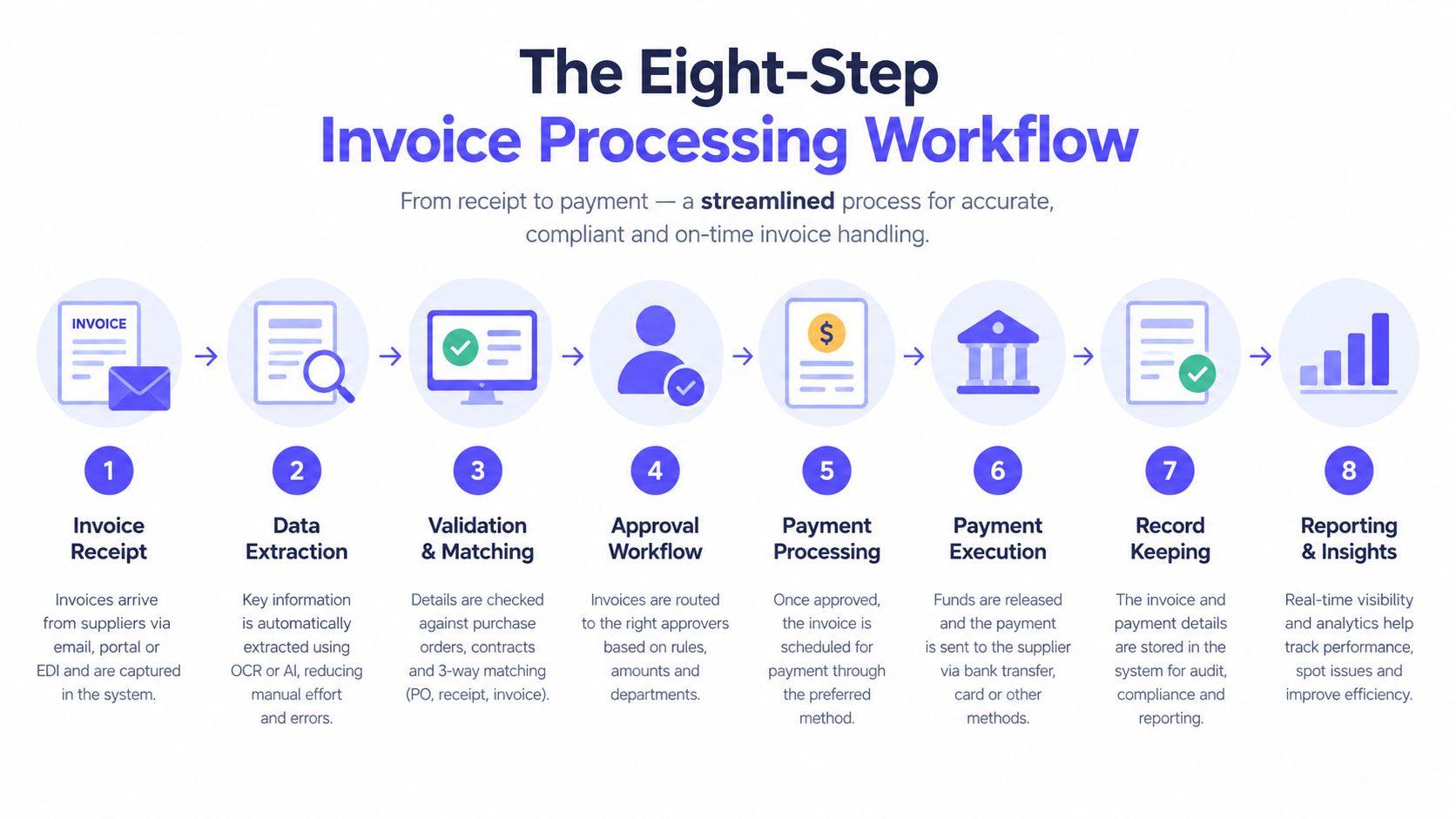
The eight controlled states
-
Capture and normalize. The workflow receives the invoice and standardizes supplier identity, invoice number, currency, tax, purchase order, and line-item data. Structured values make later rules deterministic.
-
Validate the supplier. The system checks the supplier against the approved master. A missing supplier, inactive record, or changed payment account should stop automatic progression.
-
Match the transaction. Two-way matching compares the invoice with the purchase order. Three-way matching also checks the receipt or service confirmation. The match must consider price, quantity, tax, currency, and relevant tolerances.
-
Route the exception. A price variance goes to the purchasing owner. A quantity variance goes to receiving. A coding issue goes to the cost-center owner. A missing purchase order goes to the person accountable for policy compliance.
-
Obtain approval. Delegated authority determines the approver. The workflow should record the applicable threshold, approver identity, timestamp, and decision. Email approval without a linked invoice creates weak evidence.
-
Post the payable. The system posts the approved liability with entity, supplier, account, tax, currency, and supporting documents. Posting should be blocked when mandatory evidence remains missing.
-
Run payment controls. Duplicate checks, sanctions checks, bank-account checks, and payment-run reviews occur before release. A payment proposal is not the same as an authorized payment.
-
Reconcile and report. The payment is reconciled to the bank and subledger. The workflow preserves status, settlement evidence, unresolved items, and reporting outputs.
A spreadsheet does not reliably enforce state transitions. It can show a value, but it rarely proves why that value changed or whether the right person approved it. A governed invoice processing automation workflow should expose the exception queue with reason codes, aging, owner, resolution, and downstream impact.
Practical rule: Clean purchase-order invoices can be designed for touchless handling. Non-PO, tax-sensitive, intercompany, and new-supplier invoices should carry explicit evidence and approval.
The design target isn’t maximum automation. The target is accurate, authorized posting and payment. Capture accuracy matters, but it isn’t the control objective. A perfectly extracted invoice can still be unauthorized, duplicated, or posted to the wrong entity.
Preventing Duplicate Payments Through Layered Controls
Duplicate-payment prevention requires multiple independent checks. Supplier aliases, malformed invoice numbers, OCR variations, credit memos, and human overrides can defeat a single matching rule.
The U.S. Department of Defense Inspector General found 879 improper payments, including 156 duplicate payments valued at $4 million, according to its duplicate-payment audit report. The finding supports a simple position: a warning is not a control unless the organization investigates, documents, and resolves it.
What layered prevention looks like
The first layer standardizes supplier identity and payment-account ownership. Vendor aliases should resolve to one controlled supplier record. Bank-account changes should require independent verification rather than relying on the same email channel that submitted the request.
The second layer normalizes invoice identifiers. Punctuation, whitespace, predictable prefixes, and OCR substitutions can make identical invoices appear different. Normalization should happen before matching, not after a duplicate has been paid.
The third layer compares multiple fields:
- Supplier identity: Match the approved supplier record, aliases, and payment-account ownership.
- Invoice identity: Compare normalized invoice number, invoice date, purchase order, and historical submissions.
- Financial values: Compare gross amount, tax, currency, line items, receipts, and credit memos.
- Similarity tolerance: Apply fuzzy checks where OCR can confuse characters or omit formatting.
- Payment history: Screen proposed payments against settled invoices and prior credits.
A high-risk match should be quarantined for independent review. The reviewer should see the original documents, the matching fields, the historical comparison, and the reason the system raised the alert. Every override should record the approver, reason, evidence, and timestamp.
A manual AP process does duplicate checking in disconnected files. Loopfour does duplicate checking through layered rules and recorded exceptions instead. A controller evaluating accounts payable reconciliation should require reporting for duplicate-alert precision, prevented value, false positives, override rate, recovery time, and residual duplicates.
Segregation of duties closes the final gap. The same person shouldn’t create a supplier, change bank details, approve an invoice, and release the payment. Automation can enforce that separation, but only when permissions and approval gates are designed before deployment.
Building Fraud Resilience into the AP Process
Automation should accelerate deterministic work, not create an opaque payment agent. AI can interpret documents under defined confidence thresholds, while approval, supplier changes, payment release, and system writes remain governed actions.
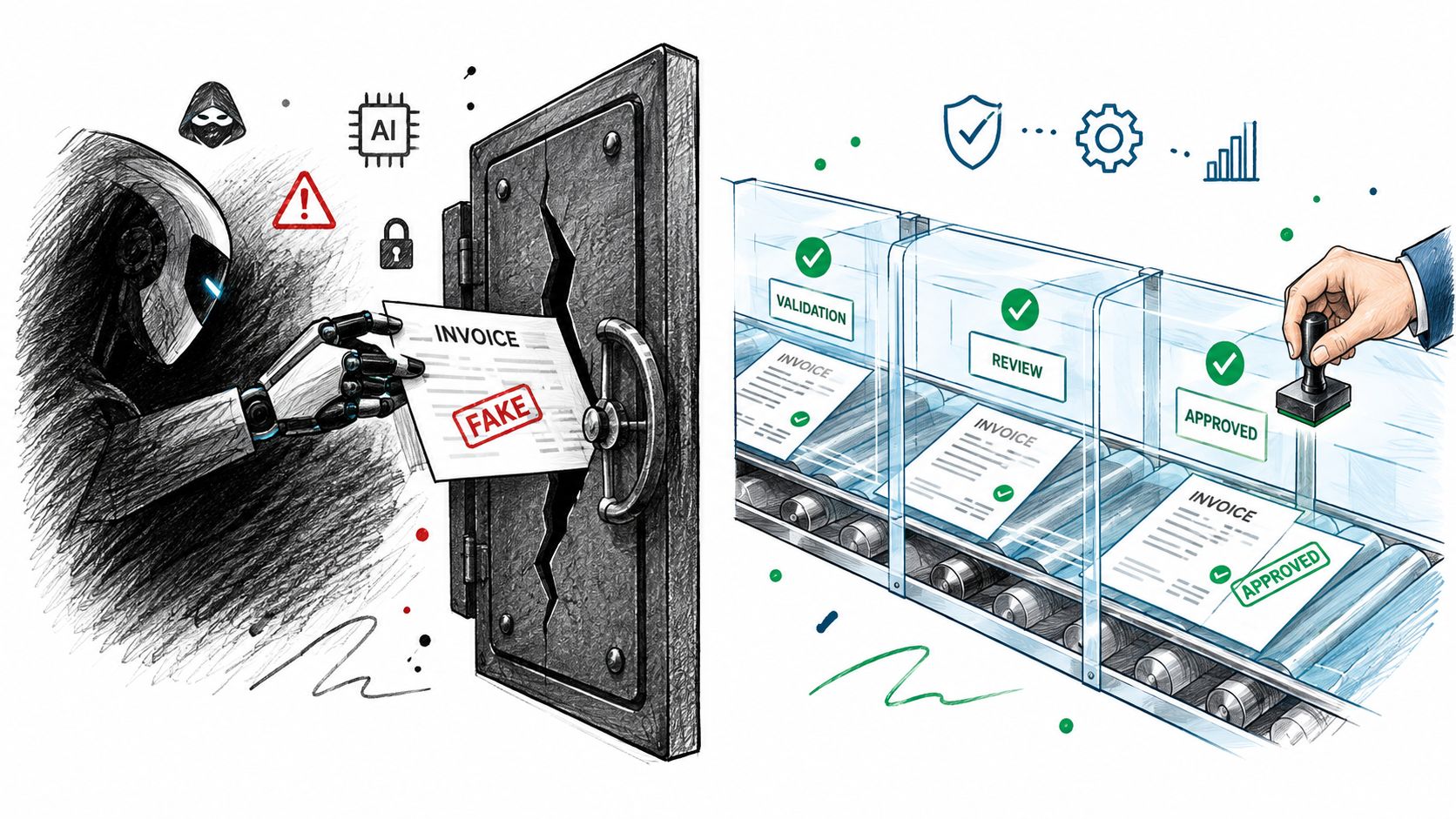
The fraud threat isn’t limited to fake invoices. Fraud-readiness survey findings identify phishing and social engineering, along with human error, as high priorities for resilience. The same findings identify stronger approval workflows with complete audit trails as confidence-building measures.
Control by design
A secure AP workflow assigns different jobs to different mechanisms:
- Rules execute deterministic checks. Supplier status, required fields, approval thresholds, duplicate logic, and posting permissions should use predefined rules.
- AI interprets uncertain documents. Document parsing can extract line items, dates, tax, and vendor details. Low-confidence results should route to a named reviewer.
- People approve accountable decisions. A human should approve exceptions, supplier-bank changes, unusual payments, and policy overrides when evidence cannot establish authorization.
- Logs preserve execution evidence. The system should retain every read, decision, approval, exception, and system write with version history.
An AI agent can accelerate a bad vendor change if the organization grants it broad permissions. A deterministic workflow limits the blast radius. The system can interpret an invoice, but it shouldn’t independently redefine approval policy or bypass segregation of duties.
The control design also needs change governance. A rule change should show who proposed it, who approved it, which entities it affects, and when it became active. A controller should be able to reconstruct the workflow that processed a disputed payment, not merely inspect the final ERP entry.
The following video can support training discussions about secure invoice verification and workflow accountability.
Fraud resilience is therefore a process property. More automation isn’t automatically safer. Predefined permissions, independent verification, approval gates, and complete execution evidence make speed compatible with accountability.
The Economics of Invoice Processing
Invoice volume creates a measurable cost base. Manual processing carries labor, exception resolution, storage, rework, and late-payment effects, while automated processing shifts the operating model toward rules and controlled exception handling.
Invoice processing cost benchmarks place the fully loaded cost of manual processing at roughly $12 to $30 per invoice. Automated processing is commonly benchmarked at approximately $2 to $5 per invoice.
A direct cost comparison
| Cost view | Manual processing | Automated processing |
|---|---|---|
| Fully loaded cost per invoice | $12 to $30 | $2 to $5 |
| Midpoint used for illustration | $21 | $3.50 |
| Cost for 100,000 invoices | $2.1 million | $350,000 |
| Implied difference before implementation costs | $1.75 million |
The 100,000-invoice illustration uses the cited midpoint comparison. It isn’t a promised saving. Actual economics vary with invoice complexity, labor costs, tax requirements, country, approval structure, and implementation cost.
Error work adds a second cost layer. The same research cites annual invoice error rates of approximately 2% for manual processes and 0.8% when automation is used. On 100,000 invoices, that represents roughly 2,000 versus 800 invoices requiring correction or investigation, or about 1,200 fewer exceptions before considering the work imposed on procurement, approvers, suppliers, and audit teams.
A spreadsheet process does cheap-looking work by hiding labor in other departments. A controlled workflow makes the cost visible. Finance leaders should therefore track processing cost alongside exception rate, cycle time, payment-on-time performance, and rework.
The business case should also include control effects. A lower invoice cost has limited value if the system increases unauthorized payments or removes evidence. The right comparison is not manual versus automatic in isolation. It is fragile manual execution versus deterministic execution with governed human intervention.
Tracking the Right Accounts Payable KPIs
AP performance should be measured through cost, quality, and speed. Invoice volume alone rewards activity, not control effectiveness.
APQC accounts payable benchmarks identify three practical measures: total cost per invoice processed, the percentage of disbursements that are error-free on the first attempt, and cycle time from invoice receipt to payment transmission. APQC includes personnel, systems, overhead, and third-party vendors in the cost measure, which makes it more useful than labor cost alone.
The controller’s KPI set
| KPI | What it proves | What to segment |
|---|---|---|
| Total cost per invoice | The full operating burden | Entity, invoice class, channel, and supplier |
| Error-free first-attempt disbursement rate | Payment quality and rework avoidance | Payment rail, exception type, and approval path |
| Receipt-to-transmission cycle time | Workflow speed and cash execution | PO-backed, non-PO, tax-sensitive, and intercompany invoices |
| Exception rate | The share requiring human intervention | Root cause, owner, aging, and supplier |
| Approval aging | Where authorization stalls | Approver, entity, threshold, and cost center |
| Duplicate override rate | Whether controls are being bypassed | Reviewer, supplier, reason, and outcome |
APQC reports that top-performing organizations incur about one-fifth the accounts payable cost of bottom-quartile organizations, while median performers incur approximately twice the cost of top performers, according to the APQC benchmark collection. The gap indicates that process design matters beyond headcount.
Targets should be segmented by invoice class. A clean purchase-order invoice has a different control path from a non-PO invoice or a new-supplier invoice. Averaging them together can hide poor policy compliance or make a difficult class appear to fail an unrealistic target.
Speed without first-attempt accuracy is deferred rework. A fast payment that needs correction is not an efficient payment.
Exception metrics should include reason code, owner, aging, resolution, and downstream impact. Recurring price mismatches may indicate procurement problems. Missing receipts may indicate receiving discipline. Repeated approval delays may indicate delegated-authority design. The KPI system should direct root-cause remediation, not merely report queue size.
Ensuring Audit Readiness and Compliance
Basic automation isn’t audit readiness. An auditable accounts payable process preserves the evidence that links the invoice to the underlying transaction, approval, posting, and settlement.
European Commission VAT guidance identifies matching as a practical control. A supplier invoice can be matched with the purchase order, transport documents, and proof of payment. The customer can also match the invoice with the approved purchase order, delivery note, payment record, and remittance advice.
Evidence that should survive the workflow
- Original invoice and structured extracted data
- Purchase order and purchasing authorization
- Delivery note, receipt, or service evidence
- Exception reason and resolution
- Approval identity, timestamp, and applicable rule
- ERP posting record and payment instruction
- Bank settlement and reconciliation evidence
- Change history for supplier, bank, policy, and workflow records
IRS recordkeeping guidance lists paid bills, invoices, receipts, deposit slips, sales slips, and canceled checks among supporting business records. Retaining only an invoice or only a payment confirmation leaves the transaction trail incomplete.
Electronic invoicing also requires precision. The European Commission eInvoicing standard defines eInvoicing as a structured, machine-readable exchange that supports automatic processing. EN 16931-1 establishes common core invoice elements. A PDF attachment may still require interpretation, while structured data can support predefined validation and posting rules.
Controllers reviewing their broader control environment may find internal controls assessment guidance from AmbitionCFO useful for framing ownership, evidence, and testing. The AP workflow should then turn those control expectations into executable gates, permissions, and retained records.
Accounts Payable Process FAQs
What is an accounts payable process?
An accounts payable process is the controlled sequence used to receive, validate, approve, post, pay, and reconcile supplier invoices. A complete process also records exceptions, evidence, responsibilities, and payment outcomes.
Why does the accounts payable process need exception management?
Exceptions reveal where purchasing data, supplier records, receiving evidence, tax treatment, or approval policies fail. Routing each exception to a named owner gives finance leaders a way to resolve the invoice and eliminate recurring causes.
How should AP teams automate invoice processing?
AP teams should automate deterministic tasks such as data normalization, supplier validation, matching, approval routing, duplicate checks, posting, and reconciliation. Human reviewers should handle uncertainty, overrides, sensitive supplier changes, and decisions that require accountable judgment.
What controls prevent duplicate payments?
Effective controls combine supplier identity normalization, invoice-number normalization, multi-field matching, tolerance checks, historical comparisons, quarantine queues, documented overrides, and segregation of duties. One matching rule isn’t sufficient.
What evidence should an AP system retain?
An AP system should retain the source invoice, purchase order, receipt or service evidence, approval record, exception resolution, posting record, payment instruction, bank settlement, and change history. The records should connect to the same transaction.
Which AP KPIs matter most to controllers?
Controllers should track total cost per invoice, error-free first-attempt disbursements, receipt-to-payment transmission cycle time, exception rate, approval aging, and duplicate-control outcomes. Each KPI should be segmented by invoice type and entity.
Loopfour, the deterministic finance workflow automation platform, converts recurring AP work into auditable code across ERP, document, approval, and payment systems. Finance leaders can replace spreadsheet handoffs with predefined execution, controlled exception routing, and retained evidence without replacing the core finance stack. Visit Loopfour to assess an accounts payable workflow built for deterministic execution and audit-ready control.