
Most advice on accounts payable reconciliation starts in the wrong place. It treats reconciliation as a matching exercise, when the core job is to prove that the liability, the posting, and the evidence all line up well enough to survive review.
Accounts payable reconciliation is the periodic comparison of the AP subledger, the general ledger control account, vendor statements, and source documents so finance can explain every difference before close. Done properly, it supports completeness, accuracy, and existence for payables, not just bookkeeping neatness.
Table of Contents
- What Accounts Payable Reconciliation Actually Does
- Preparing the Data Before You Begin the Rec
- Matching Rules That Catch Real Exceptions
- Handling Exceptions Without Burying Them
- Capturing Evidence That Holds Up to Audit
- Where Manual and AI Approaches Break Down
- Closing Checklist and Common Questions
What Accounts Payable Reconciliation Actually Does
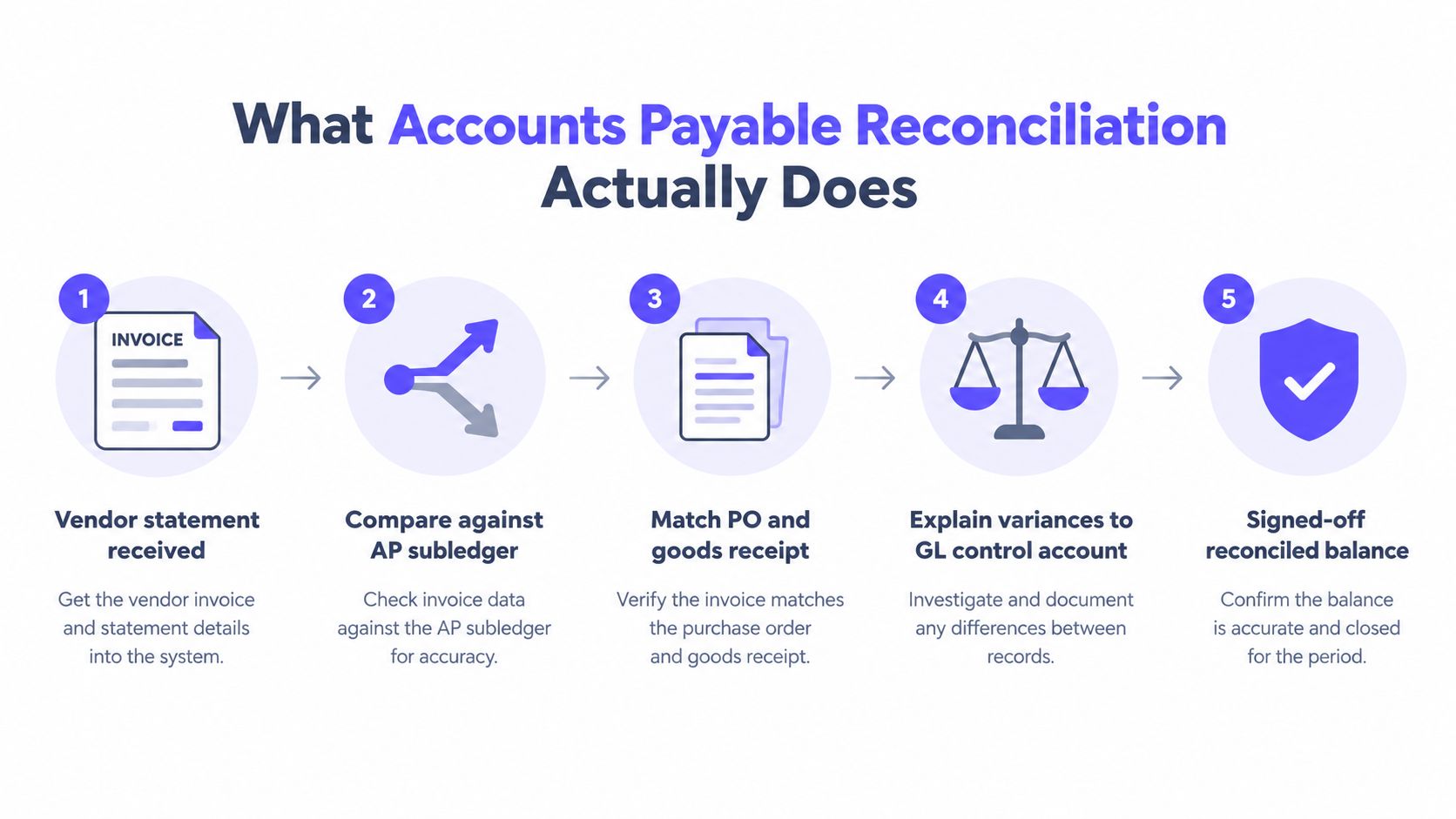
Accounts payable reconciliation confirms that what AP says it owes is what the books, vendor statements, and supporting documents fully support. It is a control, not a cleanup task. If the reconciliation cannot explain a difference, the balance is not ready.
The practical goal is simple. Tie the AP subledger to the AP control account, compare vendor statements to the ledger, and then clear the differences with evidence. That sequence is what makes the liability defensible at close, and it’s why AP reconciliation supports the broader control environment described in standard AP process guidance, including invoice receipt, matching, approval, payment, and record keeping in the accounts payable process overview.
Practical rule: If a recon item can’t be replayed from source documents, it isn’t reconciled.
The recurring failures are predictable. Timing gaps appear when goods are received before invoices arrive. Duplicate payments slip through when invoice identity is weak. PO-versus-key mismatches show up after vendor master changes or manual edits. Stale credits inflate the liability when no one clears them.
A useful way to think about the work is that AP reconciliation does two things at once. It checks that the ledger is right, and it checks that the process behind the ledger is controlled. That’s why a good recon file is evidence, not commentary.
If a team wants a broader operational view of invoice-level controls, Resolut’s automated invoice reconciliation guide is a useful companion reading.
Loopfour, the deterministic finance workflow automation platform, fits this control-first view because it routes predefined steps, preserves execution evidence, and keeps exceptions visible instead of burying them.
Preparing the Data Before You Begin the Rec
AP reconciliation gets messy when the inputs are sloppy. The matching step should not be doing data cleanup, because cleanup work hides defects that ought to be visible to the controller.
The right approach is to lock down the source pulls first, then reconcile against a stable cutoff. That usually means the AP subledger, vendor statements, open PO and goods-received-but-not-invoiced reports, GR/IR detail, and a current vendor master snapshot. Where currency is involved, the team also needs a defined conversion basis, which is why a multi-entity close often benefits from the discipline described in NAS Ledger’s multi currency close guidance.
Source data pulls and reconciliation purposes
| Data Source | Key Fields | Role in Reconciliation |
|---|---|---|
| AP subledger | Invoice number, vendor ID, document date, posting date, amount, tax code, cleared or uncleared flag | Anchors the ledger side of the tie-out |
| Vendor statement | Opening balance, period activity, closing balance | Confirms what the supplier says is outstanding |
| Open PO report | PO number, line, quantity, price, status | Supports invoice-to-PO comparison |
| GR/IR detail | Receipt reference, clearing status, unmatched balances | Surfaces timing differences and receipt gaps |
| Vendor master snapshot | Vendor ID, legal name, bank detail, terms, currency | Prevents identity drift and false mismatches |
The cadence should match the volume and risk of the account. Monthly close discipline works when the business wants a period-end proof. Continuous sub-ledger reconciliation works better when the team is trying to catch breaks earlier and keep the exception queue small.
Normalization matters just as much as extraction. The team needs one cutoff timestamp, one date basis, one currency basis, and deduplicated invoices before any item hits the match engine. A control that starts with inconsistent inputs only manufactures more exceptions.
Operational habit: Freeze the source files before matching starts, then route only true exceptions to humans.
Internal plumbing matters too. A stable extraction and synchronization layer reduces the chance that different reports point to different truths, which is why a dedicated automatic data synchronization workflow is worth treating as control infrastructure, not convenience.
Matching Rules That Catch Real Exceptions
AP reconciliation works when the match rules are strict on identity and disciplined on tolerances. It fails when everything is treated as “close enough.” The control is the rule set itself.
Three-way match is the baseline. The invoice should align with the PO and the goods receipt on amount, quantity, and description. Four-way match adds an acceptance or inspection layer when receiving quality matters, or a service-entry sheet when the work is service-based. That extra step is not bureaucracy. It is how finance keeps receipt control from becoming a blind spot.
The useful distinction is between fixed identity fields and controlled variances. Invoice number and vendor ID should match exactly. Rounding, line-level quantity deltas, freight passthroughs, and tax treatment can have tolerance rules, but those rules need to be predefined and reviewed. Otherwise, tolerance becomes a hiding place for duplicate charges.
Strict vs. tolerant matching tolerances
| Matching Dimension | Strict Setting | Tolerant Setting | Failure Mode When Misapplied |
|---|---|---|---|
| Invoice number | Exact match | No tolerance | Loose matching lets duplicates through |
| Vendor ID | Exact match | No tolerance | Vendor master drift creates false positives |
| Amount | Exact on identity fields | Small rounding tolerance | Overly wide bands hide overbilling |
| Quantity | Exact to receipt or service record | Limited agreed variance | Too narrow generates noise, too wide masks shortages |
| Freight or tax lines | Exact where coded | Controlled passthrough tolerance | Unclear rules create avoidable exceptions |
The failure mode is not the variance itself. The failure mode is a rule set that is too loose to catch duplicates or too rigid to pass legitimate business differences. That’s where the control becomes operationally expensive.
For teams comparing workflow patterns, the payment reconciliation process guidance is a useful adjacent reference because the same discipline applies after invoice approval and cash release.
Handling Exceptions Without Burying Them
Exceptions should surface quickly, get classified, and move to the right owner. They should not sit in a spreadsheet until someone “cleans them up” at month-end.
A classic duplicate-payment case makes the point. Vendor X invoices $14,200 on PO 88421, then the AP clerk posts it twice within nine days. The second posting hits a closed PO with a 6% quantity variance. That is not a rounding issue. It is a control event that needs traceable routing.
Exception classification and routing reference
| Exception Type | Rule Trigger | Owner | Required Artifact | SLA |
|---|---|---|---|---|
| Duplicate invoice | Exact invoice number or near-duplicate amount tolerance | AP manager | Original invoice, match log, duplicate notice | Same day |
| Quantity or unit-price mismatch | Variance above defined basis-point band | Buyer or procurement lead | PO, receipt, supplier explanation | 2 business days |
| Missing PO or unvouchered invoice | No valid PO or approval chain | Procurement or requester | Approval record, coding note, invoice copy | 2 business days |
| Aged exception | Open item beyond stated threshold, such as 60 days | Controller | Exception summary, escalation note, owner assignment | Immediate escalation |
The point of the queue is not to let AP teams “work around” problems. It is to make ownership explicit. Silent spreadsheet corrections are the actual control failure, because they remove the trail that auditors need.
Each lane needs a different artifact. Duplicates need proof of identity. Quantity mismatches need the source documents and a business explanation. Missing PO items need the authorization chain. Aged items need escalation, not more debate.
A team that wants flexible tooling can compare rules engines, workflow systems, and guided automation, including reconciliation tools for SaaS, but the routing logic still has to be deterministic. The tool does not matter if the exception owner is vague.
Exceptions are not the problem. Unowned exceptions are the problem.
Capturing Evidence That Holds Up to Audit
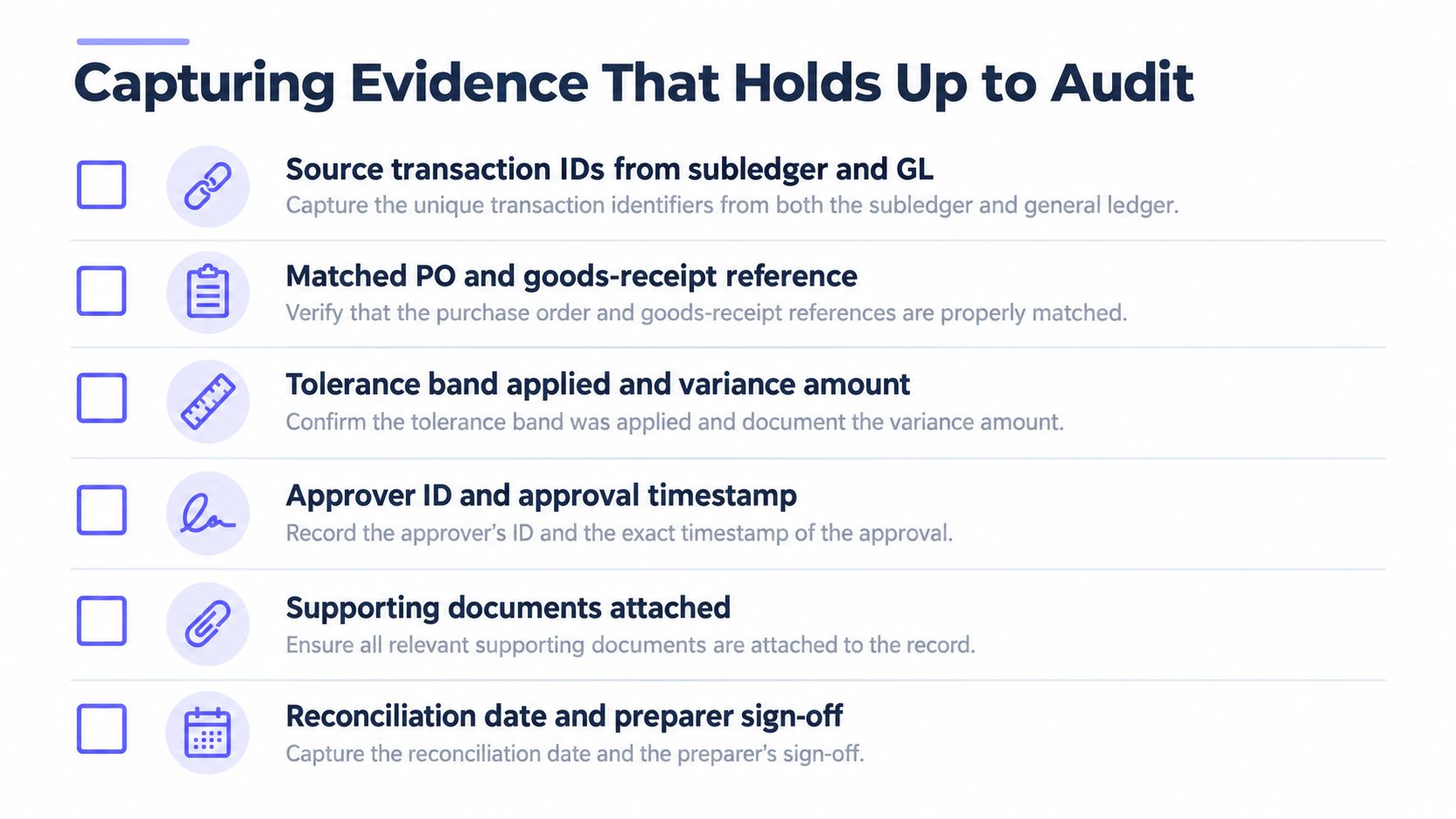
Audit-ready AP reconciliation depends on evidence assembled at posting, not reconstructed later. If the file can’t show how the item was matched, who approved it, and what rule applied, the control is weak even if the balance looks fine.
A defensible evidence packet needs a narrow set of fields. It should include transaction IDs from the subledger and GL, the matched PO and goods-receipt reference, the tolerance band used, the approver ID and timestamp, and linked document images or system pointers for the invoice, PO, and receipt. For exceptions, add the classification label, the root-cause note, the resolution path, and a second approval when the item exceeds the materiality threshold.
Evidence packet checklist
- Source transaction IDs: Keep the AP, subledger, and GL references together so the item can be replayed end to end.
- Matched references: Attach the PO and receipt references that justified clearance.
- Tolerance record: Store the variance amount and the rule that allowed or blocked the match.
- Approval lineage: Preserve the approver identity, timestamp, and any override reason.
- Document pointers: Link to the invoice image, PO, and receipt in the system of record.
- Exception history: Capture the classification, resolution path, and any escalation sign-off.
The key is immutability. The matching log should not be editable after the fact, because an editable log invites retrospective storytelling. A reviewer should be able to open one item and replay it without leaving the file.
Retention discipline matters too. If the evidence lives in email threads, ad hoc spreadsheets, and half-saved PDFs, the file will not survive a control test cleanly. A good recon packet tells one story, with one version of the truth.
Audit rule: If the approver can’t be tied to the item, the approval didn’t happen for control purposes.
Where Manual and AI Approaches Break Down
Spreadsheet reconciliation appears flexible until close pressure exposes stale tabs, copied formulas, and tolerance settings that no one can defend. Manual work also weakens identity quality. A vendor name or invoice number can look close enough while pointing to the wrong entity or transaction.
Rules-based workflow engines handle the clearing step more consistently because they execute defined logic the same way each time. Their value depends on the rule design: normalized supplier identity, exact source references, approved tolerances, and deterministic outcomes. Each match or exception can then be explained from its inputs and rule path. Loopfour’s finance workflow design follows this model, using versioned steps and retained execution evidence rather than hidden logic.
Probabilistic AI solves a different problem. It can interpret unstructured invoices and supporting documents, but a confidence score should not make the final accounting decision on its own. If an invoice cleared last Tuesday because “the model was confident,” the controller cannot reproduce or defend that result. AI can assist classification and extraction. The control should remain deterministic.
A practical comparison exposes the trade-offs:
| Operating Model | Practical Strength | Practical Weakness |
|---|---|---|
| Spreadsheet reconciliation | Familiar and quick to start | Vulnerable to version drift and manual edits |
| Rules-based workflow engine | Deterministic, identity-aware, and replayable | Requires deliberate design and maintenance |
| Agentic or probabilistic AI | Useful for interpretation tasks | Final decisions can be harder to reproduce |
Automation should be judged first by control quality, then by speed. Reduced touch time matters, but it does not compensate for an unclear decision trail or unreliable entity matching. Teams comparing reconciliation tools for SaaS should test whether the system can replay a cleared item and explain every match input.
For teams assessing process software, Loopfour’s deterministic finance workflow platform provides one comparison point. Start the evaluation with replayability, identity-quality matching, and exception handling, not promotional claims.
Closing Checklist and Common Questions
AP reconciliation closes cleanly when the team uses a short, repeatable checklist. Tie the subledger to the GL, verify the match coverage, classify aged exceptions, attach the evidence packet, and sign off the preparer and reviewer. Then archive the working file in a place auditors can easily find.
The schedule should stay boring. Daily or weekly review works for fast-moving AP, while month-end proof still needs a fixed cutoff and a locked file. Deluxe notes that 70% of mid-sized organizations reconcile payments daily or weekly, and 64% finish the process in one to four hours, which is a strong reminder that cadence and scope matter as much as tooling (Deluxe reconciliation research).
Common questions
-
How often should AP reconciliation happen?
It should happen on the cadence that matches risk. Fast-moving AP usually needs daily or weekly exception review, then a formal close tie-out at period end. -
Who should own sign-off?
The preparer should not be the final approver. A reviewer, usually a senior accountant or controller, should sign off on the file. -
What if the vendor statement disagrees with the ledger?
The team should reconcile against source documents, then isolate whether the break is timing, a missing posting, or an incorrect vendor balance. -
How do partial payments and credit memos affect matching?
They should be treated as explicit recon items, not informal offsets. The file needs the clearing logic, the remaining balance, and the related source references. -
When does a small balance still need investigation?
Any balance with an unexplained pattern, repeated recurrence, or missing support deserves review, even if it sits below a materiality threshold.
The controller’s standard should stay the same every month. If a balance can’t be explained, it doesn’t belong in the close file.
Loopfour helps finance teams turn AP reconciliation into a deterministic workflow with routed exceptions, versioned rules, and evidence captured at every step. If your team wants reconciliation that holds up to audit instead of another spreadsheet with a nicer name, visit Loopfour and compare how governed automation can fit your stack.