
Accounts payable is a current liability for what you owe suppliers on goods and services already received. Accounts receivable is a current asset for what customers owe you on sales already made and not yet collected. Both exist because trade happens on credit, and the timing of each has a metric: days payable outstanding (DPO) for money going out, days sales outstanding (DSO) for money coming in.
Now the number that should reframe the whole comparison. Across the 1,000 largest listed nonfinancial U.S. companies, the gap between top and median performers in DSO was 18 days, representing roughly $600 billion in excess working capital tied up in receivables, according to the Hackett Group’s 2025 working capital survey. The same survey recorded a 3% improvement in DPO. Payables got faster. Receivables stayed a trap.
That contrast is the case this guide makes. Finance teams have spent a decade tightening invoice capture and payment timing on the outflow side. They have not fixed collections with the same discipline, and most still have no named owner for the combined cycle. Reading accounts payable vs accounts receivable as a debit-versus-credit glossary keeps the leak open. Read it as one working-capital system with a shared exception queue, one scoreboard, and controls an auditor can test, and the trapped cash stops being an abstraction.
By Marcus Feld, controller and finance systems writer covering payables, receivables, and close operations.
Table of Contents
- Accounts Payable vs Accounts Receivable Side by Side
- Who Owns the Cash Conversion Cycle
- KPIs That Show AP and AR Health
- Controls Auditors Test on Both Ledgers
- Real Operating Breaks and What They Cost
- Where Finance Leaders Should Automate First
- Questions Controllers Ask After the Comparison
Accounts Payable vs Accounts Receivable Side by Side
Accounts payable is money you owe a supplier for goods or services already received. Accounts receivable is money a customer owes you for a sale already made. Neither balance exists without credit, and both convert to cash on a schedule you either control or don’t.
Accounts payable is a current liability. It records amounts a company owes suppliers for goods and services purchased on credit without a promissory note, and it normally carries a credit balance until settlement (AccountingCoach on accounts payable and accounts receivable). Recording the bill credits Accounts Payable and debits the expense or asset. Paying it debits Accounts Payable and credits Cash, and the remaining credit balance should equal the recorded supplier invoices not yet paid. Terms commonly run 10, 30, or 60 days (AccountingCoach accounts payable walkthrough).
Accounts receivable is a current asset recording the company’s claim on customers who took goods or services on credit. Under accrual accounting the balance rises the moment revenue is earned, well before the customer pays. When cash arrives, you debit Cash and credit Accounts Receivable. Invoice terms such as net 30 and 2/10, n/30 identify those credit sales, and 2/10, n/30 means the customer can take a 2% discount by paying within 10 days, with the full amount due at 30 (AccountingCoach on accounts receivable).
| Criterion | Accounts payable | Accounts receivable |
|---|---|---|
| Balance-sheet class | Current liability | Current asset |
| Normal balance | Credit | Debit |
| What it records | Amounts owed to suppliers for goods or services received | Amounts customers owe for sales already earned |
| Settlement entry | Debit Accounts Payable, credit Cash | Debit Cash, credit Accounts Receivable |
| Typical terms | 10, 30, or 60 days | Net 30, or 2/10, n/30 |
| Primary timing metric | Days payable outstanding (DPO) | Days sales outstanding (DSO) |
| Cash effect of improving it | Slows cash leaving, if discounts and supply are protected | Speeds cash already earned into the bank |
| Dominant failure | Duplicate, late, or unauthorized payment | Late collection, dispute, or uncollectible balance |
| Usual owner | AP manager or procure-to-pay lead | Credit, billing, or collections lead |
Read the table as a cash map, not an accounting exercise.
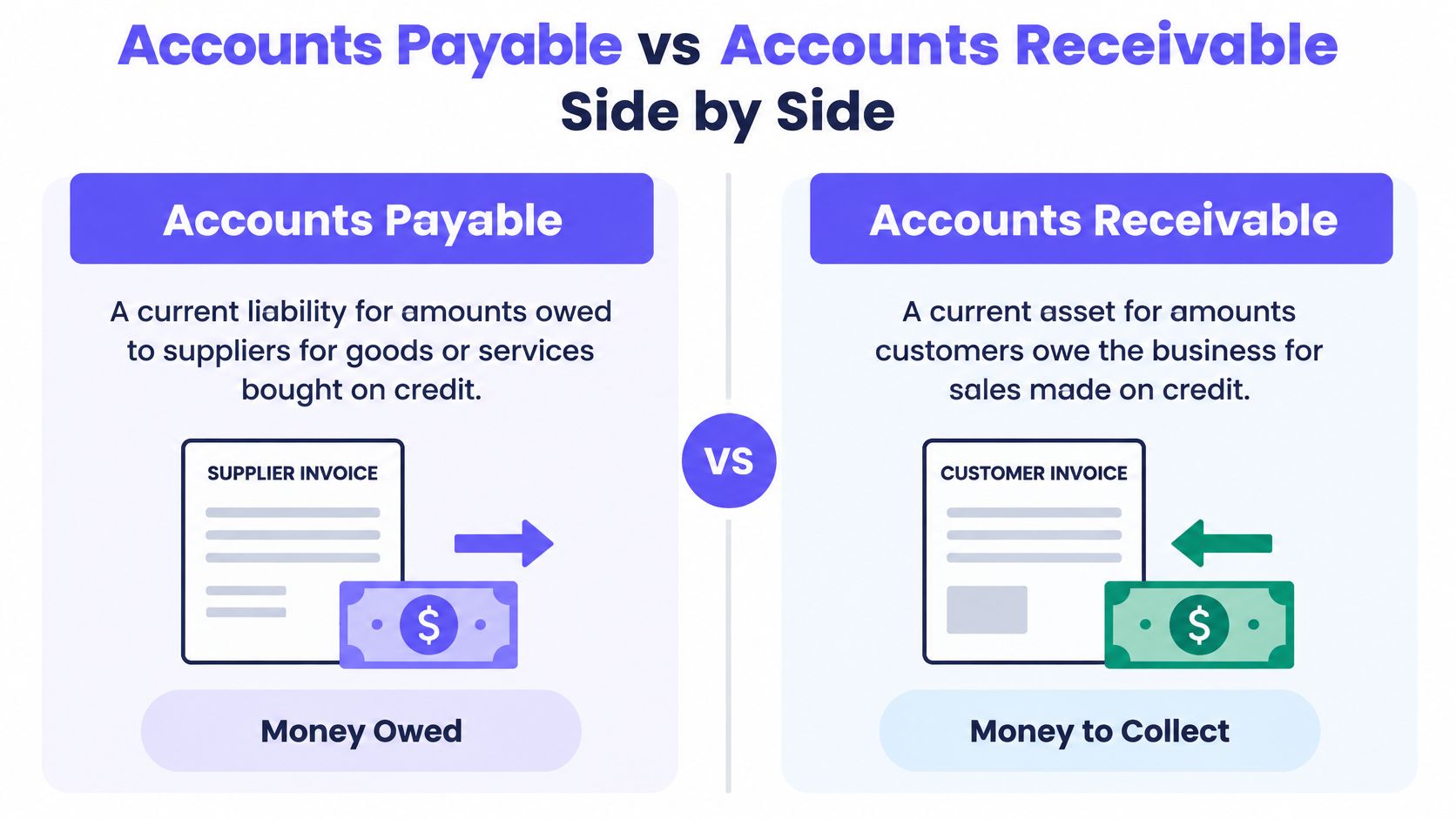
The cash direction is the part teams get wrong. Stretching DPO preserves cash only for a while, and pushing past agreed terms buys liquidity with supply risk. Shortening DSO brings in cash that was already earned, with no new sale attached. One lever borrows time from a supplier. The other collects money you already booked.
Read the entries together: every payable on your ledger is somebody else’s receivable, usually with a controller on the other end who is also waiting.
Four things decide whether the cycle works: one owner for the combined cash-conversion result, one benchmark scorecard, auditor evidence that ties each source document to a system write, and an automation choice that treats approval as a control rather than a delay.
Who Owns the Cash Conversion Cycle
One person should own the whole cycle. Few companies have that person. Accounts payable controls when cash leaves, accounts receivable controls when it arrives, and optimizing either one alone damages liquidity somewhere else.
The evidence is blunt. 82% of APAC CFOs identified working-capital efficiency as an area needing improvement, and fewer than half of surveyed CFOs and senior executives had a dedicated owner for working-capital performance, per FutureCFO’s coverage of the working-capital gap. Stretch supplier payments too far and you create supply risk. Push collections too hard and you strain the customers who fund next quarter.
What payable operations actually run
Invoice intake. Three-way match against purchase order and receipt. Approval by the person who owns the spend. Payment on the agreed date. Evidence attached to the payment, not buried in a shared inbox.
What receivable operations actually run
Billing from the contract or order. Dispute handling with a clock on it. Follow-up on promised payment dates. Cash application against specific open invoices, not a lump sum parked in a suspense account. The accounts receivable collection process breaks that sequence into stages a controller can assign to named people.
Ownership splits across functions in practice. Procurement and AP own the outflow, credit and collections own the inflow, treasury owns the forecast, and the controller owns the combined result. That last seat is the one that’s usually empty, and it’s the only one that sees both sides.
Where the cycle breaks: a supplier bill sits unapproved past its due date and the early-payment discount dies. That same week an invoice ships with the wrong PO number, the customer disputes it, and the cash meant to cover that supplier payment arrives a month late.
Exceptions are what cross the cycle: disputed bills, credit notes, unapplied cash, and supplier holds. Managing cash flow between customer payments and supplier obligations is a timing exercise in those four items, not a definition exercise, and EndureGo’s guide to small-business cash flow frames the same discipline for teams without a treasury function.
A multi-entity group needs one view across ERP, CRM, billing, and bank. Four systems producing four versions of the same obligation is a reconciliation queue pretending to be a process.
KPIs That Show AP and AR Health
Grade the two functions on different scorecards. Accounts payable is an invoice-to-payment control problem. Accounts receivable is a billing-to-cash conversion problem. Mixing the two metrics produces an average that describes nothing.
APQC’s payables benchmarking found that top-performing AP organizations run at roughly one-fifth the cost per invoice of bottom-quartile peers, process invoices at about five times the productivity, and need approximately half the invoice-to-payment cycle time, while bottom performers may need four times as many AP FTEs relative to revenue (APQC on the four KPIs that separate good payables teams).
On the collection side, APQC reports that top AR performers collect in 30 days or less, median organizations take about 38 days, and bottom performers take 46 days or longer (APQC on accounts receivable performance).
| Metric | What it measures | Stronger performance | Weaker performance |
|---|---|---|---|
| AP cost per invoice | Cost to process one supplier invoice | About one-fifth the cost of bottom quartile | Bottom-quartile cost |
| AP productivity | Invoices processed per FTE | About five times bottom-quartile output | Baseline productivity |
| Invoice to payment cycle | Days from receipt to payment transmission | About half the cycle time of weaker teams | Up to twice the elapsed time |
| AP staffing vs revenue | FTEs needed to run payables | Leaner team at equal control | About four times the FTEs |
| DSO | Days to turn credit sales into cash | 30 days or less | Median about 38 days; bottom 46 days or longer |
The DSO number is the one to convert into money. Cash released per DSO day equals annual credit sales divided by 365. Run that on your own ledger and a two-day collection improvement stops sounding like housekeeping.
Then segment. DSO by customer, entity, currency, payment terms, dispute reason, and aging bucket tells you where to send people. A single blended DSO tells you a number moved last month.
The rule for controllers: cycle time you gained by skipping an approval isn’t performance. It’s a control failure nobody has found yet.
Below those KPIs sit the instruments that move them: intake-to-approval latency, exception rate, duplicate rate, touchless throughput, and payment-control evidence. Instrument them separately. One “automation percentage” is a slide, not a control. Every ERP write, approval, exception, and payment-scheduling action needs its own auditable step, and the accounts payable aging report is the first place to see whether the steps are working.
Controls Auditors Test on Both Ledgers
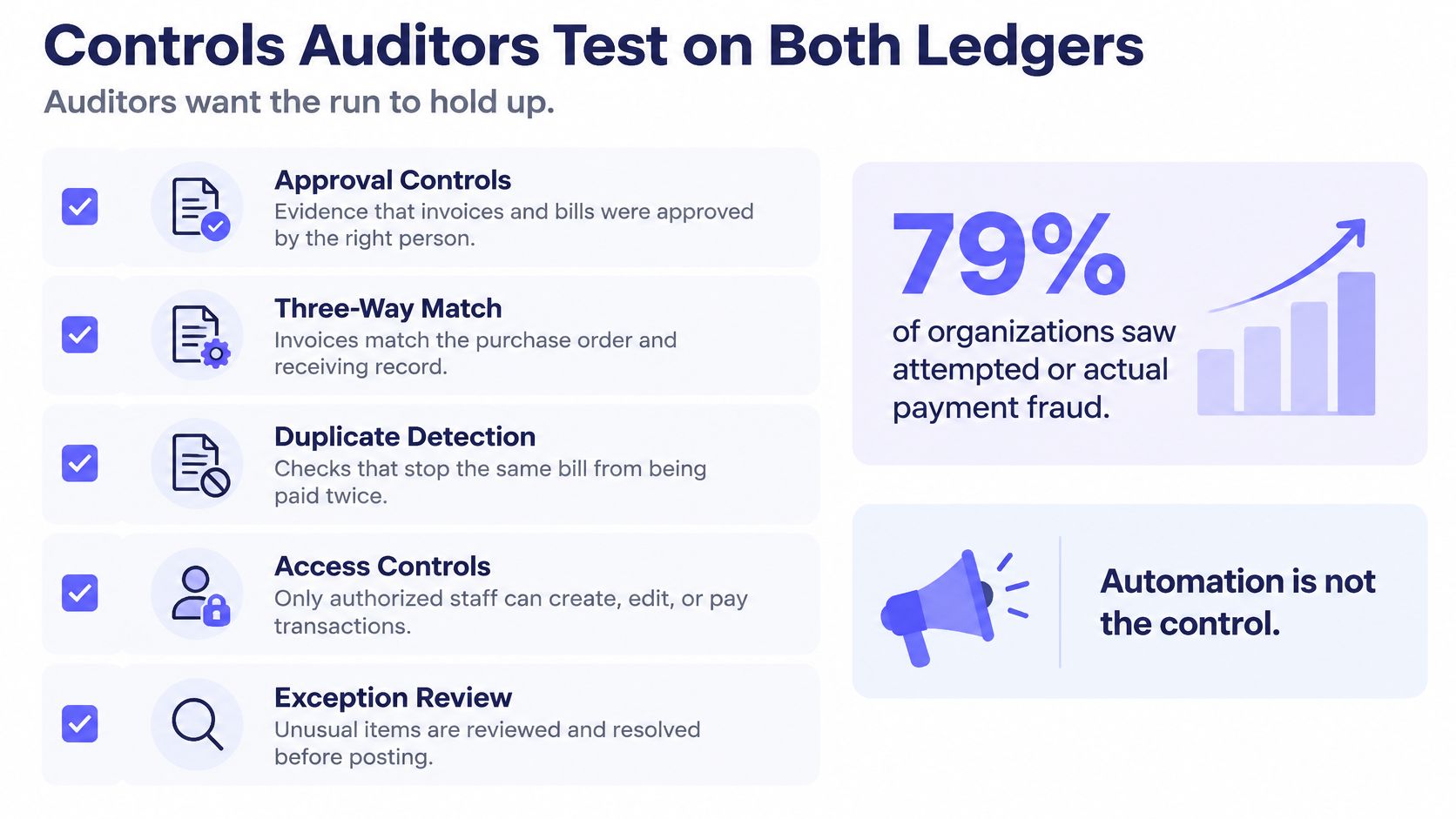
AP and AR controls should share one owner for working capital, one exception process, and evidence an auditor can trace. Test the same points on both ledgers: approval, matching, duplicate prevention, access, and exception handling. Paper or API, the evidence must be retained.
Automation does not replace controls. The 2025 AFP Payments Fraud and Control Survey reported that 79% of organizations experienced attempted or actual payments fraud in 2024, 65% experienced check fraud, and 60% reported vendor impersonation (AFP survey highlights via Truist). Keep approval and verification rules explicit, then preserve evidence of each action.
| Risk event | Accounts payable control | Accounts receivable control |
|---|---|---|
| Changed bank details | Independent callback and a second approver | Verify refund destination before release |
| Duplicate document | Block a second payment on the same invoice | Block a second application of the same receipt |
| Skipped approval | Threshold gate before the payment file | Named owner before a credit memo posts |
| Bad match | Hold the payment rather than force it | Hold unapplied cash rather than force-match |
| Weak evidence | Source invoice tied to the ERP write | Contract or invoice tied to the cash application |
Receivables carry a separate risk: an unpaid invoice is not cash. Receivables remain a current asset because collection is expected within a year or the operating cycle, whichever is longer. If part of the balance will not be collected, reported receivables and stockholders’ equity are overstated until bad debt is recognized (AccountingCoach on receivables and bad debts).
Set the controls once across both ledgers: verify changes independently, separate duties, require a named approver at defined thresholds, retain change history, and link each source document to its system write. In order to cash, reconcile the ledger, bank, and invoice, then retain evidence of the agreement. A traceable audit trail for finance workflows records each payment match, the rule used, and the confidence it cleared. Auditors can follow the evidence from invoice to cash application without relying on an unexplained system result.
Real Operating Breaks and What They Cost
The first fix depends on which side is leaking cash. Match the situation, then act on that side only.
- Long vendor list, invoices arriving by email. Fix payable match and approval before chasing a one-day collection gain. Duplicate payments and missed discounts spend cash you still hold. Teams modernizing legacy payables usually start with the accounts payable process improvement playbook from Doczen before touching collections.
- SaaS or services firm on net 30 with dispute-heavy invoices. Fix billing accuracy, dispute latency, and collections first. Weak collection timing traps cash you already earned, and APQC reports that productive AR workflows prioritize invoice accuracy, dispute-resolution latency, collection prioritization, promised-payment tracking, and cash application rather than invoice generation alone. Compare your DSO against the bands in the scorecard above before buying anything.
- Multi-entity group where bank, ERP, and billing disagree. Fix cash application and stand up one shared exception queue before either team buys a point tool. Two systems that both look right and disagree are worse than one that looks slow.
- Small business treating the receivable as cash. Don’t. In 2025, 56% of surveyed U.S. small businesses reported being owed money from unpaid invoices, with an average of $17,500 outstanding per affected business, according to Intuit QuickBooks’ late payments report. Large UK businesses paid suppliers in an average of 32 days in 2025, per the UK Department for Business and Trade payment-practices statistics, so the outflow clock is not the problem on most small ledgers. The inflow is.
The line a person still owns: a short payment, an overpayment, or one receipt covering several invoices. A clean multi-invoice receipt splits by the customer’s rule. Ambiguous cash stays unapplied until someone assigns it.
Partial payments, overpayments, and one-to-many allocations get handled by policy, and ambiguous items get held rather than force-matched. Force-matching to close a queue is how an unapplied cash balance becomes a bad debt surprise.
The situational test is simple. Fraud or duplicate-pay exposure starts on accounts payable. Earned cash that isn’t arriving starts on accounts receivable.
Where Finance Leaders Should Automate First
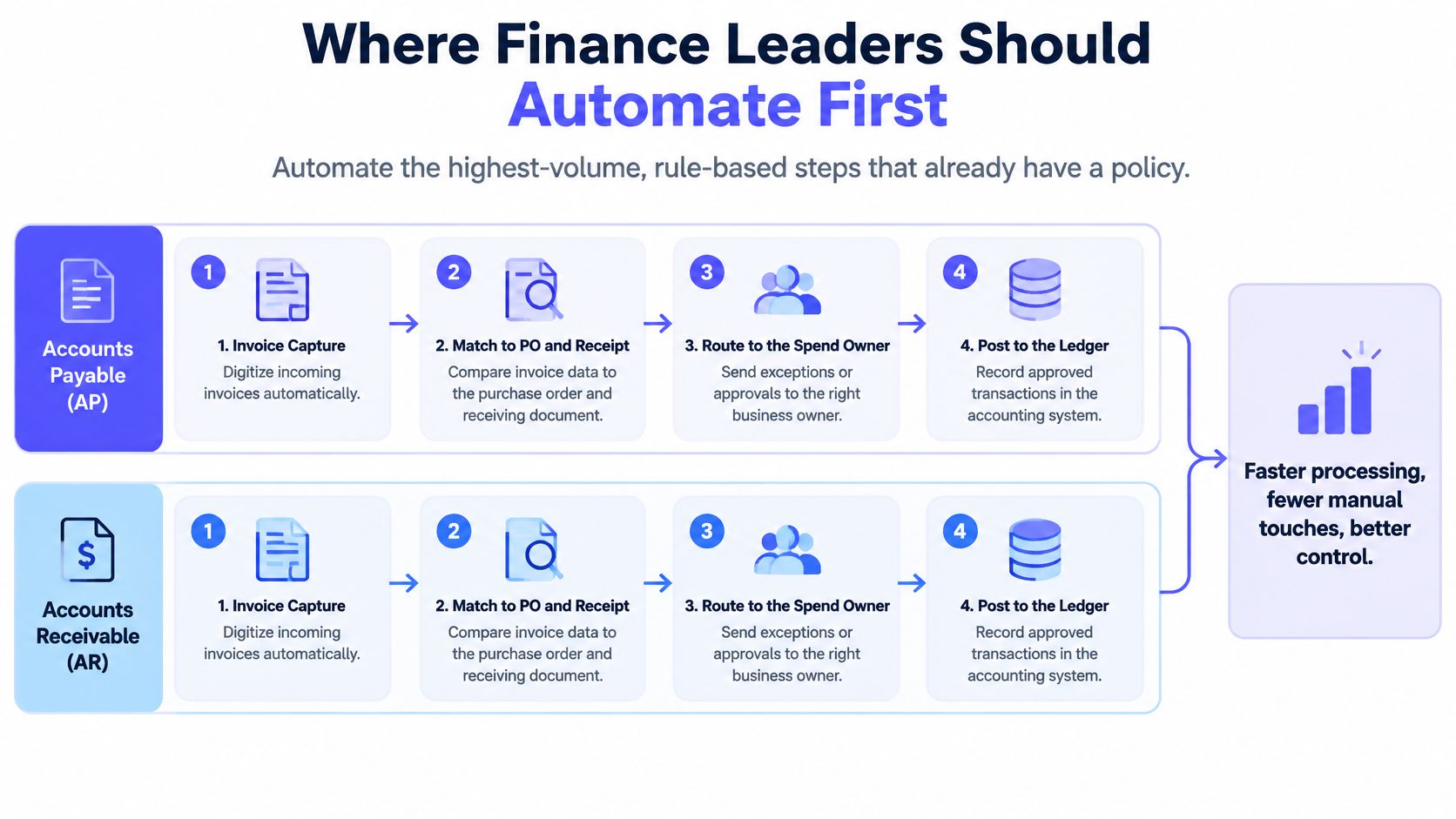
Automate the highest-volume, rule-based steps that already have a written policy. Capture, match, and routing come first. A model that decides whether cash posts comes never.
On the payable side, that means invoice capture, match to purchase order and receipt, routing to the spend owner, and evidence attached to the payment. On the receivable side, scheduled invoicing, a dunning cadence the customer defines, and cash application that logs every reminder and every match against the invoice.
Manual work does the opposite. It re-keys the same fields into two systems, leaves the approval in an email thread, and produces an audit trail thin enough that your auditor samples it twice.
Loopfour, the deterministic finance workflow automation platform, runs those steps as predefined, versioned code on the ERP, billing, and bank tools you already use. Its accounts payable automation captures the invoice, matches it against the PO and receipt, routes approvals to the person who owns the spend, and attaches the evidence to the payment. Its receivable automation covers invoicing, dunning, and cash application, with every reminder and matched payment logged against the invoice. Reminders follow a schedule the customer defines, and accounts that miss it escalate to the person who owns the relationship.
Scope any document reading to a confidence threshold with a human fallback. Let a model parse a PDF and propose fields. Don’t let it decide whether cash posts. Spreadsheets guess and drift. Loopfour keeps the execution tree instead, so the run that cleared an invoice last month is the run you can inspect this quarter.
Then order the work by exposure, not by ambition. If cash is trapped in receivables, start with billing accuracy, dispute latency, and cash application. If duplicate pay or vendor-bank fraud is the live risk, start with payable match and approval gates. Keep revenue recognition and month-end close for later pilots unless that is where the hours sit, and small teams comparing build versus buy can use this practical AP automation guide for SMEs from Kushan Business Solutions to scope the first phase.
Scope the model, not the judgment: document reading runs to a threshold. Approval runs to a person.
Run a two-week check before committing budget. Pick one entity, one policy, and one exception owner. If the workflow can’t produce a clean evidence trail for that slice, the problem was never the software.
Questions Controllers Ask After the Comparison
What does 2/10, n/30 mean? The customer may deduct 2% if they pay within 10 days. Otherwise the full amount is due in 30 days. On a large invoice, that discount is a real cost when AP misses the date.
What entry settles a supplier invoice? Debit Accounts Payable and credit Cash. The remaining accounts payable credit balance should equal the recorded vendor invoices that haven’t been paid yet.
When can receivables overstate equity? When customers won’t pay and bad debt hasn’t been recognized. The current asset is too high, so stockholders’ equity is too high by the same amount.
How do a credit note and unapplied cash cross the cycle? A credit note cuts what the customer owes. Cash that doesn’t match a rule stays unapplied until a person assigns it. Leave it parked and the forecast is wrong, along with the supplier payment that depended on it.
Does an electronic invoice remove approval? No. The file still needs a named approver, a threshold, and a link from the source document to the ERP write. Touchless throughput is a measure of volume, not a control.
Where does Loopfour fit? It runs predefined payable and receivable steps on the ERP, billing, and bank tools already in use, and keeps the evidence for each step. It doesn’t replace the ERP or the approver.
Loopfour turns the payable and receivable steps in this guide into deterministic, auditable workflows that run on the ERP, billing, and bank tools already in place, with every match, approval, and exception recorded as evidence rather than reconstructed later. If your last automation project left two systems to reconcile by hand, start with one entity, one policy, and one exception owner, then let the run log prove the rest. Visit Loopfour to see how both lanes are built.