
The advice to recognize revenue when an invoice goes out is incomplete. Revenue recognition under ASPE means recording revenue when performance has been achieved and ultimate collection is reasonably assured, not when billing occurs. The finance team’s job is to preserve evidence that supports the amount, the timing and the judgment behind each entry.
Table of Contents
- What Revenue Recognition Under ASPE Actually Means
- The Four Conditions Behind Every Revenue Posting
- Measuring Revenue for Goods, Services and Long-Term Work
- Journal Entries for Subscriptions, Services and Bundles
- How ASPE Compares With IFRS 15 and ASC 606
- Disclosure Rules and Audit Evidence Your Team Needs
- Confirm Controls Before You Automate Revenue Postings
- Frequently Asked Questions About ASPE Revenue Recognition
What Revenue Recognition Under ASPE Actually Means
ASPE Section 3400, Revenue, governs revenue from ordinary activities for Canadian private enterprises, including goods, services, interest, royalties and dividends. Its central principle is recognition when performance has been achieved and ultimate collection is reasonably assured.
The authoritative framework is the CPA Canada Handbook, Part II, Section 3400. As summarized in BDO’s Section 3400 guidance, the standard became effective for fiscal years beginning on or after January 1, 2011.
Billing and earning answer different questions. A billing record documents a request for payment. Recognized revenue records an accounting conclusion about completed performance and the consideration expected in return.
Practical rule: An invoice supports the billing record. Performance evidence supports the revenue entry.
A signed agreement establishes commercial terms, but it doesn’t prove delivery. A cash receipt establishes payment, but it doesn’t prove that services have been rendered. Even a non-refundable payment requires an accounting assessment rather than an automatic credit to revenue.
For recurring arrangements, the supporting evidence often sits outside the general ledger:
- Subscriptions: Service commencement and access records establish the period being served.
- Implementation services: Accepted deliverables and project records support the assessment of completed work.
- Usage-based charges: Usage records and agreed pricing support the amount earned.
- Multi-period contracts: Contract terms and progress records support the allocation between reporting periods.
Judgment enters when the controller decides what constitutes performance and whether the evidence measures it faithfully. That judgment should become a documented policy, not a fresh interpretation at every close.
A useful contract-level test is: Has the work been performed, and is the money likely to be collected? If the answer lacks support, the revenue entry isn’t ready for approval.
The Four Conditions Behind Every Revenue Posting
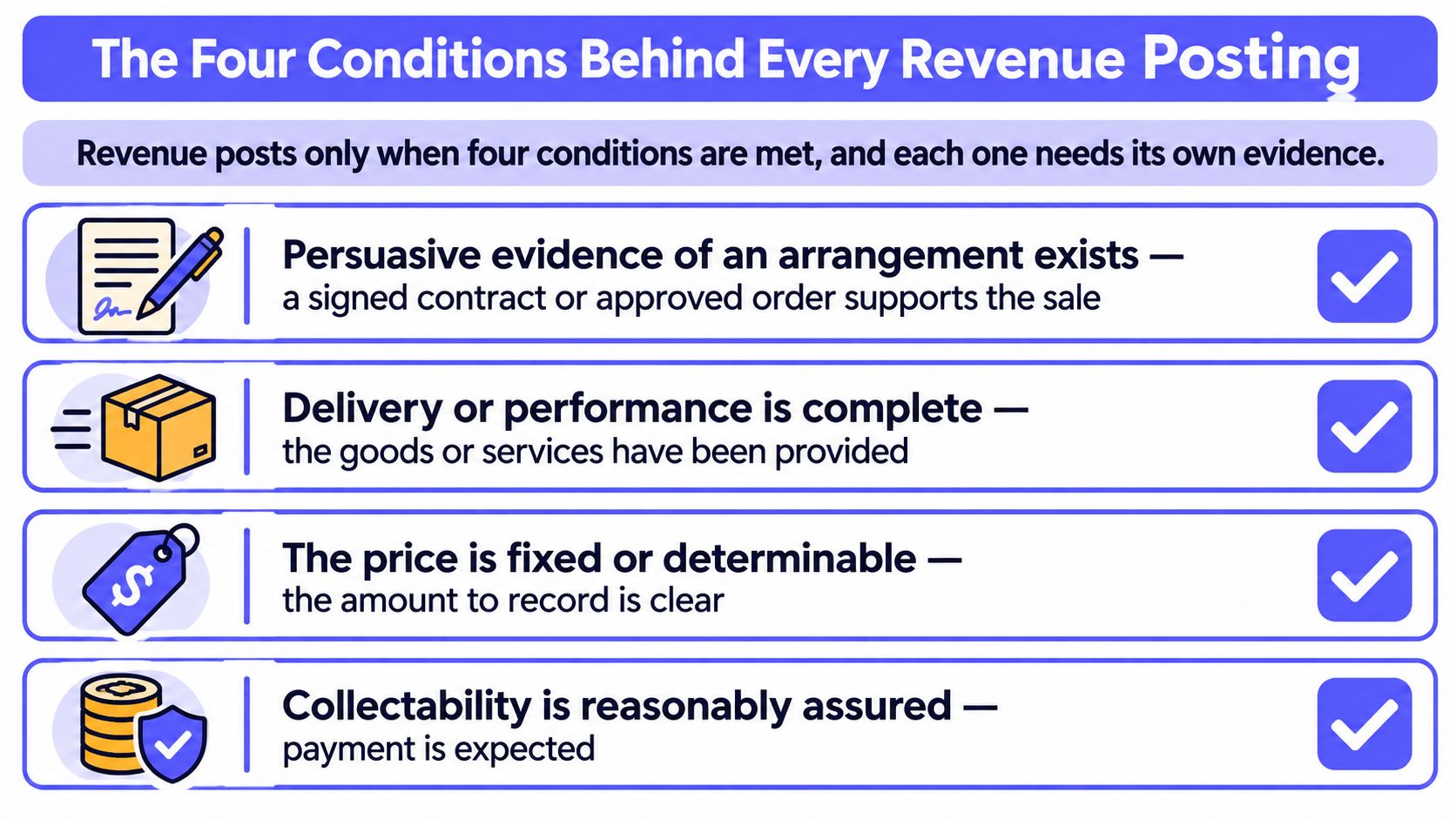
ASPE revenue recognition requires persuasive evidence of an arrangement, delivery or service performance, a fixed or determinable price, and reasonable assurance of collection. Each condition needs evidence rather than a single billing-system status.
CPABC’s guidance on recognizing revenue under ASPE identifies these conditions and connects performance to transferred ownership risks or services rendered. A practical control therefore separates the commercial agreement, performance record, pricing terms and collectability assessment.
The recognition checklist makes those separate decisions visible.
Recognition conditions, evidence and common failures
The strongest close file connects each recognition condition to a specific record. The following table identifies practical evidence and failure modes that warrant review.
| Condition | Evidence to retain | Common failure |
|---|---|---|
| Arrangement exists | Signed contract, order form or statement of work | Scope agreed verbally, renewal unsigned |
| Delivery or performance occurred | Delivery receipt, go-live sign-off or timesheets | Billed in advance with no performance record |
| Price fixed or determinable | Rate card, pricing schedule or approved change orders | Usage charges with no agreed rate |
| Collection reasonably assured | Credit review and payment history | Customer in default with no assessment on file |
A contract reference alone isn’t enough. The reviewer needs the applicable version, including amendments and accepted changes. Similarly, a go-live date needs evidence that the event occurred and satisfies the policy’s performance test.
Collection also deserves a separate conclusion. An approved credit limit from contract inception may not address a customer’s financial deterioration before recognition. The file should explain the information considered and the conclusion reached.
Build the decision trail before approval
The revenue approval should link to separate evidence records, even when those records originate in different systems. A DocuSign agreement, Salesforce order and project timesheet can support one entry without being collapsed into an unexplained attachment.
The controller’s checklist should include:
- Terms retained: The accepted contract and relevant amendments are accessible.
- Performance dated: Delivery or service records identify the accounting period.
- Rate confirmed: The pricing version matches the work being recognized.
- Credit reviewed: The collection conclusion reflects relevant customer information.
- Entry linked: Each supporting record connects to the proposed posting.
Missing evidence should create an exception with an owner. It shouldn’t become an assumption that the invoice proves everything.
Measuring Revenue for Goods, Services and Long-Term Work
Goods revenue generally follows the transfer of significant ownership risks and rewards. Services and long-term work follow the method that best relates revenue to work accomplished. Neither approach treats the invoice amount as a substitute for performance.
For goods, the seller assesses whether significant risks and rewards have passed to the buyer. The seller must also retain no continuing managerial involvement or effective control, and the consideration and potential returns must be measurable.
For services, BDO’s Section 3400 technical summary explains the choice between percentage of completion and completed contract. Percentage of completion applies when progress can be reasonably estimated; completed contract is restricted to substantially a single act or circumstances where progress can’t reasonably be measured.
Measurement method by arrangement type
The arrangement’s substance determines the method. The finance team should select a progress measure that reflects actual performance and retain the records behind it.
| Arrangement | Use when | Progress measure | Common error |
|---|---|---|---|
| Goods at transfer | Significant risks and rewards of ownership have passed | Delivery or transfer evidence | Recognizing at shipment without transfer |
| Percentage of completion | Progress can be reasonably estimated | Output or input measures | Using billed amounts as progress |
| Completed contract | Single act, or progress cannot be measured | Completion evidence | Recognizing partial delivery too early |
Output measures include units delivered or project milestones. Input measures include labour hours or machine usage. A milestone label isn’t sufficient by itself; the project owner should retain the deliverable or acceptance evidence behind it.
Amounts billed aren’t an appropriate measure of performance. A deposit invoice can precede work, while a delayed invoice can follow completed work.
Calculate cumulative revenue, then the period entry
Percentage-of-completion accounting calculates the cumulative amount earned before determining the current posting. Consider a hypothetical fixed-fee project priced at $120,000, with supported progress of 30%.
- Estimate total expected effort. Retain the approved project estimate and its basis.
- Measure progress to date. Compare supported work with the applicable total estimate.
- Calculate cumulative revenue. In this example, $120,000 multiplied by 30% equals $36,000.
- Subtract revenue already recognized. Use the contract’s posted revenue history.
- Post the difference. Reconcile the result to the contract schedule and general ledger.
The estimate version matters. If expected remaining effort increases, the completion percentage may fall even though the team performed additional work. The revised calculation can change current-period revenue and the balance remaining deferred.
Preserve the original estimate, the revised estimate and the approval. Overwriting the estimate removes the explanation for the change.
Usage-based arrangements need comparable discipline. Where the agreed policy treats delivered units as performance, the calculation should link delivered usage to the fixed or determinable rate. The invoice date shouldn’t replace the underlying delivery date.
Journal Entries for Subscriptions, Services and Bundles
Advance-billed arrangements commonly begin with a receivable and deferred revenue, followed by releases as performance occurs. That pattern applies only when billing creates a receivable before the related revenue is earned. Work performed before billing requires a different accounting sequence.
The following examples are hypothetical. They assume reasonable assurance of collection, enforceable billing terms and no sales taxes, financing components or other adjustments.
An annual subscription billed before service
An evenly delivered subscription can release deferred revenue over its service period. Suppose an annual plan costs $12,000, is billed on 1 January, and provides uniform service throughout the year.
At billing, debit accounts receivable and credit deferred revenue. The invoice creates the receivable, while the liability represents service still owed.
As each month’s service is provided, debit deferred revenue and credit subscription revenue for $1,000. If payment arrives separately, debit cash and credit accounts receivable. That cash entry doesn’t create additional revenue.
The first two rows of the journal-entry table show the billing and release entries. The subscription schedule should also retain service dates, amendments and evidence supporting any interruption or cancellation.
A services project billed ahead of measured progress
A services project separates billing from the cumulative revenue supported by work completed. Consider a hypothetical $120,000 fixed-fee project that is 30% complete at quarter-end, with $40,000 billed in advance.
The cumulative recognized amount is $36,000. Assuming no prior recognition, the finance team debits deferred revenue and credits services revenue for that amount.
The remaining $4,000 stays in deferred revenue. The billing total doesn’t justify recognizing the difference.
The close file should contain the approved progress calculation, the billing record and the reconciliation between them. If earlier periods already included revenue, the current entry would recognize only the difference between the updated cumulative amount and prior postings.
A setup and support bundle
A bundled contract needs an allocation supported by relative value, not merely the invoice labels. Suppose a hypothetical $10,000 arrangement includes setup and twelve months of support.
Assume the entity’s documented policy identifies setup as a separate unit of account. Further assume evidence of relative value supports allocating $2,000 to setup and $8,000 to support. Under those assumptions, setup revenue is recognized at supported go-live, while support revenue follows the service period.
A setup charge isn’t automatically earned at go-live. If setup doesn’t qualify for separate accounting under the applicable policy, the illustrative setup entry below wouldn’t apply.
Illustrative ASPE journal entries for common transactions
These entries illustrate the stated assumptions rather than a universal posting template. The support release uses rounding, with the final release adjusted so total recognition equals the allocated amount.
| Transaction | Debit | Credit | Amount |
|---|---|---|---|
| Annual subscription billed in advance | Accounts receivable | Deferred revenue | $12,000 |
| Monthly subscription release, months 1 to 12 | Deferred revenue | Subscription revenue | $1,000 per month |
| Services project billed in advance | Accounts receivable | Deferred revenue | $40,000 |
| Services project cumulative release | Deferred revenue | Services revenue | $36,000 |
| Bundle setup fee at go-live | Deferred revenue | Setup revenue | $2,000 |
| Bundle support, each month of twelve | Deferred revenue | Support revenue | Approximately $666.67, with final-period rounding adjustment |
For an additional debit-and-credit walkthrough, the Jumpstart Partners revenue recognition guide provides a companion resource. Loopfour’s revenue recognition journal entry guide offers another reference for reviewing posting mechanics.
The accounting conclusion must precede the entry. Each illustration must be adapted to the entity’s documented policies, contract facts and guidance in force.
How ASPE Compares With IFRS 15 and ASC 606
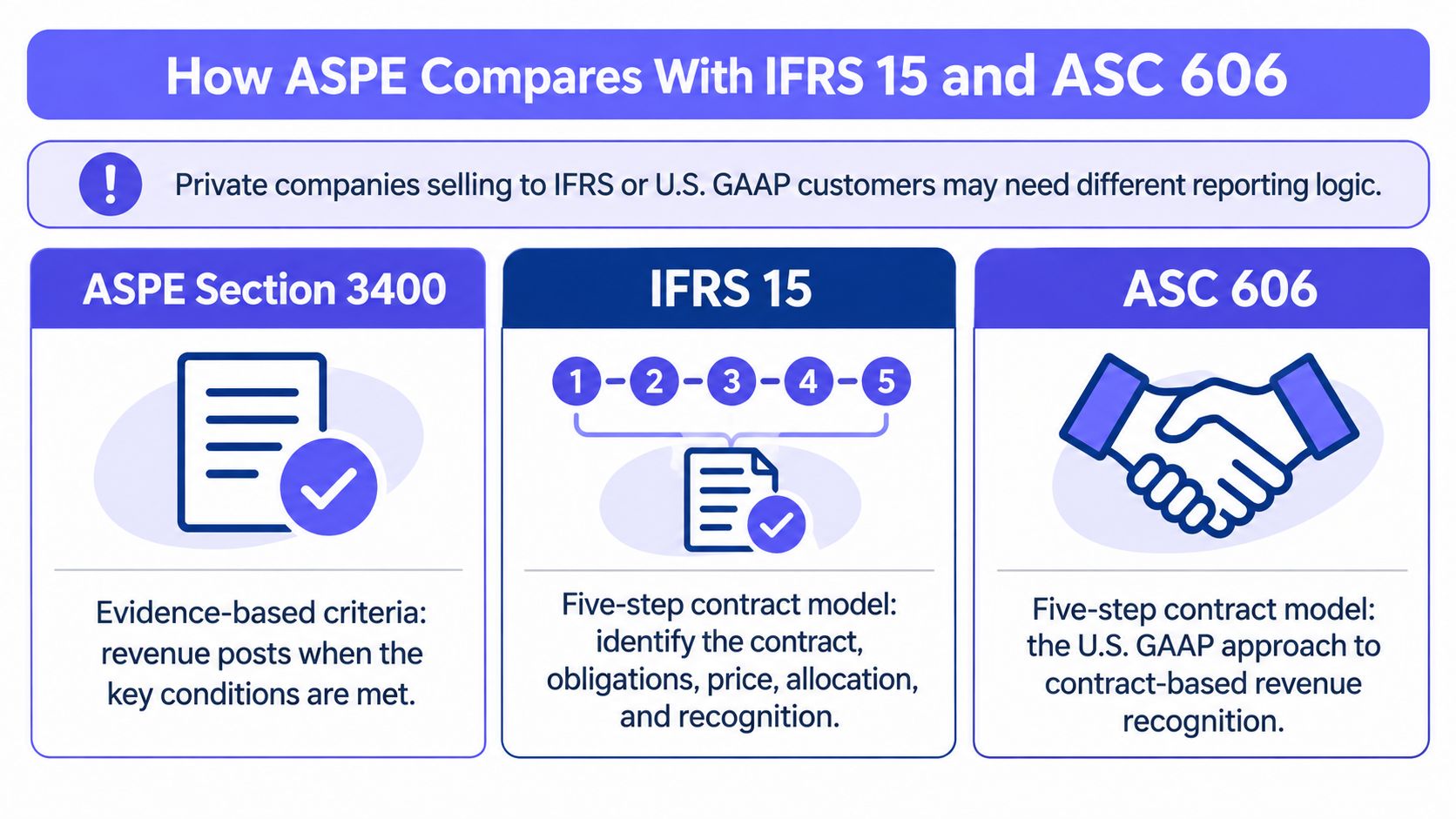
ASPE Section 3400 uses performance-based recognition criteria, while IFRS 15 and ASC 606 use a five-step contract model. A customer’s reporting framework doesn’t determine the seller’s accounting, but a parent’s reporting requirements may require a separate conversion.
The framework distinction is summarized below.
| Topic | ASPE Section 3400 | IFRS 15 | ASC 606 |
|---|---|---|---|
| Core model | Evidence-based criteria tied to performance | Five-step contract model | Five-step contract model |
| Long-term services | Percentage-of-completion or completed contract | Over time or at a point in time | Over time or at a point in time |
| Multiple elements | Units of account and allocation under amended guidance | Performance obligations and standalone selling price | Performance obligations and standalone selling price |
| Upfront non-refundable fees | Guidance indefinitely deferred and available for use; inception-fee disclosure applies | Assessed within performance obligations | Assessed within performance obligations |
| Typical users | Private Canadian enterprises | IFRS reporters | US GAAP entities |
The December 2019 amendments added guidance on units of account, multiple-element arrangements, percentage of completion, gross-versus-net presentation, bill-and-hold transactions and upfront fees, according to IAS Plus’s Section 3400 history. The amendments generally applied to fiscal years beginning on or after January 1, 2021, with earlier application permitted.
The upfront-fee guidance subsequently followed a separate transition path. Historical effective dates shouldn’t be treated as the current policy conclusion.
For broader orientation, Bookkeeping and Accounting of Florida guidance provides a general accounting resource. Loopfour’s IFRS revenue recognition overview provides a companion framework discussion.
A controller should maintain a bridge schedule from ASPE results to any required parent or lender reporting basis, with each adjustment supported separately.
Disclosure Rules and Audit Evidence Your Team Needs
ASPE enterprises must disclose the nature and amount of upfront non-refundable fees recognized as revenue when an arrangement begins. The requirement applies to fiscal years beginning on or after January 1, 2025, according to BDO’s ASPE Update 2025.
The AcSB indefinitely deferred the effective date of the related recognition guidance, but that guidance remains available for use. Deferral therefore doesn’t remove the need to identify these fees or support the reporting conclusion.
The practical risk shifts toward disclosure completeness, policy consistency and data lineage. A defensible policy won’t produce a complete disclosure if activation fees remain scattered across billing systems and entities.
Build the contract population before the disclosure
The disclosure process needs a complete population of potentially relevant fees. Searching only for a general-ledger account named setup revenue can miss differently labelled charges.
- Contract inventory: Include active arrangements across entities, CRM records, billing systems and document repositories.
- Fee classification: Identify activation, initiation, onboarding and other non-refundable charges by substance.
- Units of account: Record whether the fee relates to separately assessed work or the broader arrangement.
- Recognition treatment: Identify amounts recognized at inception and amounts deferred.
- Ledger reconciliation: Connect billing and contract schedules to posted balances.
- Disclosure roll-forward: Retain opening-to-closing movements, inception-recognized fees, adjustments and the proposed disclosure total.
The roll-forward should explain adjustments rather than hide them in a balancing line. Credit notes, contract changes and reclassifications need identifiable support.
Preserve a file that can reproduce the number
An auditable revenue file allows a reviewer to repeat the calculation using the same evidence and policy version. A useful audit-preparation package includes:
- Versioned policies: Effective dates, transition decisions and approved interpretations.
- Contract-level schedules: Recognition amounts linked to the terms that govern them.
- Approval records: Reviewer identity, timestamps and exception resolution.
- Cut-off support: Evidence establishing the correct performance period.
- Estimate-change logs: Previous assumptions, revised assumptions and reasons.
- Materiality judgments: The basis for disclosure and adjustment decisions.
The fear is specific: auditors need the number to hold up when they recompute it. A spreadsheet that can’t reproduce the figure doesn’t provide that support.
An audit trail should explain both the posted amount and why a different amount wasn’t posted.
Loopfour’s guide to auditing revenue recognition provides a companion checklist for organizing the review. The controller remains responsible for the accounting conclusion and the completeness of the supporting population.
Confirm Controls Before You Automate Revenue Postings
A posting is ready to automate only when the team can show what evidence supports it, which policy produced the amount, and who approves exceptions. The same contract facts and policy version should produce the same result each time.

Before automation, define who owns exceptions, which entries need approval, and how the revenue schedule will be reconciled to the ledger at close. Route large or unusual entries to a controller before posting. These controls make the process repeatable without treating an automated calculation as an accounting judgment.
Loopfour applies the recognition policies that the customer’s controllers define identically to every contract and every period. Each recognized amount links to the contract term and the exact rule that produced it. When a contract changes, such as through an upgrade, downgrade or cancellation, the schedule is recomputed under the customer’s rules. The before-and-after change is logged rather than overwritten.
AI is limited to scoped interpretation under confidence thresholds, with human fallback when confidence is insufficient. It does not decide how revenue is booked. The underlying workflow uses governed, versioned definitions rather than undocumented posting logic.
The accompanying video provides additional platform context.
Test one contract from source terms through performance evidence, calculation, approval and posting. Then have a reviewer reproduce the amount from the same evidence and policy version. If the result cannot be repeated, resolve the control gap before scaling automation.
Frequently Asked Questions About ASPE Revenue Recognition
ASPE revenue questions often turn on measurement, policy changes and the location of authoritative guidance. The answers below distinguish the accounting requirement from the evidence needed to support it.
How is revenue recognized on goods customers can return under ASPE?
ASPE Section 3400 requires potential returns to be reasonably measurable. If the seller can’t reasonably measure returns, revenue is deferred until measurement is supportable. Return terms and the estimation basis belong in the recognition file.
What happens when a private enterprise changes its revenue policy?
A change required by a new standard follows that standard’s transitional provisions. Voluntary accounting policy changes fall under ASPE Section 1506, Accounting Changes. The enterprise should preserve the approved rationale, effective date and applicable transition treatment.
Where is the authoritative text of ASPE revenue guidance?
The CPA Canada Handbook, Part II, Section 3400, Revenue, is the authoritative source. Summaries help explain the framework, but the current Handbook text governs the accounting assessment.
Can ASPE recognize revenue when the price is still being negotiated?
ASPE Section 3400 requires the seller’s price to be fixed or determinable before recognition. An unresolved negotiation doesn’t satisfy that condition merely because work has started. The file should retain accepted pricing terms and approved changes.
Loopfour offers deterministic finance workflow automation that connects contract terms, controller-defined recognition rules and retained posting evidence. Finance teams can visit Loopfour to discuss testing an ASPE revenue workflow against a representative contract before expanding automation.