
Accounts receivable automation is software-driven execution of the order-to-cash cycle that turns manual steps into event-triggered workflows, routes exceptions to humans, and retains an execution trail an auditor can reconstruct. Its scope extends beyond invoice delivery to collections, payment matching, cash application, and reporting.
At month-end, a controller may still be reconciling an aging report while searching email for a disputed invoice. A payment awaits posting, and sales wants a credit decision. The problem isn’t that each task takes time. The problem is that nobody can readily establish which record is authoritative, who approved the next action, or whether that action reached the ERP.
Useful AR automation connects those decisions, actions, and records. Faster collections matter. So does being able to explain every adjustment after the person who handled it has gone home.
Table of Contents
- What Accounts Receivable Automation Actually Means
- Deterministic vs Probabilistic AR Automation
- The Four Core Components of an AR Automation System
- Measurable Benefits and the Real ROI of AR Automation
- Governance, Controls, and Audit Evidence
- Where AI Fits in AR Without Breaking Controls
- Integrating AR Automation With Your ERP, CRM, and Billing Stack
- Frequently Asked Questions About AR Automation
What Accounts Receivable Automation Actually Means
Accounts receivable automation replaces repeated manual handling with connected, rules-based workflows across billing, customer communication, payments, and exception resolution. Its foundational purpose is consistent, timely order-to-cash execution, not merely digitizing an invoice.
For a controller balancing spreadsheets and email, that distinction is practical. An emailed invoice doesn’t establish whether the customer received valid billing data, whether a dispute should suppress reminders, or whether an incoming payment was posted correctly.
The operational pressure points are easy to recognize.
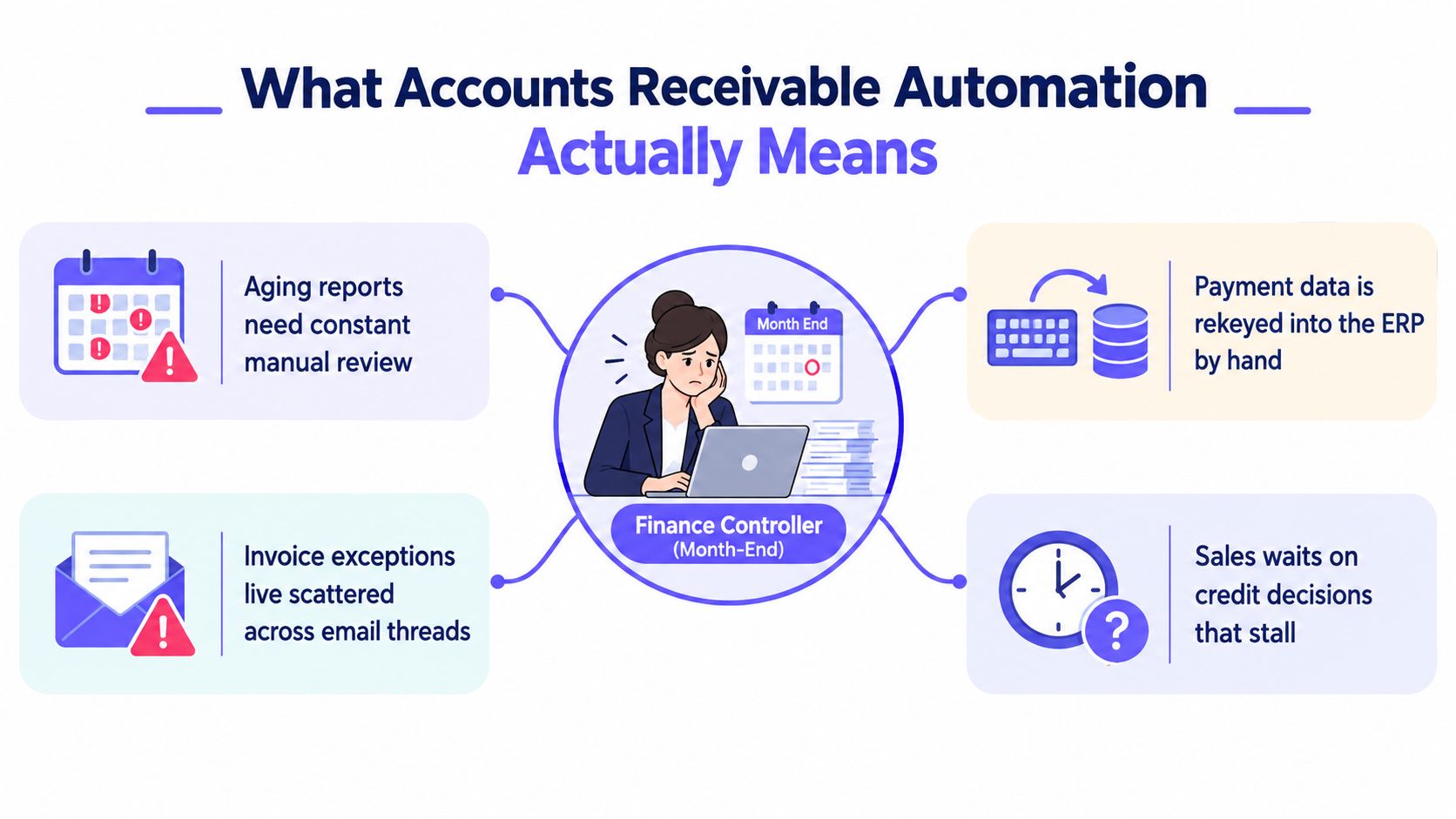
A 2022 global survey reported nearly 49% of businesses still using legacy AR processes. Complete automation reached only 19% for invoice generation, 15% for invoice sending, and 8% for customer payment-plan setup and management in that survey.
Those findings help explain why purchasing an invoicing tool doesn’t necessarily resolve the controller’s workload. Individual tasks may be digital while the handoffs remain manual.
The operating model behind the software
An AR operating model defines what triggers work, which rules apply, and who owns exceptions. A workflow should connect the original transaction to the resulting communication, approval, and ledger entry.
Consider a hypothetical disputed invoice. A controlled workflow should recognize the dispute, assign an owner, and prevent inappropriate follow-up while the issue remains open.
- Trigger: A billing event or scheduled review starts the workflow.
- Validation: Customer details, terms, and transaction references pass predefined checks.
- Decision: Policy determines whether processing continues or requires approval.
- Evidence: The record retains the decision, responsible actor, and resulting action.
Practical rule: A digital invoice is a document. An automated receivables process is an operating model.
Accounts payable and accounts receivable can also be confused. AR manages customer amounts owed to the business; AP manages supplier obligations. For readers comparing the workflows, Matil’s accounts payable automation explained provides a useful companion resource.
The answer to “what is accounts receivable automation?” therefore needs an operational boundary. Automation should cover the work between issuing an invoice and establishing that the corresponding cash has been correctly recorded.
Deterministic vs Probabilistic AR Automation
Deterministic AR automation follows predefined rules. Probabilistic AR automation uses prediction to interpret or generate an output. Finance teams should distinguish those behaviors before deciding which system receives posting authority.
For deterministic execution, the same captured inputs, workflow version, and relevant system state should produce the same decision. A probabilistic interpretation may vary and requires verification appropriate to the financial consequence.
The comparison below illustrates the distinction.
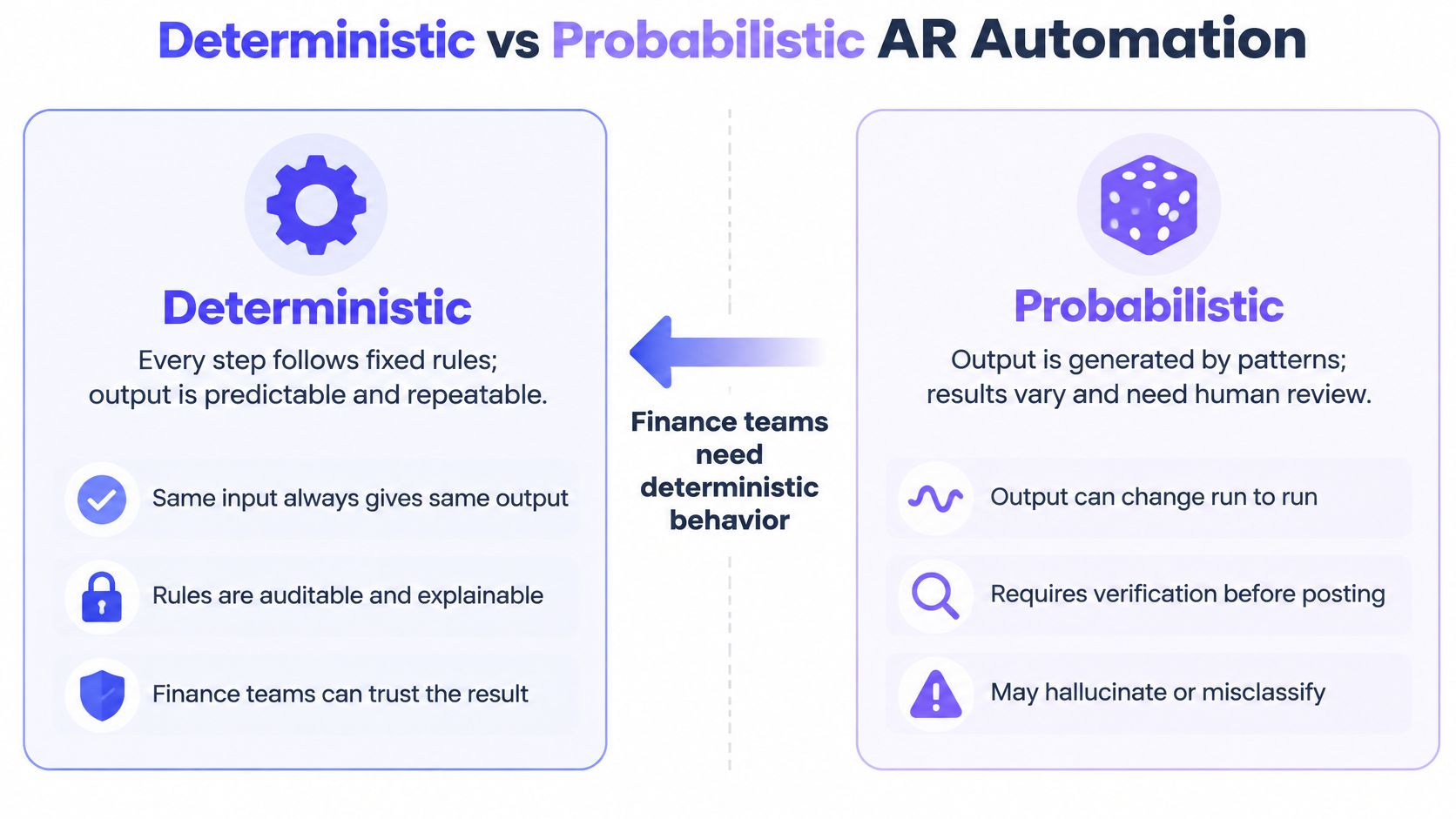
A draft reminder and a credit memo aren’t equivalent control events. A collector can review an imperfect sentence before sending it. A posted adjustment changes financial records and requires an authorized, explainable decision.
| Evaluation question | Deterministic execution | Probabilistic interpretation |
|---|---|---|
| What determines the result? | Explicit rules and captured inputs | A predictive model |
| What should reviewers inspect? | Rule version and decision path | Source material and proposed interpretation |
| Where does authority belong? | Within approved policy boundaries | Behind validation and approval gates |
The commercial pressure is real. A 2026 survey of 163 finance professionals reported 92% typically receiving payment after the due date. Among respondents, 43% used AR automation; 71% of those users received payment within two weeks of the due date, versus 47% among the 57% using manual methods.
That association doesn’t establish that automation caused better payment outcomes. It also doesn’t compare deterministic systems with probabilistic systems.
Reproducibility is a purchasing criterion
A controller should ask whether a vendor can reconstruct a historical run using preserved inputs and the applicable workflow definition. The vendor should distinguish safe replay from repeating a live posting.
Loopfour, the deterministic finance workflow automation platform, converts recurring finance work into governed code on existing systems. Black-box execution leaves reviewers reconstructing decisions. Loopfour retains execution evidence instead, including actions, approvals, exceptions, and system writes.
The accompanying video provides additional context for evaluating the approach.
The useful question isn’t whether software can produce an answer. It’s whether finance can establish why the system was authorized to act on that answer.
The Four Core Components of an AR Automation System
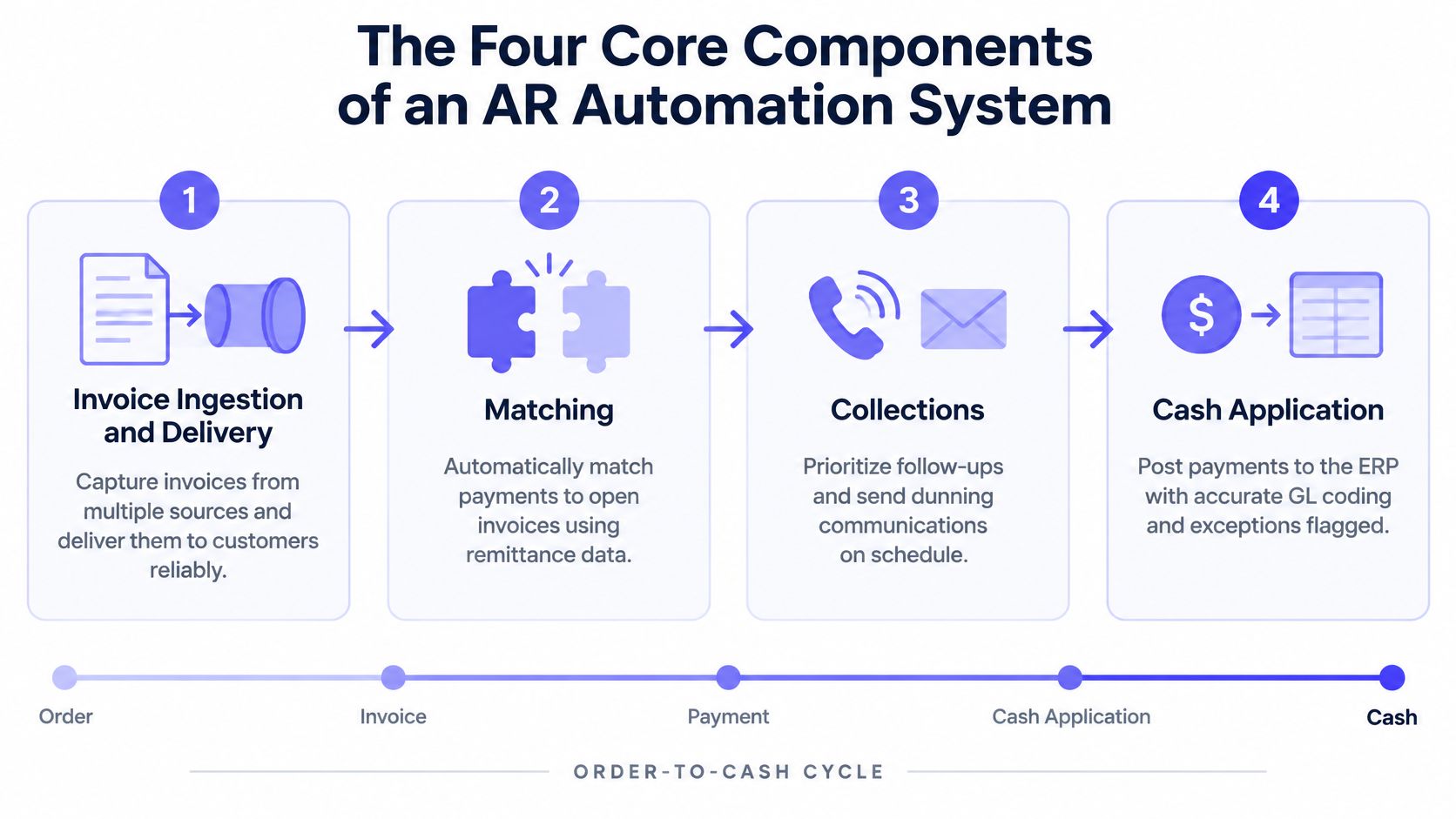
An AR automation system connects invoice ingestion and delivery, matching, collections, and cash application. Matching identifies what a payment belongs to; cash application records the approved allocation in the accounting system.
The components share information, but they don’t always operate in a rigid sequence. Collections can continue while a separate payment awaits identification, and a dispute can interrupt otherwise routine processing.
The diagram shows the principal responsibilities.
A 2025 AR automation survey found only 3% of surveyed organizations reported fully automated AR. 28% still invoiced manually, more than half relied on manual collections, and only 14% had mostly or fully automated cash application.
Invoice ingestion and delivery
Invoice ingestion should assemble authorized billing data and validate it before delivery. In a proposed workflow, Salesforce or another CRM supplies customer context, while billing and contract systems supply approved commercial terms.
The design should explicitly check customer identity, billing address, payment terms, and applicable tax handling. Missing purchase-order details or conflicting terms should create an exception, not an invented value.
Structured electronic invoicing uses machine-readable formats and can include validation, secure transmission, and delivery into the recipient’s financial system. A PDF attachment alone doesn’t provide that complete machine-readable exchange.
Matching and collections
Payment matching should identify supported allocations, while collections should act on the customer’s current account status. Both need access to disputes and unresolved payment information.
| Component | Routine work | Example exception owner |
|---|---|---|
| Matching | Compare bank transactions and remittances with open invoices | Cash application specialist |
| Collections | Schedule reminders and monitor promised payments | Collector or account owner |
A hypothetical remittance may identify an invoice while the payment amount is lower than the balance. The workflow should flag the deduction for review rather than treat it as an approved write-off.
Collections needs equally explicit stop conditions. A predefined AR workflow can pause during disputes, resume after promised-payment dates, and create human tasks when customers don’t respond. A documented accounts receivable collection process helps assign those responsibilities.
Cash application
Cash application posts the authorized payment allocation into the ERP subledger. The integration design should then synchronize the relevant customer status with the CRM.
- Before posting: Validate the entity, customer, invoice, amount, and approval state.
- After posting: Retain the ERP response and reconcile the resulting record.
- When posting fails: Route the exception without treating an attempted write as a completed transaction.
That last distinction matters. Matching confidence isn’t proof that the accounting entry succeeded.
Measurable Benefits and the Real ROI of AR Automation
AR automation ROI should combine collection outcomes, processing efficiency, and control quality. A defensible business case measures completed, reconciled work, not merely reminders sent or tasks triggered.
The Hackett Group’s Radiance 2018 benchmark reported 90% of credit sales collected within terms for world-class organizations, versus 76% overall. Average delinquent days were 4 versus 10, respectively.
AR Performance Benchmarks (Hackett Group, Radiance 2018)
| Metric | World-Class | Overall Database |
|---|---|---|
| Credit sales collected within terms | 90% | 76% |
| Average delinquent days | 4 | 10 |
The benchmark describes performance differences. It isn’t a promised implementation result or proof that software alone explains the gap.
Measure the outcome and its quality
AR measurement should distinguish faster execution from work that remains unresolved elsewhere. An impressive matching rate means little if unapplied cash continues aging.
- Straight-through processing: Eligible transactions completed without manual intervention.
- Auto-cash-application rate: Payments correctly applied automatically, with reversals examined separately.
- Unapplied-cash aging: How long received cash remains unallocated.
- Invoice exception rate: Invoices requiring correction or investigation.
- Dispute cycle time: Time from dispute opening to documented resolution.
- DSO by entity and customer segment: Collection timing viewed alongside customer terms and business mix.
A reminder sent is an activity. A reconciled receipt is an outcome.
Build the cost case without pretending
A credible ROI model includes implementation, integrations, internal testing, training, maintenance, and control operation. Finance should record actual time spent assembling evidence and correcting failed runs, rather than assuming those costs disappear.
The model should also separate cash released earlier from operating expense saved. Earlier customer payment changes cash timing; it doesn’t automatically create equivalent income.
A practical assessment compares equivalent customer groups and documents changes in terms, disputes, or sales mix. Otherwise, a DSO improvement could receive credit that belongs to a different commercial decision.
The strongest case isn’t that every collector can be removed. It’s that routine work becomes reproducible, exceptions receive accountable owners, and finance can demonstrate what happened without rebuilding the record from email.
Governance, Controls, and Audit Evidence
AR automation governance establishes who can authorize financial actions, which limits apply, and what evidence must remain afterward. Speed doesn’t compensate for an unsupported write-off, an unauthorized credit change, or an unreconciled posting.
A skeptical controller’s fear is specific: the demonstration works, the vendor promises a clean close, and the evidence falls apart during testing. Auditors want the process to hold up, not merely finish quickly.
The checklist below translates that concern into control requirements.
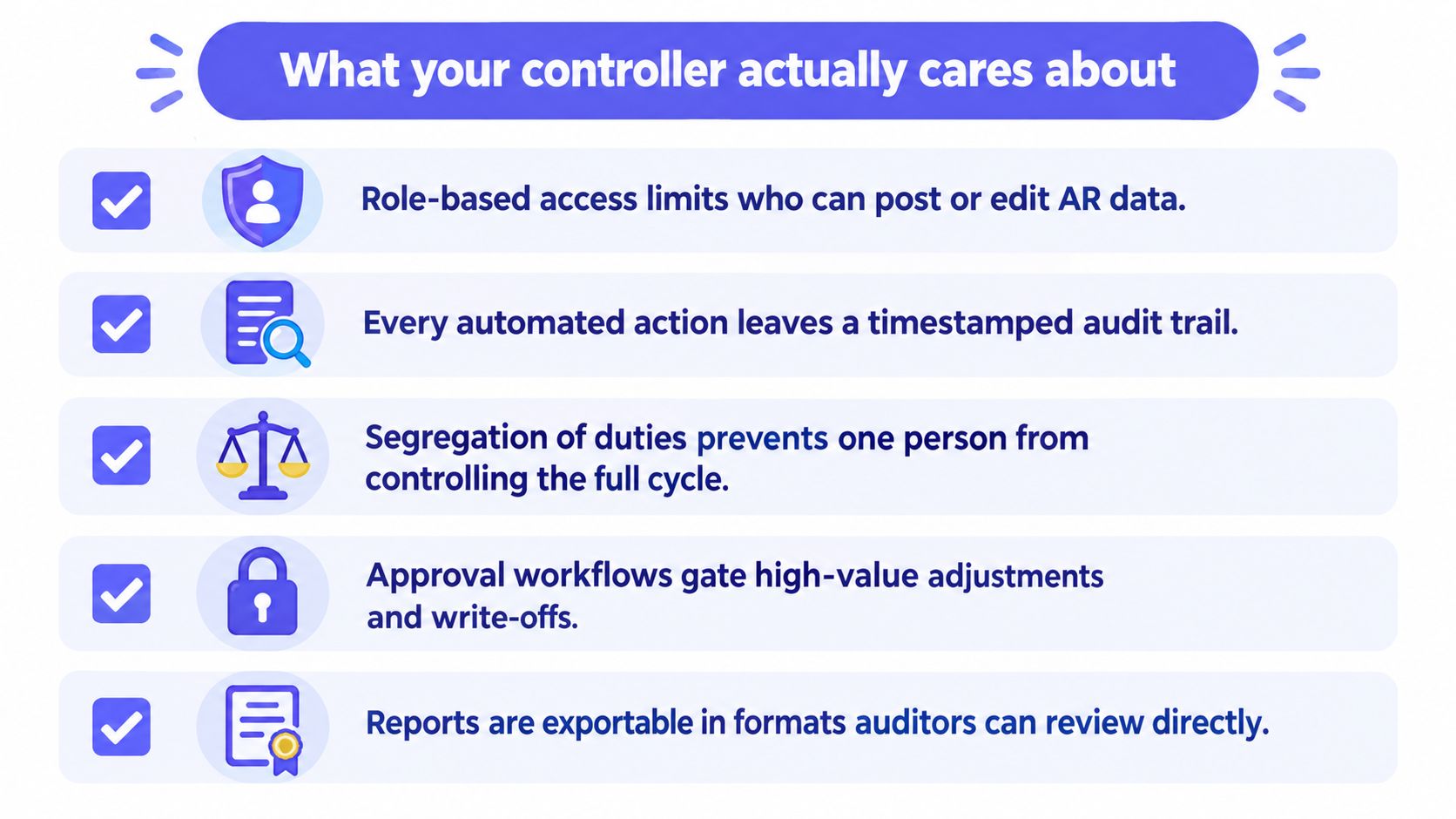
Permissions and approvals need to govern the underlying financial action, not just access to the automation interface. A service account with broad ERP authority can undermine an otherwise careful approval design.
Controls belong at the action boundary
AR control design should connect each risk to a preventive or detective control. The following checklist gives controllers a concrete starting point for SOX or SOC discussions.
| Control | Evidence to request |
|---|---|
| Segregation of duties | Requester, approver, and posting identities |
| Credit and write-off thresholds | Applicable policy and approval record |
| Immutable activity logs | Timestamped events and protected history |
| Subledger-to-general-ledger reconciliation | Comparison results and exception resolution |
| Versioned workflow changes | Approved definition, change history, and effective version |
| Role-based permissions | Access scope and review records |
An approval should attach to the transaction and its relevant values. If those values change afterward, the design should determine whether approval remains valid.
A write-off threshold also needs entity and currency context. A numeric limit without a defined scope isn’t a complete policy.
Evidence should explain attempted and completed work
An auditable run should retain inputs, outputs, validation results, approvals, exceptions, and system responses. Where interpretation used AI, the record should also retain its proposed result and confidence information.
A failed ERP call belongs in the evidence record. So does the eventual retry, resolution, or cancellation.
Control test: A reviewer should be able to distinguish what the workflow proposed, what a human approved, and what the ERP actually recorded.
Loopfour supports SOC 1 control audits through evidence capture for actions, approvals, exceptions, and system writes. Its platform documentation identifies SOC 2 Type II and HIPAA controls; those platform controls don’t replace the customer’s assessment of AR process design.
The purchasing discussion should therefore include sample evidence exports and a failed-run demonstration. A polished success path can’t establish exception ownership.
Where AI Fits in AR Without Breaking Controls
AI fits AR most safely as an interpretation layer inside governed workflows. AI can propose meaning; predefined controls should determine whether a financial action is permitted.
A 2025 survey reported 67% of finance leaders evaluating AI for AR, while only 14% had deployed it meaningfully. Respondents cited limited internal expertise, integration problems, and ROI or budget concerns.
That gap supports a more practical evaluation than asking whether an AR product has an AI feature. Finance leaders need to establish which decisions the model influences and what happens when its interpretation is wrong.
| Task | Appropriate AI role | Required boundary |
|---|---|---|
| Payment-term extraction | Propose terms from contract text | Validate against authorized commercial records |
| Remittance classification | Identify document type and candidate references | Check customer, entity, and open invoices |
| Dispute intake | Categorize the issue and suggest routing | Assign an accountable owner |
| Credit-limit change | Summarize supporting information | Require policy checks and authorized approval |
| Collection escalation | Draft context for review | Apply approved escalation rules |
Confidence isn’t authorization
A confidence score should determine whether an interpretation proceeds to validation or human review. It shouldn’t grant permission to post, close an account, or change a credit limit.
Consider a hypothetical remittance with an ambiguous invoice reference. The model might identify a likely match, but deterministic checks should still test customer identity, entity, currency, and invoice availability.
- Accept for validation: The proposed interpretation meets the configured confidence threshold.
- Route for review: The source is unclear, contradictory, or below threshold.
- Reject the action: Required policy checks fail, regardless of model confidence.
An AI Copilot should assist interpretation without becoming an unreviewed posting authority. Controller sign-off should depend on documented boundaries, not the friendliness of the interface.
Govern the hybrid workflow
Governed hybrid automation retains model outputs while keeping repeatable policy decisions reproducible. Human reviewers resolve ambiguous cases, and authorized rules control subsequent execution.
Security review should cover document access, permitted tools, credentials, and the financial actions an agent could attempt. The same boundary questions apply to AI agent security across the finance stack.
Model or prompt changes also deserve change control when they affect financial interpretation. Testing should include misleading remittances, missing fields, and contradictory instructions inside documents.
The production question is straightforward: can the organization explain why ambiguous information was accepted and why the resulting action was authorized?
Integrating AR Automation With Your ERP, CRM, and Billing Stack
AR automation should connect existing systems without replacing their accounting authority or approval matrices. The integration design must identify the system of record, permitted writes, synchronization rules, and failure handling.
A customer name appearing in Salesforce, Stripe, and NetSuite doesn’t establish that the records represent the same legal customer. Finance and engineering teams should agree on identifiers and entity mappings before activating automated postings.
| System responsibility | Example tools | Design decision |
|---|---|---|
| Accounting records | NetSuite, Sage Intacct, QuickBooks | Which system owns receivable balances? |
| Customer context | Salesforce, HubSpot | Which fields can synchronize back? |
| Billing and payment events | Stripe | Which event starts processing? |
| Signed documents | DocuSign | Which approved version supplies terms? |
| Exception communication | Slack, Microsoft Teams, email | Who owns resolution and escalation? |
Loopfour provides native connectors across these categories and secure browser automation for homegrown or legacy systems without APIs. Its implementation approach runs workflows on the customer’s existing stack rather than requiring replacement of core systems.
Integration success requires operational visibility
AR integration monitoring should expose business failures as well as technical failures. A successful API response doesn’t necessarily establish that the correct customer or entity received the posting.
Run logs and execution trees should show where processing stopped. Latency metrics and success and error rates help operations teams identify delays or recurring failures.
- Prevent duplicate writes: Define transaction identifiers and retry behavior.
- Route actionable exceptions: Include the record, failed check, and responsible owner.
- Verify synchronization: Compare intended changes with recorded results.
- Control changes: Assess upstream field and policy changes before deployment.
A documented approach to automatic data synchronization helps distinguish event delivery from verified agreement between systems.
The acceptance test should include an interrupted run, unavailable source system, and rejected ERP write. Preserving existing controls requires evidence that those failure paths work, too.
Frequently Asked Questions About AR Automation
AR automation approval depends on practical answers about staffing, measurement, auditability, and rollout. Controllers should use these questions to test project readiness.
Does AR automation replace collectors?
AR automation shifts collectors toward disputes, customer negotiations, and judgment-based exceptions. Staffing decisions should follow observed workload changes, not assumed elimination of human involvement.
What should finance measure after go-live?
Finance should establish a baseline, then monitor processing completion, unapplied cash, exceptions, disputes, and collection timing. Measures should distinguish genuine improvement from work transferred to another team.
How does deterministic automation differ from RPA scripts and AI agents?
Deterministic automation describes execution behavior, not a product label. RPA scripts can be deterministic; auditability requires governed changes, approvals, preserved inputs, and execution evidence.
How long should the first AR workflow take?
An AR workflow timeline depends on data quality, integration access, policy clarity, and testing. A defensible rollout uses acceptance criteria rather than an unsupported calendar promise.
Loopfour offers deterministic finance workflow automation across existing ERP, CRM, billing, and document systems, with exception routing and retained execution evidence. Visit Loopfour to discuss an AR workflow and review its approval boundaries, failure handling, and audit record before expanding its scope.