
Vendor payment reconciliation verifies that supplier invoices, purchase orders, receiving records, outgoing payments, and ledger postings agree. It helps catch overpayments, duplicate payments, payments for undelivered goods, missing credits, and timing or coding differences before they distort cash balances or the general ledger.
At month-end, a payment may have cleared the bank and still be wrong in your books. Perhaps it was applied to the wrong invoice, or posted to the wrong legal entity. The bank can confirm that funds moved, but it can’t confirm that the payment was matched to the correct liability. That’s why reconciliation is a control over connected records, not just a check for a bank transaction.
By Finance Operations Editorial Team
Finance operations education
Table of Contents
- What Vendor Payment Reconciliation Controls
- How Matching Works Across Finance Systems
- Common Vendor Payment Reconciliation Breakpoints
- Design a Deterministic Reconciliation Pipeline
- Compare Manual, Rules-Based, and Automated Reconciliation
- Build Exception Ownership and Resolution Evidence
- Apply Governed Workflows Across Entities and Currencies
- A Practical Reconciliation Implementation Checklist
What Vendor Payment Reconciliation Controls
Vendor payment reconciliation checks whether the supplier’s invoice, purchase order, receiving evidence, payment, and accounting records agree. It detects mismatches that can otherwise distort cash balances, payables, or the general ledger.
Consider a controller reviewing a payment that cleared the bank. The payment amount looks right, but the ledger shows it against a different invoice or entity. The funds reached the supplier, yet the accounting record is wrong. Vendor payment reconciliation helps identify that break and establish how it should be corrected.
The control covers more than payment confirmation. It can identify duplicate payments, overpayments, payments for goods that weren’t received, missing credits, and differences caused by timing or coding. Those are distinct problems, so a useful reconciliation process records what happened rather than treating every discrepancy as a generic variance. Vendor payment reconciliation connects records created across AP, procurement, receiving, treasury, banking, and accounting.
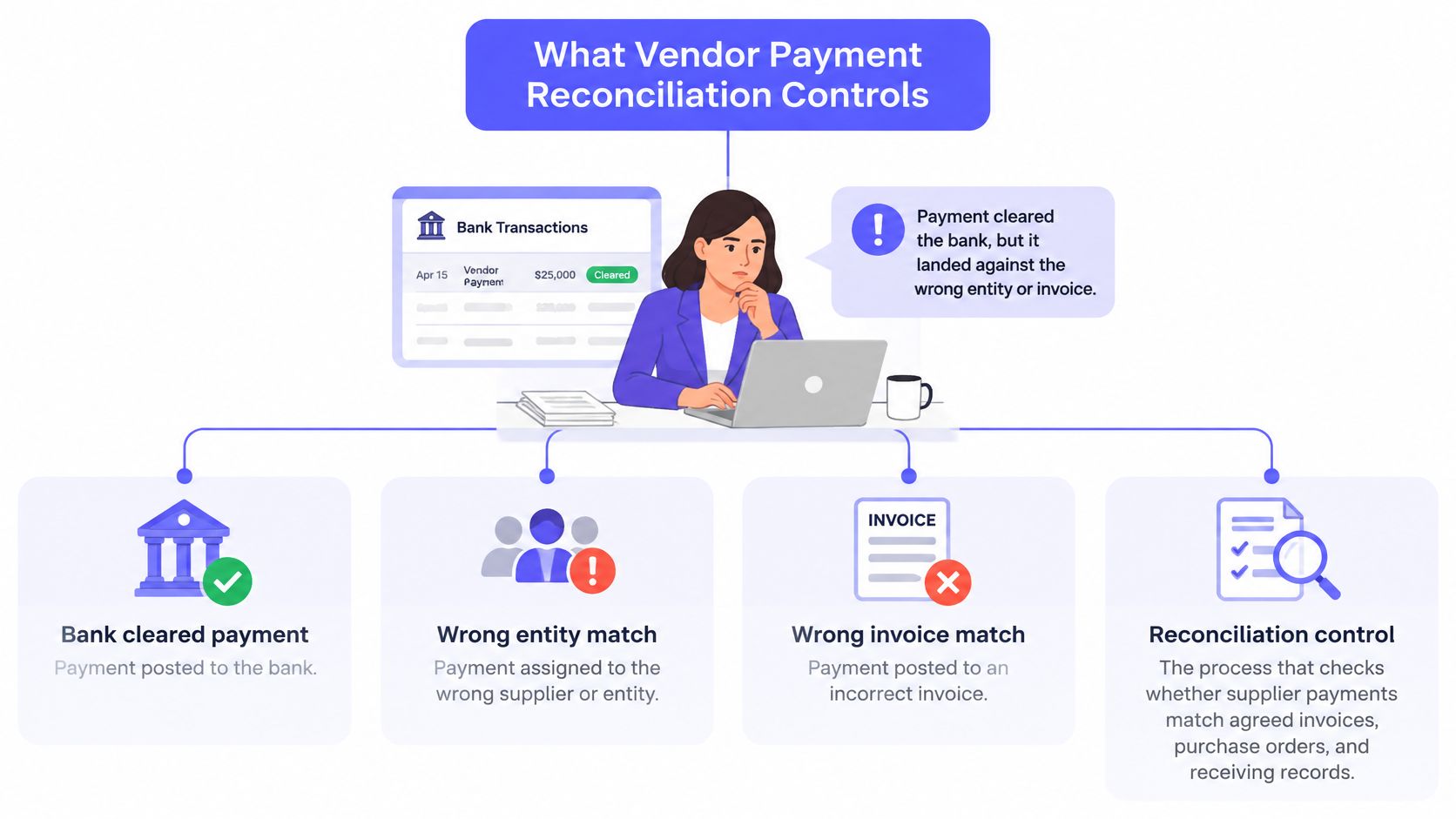
The control follows the liability through settlement
Before payment, invoice-to-PO matching checks whether the supplier invoice aligns with the approved purchase order. Receiving records add evidence that the goods or services arrived. This three-way match helps establish whether the liability is supported before it’s paid.
After payment, payment-to-invoice matching checks whether the outgoing funds settled the approved liability for the right amount and reference. A payment can be correctly sent but misapplied to the wrong vendor, invoice, currency, entity, or accounting period. Settlement is evidence that money moved, not proof that the books are correct.
The evidence trail should retain approvals, adjustments, unresolved exceptions, and final sign-off. That trail helps finance teams explain decisions during close and gives auditors records to test. For a useful introduction to the related discipline of bank reconciliation, see Allied Tax Advisors’ bookkeeping support.
How Matching Works Across Finance Systems
Vendor payment reconciliation works as a chain of linked controls, from the original invoice to the general-ledger posting. A bank-to-ledger comparison is only one link; it doesn’t establish that the invoice was approved, the goods were received, or the payment was applied correctly.
The foundation is the three-way match:
- Invoice: The supplier’s request for payment, including its identity, amount, and reference.
- Purchase order: The approved order that establishes what the organization intended to buy.
- Receiving report: Evidence that the goods or services were received.
Once those records support the liability, the control follows it through the payment instruction, bank-clearing result, vendor statement, and general-ledger posting. The linked record chain matters because each system answers a different question. A purchase order establishes authorization, a receiving record supports delivery, and a bank record confirms settlement.
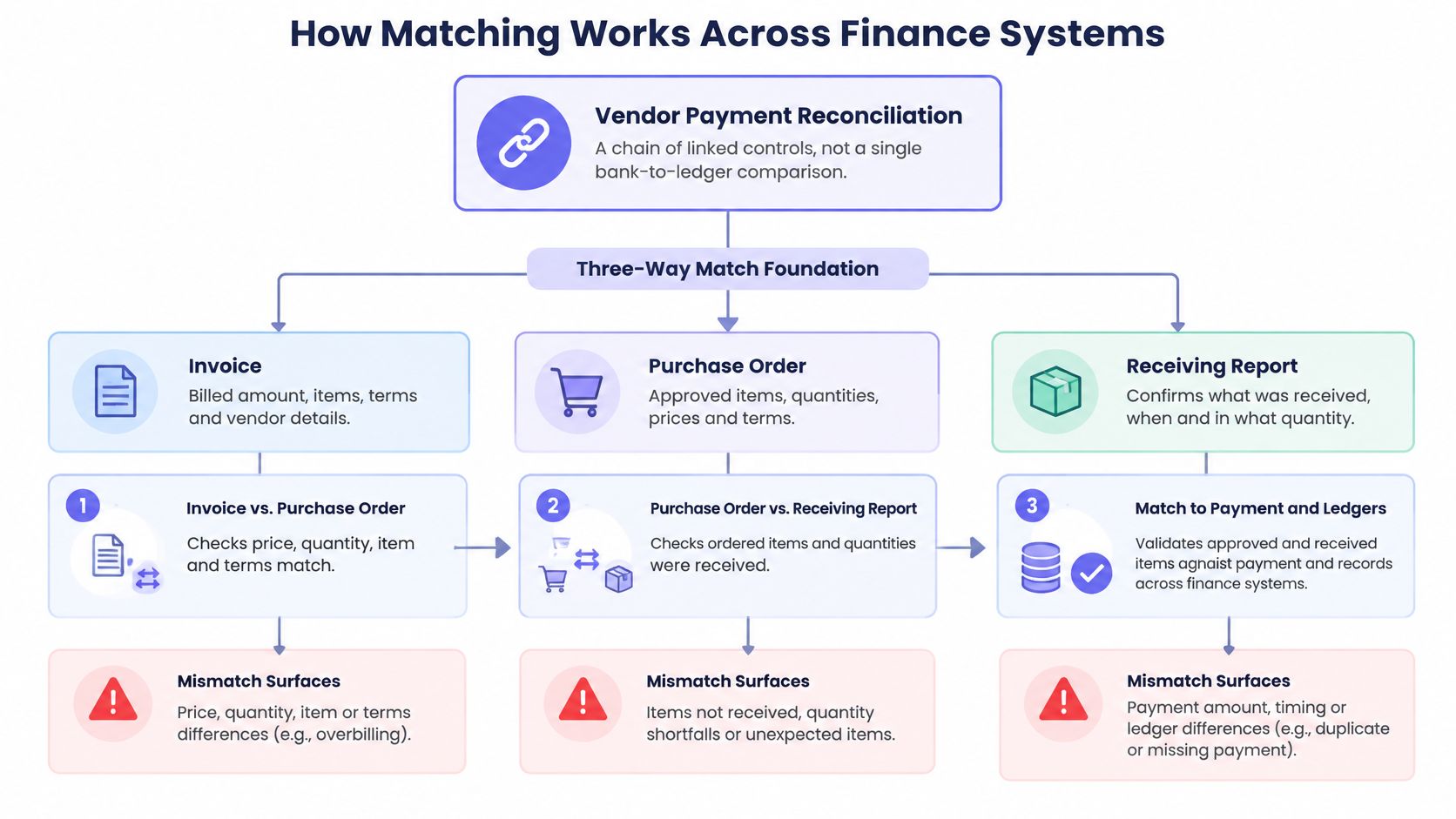
Match, exception, or control break
A match means the records agree according to the organization’s defined rules. An exception is a difference that needs classification or review. An unresolved control break is an exception without an approved, documented disposition.
One-to-one matching isn’t always the right expectation. A supplier may receive a partial payment, or several approved invoices may be settled together. Credits, bank fees, foreign-exchange differences, and timing can also produce legitimate differences. Each requires a clear rule or human review, not an automatic assumption that the records are wrong.
The control should link the invoice, purchase order, receipt evidence, payment instruction, bank-clearing result, and ledger posting, then classify exceptions such as voids, returns, duplicate invoices, and statement disputes. That end-to-end view is easier to maintain when records move consistently between systems. Finance teams evaluating data movement can also review automatic data synchronization across finance systems.
Common Vendor Payment Reconciliation Breakpoints
A payment can be approved and cleared while still failing reconciliation. The usual breakpoints involve data quality, transaction identity, settlement timing, accounting treatment, or differences between systems.
A supplier might appear under slightly different names in the ERP and payment file. An invoice number might be reused or entered inconsistently. A payment may be partial, returned, or recorded in a different currency. A receipt can be missing, or a bank charge can appear without a corresponding ledger entry. In each case, the payment’s existence doesn’t prove that its application is correct.
| Breakpoint | What to inspect | Control response |
|---|---|---|
| Vendor identity differs | Vendor record, bank beneficiary, and entity | Resolve identity differences before matching or changing payment details |
| Invoice number repeats | Vendor, invoice date, amount, currency, and payment status | Flag exact and near matches for review |
| Receipt doesn’t support invoice | Purchase order and receiving evidence | Hold or route the liability for approval |
| Settlement is partial or pending | Payment instruction, clearing status, and open balance | Record the remaining liability or pending status |
| Bank charge or return appears | Bank record, payment reference, and ledger entries | Classify the charge or return and route it for posting |
| Currency or coding differs | Original currency, accounting currency, entity, and account | Apply documented treatment or send for review |
Duplicate prevention needs both pre-payment and post-payment controls. Before payment, suspicious vouchers should be held for examination and approval. The U.S. Government Accountability Office describes pre-certification voucher review and procedures to prevent duplicate disbursements, including identifying vouchers and supporting documents so they aren’t paid again. GAO disbursement-control guidance supports the principle that suspected duplicates belong in a review path, not an automatic release.
Invoice-number checks help, but they aren’t sufficient alone. The Washington State Auditor’s internal-controls checklist notes that systems may flag repeated invoice numbers and dates for a vendor, while detection behavior varies by software. A useful diagnostic asks whether a record is missing, mismatched, or pending settlement. That classification directs investigation to the cause instead of turning every break into spreadsheet cleanup.
Design a Deterministic Reconciliation Pipeline
A deterministic vendor payment reconciliation pipeline normalizes records, applies predefined matching rules, routes ambiguous cases, and records the final accounting result. The pipeline should preserve the evidence and logic behind each decision.
Normalize before matching
Start by standardizing the fields that identify a transaction: vendor identity, invoice number, currency, amount, dates, payment reference, entity, and accounting period. Preserve the original values alongside normalized values. If a vendor’s name or invoice reference is transformed, retain the transformation rule so a reviewer can reproduce the match.
Then define matching stages:
- Exact matching: Match payment ID and amount where the reference is reliable.
- Tolerance-based matching: Apply approved tolerances for known FX or bank-fee differences.
- Temporal matching: Recognize pending settlements that haven’t cleared yet.
- Historical comparison: Flag repeated invoices or changes to vendor banking details for review.
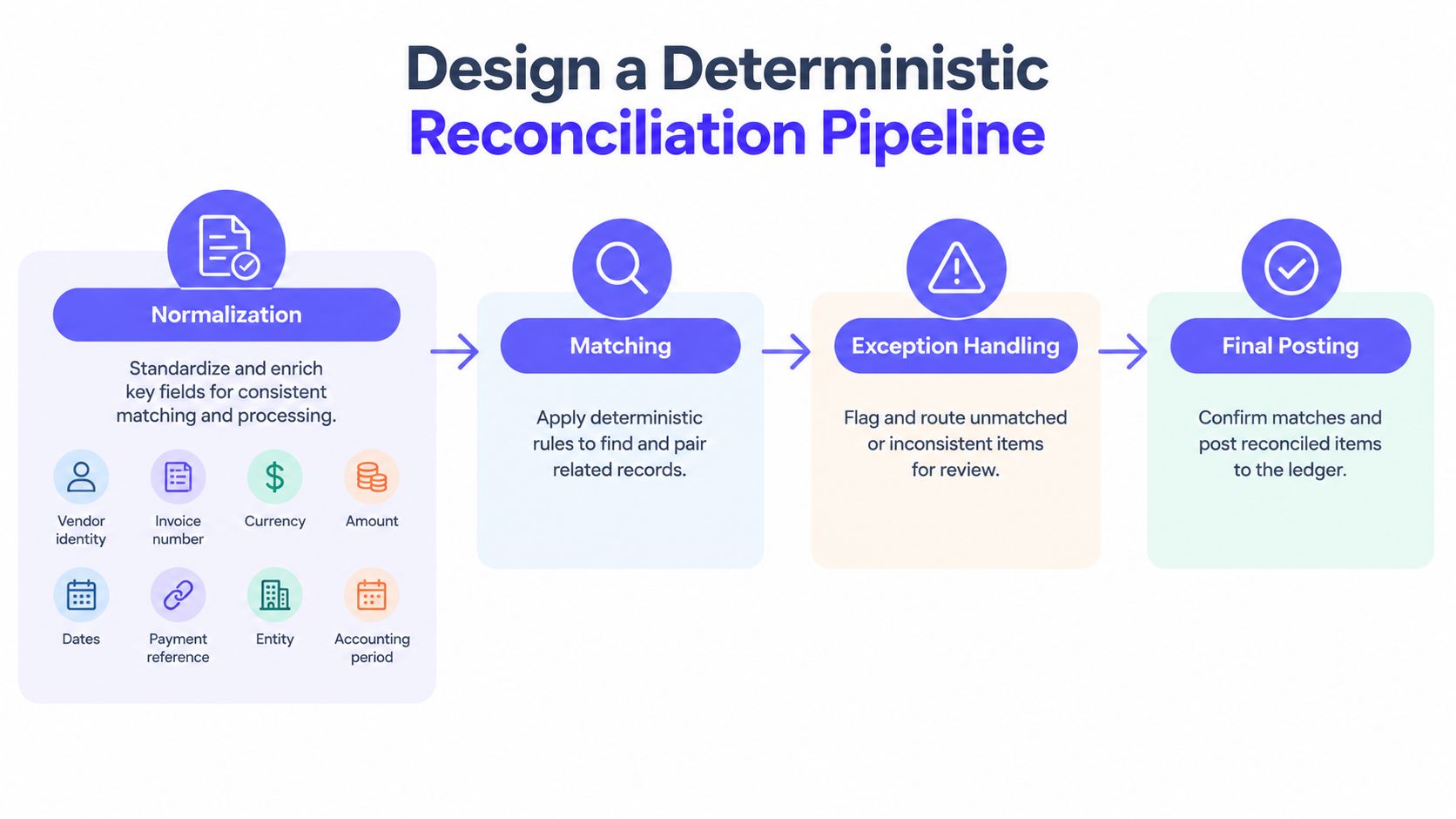
Preserve the run and the decision
An ambiguous match shouldn’t be forced into a positive result just to improve a dashboard. Route it to an accountable owner with the source records, matching criteria, exception type, and available options. Record the reviewer’s decision and any resulting ERP write.
A deterministic run should make its inputs, criteria, decisions, approvals, and writes inspectable. That way, a change to a rule can be reviewed and tested rather than hidden in spreadsheet formulas. Teams comparing practical tools and workflows can consult a reconciliation module for accountants, while assessing whether its process meets their own control and evidence needs.
AI can assist with narrow interpretation tasks, such as extracting fields from documents, but uncertain results need confidence thresholds and human fallback. The final match and posting should follow explicit rules, not an opaque suggestion.
Compare Manual, Rules-Based, and Automated Reconciliation
Manual reconciliation offers flexibility, rules-based reconciliation makes repeatable conditions more consistent, and automation can coordinate work across systems. None removes the need for clear ownership, approval gates, and evidence.
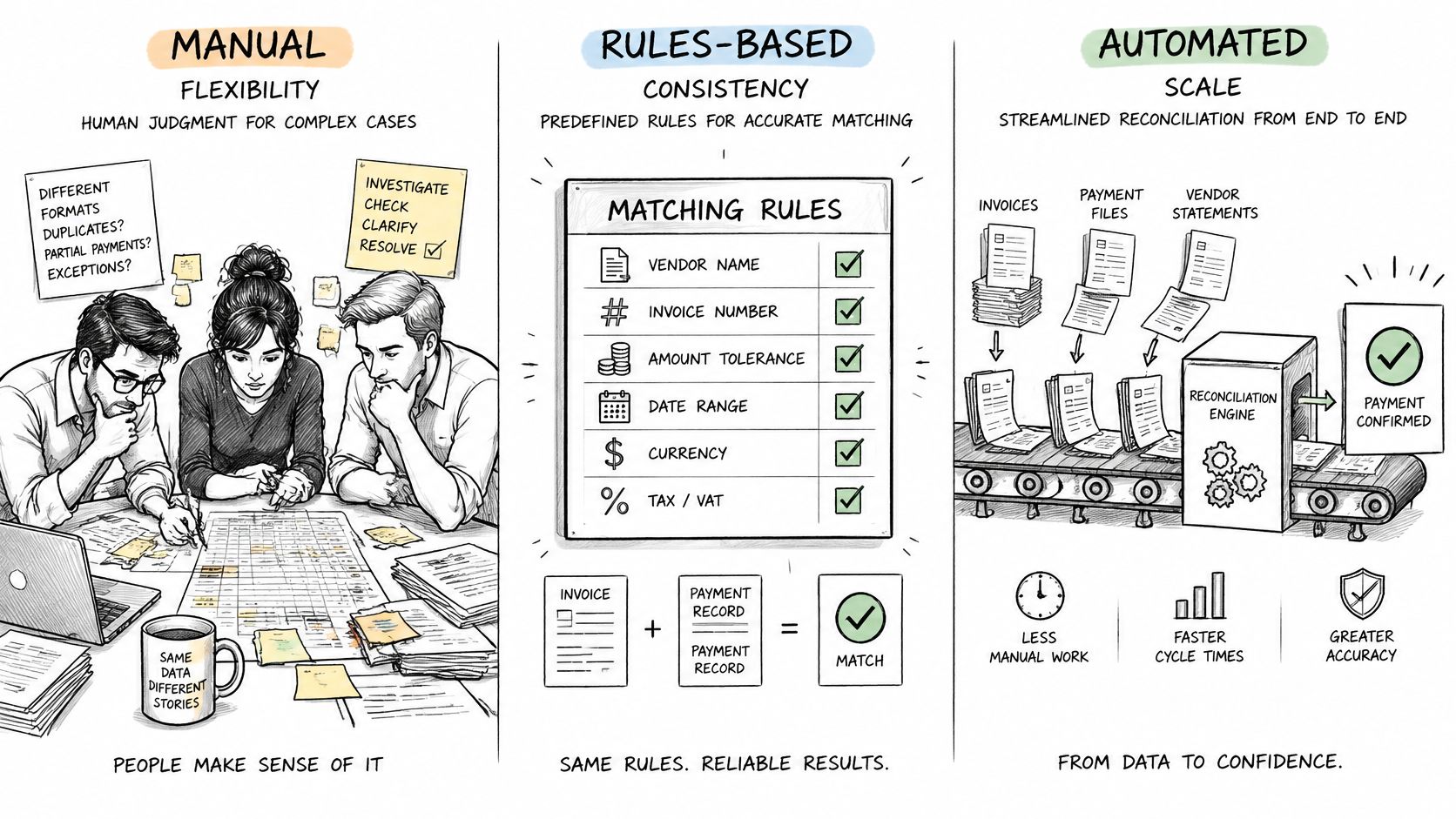
| Approach | Control strength | Evidence | Main limitation |
|---|---|---|---|
| Manual | Flexible for unusual cases | Depends on saved files and reviewer notes | Repeated report pulls and spreadsheet steps are hard to standardize |
| Rules-based | Consistent for stable matching conditions | Rules and results can be documented | Changes in formats or system configuration require maintenance |
| Automation-assisted | Can coordinate repeatable work across connected systems | Strong when each run retains inputs, decisions, and approvals | A black-box result or broad permissions can weaken control |
Your auditors want the reconciliation to hold up when a match is challenged. That requires a clear explanation of the source records, rules applied, exceptions raised, and person who approved any override. A tool that moves records quickly but can’t explain the decision doesn’t resolve that concern.
Loopfour, the deterministic finance workflow automation platform, converts recurring finance operations into predefined, versioned workflows that preserve execution evidence and route exceptions to owners. The choice between manual, rules-based, and automated work depends on transaction volume, exception complexity, system access, audit requirements, and the team’s ability to maintain the control. For a broader look at accounting workflow automation, FastCorp’s overview of accounting workflows offers additional context.
X does manual reconciliation by copying records across systems. Loopfour does deterministic reconciliation by executing governed, inspectable steps instead.
A short demonstration can help finance teams assess how reconciliation workflows are presented in practice:
Build Exception Ownership and Resolution Evidence
The exception queue is often where reconciliation control becomes fragile. Each break needs an owner, a decision path, and evidence that shows how it was resolved.
A 2025 reconciliation survey identified data collection, matching, and exception management as the largest bottlenecks. It also found that 44% of reconciliation errors arose from system-integration problems and human intervention combined (Kani Payments’ 2025 reconciliation survey). That finding makes exception governance central: a match engine can’t compensate for unclear ownership or undocumented manual changes.
Route by risk, not convenience
Assign each exception to a named role or team. Define aging thresholds and approval requirements based on financial risk. A low-risk timing difference may need a documented status and follow-up. A suspected duplicate or changed banking detail may require a hold and additional approval.
The audit record should preserve the original records, matched and unmatched values, the rule applied, reviewer comments, approvals, adjustments, and final sign-off. If a person overrides a match, the evidence should state why the automated outcome was inappropriate and what source records supported the decision. A write-off should include its rationale and approval as well.
Control principle: A near match is still an exception until an authorized person or a predefined rule establishes how it should be treated.
Track unresolved value, mean time to resolution, override rate, and repeat-break rate by entity, vendor, currency, and payment rail. These measures show where breaks accumulate and whether the same cause keeps returning. They’re useful only when each open item has an owner and a clear next action. For related process design, see accounts payable automation workflows.
Apply Governed Workflows Across Entities and Currencies
Global and multi-entity vendor payment reconciliation needs to preserve differences in legal entity, currency, identifier, settlement date, and exchange-rate source. A controlled match may connect several records without forcing every value into a one-to-one relationship.
Suppose a parent company approves an invoice in one currency, while a subsidiary records the liability and a payment provider settles funds through a different channel. The ERP, payment file, bank record, and vendor statement may use different references or dates. Matching only on amount can misstate the result, while matching only on invoice number can connect the wrong entity.
A stronger design assigns a canonical transaction key and keeps both original and normalized values. The record should identify the rate source and effective date. It should also distinguish settlement date from accounting date, so a payment that clears after a period boundary isn’t treated as if it settled earlier.
A 2025 survey reported that 29% of reconciliation difficulty was associated with multiple payment channels and distinct data formats (Tier2 Systems’ discussion of reconciliation costs). In this environment, one-to-one matching may be the wrong target. A controlled many-to-one match can better represent combined payments, partial settlements, credits, fees, or currency effects.
Set the accounting treatment before the break occurs
For each known variance type, specify where the difference belongs. A bank fee may post to bank charges; an approved currency difference may post to realized FX; a cross-entity settlement may require an intercompany account. A temporary suspense balance should have an owner and resolution path, not become a permanent parking place.
Reconcile at entity and currency level before consolidation. That allows the controller to distinguish a legitimate settlement difference from an incorrect entity, duplicate, or other operational signal. The workflow connects ERP, treasury, banking, and vendor records without replacing those systems. For an adjacent control area, review intercompany account reconciliation.
A Practical Reconciliation Implementation Checklist
A $12,400 vendor payment clears the bank, but the ERP shows two invoices still open and the vendor statement shows a credit. The reconciliation control must connect those records, determine whether the difference is valid, and preserve who approved the final treatment. A high match rate alone cannot show that the control worked.
Use this checklist to test the design:
- List the records: Identify the invoice, purchase order, receipt evidence, payment instruction, bank-clearing result, vendor statement, and ledger posting.
- Define transaction identity: Set canonical fields for vendor, invoice, currency, amount, dates, payment reference, entity, and accounting period.
- Specify match behavior: Document exact, tolerance-based, temporal, and historical rules. State which cases require human review.
- Assign exception owners: Name the responsible role, approval threshold, aging expectation, and escalation path for each exception class.
- Connect systems carefully: Link ERP, treasury, banking, and vendor-statement records through controlled connectors. If an API is unavailable, browser automation can support the workflow when permissions are controlled and evidence is retained.
- Retain run evidence: Preserve inputs, outputs, execution trees, rule versions, approvals, exceptions, and resulting system writes.
- Test the control: Include duplicate-payment checks, partial payments, FX differences, pending settlements, and deliberate rule changes. Confirm that each test produces the expected outcome and evidence.
A vendor statement comparison can expose differences that an internal payment match will miss. Compare invoice numbers, dates, amounts, credits, payments, and outstanding balances against AP records. The Washington State Auditor’s Accounts Payable Guide describes this type of review.
Is a bank transaction sufficient evidence of payment?
No. Link the payment instruction, bank-clearing result, AP record, and ledger posting, then treat any gap as an exception with a named owner. This lets a reviewer trace the payment to the right invoice, entity, and period.
How should teams handle partial payments and credits?
Record the amount settled and the remaining liability in AP. Apply credits using documented rules, retain the credit record, and compare the resulting open balance with the vendor statement. If the records do not explain the settlement, assign an owner to investigate the difference.
Where should foreign-exchange variances go when systems use different rates?
Keep the original currency and amount, normalized values, rate source, and effective date together. Apply predefined accounting rules to assign the variance to realized FX, bank charges, AP, an intercompany account, or temporary suspense. A reviewer should approve any case that falls outside the defined treatment.
What should an auditor receive after a human override?
Provide the source records, original match result, rule or tolerance applied, reviewer’s rationale, approval evidence, adjustment, and final posting. That trail should let the auditor reproduce the decision and confirm the exception was resolved, not merely cleared.
A strong control records who owned each exception, why the team chose its treatment, and who approved the final accounting result. The closing review should confirm that unresolved differences remain visible and assigned rather than disappearing from the workflow.