
A sale can create revenue without producing usable cash. The order to cash business process flow is the control chain from a customer order through credit review, fulfillment, invoicing, collections, payment receipt, cash application, and clearing the receivable. Deloitte’s order-to-cash guidance explains why the distinction matters: extended payment terms reduce operating cash, while processing errors can delay payment or prevent collection entirely.
Table of Contents
- The Order to Cash Business Process Flow
- Order Capture Through Collections in Sequence
- Failure Points and Who Owns Each Exception
- Controls and Audit Evidence for Every Step
- Working Capital Metrics That Expose a Slow Flow
- Instrument the Flow With a Deterministic Run
- Questions Finance Teams Still Ask
- What is the order to cash business process flow?
- How is order to cash different from invoice to cash?
- Who owns cash application versus collections?
- What should an auditor sample on an invoice?
- Does sending invoices as files fix late payment?
- Where should a finance team start when AR automation feels risky?
The Order to Cash Business Process Flow
The order to cash business process flow connects commercial commitments to cleared, reconciled cash. Accounts receivable is part of that chain, not its starting point.
The operating sequence below separates the work into stages that a controller can test. System names describe the intended system of record. Each organization should assign a specific application and accountable owner to every row.
Order to cash stages, systems, and evidence
| Stage | What happens | System of record | Evidence to keep | Failure that stops cash |
|---|---|---|---|---|
| Order capture | Commercial terms and the order are recorded | CRM or CPQ | Signed order, price, and PO reference | Wrong price or missing PO |
| Credit review | Limit and risk are checked before release | ERP credit | Approval or credit hold | Shipment against a bad account |
| Fulfillment | Goods or the service are delivered | Order management | Proof of delivery or acceptance | Billing with no delivery evidence |
| Invoicing | The bill is issued from the order and terms | Billing | Invoice version, tax, and currency | Rejected or incomplete invoice |
| Collections | Overdue balance is worked to a promise or dispute | Accounts receivable | Dunning log and owner | Chasing a bill the customer will not pay |
| Cash application | The receipt is matched to open invoices | Bank and accounts receivable | Payment allocation | Unapplied cash |
| Dispute handling | The deduction is investigated and resolved | AR with sales or delivery | Credit note and resolution note | Aging with no owner |
| Reconciliation | Subledger, bank, and general ledger agree | ERP | Tie-out of counts and amounts | Paid item still open on the ledger |
The diagram presents the main path. Disputes and reconciliation controls operate across that path, rather than waiting politely at the end.
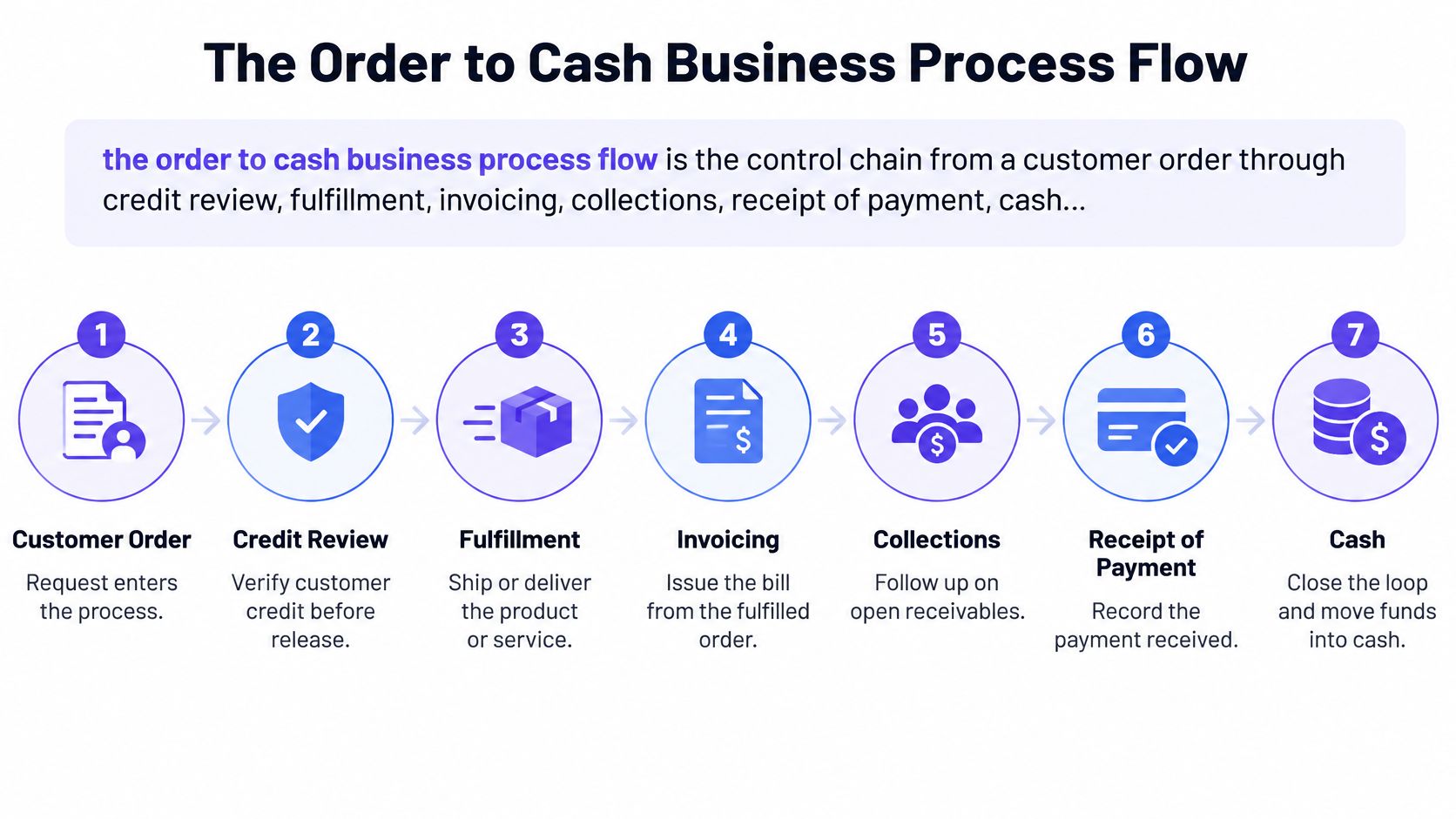
Why the chain is wider than receivables
Order-to-cash performance depends on decisions made before an invoice exists. Sales sets payment terms, operations confirms delivery, and billing translates those records into a collectible balance.
Days sales outstanding, or DSO, is the headline measure of average time from sale to collection. Deloitte’s working-capital indicators also include late-paying customer percentages, invoice volumes, unreconciled items, write-offs, bad-receivable collection rates, and collection-campaign results.
Those measures answer different questions. Invoice volume describes workload. Unreconciled items reveal unfinished accounting. Write-offs show balances that didn’t become cash.
Practical rule: A completed task isn’t a completed control unless its output can be traced to the next system.
Payment receipt also differs from cash application. Money can reach the bank while the corresponding invoice remains open in accounts receivable. The customer has paid, but the accounting record still needs resolution.
A controller can begin with one recent order. Trace its identifiers through the table, including the invoice, receipt, allocation, and ledger entry. Mark the first stage without a timestamp or shared identifier. That gap is the first control question, even when the final balance happens to agree.
Order Capture Through Collections in Sequence
Order capture establishes the rules that fulfillment, billing, and collections must follow. Signed terms should become controlled records, not instructions that each department interprets again.
Consider a hypothetical SaaS order with a pricing tier and a contractual minimum. The expected result is an invoice supported by the agreement, a corresponding receivable, and an expected cash date derived from payment terms. The challenge is preserving that relationship across Salesforce, the billing application, and the ERP.
Order capture establishes the commercial rules
Order capture should preserve the signed contract, customer identity, pricing tier, minimum, discount approval, purchase-order reference, and payment terms. In the order-to-cash cycle, signed contract terms, pricing tiers, and minimums are read once and become the rules the rest of the cycle runs on.
A price stored only in a sales email isn’t a dependable billing rule. The approved value needs a controlled destination, an effective date, and a clear relationship to the order.
Credit review then determines whether the order can proceed under the approved exposure and terms. A credit hold should produce a visible exception, not an unexplained pause between sales and delivery.
Fulfillment supplies the billing evidence
Fulfillment establishes what was delivered or accepted. A shipment confirmation, service acceptance, or usage record should support the billable event.
For the hypothetical SaaS order, billing should distinguish the contractual minimum from usage-based charges. The delivery or usage record must support whichever calculation applies.
Before billing, the operator should check:
- Commercial consistency: The tier and minimum match the approved agreement.
- Delivery support: The relevant service or usage evidence exists.
- Customer readiness: The legal entity, PO reference, tax attributes, and currency are complete.
Billing and collections require accepted records
Billing converts approved terms and fulfillment evidence into an invoice. Sending a PDF doesn’t establish structured invoice acceptance.
The Order-to-Cash Monitor 2026 report covering more than 250 Dutch organizations reported that 11% sent true e-invoices, while 76% still used PDFs; average order-to-payment time reached 59 days, and disputes added 29 days on average. That evidence supports checking acceptance status, not merely confirming that an email left the billing system.
Collections works an outstanding, valid balance through dated follow-up, payment commitments, and dispute routing. A disciplined accounts receivable collection process distinguishes a customer who hasn’t paid from a customer who couldn’t accept the invoice.
The controller should identify which subprocess still requires re-keying: order capture, fulfillment confirmation, billing, or collections. Then test its handoff. An order missing from billing, an unbilled delivery, or a subledger posting missing from the general ledger needs an explicit exception.
Failure Points and Who Owns Each Exception
Order-to-cash improvement should start with the defect that prevents payment, not automatically with more collection reminders. An upstream billing problem remains an upstream billing problem after a collector sends another email.
Research covering more than $8 trillion in anonymized B2B transactions, reported by IBS Intelligence, found that global businesses took an average of 51 days to get paid in 2025: 32 days reflected contractual terms, while 19 days were delays beyond the due date. The finding separates negotiated credit from overdue delay; it doesn’t establish that every overdue day originated upstream.
The operating implication is narrower and useful. A wrong price, missing PO, or delivery dispute should go to the person able to correct it. A collector can coordinate resolution without owning the underlying source record.
Order to cash exceptions and owners
| Failure | Owner | Escalate when | Metric it moves |
|---|---|---|---|
| Missing purchase-order reference | Order management | Before the invoice is sent | Invoice rejection and dispute aging |
| Unauthorized discount or price override | Sales operations with finance approval | At order release | Revenue leakage |
| No fulfillment or acceptance evidence | Fulfillment or delivery owner | Block billing | Unbilled orders and disputes |
| Duplicate or wrong-version invoice | Billing | Before send | Short-pay and credit notes |
| Payment with no matching open item | Cash application | Same day the cash arrives | Unapplied cash |
| Subledger does not tie to the general ledger | Controller | Before close | Completeness risk |
| Contract terms read with low confidence | Revenue accountant | Before the schedule posts | Cutoff and ASC 606 error |
Ownership requires authority to repair the source
An exception owner must be able to change the record that caused the failure. Assigning every unresolved item to accounts receivable creates a queue, not accountability.
Consider a customer disputing a pricing tier. Billing should compare the invoice against the approved terms. Sales operations should resolve an incorrect commercial record, with finance approving any required concession.
The resolution must distinguish correction from concession. Correcting an invoice to the signed price isn’t the same decision as granting a new discount. The accounting evidence should preserve that distinction.
The owner is the person who can fix the source record, not the person who sends the reminder.
Escalation should follow a predefined condition
Exception escalation should depend on the failed control and its operational deadline. Missing delivery evidence should block unsupported billing. A failed ledger tie-out should reach the controller before close.
Each exception record should contain:
- Failure condition: The exact validation or reconciliation that failed.
- Accountable owner: The person authorized to resolve the source issue.
- Required evidence: The document, approval, or corrected record needed for release.
- Resolution status: The action taken and the downstream records affected.
Closing an exception should mean the correction reached every affected system. A resolved support ticket isn’t sufficient when the wrong invoice remains open.
Controls and Audit Evidence for Every Step
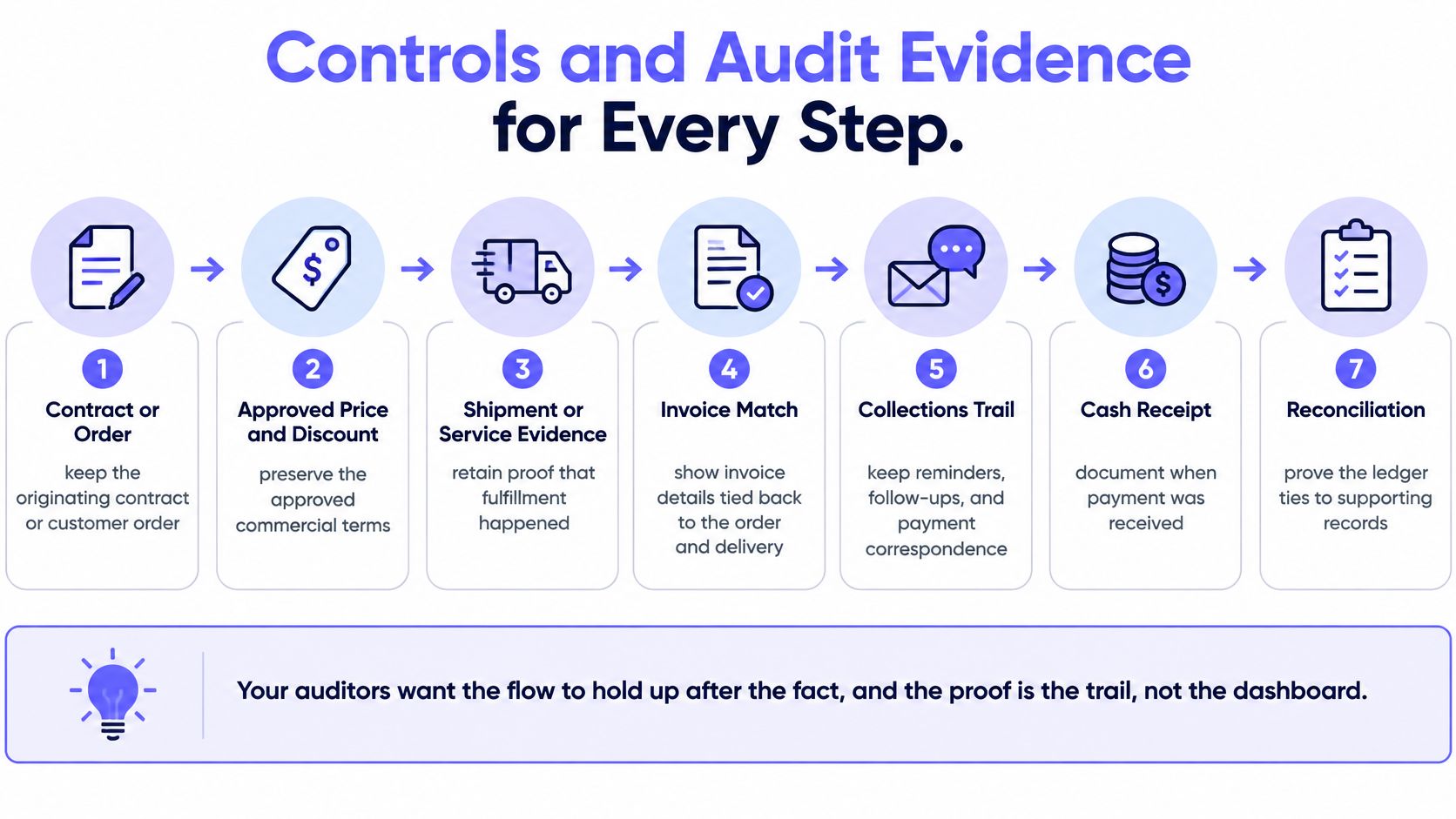
Order-to-cash controls must let auditors reconstruct what happened after the event. A dashboard status isn’t enough; auditors need linked evidence of authorization, execution, and reconciliation.
For each invoice, the control trail should preserve the originating contract or order, approved price and discount, fulfillment evidence, tax and currency attributes, invoice version, payment allocation, credit notes, and revenue treatment. Internal Audit 360’s order-to-cash control guidance also identifies order creation, pricing override, invoice generation, and cash application as high-risk incompatible permissions requiring access testing.
The control checkpoints below show what the evidence must support.
Test actual access and interface completeness
Segregation-of-duties testing should inspect permissions in the ERP, CRM, and billing systems. Organizational charts don’t reveal inherited roles, shared accounts, or integration credentials.
A sound control design separates order creation from cash application. Where staffing prevents full separation, the controller should document an independent review of the incompatible activity.
Interface testing should establish both completeness and accuracy:
- Order to billing: Every billable order produces the required invoice or an explained exception.
- Billing to receivables: Invoice identifiers, counts, and amounts arrive without omission or duplication.
- Subledger to general ledger: Posted totals reconcile, with differences investigated.
- Bank to invoice: Receipts have supported allocations, and unmatched amounts remain visible.
The audit trail process should retain the underlying records, not only a summary that a check passed. In the order-to-cash cycle, the ledger, bank, and invoice are reconciled, and evidence of that agreement is retained.
Revenue review remains a judgment control
Revenue accounting should evaluate contracts under FASB’s ASC 606 model rather than treating an invoice as automatic proof of revenue. The cited audit guidance calls for reviewing performance obligations, variable consideration, principal-versus-agent judgments, and period-end cutoff.
Low-confidence contract interpretation belongs with the revenue accountant before a schedule posts. Missing delivery evidence belongs with the delivery owner. The exception ownership table defines the operational handoff; accounting approval determines whether the resulting treatment is acceptable.
A deterministic run follows predefined steps and retains the input, decision, approver, timestamp, system write, and reconciliation result. Auditors should be able to inspect the applied rule version and understand why a transaction advanced or stopped.
Control test: Another reviewer should be able to reconstruct the posting without relying on the operator’s memory.
The accompanying video provides additional viewing alongside those control checkpoints.
Working Capital Metrics That Expose a Slow Flow
Order-to-cash measurement needs stage-level indicators alongside DSO. DSO describes the overall collection result, but it doesn’t identify the handoff responsible for delay.
A 2025 Hackett Group survey, cited in industry reporting on working-capital performance, found an 18-day DSO gap between top and median performers among the 1,000 largest publicly listed nonfinancial companies in the United States, representing approximately $600 billion in excess working capital held in receivables. The same reporting cites an Intrum study of 8,385 businesses in 20 European countries, where the gap between agreed and actual B2B payment timing widened from 16 days in 2023 to 20 days in 2026.
The comparison makes contractual terms and actual collection timing distinct management questions.
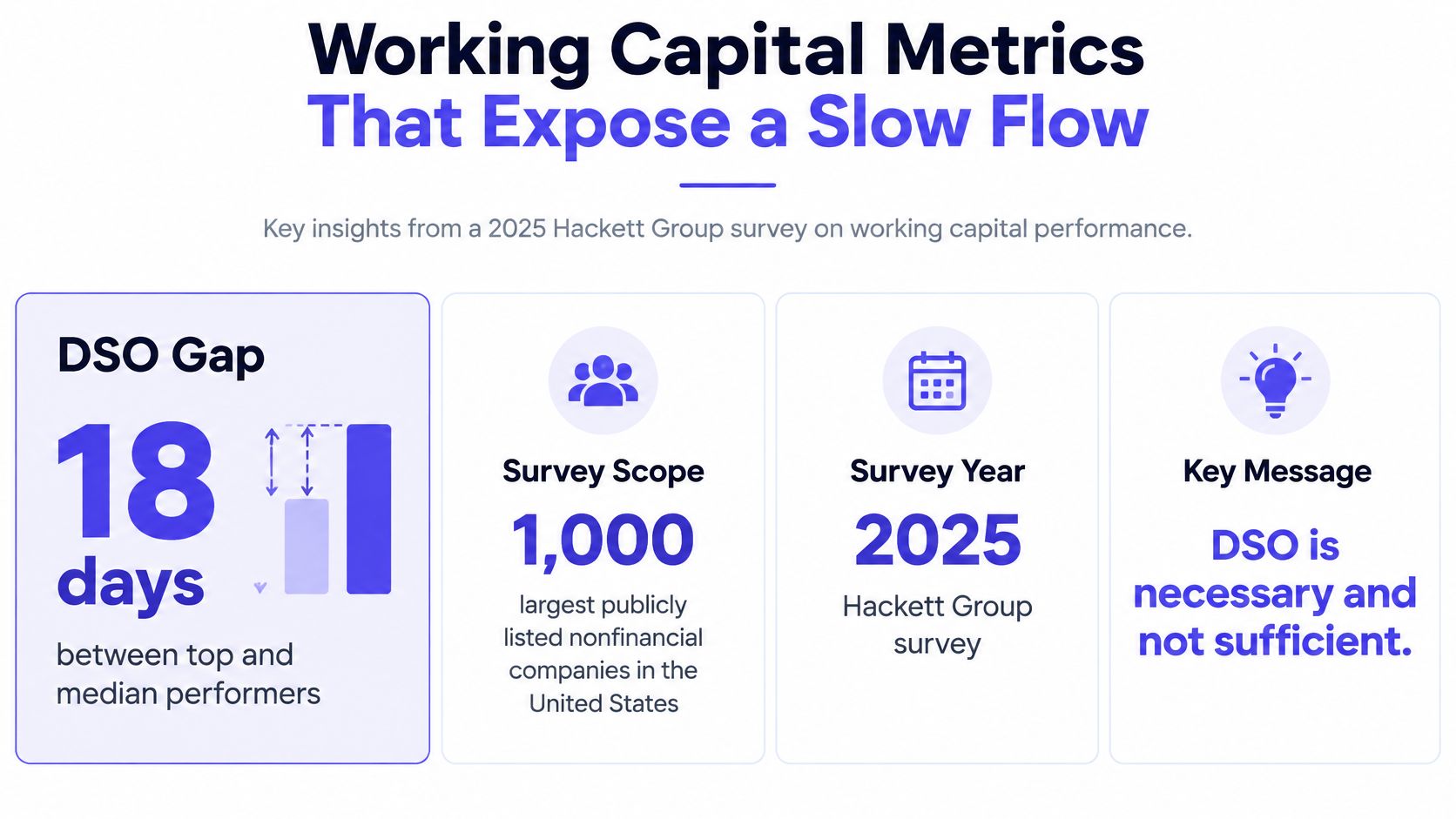
Order to cash measures beyond DSO
| Measure | What it counts | Stage it implicates |
|---|---|---|
| Days sales outstanding | Average time from sale to collection | Whole cycle |
| Order-to-invoice cycle time | Business days from order receipt to a bill | Order capture and billing |
| Invoice accuracy and acceptance | Share of invoices accepted the first time | Billing and master data |
| Dispute aging | Days a deduction stays open | Fulfillment and collections |
| Unapplied cash | Receipts not matched to an open item | Cash application |
| Time from receipt to reconciliation | Days until bank, subledger, and ledger agree | Reconciliation |
| Write-offs and bad-receivable collection | Balances written off and recovery of bad receivables | Credit and collections |
Separate speed, accuracy, and cash measures
Order-to-cash cycle time starts before invoicing. APQC’s Order-to-Cash Performance Assessment defines the cycle across order receipt, delivery, credit processing, invoicing, receivables processing, and collections; it also identifies invoice-to-payment time, staffing per revenue, and adjustment or deduction workload as useful measures.
That distinction changes dashboard design. A fast invoice-to-payment result can coexist with slow billing after delivery. A low unapplied-cash balance can coexist with expensive manual matching.
The operating dashboard should also include overdue balances and collection effectiveness. Those measures help distinguish unresolved overdue exposure from the team’s ability to collect amounts due.
A practical starting set combines a speed measure, an accuracy measure, and a cash measure. Order-to-invoice time, first-pass invoice acceptance, and unapplied cash provide a workable combination.
Metric definitions need fixed timestamps, inclusion rules, and accountable owners. Otherwise, teams can improve the reported number by changing the denominator rather than the process.
Instrument the Flow With a Deterministic Run
A deterministic order-to-cash run executes predefined, versioned rules and retains evidence of each action. For your team, that means automation should make a process inspectable. A posting should never appear without a clear record of how it happened.
According to BillingPlatform’s 2025 State of AR Automation Survey, 80% of surveyed respondents rated accounts-receivable automation as important, a high priority, or critical, while only 3% reported fully automated AR. The figures show a gap between interest and completed automation. They do not explain why implementations remain incomplete.
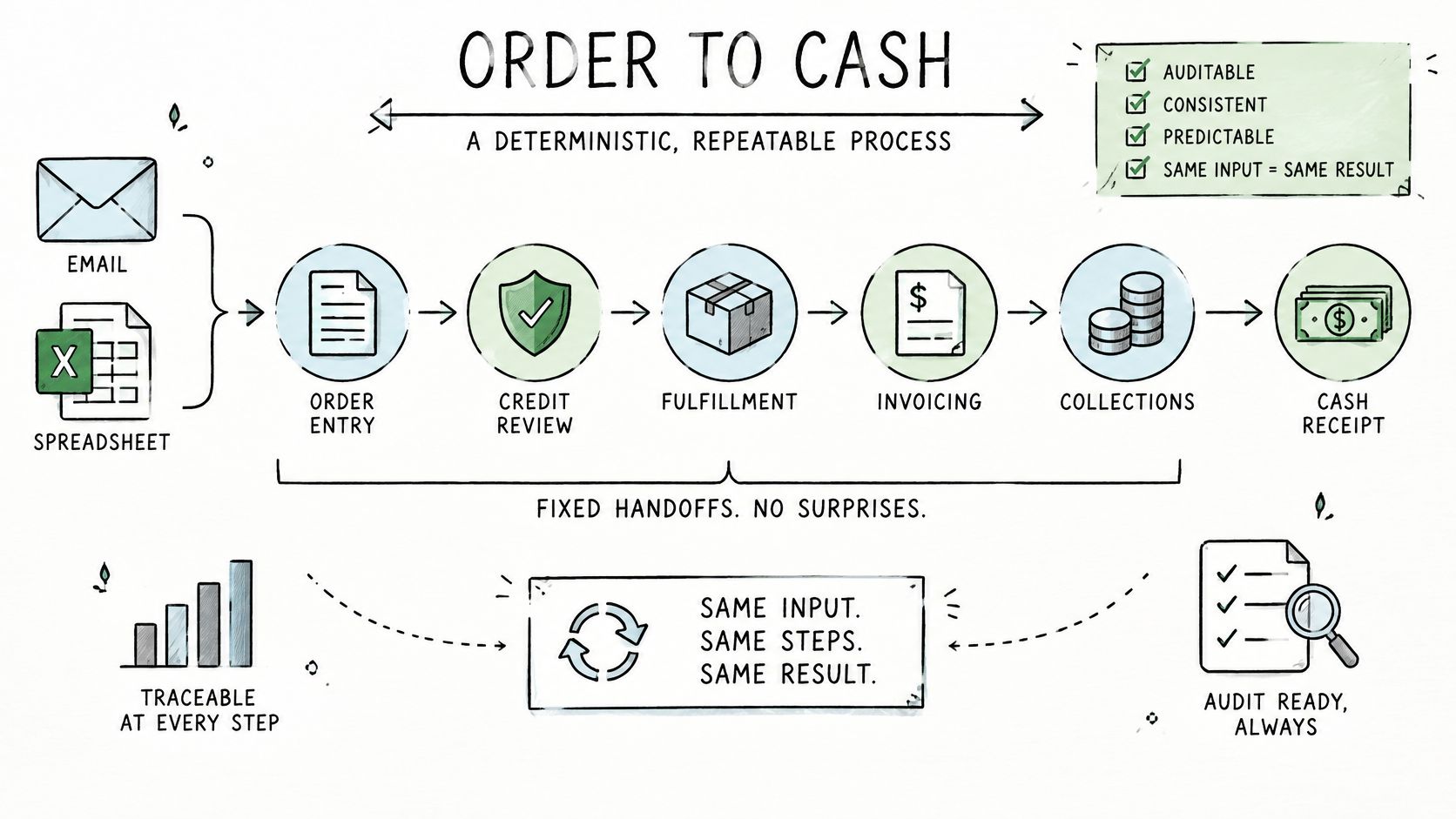
Keep interpretation separate from posting authority
Loopfour runs predefined, versioned finance workflows across the ERP, CRM, billing, and document systems your organization already uses. AI is limited to interpretation tasks, such as document parsing, with confidence thresholds and human review when needed.
A script can perform a step without leaving a dependable execution record. A governed workflow retains the definition used, approvals, system writes, and exceptions, so another person can inspect what happened and why.
Document interpretation may identify a contract term, but the posting should follow approved rules. If an extracted term falls below the confidence threshold, route it for review with the source passage available to the reviewer.
A controlled ERP integration with CRM should preserve shared identifiers across systems. An API response alone does not show that the intended business record reached the correct ledger.
Begin with a workflow that remains manually verifiable
Choose a first workflow your finance team can check by hand. Cash application or a billing batch can be a bounded starting point when inputs and expected outputs are clear.
Use an acceptance test that makes each run inspectable:
- Input and output: Identify the source records and resulting artifacts.
- Rule version: Record which approved definition ran.
- Approval: Show that required reviewers authorized the action.
- System write: Capture destination record identifiers.
- Tie-out: Reconcile counts and monetary totals, or leave an exception open.
Manual work can preserve evidence, and scripts can be governed. The practical test is whether another person can reproduce the reasoning and verify the result.
For an initial cash-application run, have the controller approve matching rules, assign an owner to unmatched payments, and compare proposed allocations with a manual result. Expand posting authority only after the team can verify the run. Its output should be an auditable record, not merely a shorter task list.
Questions Finance Teams Still Ask
Order-to-cash questions usually concern process boundaries, ownership, and acceptable evidence. Clear definitions prevent teams from treating billing, collections, and reconciliation as interchangeable work.
What is the order to cash business process flow?
The order to cash business process flow connects a customer order with credit approval, fulfillment, invoicing, collections, payment application, and receivable clearance. DSO is its headline collection-timing measure, while stage-level measures reveal specific delays.
How is order to cash different from invoice to cash?
Order to cash begins with the customer order. Invoice to cash begins with the invoice, so it doesn’t capture the earlier work of order validation, delivery confirmation, and preparing billable records.
Who owns cash application versus collections?
Collections manages outstanding balances, follow-up, and payment commitments. Cash application matches money already received to open invoices and resolves allocation exceptions; the responsibilities remain distinct even when one team performs both.
What should an auditor sample on an invoice?
An auditor should trace the invoice to its originating order, approved price, fulfillment evidence, invoice version, payment allocation, and general-ledger tie-out. The sample should also show required approvals and explain any correction or exception.
Does sending invoices as files fix late payment?
Sending an invoice file doesn’t establish that the customer accepted a valid bill. Correct terms, required references, delivery support, and acceptance status still need checking before collections treats the balance as ready for payment.
Where should a finance team start when AR automation feels risky?
A finance team should start with a predefined workflow that remains easy to verify manually. The initial scope should include an exception owner, an approval gate, and retained execution evidence before unattended posting expands.
Loopfour offers deterministic finance workflow automation for billing, cash application, and reconciliation on existing systems. Finance teams can visit Loopfour to arrange a workflow review and map a selected order-to-cash process, including its triggers, controls, integrations, and approval loop.