
A bank-reconciliation automation case reduced outstanding transactions by more than 95%, according to Auxis. Reconciliation proves that independently maintained records agree, or documents exactly why they don’t. Useful examples of reconciliation include bank, accounts payable, accounts receivable, payment processor, intercompany, purchase-order matching, payroll, and billing-to-revenue controls.
The important result isn’t a matched total. It’s an auditable explanation connecting source records, reconciling items, approved adjustments, and the final balance. A spreadsheet can balance while missing transactions remain outside its export.
Finance leaders who’ve been burned by automation recognize the fear: a workflow runs successfully, but nobody can explain what it excluded. Their auditors want the control to hold up, not merely finish.
Every reconciliation therefore needs a clear answer to three questions:
- What does the comparison prove? Define the account, transaction population, period, and source records.
- How can the control fail? Identify missing data, timing differences, duplicate transactions, and unsupported judgment.
- What happens after a mismatch? Assign an owner, retain evidence, and document the resolution.
Daily operational matching and period-end account certification serve different purposes. Daily matching catches transaction breaks. Certification establishes that the closing balance has sufficient support. Neither replaces the other.
Table of Contents
- 1. Bank Reconciliation
- 2. Accounts Payable Subledger to General Ledger Reconciliation
- 3. Accounts Receivable Subledger to General Ledger Reconciliation
- 4. Payment Processor Payout Reconciliation
- 5. Intercompany Reconciliation
- 6. Three-Way Match (Purchase Order, Receipt, and Invoice)
- 7. Payroll Register to General Ledger Reconciliation
- 8. Billing-to-Revenue Reconciliation (Contract to Ledger)
- The 8 reconciliation examples at a glance
- Frequently Asked Questions About Reconciliation
- Making Every Reconciliation Auditable by Default
1. Bank Reconciliation
Bank reconciliation compares the general ledger cash balance with the bank statement and explains every difference. The control establishes whether recorded cash is supported by bank activity, after accounting for legitimate timing differences and corrections.

An SEC-filed reporting package expressly calls for a bank reconciliation, or a copy, for each account. That document illustrates why an aggregate cash tie-out isn’t enough: individual accounts need their own support.
Consider a controller matching bank feeds to the general ledger at close. Deposits in transit explain receipts recorded internally but not yet reflected by the bank. Outstanding checks explain payments recorded internally but not yet cleared.
Bank fees and interest require different treatment. If the bank has recorded them but accounting hasn’t, the team needs an approved entry, not a permanent reconciling item.
Make Outstanding Items Accountable
Every bank reconciling item should have an explanation, an age, and a named owner. A timing difference without an expected clearing event becomes an unresolved exception.
- Set the cadence. Reconcile monthly at minimum, with daily matching for high-volume accounts.
- Separate responsibilities. Keep cash recording separate from reconciliation and review.
- Define investigation thresholds. Apply approved materiality rules without ignoring suspicious small transactions.
- Preserve source evidence. Retain statements, extracts, adjustments, and reviewer approval.
Stewart Accounting’s guide to reconcile business bank transactions in ten minutes offers a practical daily routine. Enterprise controls also need account-level ownership and escalation.
Practical rule: A carried-forward difference needs fresh evidence, not a copied explanation.
2. Accounts Payable Subledger to General Ledger Reconciliation
Accounts payable reconciliation confirms that open vendor balances in the AP subledger agree with the general ledger control account. Agreement supports the recorded liability balance, but it doesn’t independently prove that every supplier obligation was captured.
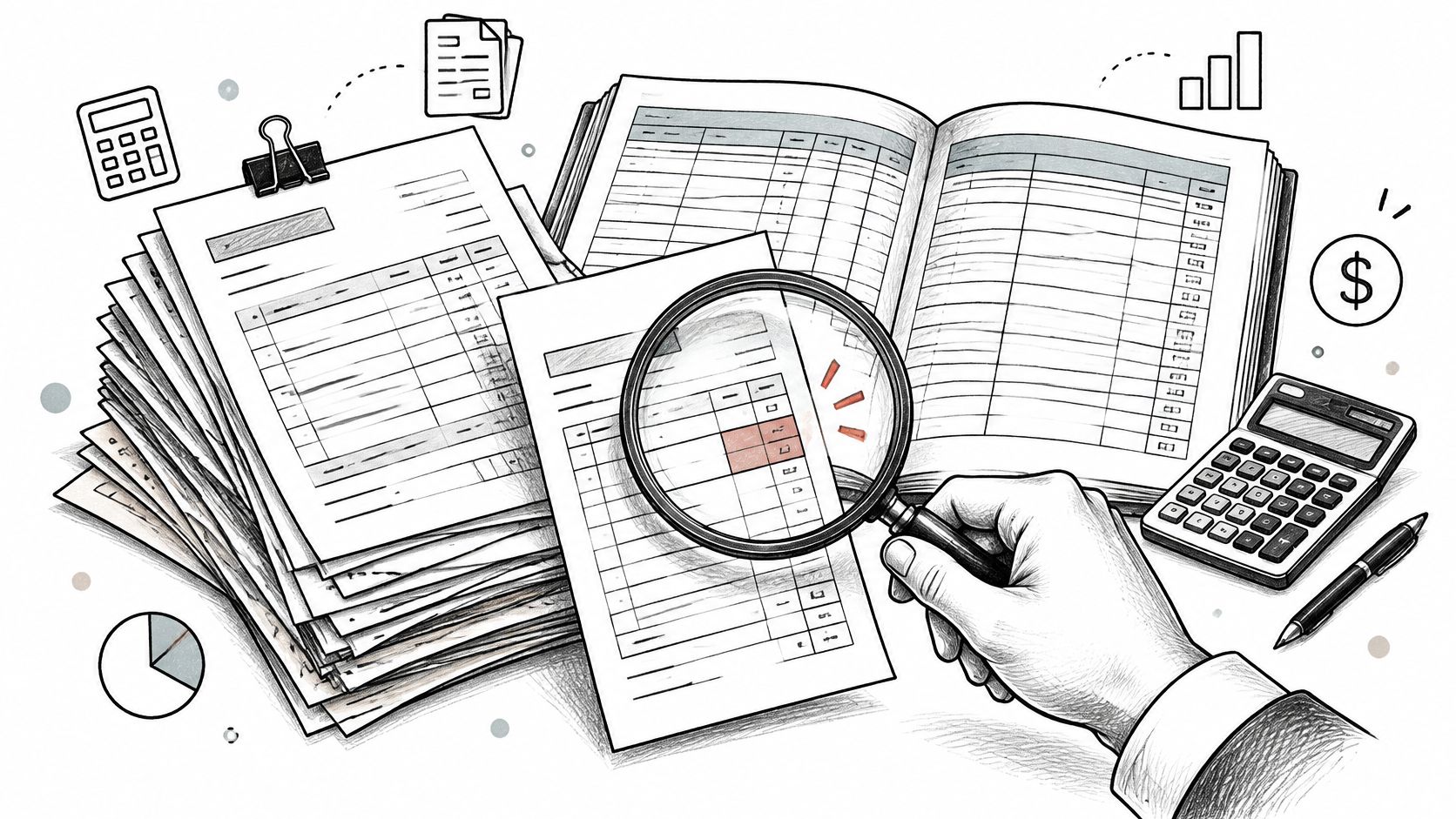
Consider an invoice batch accepted by the AP system but rejected during the ERP posting process. The vendor invoices appear in the aging report, while the corresponding liability never reaches the ledger. Comparing totals identifies the gap; tracing batch identifiers explains it.
A different failure occurs when an accountant posts directly to the AP control account. The ledger changes without a corresponding vendor transaction. Repeated manual corrections can conceal the original integration problem.
The SEC’s discussion of internal controls identifies basic account reconciliations as a financial-reporting control and emphasizes written procedures, delegated responsibility, and periodic checks. Those principles matter more than the spreadsheet layout.
The actionable takeaway is to freeze the comparison population before investigating differences.
- Align the cutoff. Extract the aging report and ledger for the same entity, period, and posting status.
- Separate variance types. Distinguish rejected batches, direct journals, duplicate reversals, and currency differences.
- Require reason codes. Record the cause and supporting document for material exceptions.
- Verify corrections. Confirm that approved entries posted successfully and that rerunning the comparison clears the intended variance.
Automating exports helps. Automating a comparison between inconsistent cutoffs merely produces the wrong answer on schedule.
3. Accounts Receivable Subledger to General Ledger Reconciliation
Accounts receivable reconciliation ties open customer balances to the AR control account in the general ledger. The comparison tests whether invoices, receipts, credit memos, and write-offs moved consistently through the accounting stack.
Consider a distributor receiving a lockbox file. The bank deposit arrives, but some receipts lack usable customer references. Accounting records the cash in an unapplied account while collections still sees the invoices as overdue.
A total-only reconciliation can obscure that problem. The receivable balance may appear plausible while collectors pursue customers who’ve already paid.
Separate cash application from the ledger tie-out. First establish whether billing transactions reached the subledger. Then compare the subledger with the control account, and reconcile unapplied cash separately.
Distinguish Agreement From Collectability
AR reconciliation establishes recorded-balance consistency; it doesn’t establish that every customer will pay. Collections, disputes, and credit-loss assessment require additional judgment.
- Trace billing completeness. Compare invoice identifiers and credit memos across billing and AR.
- Isolate unapplied receipts. Keep unidentified cash visible rather than netting it against unrelated customer balances.
- Inspect manual activity. Review write-offs and direct journals against approval limits.
- Preserve allocations. Retain the explanation when a receipt covers several invoices or only part of an invoice.
A useful exception record names the customer, invoice, payment reference, accounting period, and proposed correction. That record lets another accountant reproduce the decision without reconstructing an email conversation.
A balanced AR control account doesn’t mean the collections queue is correct.
Loopfour’s order-to-cash process reconciles the ledger, bank, and invoice and retains evidence of their agreement. That process distinction matters: successful cash application and a supported closing balance need connected evidence, not separate assertions.
4. Payment Processor Payout Reconciliation
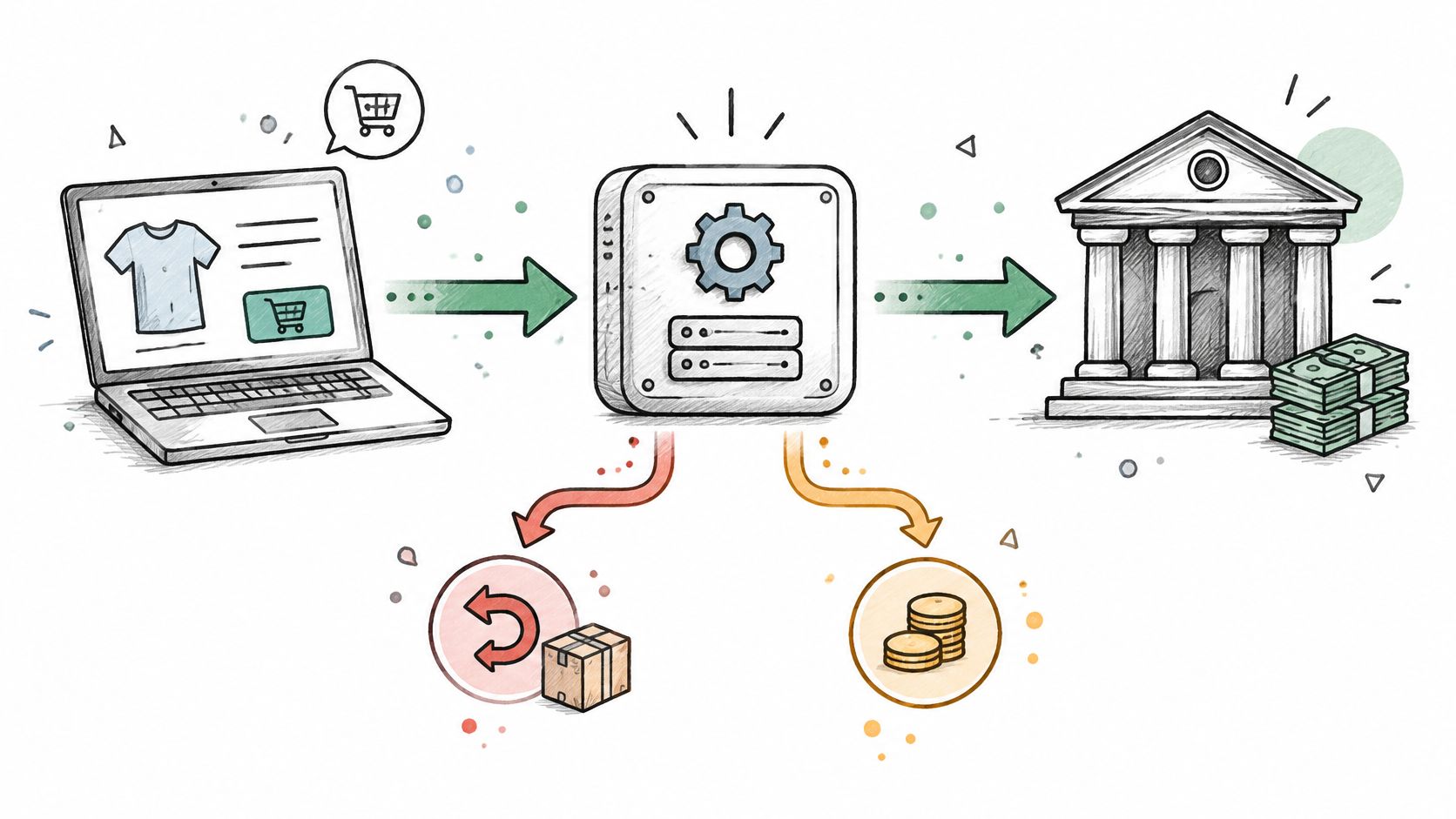
Payment processor reconciliation explains how gross customer activity becomes a net bank payout. It connects charges, refunds, fees, chargebacks, disputes, and settlement timing to the cash received.
In Modern Treasury’s 2025 survey, 23% of U.S. financial decision-makers at companies with 500–9,999 employees reported a high rate of reconciliation errors, according to Modern Treasury. That finding concerns the surveyed companies, not every payment operation.
Consider a marketplace using Stripe. A payout combines customer payments, seller-related adjustments, processor fees, and refunds from different transaction dates. Matching the deposit directly to sales leaves the components unexplained.
Start with the processor’s balance transaction report, not just the payout summary. Preserve the processor transaction identifier through the bank, clearing account, and ledger entries.
- Build the payout bridge. Explain gross activity, deductions, adjustments, and settlement timing.
- Use distinct accounts. Record fees and disputes separately from sales and cash.
- Track expected settlement. Escalate missing or unexpected payouts rather than automatically classifying them as timing.
- Handle currency explicitly. Preserve transaction currency, settlement currency, and the conversion evidence.
A documented payment gateway reconciliation process should explain the exception path as clearly as the matching path.
Loopfour built a matching engine for a fintech payment processor that had outgrown its reconciliation platform. The relevant lesson is architectural: transaction-level traceability must survive growing volume and changing payment flows.
The actionable takeaway is to reconcile the components before certifying the deposit. A matching net amount alone doesn’t prove correct revenue, fees, or seller liabilities.
5. Intercompany Reconciliation
Intercompany reconciliation confirms that related entities record corresponding transactions consistently. Both entities must agree on the balance, currency, period, and underlying transaction before consolidation adjustments are finalized.

An SEC document describing intercompany control failures records a policy requiring monthly reconciliation and balance confirmation between business units. The company lacked a process ensuring consistent performance, and reconciliations were late with frequent, significant differences.
The lesson is specific. A written deadline doesn’t establish that counterparties confirmed their balances.
Consider a shared-services entity billing regional subsidiaries. The service provider records a receivable when it issues the charge. A recipient books the payable later, uses a different currency treatment, or disputes the allocation.
Require Bilateral Confirmation
Intercompany reconciliation needs confirmation from both sides, not unilateral sign-off. A group accountant shouldn’t treat silence from a subsidiary as acceptance.
- Maintain entity mappings. Align counterparty codes, account structures, and transaction identifiers.
- Agree matching rules. Define currency treatment and approved tolerances before close.
- Set resolution ownership. Identify which entity investigates each variance and who approves the correction.
- Control the deadline. Escalate unresolved balances before the consolidation run.
A useful intercompany account reconciliation workflow retains both confirmations and the evidence behind any adjustment. Netting unrelated differences can conceal missing transactions and should not substitute for investigation.
The trade-off is coordination effort. Bilateral confirmation takes longer than accepting a consolidated total, but it preserves accountability at the legal-entity level.
The actionable takeaway is to make confirmation a required approval gate. A matched amount with inconsistent currencies or cutoffs remains a reconciliation failure.
6. Three-Way Match (Purchase Order, Receipt, and Invoice)
Three-way matching compares the purchase order, receipt, and vendor invoice before payment approval. It tests whether the organization ordered the goods or services, received them, and was billed consistently with the approved terms.
Consider a manufacturer receiving a partial shipment. The vendor invoices the full order, but the receiving record supports only the delivered quantity. AP should hold the unsupported portion and route the difference to purchasing or receiving.
A price discrepancy needs a different owner. Purchasing may have approved a contract amendment that never reached the purchase order. Automatically rejecting every difference creates needless holds; automatically accepting every difference removes the control.
The workflow can be visualized as follows.
The actionable takeaway is to define exception policy before automating payment release.
- Set category-specific tolerances. Treat freight, measured commodities, and fixed-price services according to their purchasing terms.
- Validate receipt evidence. For services, require an authorized acceptance record rather than inventing a goods receipt.
- Separate exceptions. Route price issues to purchasing and quantity issues to receiving.
- Check duplicates independently. Matching a valid purchase order doesn’t prove that an invoice hasn’t already been paid.
A governed procure-to-pay automation process should preserve the approval decision and the source documents used.
Control boundary: An absent receipt is missing evidence, not permission to infer delivery.
The strongest match rule is not the strictest rule. It’s the predefined rule that reflects purchasing policy, handles legitimate exceptions, and prevents unsupported release.
7. Payroll Register to General Ledger Reconciliation
Payroll reconciliation confirms that the payroll register agrees with posted wages, employer taxes, deductions, net pay, and related liabilities. Tax liabilities also need a separate tie to filings and payment confirmations.
Consider a services company changing a payroll mapping. The provider calculates payroll correctly, but the integration posts an employer tax component to the wrong liability account. Net pay agrees with the bank, yet the financial statements still contain a classification error.
That example shows why cash agreement alone isn’t enough. Payroll contains expense, liability, deduction, and settlement components that require separate checks.
Reconcile Components Before Close
Payroll reconciliation should finish before the financial close is approved. A later correction can affect both expense reporting and liability support.
- Map each component. Connect payroll codes to approved ledger accounts and legal entities.
- Review changes. Check new deduction codes, tax mappings, and manual adjustments.
- Tie settlement evidence. Connect payroll clearing balances to funding and payment records.
- Retain approval history. Record who authorized off-cycle payments and corrective journals.
Contractor payments and employee payroll should remain distinguishable. Reconciliation can reveal inconsistent posting, but it doesn’t replace the underlying worker-classification assessment.
A useful reconciliation also explains movement from the opening liability to the closing liability. Beginning balances, current payroll, payments, and adjustments should form a reproducible roll-forward.
The actionable takeaway is to reconcile the register by component, not merely by total. Equal totals can conceal offsetting mapping errors.
Sensitive payroll evidence needs controlled access. Reviewers require enough detail to validate the reconciliation, but broad distribution of employee-level files creates unnecessary exposure.
8. Billing-to-Revenue Reconciliation (Contract to Ledger)
Billing-to-revenue reconciliation connects contracts, invoices, deferred revenue, and recognized revenue in the general ledger. It tests whether billing and recognition follow the applicable accounting policy under ASC 606 or IFRS 15.
In a 2025 revenue-accounting survey, 33% of respondents identified reconciliation and revenue recognition as the hardest areas to scale, according to Leapfin. The operational issue is broader than matching invoice totals: contractual changes must reach accounting schedules.
Consider a SaaS business comparing signed renewal documents with CRM and billing records. A renewal may exist in the contract repository without an invoice or updated recognition schedule. A billing-to-ledger comparison alone won’t find that missing population.
A services business faces a different problem. Milestone invoices and revenue recognized as work progresses can legitimately differ. The reconciliation must explain that difference rather than force billing and revenue into equality.
- Trigger amendment reviews. Upgrades, cancellations, and revised terms need accounting assessment when they occur.
- Maintain deferred roll-forwards. Explain opening balances, billings, recognized revenue, and adjustments.
- Link source contracts. Preserve the document supporting each schedule and accounting judgment.
- Separate missing billing from timing. Unbilled contractual activity and valid recognition differences need different resolutions.
Loopfour’s engagements include a healthcare technology company replacing a 4,000-row manual spreadsheet with a deterministic match across pricing, orders, GL, and invoices. An industrial manufacturer replaced manual revenue-recognition workarounds with a pipeline from Epicor to posted, auditable journal entries.
The actionable takeaway is to reconcile the contract population before reconciling accounting outputs. Consistent downstream records don’t prove that upstream contracts were complete.
The 8 reconciliation examples at a glance
| Reconciliation | What It Compares | Primary Risk It Controls | When It Runs | Automation Fit |
|---|---|---|---|---|
| Bank Reconciliation | Bank statement transactions and balances against GL cash entries and balances | Cash errors, duplicate payments, and fraud | Monthly close; daily for high-volume accounts | High for transaction matching and exception routing; review unmatched items |
| Accounts Payable Subledger to General Ledger Reconciliation | Open vendor invoice totals against the GL AP control account | Incomplete or inaccurate liabilities | At period close | High for report comparison and variance identification; review exceptions |
| Accounts Receivable Subledger to General Ledger Reconciliation | Customer aging balances against the GL AR control account | Overstated receivables and billing or cash application errors | At period close; some teams review weekly | High for balance matching and variance tracking; review unapplied cash and exceptions |
| Payment Processor Payout Reconciliation | Processor charges, refunds, fees, and disputes against payouts, bank deposits, and sales records | Unrecorded fees, refunds, disputes, or revenue leakage | During close; often daily for payout matching | High for transaction-level matching and fee categorization; review unmatched payouts |
| Intercompany Reconciliation | Receivables and payables recorded by related entities | Incorrect consolidated balances and eliminations | Monthly, before consolidation | High for entity-pair matching and variance routing; review timing and currency differences |
| Three-Way Match (Purchase Order, Receipt, and Invoice) | Purchase order, receipt, and vendor invoice quantities and prices | Overpayment, duplicate payment, or payment for goods not received | Before payment is released | High for rules-based matching and exception routing; review exceptions |
| Payroll Register to General Ledger Reconciliation | Payroll register totals against GL accounts, tax remittances, and benefit invoices | Misstated payroll expenses or tax liabilities | Before period close and around payroll tax filings | High for totals matching and account checks; review adjustments and tax exceptions |
| Billing-to-Revenue Reconciliation (Contract to Ledger) | Invoices and contract terms against revenue schedules, deferred revenue, and GL postings | Incorrect revenue recognition or missed billing | Monthly, and when contracts are amended | High for schedule comparisons and variance flags; review contract terms and exceptions |
Frequently Asked Questions About Reconciliation
Financial reconciliation compares records and explains differences with evidence. These practical distinctions help finance teams define the control correctly.
What Is a Simple Example of Reconciliation?
Bank reconciliation is a simple example of reconciliation. An accountant compares the bank statement with the ledger, explains outstanding checks and deposits in transit, and records missing fees.
Does a Matching Balance Mean an Account Is Reconciled?
A matching balance isn’t sufficient evidence of a completed reconciliation. The accountant must also verify the source population, cutoff, reconciling items, and review approval.
How Often Should Finance Teams Reconcile Accounts?
Finance teams should choose reconciliation frequency according to transaction volume, risk, and reporting deadlines. High-volume cash activity benefits from daily matching, while closing balances still need period-end certification.
Can Automation Resolve Every Reconciliation Exception?
Automation can’t responsibly resolve every ambiguous exception. Deterministic rules can clear supported matches, but uncertain allocations, missing documents, and accounting judgments need authorized human decisions.
What Evidence Should a Reconciliation Retain?
A reconciliation should retain source records, extraction parameters, matching rules, exceptions, adjustments, and approval history. Another accountant should be able to reproduce the conclusion without relying on the preparer’s memory.
Making Every Reconciliation Auditable by Default
An auditable reconciliation connects source records to an approved accounting conclusion. Across the examples above, common failure points include incomplete populations, inconsistent cutoffs, unsupported adjustments, and exceptions without clear owners.
Cross-team dependencies can delay closing. Reconciliation therefore needs clear ownership and escalation as well as sound matching rules.
A deterministic control starts before matching. The workflow validates source availability, defines the comparison scope, and records extraction parameters. It applies predefined rules, separates uncertain items, and requires approval when policy calls for judgment.
The evidence package should preserve:
- Inputs and scope. Source files, reporting periods, entities, accounts, and extraction criteria.
- Execution history. Rule versions, processing results, rejected records, and system writes.
- Exception decisions. Assigned owners, supporting documents, approvals, and explanations for unresolved items.
- Final certification. The supported balance, approved adjustments, and reviewer sign-off.
Cloudvara’s guide to audit trails offers further context on recording activity history. For finance controls, the practical test is reproducibility: another reviewer should be able to establish what happened and why.
Black-box matching obscures how a decision was reached. Loopfour implements governed finance workflows on existing ERP, CRM, billing, and document systems, routes exceptions to owners, and retains execution evidence to support SOC 1 control audits. Its workflows run as deterministic, auditable code rather than black-box AI.
That approach does not remove accounting judgment or guarantee an audit outcome. It makes decisions visible and execution inspectable. Trust automation only when finance can explain the matches it cleared and the exceptions it held.
Loopfour offers a 45-minute workflow review covering reconciliation, cash application, billing, or another process the customer chooses. The customer leaves with a scoped plan for running it on their stack. Finance leaders can visit Loopfour to review source records, exception ownership, approval gates, and audit-evidence requirements.