
A payment gateway reconciliation process shouldn’t end when a gateway marks a transaction as successful or when a payout appears on a bank statement. The reliable process models authorization, capture, settlement, payout, bank posting, refunds, chargebacks, fees, reserves, and general-ledger entries as separate states, then proves how those states connect.
The popular advice is simple: export the gateway report, compare it with the bank, and investigate the differences. That approach fails when one payout contains multiple transactions, deductions are netted together, or a valid authorization hasn’t settled yet. Your auditors want the process to hold up after the spreadsheet owner leaves, not merely produce a reassuring match rate today.
Table of Contents
- Redefining the Payment Gateway Reconciliation Process
- Executing a Deterministic Three-Way Match
- Decomposing Payout Deductions and Chargebacks
- Modeling Transaction States and Timing Differences
- Automating Exceptions with Governed Execution
- Answers to Common Reconciliation Questions
- How should a manually created payment gateway payout be reconciled?
- What is the difference between balance reconciliation and payout reconciliation?
- How should a cross-period settlement be treated?
- What evidence do auditors expect from a payment gateway reconciliation process?
- How should fees and deductions be validated?
- When should payout data be retrieved?
Redefining the Payment Gateway Reconciliation Process
A payment gateway reconciliation process is a multi-dimensional settlement-control discipline. It matches internal order and billing records with processor, card-network, acquirer, bank, and general-ledger records across transaction states and accounting dates.
A matched gateway export isn’t proof of cash receipt. An authorization confirms that a payment method was approved. Capture records the merchant’s request to take the funds. Settlement moves the obligation through the processor’s clearing process. Payout transfers available funds to a bank account. Bank posting records the credit in the merchant’s account. A refund, dispute, fee, reserve, or reversal can alter the final amount at any stage.
The Bank for International Settlements payment-system framework provides useful structural context. The BIS began collecting payment-system statistics annually for the G10 in 1988, later expanding coverage to members of the Committee on Payments and Market Infrastructures. That framework covers payment instruments, payment systems, and clearing and settlement infrastructures. The implication is practical: payment activity has always crossed institutional boundaries, so the gateway report can’t serve as the entire accounting record.
What the control must prove
A sound process compares more than transaction IDs. It should test the following dimensions:
| Dimension | Control question |
|---|---|
| Identity | Does the merchant reference connect the order, processor event, payout, and ledger entry? |
| State | Was the payment authorized, captured, settled, refunded, reversed, or disputed? |
| Amount | Do gross activity, deductions, and expected net agree? |
| Currency | Does the currency match across the internal ledger, processor, payout, and bank? |
| Timing | Are transaction, settlement, payout, bank-value, and GL-posting dates separated? |
| Deductions | Are fees, refunds, chargebacks, reserves, and adjustments independently supported? |
| Cash | Does the expected payout match the bank credit by amount, currency, account, value date, and processor reference? |
A successful authorization is therefore not equivalent to revenue realized or cash received. Funds may settle later, split across deposits, or arrive net of fees and disputes. Global operations add entities, currencies, time zones, settlement calendars, and payment methods to the control surface.
Practical rule: Reconcile the lifecycle and the settlement evidence, not just the payment identifier.
A spreadsheet can display the evidence, but a spreadsheet doesn’t define the state model. The accounting consequence matters as much as the match. Revenue, receivables, cash, processor-fee expense, refunds, and reserves need reliable posting logic. A controller looking for an auditable payment reconciliation process should therefore ask whether every conclusion can be reproduced from retained source records and predefined rules.
Executing a Deterministic Three-Way Match
A deterministic payment gateway reconciliation process compares the internal sales or billing ledger, the processor settlement report, and the bank statement. The sequence matters because transaction activity and cash movement occur on different timelines.
The three-way match works best when each payout becomes a certified accounting object. A payout summary should show gross activity, every deduction, expected net, bank receipt, GL posting, match status, and evidence links. The method below follows the strict sequence described in settlement reconciliation guidance.
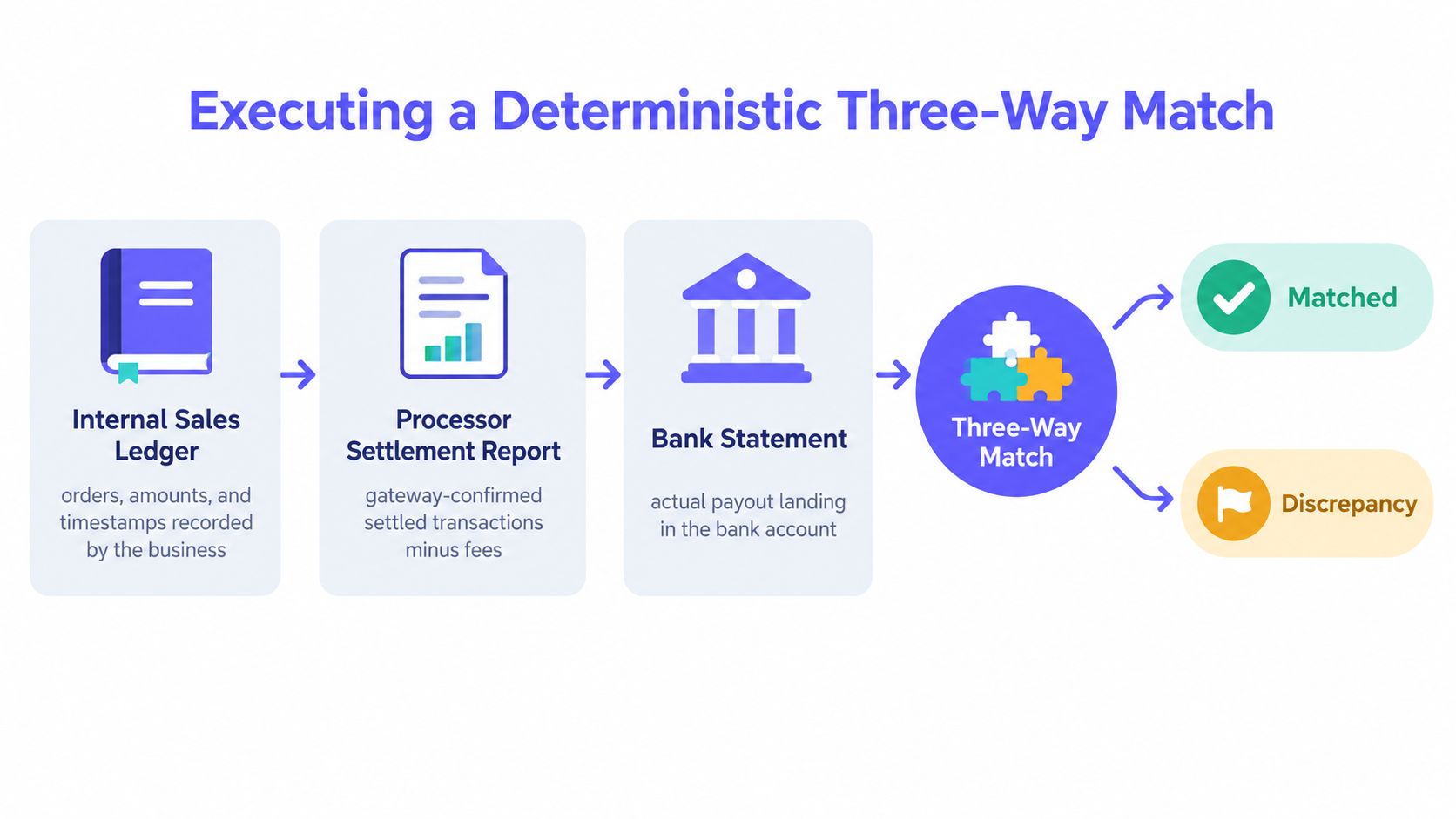
The matching sequence
-
Extract the same settlement window. Pull transaction, settlement, fee, refund, chargeback, reserve, and adjustment records for the processor-defined window. Source files and API payloads should remain immutable.
-
Normalize the keys. Standardize payment IDs, merchant references, currencies, settlement dates, batch IDs, and payout IDs. A stable merchant-generated reference should travel from the gateway request into the settlement output.
-
Group by processor batch. Build the processor’s settlement batches before comparing them with the bank. A payment-level match alone can’t explain how several records form one deposit.
-
Match gross activity. Compare captured amounts in the internal ledger with processor-reported gross settlement. Don’t net fees or refunds into this first test.
-
Validate deductions separately. Test processing fees, refunds, reversals, chargebacks, reserves, and adjustments against their own source fields and accounting treatment.
-
Calculate expected net. Use gross settlement less validated deductions. The result is the amount the bank should receive for that payout.
-
Match the bank credit. Test amount, currency, account, value date, and processor reference. A bank credit that differs from expected net is an exception, even if every underlying transaction appears matched.
-
Post or validate the GL entry. Confirm that the clearing account, cash, revenue, fee expense, refund liability, reserve, and dispute accounts receive the intended entries.
Settlement date should drive the reconciliation window, not transaction date. Payout timing can span multiple days, including a T+2 schedule, so a transaction dated at month-end may belong to a later bank credit and GL posting.
A practical certified row might contain:
- Payout identity: processor payout ID, merchant account, entity, currency, and settlement window.
- Activity totals: transaction count and gross captured amount.
- Deductions: fees, refunds, chargebacks, reserves, and other adjustments.
- Funding result: expected net, bank-confirmed net, value date, and bank reference.
- Control status: matched or exception, aging, owner, resolution, and evidence links.
Teams building integrations can use a technical reconciliation API reference to shape payloads and matching fields. The implementation should still preserve business rules outside the connector. An API can transport records reliably, but it doesn’t decide whether a cross-period settlement is pending or whether a fee variance belongs to finance operations, procurement, or the processor.
Decomposing Payout Deductions and Chargebacks
The difficult unit of reconciliation is often the deduction, not the payment. A payout can contain processing fees, refunds, chargebacks, taxes, foreign-exchange effects, rolling reserves, and other adjustments, so successful transaction matching can coexist with an incorrect net deposit.
The accounting bridge should explain how gross sales became funded cash. Each deduction needs a category, source evidence, account owner, tolerance rule, and posting destination. A processor report that shows only one net figure forces the controller to accept an unexplained reduction. That is not reconciliation. It is a balance acknowledgement.
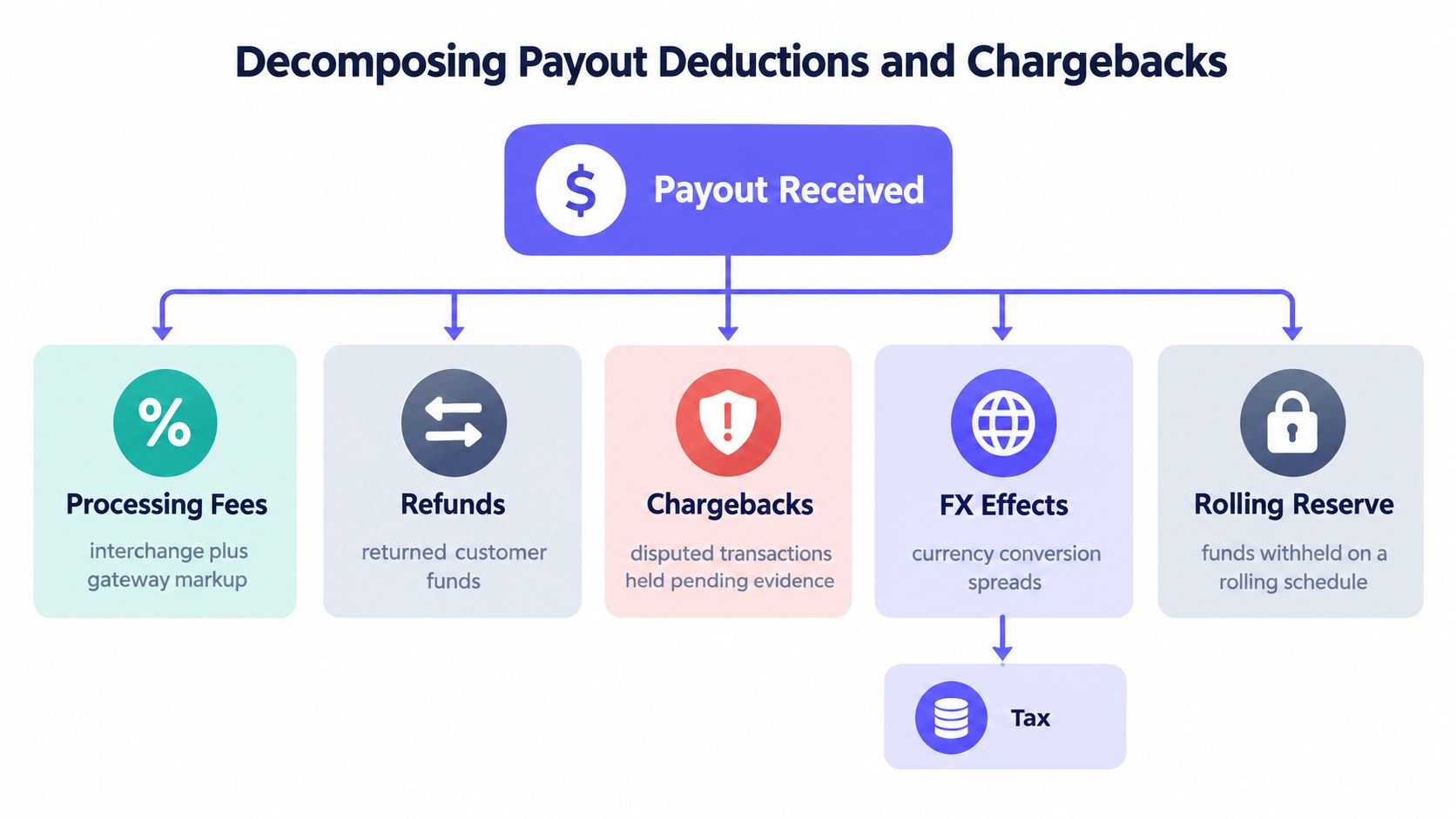
The deduction taxonomy
| Deduction | Required evidence | Typical accounting question |
|---|---|---|
| Processing fee | Processor fee detail and contracted pricing | Does the actual deduction agree with the agreed pricing model? |
| Refund | Original payment reference and refund event | Was customer liability reduced in the correct period? |
| Chargeback | Dispute record, case status, fee, and liability outcome | Which receivable, revenue, reserve, or expense account carries the loss? |
| Tax | Processor tax detail and applicable entity treatment | Was the deduction posted to the correct tax account? |
| FX effect | Currency, conversion rate, and funded currency | Is the difference a processing deduction or FX gain or loss? |
| Rolling reserve | Withholding event and release schedule | When does the reserve become available, and where is it recorded? |
| Adjustment | Processor explanation and approval | Is the item valid, duplicated, or unexplained? |
A deterministic bridge prevents a common failure mode. The transaction matches the internal order, the payout matches the bank, and the books still misstate fee expense or refund liability because the processor netted deductions without independent validation. The team needs a gross-to-net schedule, not merely a deposit tie-out.
Chargebacks require delayed-state controls
Chargebacks can reverse or adjust a transaction after the original payment appears settled. A Federal Reserve Bank of Kansas City study using processor data covering more than 20% of U.S. signature-based card transactions found that Visa and Mastercard merchants received, on average, 1.6 basis points of chargebacks by transaction count, with roughly 70% to 80% ultimately resolved as merchant liability. The Kansas City Fed study also reports higher chargeback and fraud rates for card-not-present transactions than for card-present transactions.
The original capture therefore needs a durable relationship with later dispute, representment, fee, and liability events. Controls should include:
- Aging rules: Separate newly opened disputes from stale unresolved cases.
- Duplicate detection: Prevent the same chargeback or adjustment from posting twice.
- Status-transition checks: Reject impossible movements, such as a closed dispute reopening without a new event.
- Owner routing: Assign evidence collection and approval to a named team.
- Accounting linkage: Connect the final outcome to customer balance, receivable, revenue, cash, or reserve.
Teams handling disputes can also review operational guidance on how to combat chargebacks effectively, but dispute strategy doesn’t replace accounting linkage. The reconciliation record must show the original event, the later adjustment, the evidence, and the final disposition. A controller seeking a deeper accounting definition can use what a chargeback means in accounting as a related reference.
Modeling Transaction States and Timing Differences
Payment reconciliation is a timing-and-state problem, not merely a matching problem. A valid transaction can be absent from the bank because authorization, capture, settlement, payout, and bank posting occur at different times.
The state model should preserve separate dates for:
| Date | Meaning |
|---|---|
| Transaction date | The customer payment or order event |
| Capture date | The processor instruction to take funds |
| Settlement date | The processor’s settlement recognition |
| Payout date | The transfer from available processor balance |
| Bank-value date | The date the bank recognizes the credit |
| GL-posting date | The accounting entry date |
A date-and-state matrix makes cutoff decisions explainable. A captured payment near period-end may be valid but remain in a clearing account until settlement. A refund may relate to an earlier sale but require a current-period adjustment. A chargeback may arrive after the original payout and reopen the economic history of a settled transaction.
Timing differences need controlled aging
The process should classify open items before anyone forces a match. Useful categories include:
- Pending capture
- Cross-period settlement
- Reversal
- Refund
- Chargeback
- Fee variance
- Reserve
- Bank timing difference
- Unexplained exception
Each category needs a cutoff rule, an expected next event, an owner, and an escalation condition. That design prevents a high auto-match percentage from becoming a control weakness. Matching a transaction before its settlement state is final can hide a missing payout or duplicate posting.
Stripe states that automatic payouts can transfer funds from available balance to a bank account and include funds from multiple transactions, which requires a batch-to-bank match rather than a one-to-one payment match. The Stripe payout reconciliation documentation describes the payout ID as the practical route to the BalanceTransactions included in a deposit.
Control principle: A transaction can be valid, complete, and still not be bank-funded in the same accounting period.
Asynchronous events make disciplined ingestion essential. Webhooks should trigger retrieval and processing, while the workflow retains the event identifier, source payload, processing run, and reconciliation result. A team reviewing automatic data synchronization should evaluate whether the synchronization preserves state history, rather than merely copying the latest status.
Cash forecasting also benefits from this separation. Finance leaders considering methods for managing cash flow gaps need expected settlement schedules and reserve visibility, not just authorization totals. The bank balance is backward-looking. The state matrix explains what has been earned, what is clearing, what is funded, and what remains exposed.
Automating Exceptions with Governed Execution
Manual reconciliation relies on spreadsheet formulas and analyst judgment. Those mechanisms can produce a result, but they often fail to preserve why a match was accepted, which rule applied, who approved an adjustment, and what changed afterward.
Probabilistic AI guessing is the wrong control for a skeptical controller. An AI Copilot may help interpret a document or suggest a classification, but the posting decision should follow predefined, versioned, deterministic rules with human fallback when confidence is insufficient.
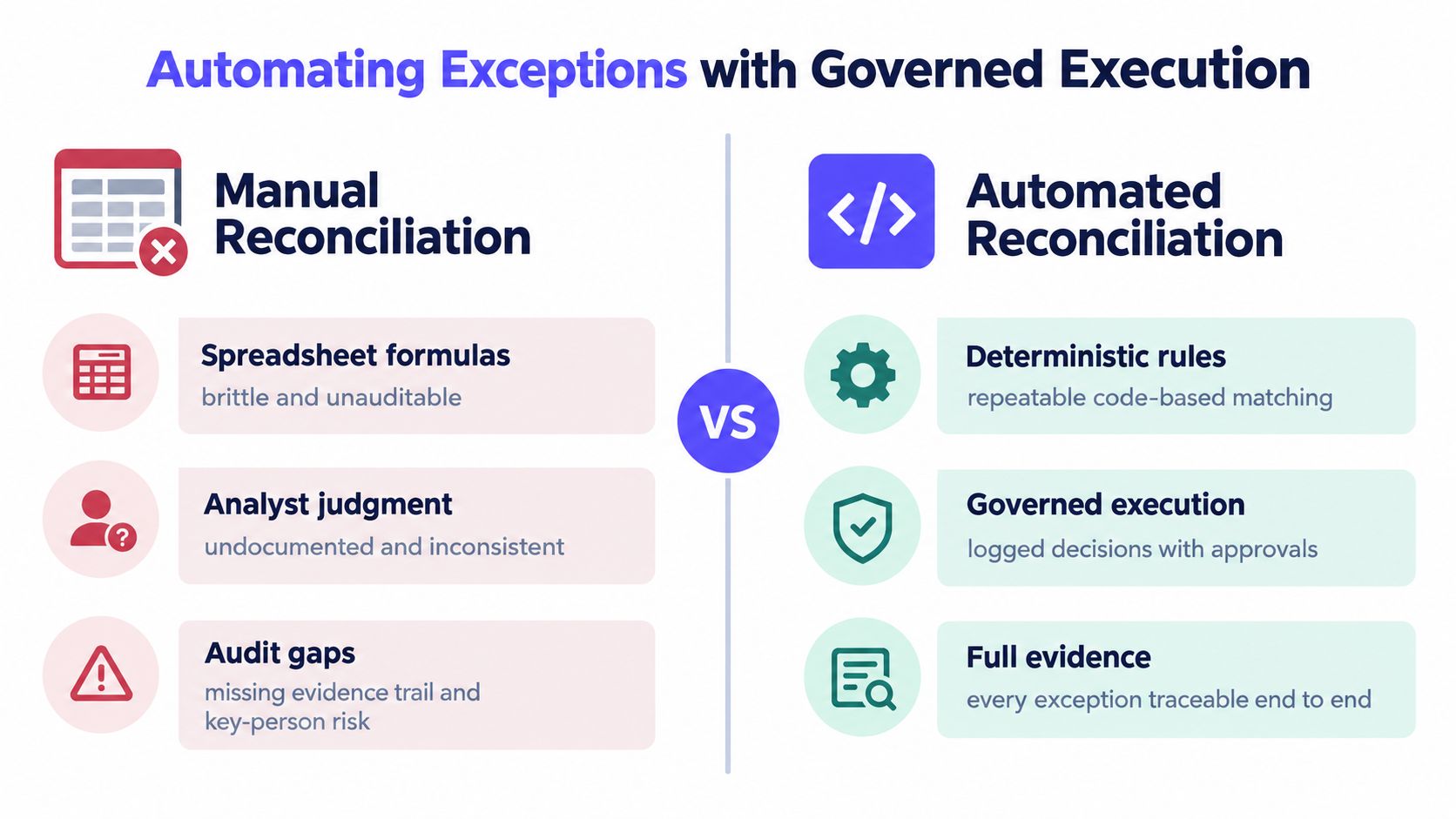
What governed execution records
Loopfour, the deterministic finance workflow automation platform, runs finance workflows as programmatic steps across existing ERP, billing, bank, and payment tools. Loopfour Studio can preserve execution trees, source identifiers, timestamps, rule versions, approvals, exceptions, and downstream ERP writes. The design is finance workflow automation and FinOps infrastructure, not an autonomous agent making undocumented accounting judgments.
A governed payment gateway reconciliation process should retain:
| Evidence | Why controllers need it |
|---|---|
| Immutable source file or API payload | Proves what the processor supplied |
| Run identifier | Connects records to one execution |
| Rule version | Shows which matching logic was active |
| Match decision | Explains why records were accepted |
| Exception classification | Identifies the break type |
| Approval record | Proves human disposition where required |
| Correction entry | Links the fix to the source exception |
| ERP write result | Confirms downstream posting |
| Change history | Shows later rule or workflow changes |
The workflow can route unresolved items to owners through Slack, Microsoft Teams, or email. That routing is useful only when the exception retains its evidence and when approval gates prevent unreviewed postings. Browser automation can support legacy systems without APIs, provided the session, permissions, and resulting writes remain logged.
Speed matters, but evidence comes first
One operational guideline reports that discrepancies are approximately 10 times easier to resolve when identified within three days, a practical heuristic rather than a universal industry benchmark. The operational reconciliation guidance supports event-driven exception routing and early investigation.
A useful run report includes transaction count, gross amount, total deductions, expected net, bank-confirmed net, fully matched count, unmatched count, exception aging, and resolution rate. Those metrics describe control performance without pretending that every variance should be zero. Fee checks should compare contracted pricing with actual deductions, while allowing for variable interchange and cross-border components.
Audit test: An auditor should be able to reproduce the match without contacting the analyst who operated the process.
That standard changes the automation decision. The objective isn’t to make the spreadsheet disappear. The objective is to make the accounting conclusion deterministic, inspectable, and durable under turnover, system changes, and audit scrutiny.
Answers to Common Reconciliation Questions
Controllers usually need answers to edge cases, not another generic matching checklist. The questions below focus on payout identity, timing, deductions, manual intervention, and evidence retention.
How should a manually created payment gateway payout be reconciled?
A manually created payout requires an independently retained transaction-to-payout mapping. Stripe states that the provider can’t identify which transactions are included in a manually created payout, so the account owner remains responsible for reconciling the payout against transaction history. The control should capture the manual instruction, selected transactions, gross activity, deductions, expected net, bank credit, approver, and final GL posting.
Automatic payouts can use provider batch associations. Manual payouts can’t inherit that confidence. Finance teams should place them in a separate exception class and require approval before posting.
What is the difference between balance reconciliation and payout reconciliation?
A Stripe Balance Summary report works like a bank statement. It shows the starting balance, activity, total payouts, and ending balance for a selected period. It doesn’t associate individual payouts with the payment transactions they contain.
Payout reconciliation answers a different question. It connects a specific bank deposit with the underlying charges, refunds, fees, and adjustments. Finance teams should use the balance view for balance movement and the payout report for batch-to-bank and gross-to-net accounting.
How should a cross-period settlement be treated?
A cross-period settlement should remain tied to its lifecycle dates. The team should record transaction, capture, settlement, payout, bank-value, and GL-posting dates separately, then classify the item as pending or settled according to the approved cutoff policy.
The accounting entry should reflect the state that existed at period close. The evidence should include the processor record, expected settlement schedule, subsequent payout or bank credit, and any accrual or reclassification approval. A later cash receipt doesn’t erase the earlier cutoff decision.
What evidence do auditors expect from a payment gateway reconciliation process?
Auditors need evidence that connects source activity to the accounting conclusion. The core package should include immutable processor data, internal ledger records, bank statements, payout identifiers, deduction detail, matching rules, exception classifications, approvals, correction entries, and ERP write confirmations.
The evidence should also show timestamps, source identifiers, rule versions, and human dispositions. A screenshot of a spreadsheet may show a result, but it rarely proves how the result was produced or whether the logic changed after the close.
How should fees and deductions be validated?
Fees and deductions should be decomposed before the expected net is calculated. The team should compare actual processor deductions with contracted pricing, then post fees, refunds, chargebacks, taxes, FX effects, reserves, and adjustments to their appropriate accounts.
A zero-variance rule is too simplistic for components that can vary by interchange, currency, or cross-border activity. Each category needs a tolerance, evidence requirement, and named owner. Unexplained netting should remain an exception.
When should payout data be retrieved?
Payout data should be retrieved asynchronously when the processor emits a paid or reconciliation-completed event. Stripe recommends retrieving payout data after the payout.paid webhook, while its documentation also notes the limitation around manually created payouts.
The workflow should treat the webhook as a processing trigger, not as the complete accounting record. It should retrieve the authoritative payout details, store the source payload, resolve the batch contents, calculate expected net, and then compare the result with the bank.
Loopfour provides deterministic payment reconciliation workflows that connect processor payouts with charges, fees, refunds, chargebacks, bank receipts, and ERP postings while routing exceptions for approval. Visit Loopfour to assess a governed workflow that preserves the evidence your controllers and auditors need.