
The month-end close is nearly complete when a $500 card dispute appears in the processor report. A separate $25 processor fee has also been withheld, while the related receivable still sits open in the ledger. The controller now has three questions: what happened, which account should absorb each amount, and whether the books can prove the answer.
What is a chargeback in accounting? A chargeback is a forced reversal of a previously settled card transaction, initiated after a cardholder disputes the payment with the issuing bank. The reversal generally reduces revenue through a contra-revenue account, while any processor or network fee is recorded separately as an operating expense. Maxima’s accounting explanation describes the core treatment clearly.
Chargebacks aren’t merely customer-service incidents. They affect revenue, cash, receivables, margins, reserves, and reconciliation. A finance team must connect the original sale to the dispute notice, provisional debit, evidence, final outcome, and general-ledger entries.
This guide is for controllers, accountants, finance operations teams, and auditors who need a chargeback process that holds together under review. The practical objective is straightforward: record the right accounting treatment, preserve the evidence, and make every open case explainable at close.
A chargeback is therefore a multi-stage subledger workflow, not a lonely journal entry. The workflow rewards deterministic execution, predefined rules, and retained evidence.
Table of Contents
- Why Finance Teams Should Care About Chargebacks
- What a Chargeback Is and How It Differs From a Refund
- Recording the Journal Entries From Dispute to Resolution
- Why Chargebacks Are a Revenue Recognition Problem, Not Just Bookkeeping
- Card-Network Deadlines and the Subledger Your Close Needs
- Evidence a Chargeback Audit Will Demand
- Manual Spreadsheets, AI Agents, and Deterministic Workflows Compared
- Key Takeaways for Finance Leaders
Why Finance Teams Should Care About Chargebacks
A card sale can be recognized on Monday, settled on Tuesday, and disputed weeks later. The bank’s reversal then reaches accounting after the original revenue entry is already posted. The team must identify whether the case is an estimate, an initiated dispute, a confirmed loss, or a recovery in progress. Timing is the small detail that makes close meetings interesting.
The accounting definition is straightforward: a chargeback is a forced reversal of a previously settled card transaction that reduces revenue rather than being recorded as an ordinary operating expense. A merchant commonly debits a contra-revenue account such as Chargebacks or Sales Returns and Allowances, then credits cash or accounts receivable for the disputed amount. A separate processor fee belongs in chargeback-fee expense.
The $500 example separates the entries:
| Event | Accounting effect |
|---|---|
| Disputed sale | Debit contra-revenue for $500 |
| Processor fee | Debit fee expense for $25 |
| Settlement withholding | Credit cash or settlement receivables for $525 |
| Returned or cancelled inventory | Consider reversing related cost of goods sold |
This treatment keeps gross-sales visibility while showing the effect on net revenue, cash, margins, and reconciliation. If inventory was delivered and later returned, the associated cost of goods sold may also require reversal.
Practical rule: A chargeback amount and a processor fee answer different management questions. Keep them separate.
The history explains the formal process. The National Association of Convenience Stores account notes that the Fair Credit Billing Act of 1974 established consumer rights to challenge certain billing problems in the United States. Cardholders generally had 60 days after receiving the relevant statement to notify the issuer.
That issuer-led process creates more than a cash adjustment. Finance needs a subledger trail connecting the original sale, dispute notice, provisional debit, evidence, final outcome, and journal entries. Each stage should retain its supporting record and apply a defined accounting rule. Deterministic processing makes the result repeatable and gives controllers an audit trail they can defend.
What a Chargeback Is and How It Differs From a Refund
A customer sees an unfamiliar card transaction and contacts the issuing bank. The bank opens a dispute, and the payment network moves the case through its rules. That sequence creates a chargeback. A refund follows a different path: the merchant approves it and voluntarily sends the money back.
The distinction matters because the customer may receive funds in either case, while finance handles the records differently. A refund begins with a merchant-controlled transaction. A chargeback begins with the cardholder and issuing bank. The network can pull funds through the acquiring chain, apply a reason code, and invite the merchant to submit evidence.
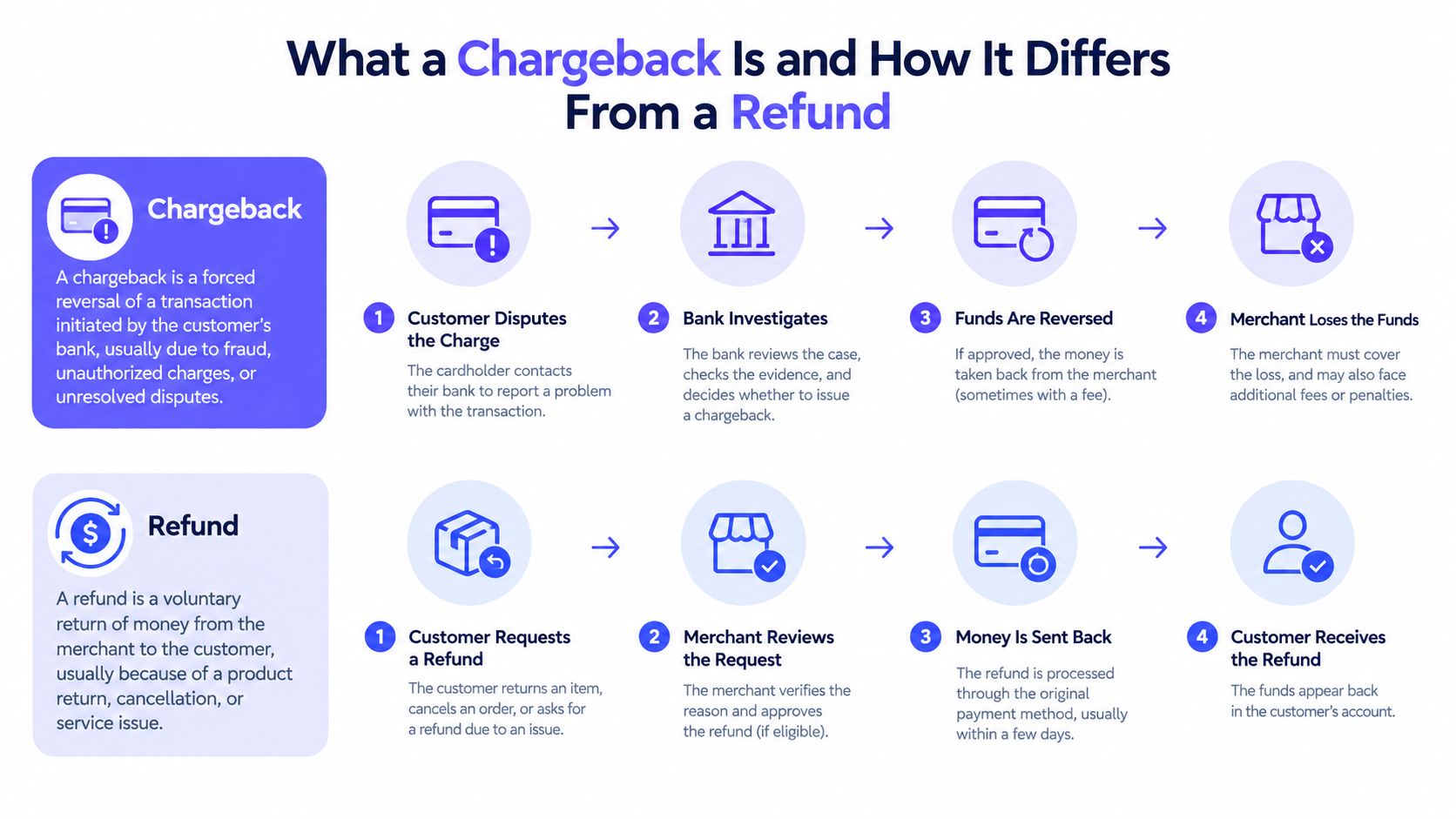
Treat the chargeback as a small subledger workflow, not one journal entry. Its accounting-relevant stages are:
- Authorization and settlement: The payment is approved, captured, and included in a processor settlement.
- Customer claim: The cardholder disputes the transaction with the issuing bank.
- Provisional debit: The processor or acquiring chain withholds the disputed amount.
- Evidence submission: The merchant provides records supporting the transaction.
- Final resolution: The case becomes a loss, recovery, or another processor-confirmed outcome.
Each stage needs its own evidence and accounting treatment. A provisional debit may sit in a disputed-funds or chargeback-clearing account. A processor fee belongs in a separate expense account. If the merchant wins, the temporary balance must be cleared without treating an expected recovery as cash already received.
The legal history helps explain why the issuer controls the opening step. The Fair Credit Billing Act established chargebacks as a consumer-protection mechanism in the United States. Cardholders generally had 60 days after the relevant statement to notify the issuer of a problem, as noted earlier. Modern network rules impose additional windows.
A refund can often be reconciled to a merchant-approved transaction record. A chargeback needs a case-level subledger containing reason codes, timestamps, settlement references, evidence status, and the final outcome. The lifecycle, not the calendar date of one bank line, drives the accounting policy.
Recording the Journal Entries From Dispute to Resolution
Chargeback journal entries change as the dispute moves from notification to resolution. A running $500 sale with a $25 processor fee shows why the ledger needs temporary status and separate accounts.
The following treatment assumes the merchant records the provisional withholding through a clearing account. The exact account names depend on the company’s policy and whether the processor has already withheld funds.
| Stage | Trigger Event | Debit | Credit |
|---|---|---|---|
| Dispute received | Processor notifies the merchant and withholds the disputed amount | Chargebacks or disputed-funds clearing, $500 | Cash or processor receivable, $500 |
| Fee assessed | Processor records the dispute fee | Chargeback-fee expense, $25 | Cash or processor receivable, $25 |
| Merchant wins | Processor confirms recovery | Cash or processor receivable, $500 | Chargebacks or disputed-funds clearing, $500 |
| Merchant loses | Processor confirms final loss | Chargebacks or Sales Returns and Allowances, $500 | Chargebacks or disputed-funds clearing, $500 |
| Inventory returned or sale cancelled | Related inventory treatment is confirmed | Inventory, applicable cost | Cost of goods sold, applicable cost |
At notification, the first entry reflects the amount already withheld. Some policies debit contra-revenue immediately. Others debit a temporary disputed-funds account until the outcome is known. The stronger choice depends on the organization’s documented policy, historical recovery pattern, materiality, and reporting objective.
A temporary clearing account prevents the ledger from treating every open dispute as a final loss. It also makes an unresolved balance visible during close. If the merchant wins, the recovery clears the temporary balance. If the merchant loses, the balance moves to the final contra-revenue account.
The $25 fee remains separate in either outcome. The fee is a cost of the dispute process. It shouldn’t disappear inside the revenue reversal, because management needs to distinguish lost sales from payment-processing friction.
A representment case shouldn’t create speculative recovery revenue. Evidence submission changes the case status, not the certainty of cash. The team records the final recovery only when the processor confirms it.
Controllers should ask: Does the entry reflect cash movement, dispute status, and the company’s approved policy at the same time?
The accounting team should link every entry to the order, invoice, authorization, fulfillment record, refund history, dispute reason code, and processor settlement reference. The automated journal entry workflow becomes useful only after those source relationships are defined.
Entries are downstream symptoms of an upstream evidence and policy decision. A neat debit and credit can still be wrong if the case status, settlement timing, or expected recovery was misunderstood.
Why Chargebacks Are a Revenue Recognition Problem, Not Just Bookkeeping
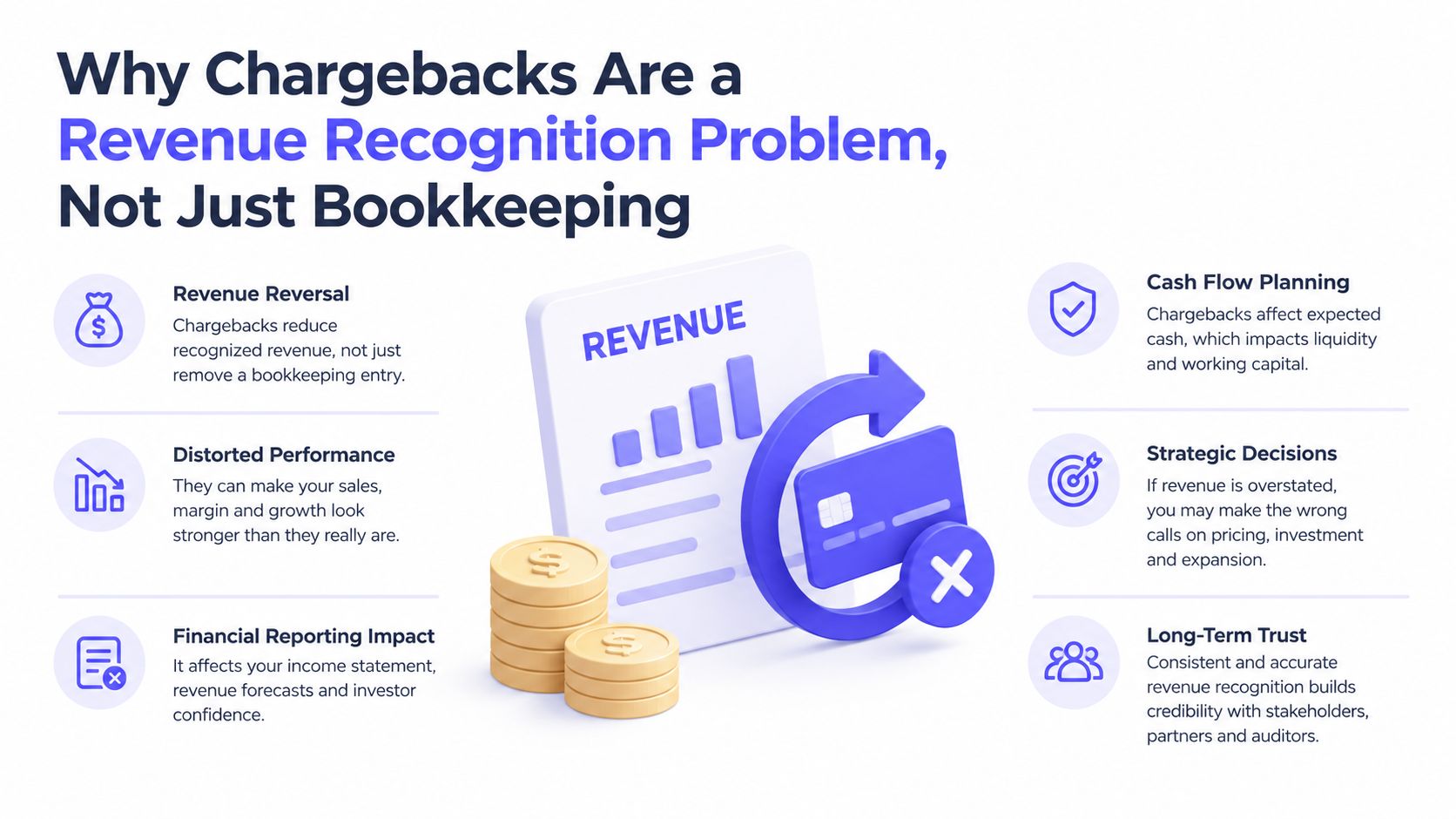
Chargebacks are a revenue measurement problem because they can affect the amount a company expects to retain from a sale. The exposure may need to be estimated at booking, tracked when a dispute is initiated, and finalized only after representment or resolution.
A public-company filing describes estimating chargebacks at the time of sale as deductions from gross product revenue. It also presents receivables net of estimated chargebacks and returns. The SEC filing illustrates why gross billings without a supported estimate can overstate revenue and receivables when dispute history is volatile or settlement data arrives late.
A defensible policy separates three states:
| Accounting state | Core question | Typical treatment |
|---|---|---|
| Estimated exposure at booking | How much of the sale may not be retained? | Revenue deduction and reserve or allowance analysis |
| Initiated dispute | Has the issuer notified the merchant and has the processor withheld funds? | Case-level clearing, contra-revenue, receivable, or liability treatment under policy |
| Finalized loss or recovery | Did the merchant lose or recover the funds? | Clear the open balance and record the confirmed outcome |
Double counting occurs when an estimate remains on the books after the processor has made the actual deduction. The reserve or allowance must be reconciled against the dispute subledger and cleared or recalibrated when the estimate becomes an actual event.
Classification adds another control problem. Datos Insights estimated 261 million global chargebacks and $33.8 billion in disputed transactions for 2025. The same source reports that financial institutions attributed 70% of chargebacks to fraud, while merchants attributed 45%.
Those classifications don’t always answer the same question. An issuer may classify a claim as fraud, while the merchant’s internal review identifies a service failure, first-party misuse, or processing error. The processor’s reason code and final outcome should remain separate from internal management classification.
The revenue recognition process should therefore segment exposure by relevant dimensions, such as product, geography, payment channel, customer cohort, and dispute reason. A finance team can then recalibrate estimates against actual outcomes without turning every open case into a bad-debt expense.
Card-Network Deadlines and the Subledger Your Close Needs
Chargeback timing is controlled by card-network rules, not by the accounting close calendar. A controller needs a subledger that shows when the case arrived, when evidence is due, and whether the processor has issued a final decision.
Cardholders can typically initiate a dispute within 120 days of the original payment, although some network rules allow longer periods. After a formal case is created, merchants may have only 7 to 21 days to respond, depending on the network, while issuers commonly take 60 to 75 days to evaluate submitted evidence, according to Stripe’s dispute lifecycle guidance.
Mastercard describes merchant response deadlines commonly falling between 20 and 45 days after notification, with the full process reaching roughly 120 days. The Mastercard merchant explanation demonstrates why a universal internal deadline is unsafe.
The subledger should retain these fields:
- Dispute date: Establishes the case timeline and supports aging.
- Response deadline: Identifies the operational cutoff for evidence submission.
- Evidence status: Shows whether records are missing, under review, submitted, or rejected.
- Final decision: Separates open exposure from confirmed recovery or loss.
- Reason code: Preserves the network’s classification for analysis and evidence selection.
- Processor settlement reference: Connects the case to the cash or receivable movement.
- Original transaction identifier: Links the dispute to the order, invoice, authorization, and fulfillment record.
A useful aging report should answer more than “how much cash was withheld?” It should show each open dispute, original sale amount, fee, current status, days open, response deadline, evidence owner, expected accounting treatment, and settlement reference.
Material unresolved exposure may require accrual or reserve tracking under the company’s accounting policy. The report should also reconcile to cash, accounts receivable, contra-revenue, fee expense, and processor statements.
Close control: A dispute should have an owner, a deadline, an evidence status, and a ledger status. Without those fields, the close team is reconciling a mystery.
A chargeback handled like a one-step refund creates timing noise. The processor can net several cases into one payout, and the dispute outcome may arrive in a different accounting period. The subledger provides the bridge.
Evidence a Chargeback Audit Will Demand
A chargeback audit trail must connect the original authorization to the processor’s final decision. Auditors need to see why the merchant recognized the sale, why funds were withheld, what evidence was submitted, and how the final accounting treatment was selected.
The evidence should be retained at the transaction and dispute levels:
- Transaction receipt and authorization record: Supports the original payment and customer authorization.
- Order and invoice details: Connects the card payment to the commercial transaction.
- Fulfillment and delivery logs: Shows whether goods or services were delivered.
- Customer communications: Documents complaints, proposed resolutions, and acknowledgements.
- Digital access records: Supports delivery where the product is software, content, or another digital good.
- Dispute reason code and timestamps: Explains the issuer’s claim and establishes the response timeline.
- Processor settlement reference: Links the operational case to the bank or processor movement.
Visa’s merchant guidance recommends submitting transaction receipts promptly, preferably within one to five days of the transaction date, with legible order, delivery, and customer-communication evidence. The Visa merchant dispute guidelines make promptness and legibility part of the evidence standard.
The accounting control should preserve immutable source records rather than relying on a screenshot copied into a spreadsheet. Each document should retain its source identifier, capture time, related transaction, and case status. Changes to the case should be logged, including approvals and evidence submissions.
The payment reconciliation process should then match processor activity to the dispute subledger and general ledger. That match supports control testing because the auditor can trace a sample from settlement report to case file to journal entry.
Audit question: Can the finance team produce the complete chain without asking one employee to reconstruct it from memory?
If the answer depends on a former analyst’s inbox, the control is more personal than procedural. Retained evidence lets the team answer the auditor directly and consistently.
Manual Spreadsheets, AI Agents, and Deterministic Workflows Compared
The chargeback workflow must satisfy three groups. Auditors want the run to hold up. Controllers want the subledger to reconcile. Operations teams want fewer urgent requests for missing evidence.
Manual spreadsheets create drift and key-person risk. Spreadsheets do the problem. Loopfour does the solution instead. A spreadsheet can list dispute dates and amounts, but formulas change, owners miss updates, and supporting files become detached from the case.
Probabilistic AI agents create a different failure mode. They may interpret documents or suggest classifications, but a reviewer may not be able to reproduce a run or explain why a specific output appeared. The audit-trail analysis from Loopfour distinguishes probabilistic execution from deterministic execution, where every action is logged to an execution tree that a reviewer can reconstruct.
Loopfour, the deterministic finance workflow automation platform, runs predefined steps with versioned definitions and retained execution evidence. AI Copilot can be scoped to interpretation tasks, subject to confidence thresholds and human fallback, while deterministic rules control postings, approvals, exception routing, and evidence capture.
| Approach | Main weakness | Control characteristic |
|---|---|---|
| Manual spreadsheet | Drift, missing evidence, key-person dependency | Human-maintained record |
| Probabilistic AI agent | Non-reproducible output and opaque reasoning | Variable execution |
| Deterministic workflow | Requires predefined policy and governed change | Versioned steps and execution tree |

Exception routing matters as much as automation. A missing delivery record should route to an accountable owner. A low-confidence document interpretation should pause for human review. A completed case should preserve the evidence and system writes that produced the accounting result.
The choice is not primarily about speed. It’s about whether a reviewer can reconstruct any run after the fact. Your auditors want the workflow to hold up, and your close team needs more than a confident-looking answer.
Key Takeaways for Finance Leaders
A chargeback in accounting is a forced reversal of a settled card transaction. The amount generally reduces revenue, while the processor fee is recorded separately as an expense.
The accounting workflow follows five stages: authorization and settlement, customer claim, provisional debit, evidence submission, and final resolution. Journal entries should distinguish estimated exposure, open disputes, confirmed losses, and recoveries. Revenue recognition requires supported estimates, careful reserve clearing, and separate internal and network classifications.
The subledger needs dispute date, response deadline, evidence status, final decision, reason code, processor settlement reference, and original transaction identifier. The audit file needs receipts, authorization records, order details, fulfillment proof, customer communications, digital-access records, and timestamps.
Spreadsheets do the problem through drift. Probabilistic agents do the problem through non-reproducible output. A deterministic workflow applies predefined steps and retains an execution tree.
Finance departments rarely receive applause for clean evidence and reconciled clearing accounts. That’s usually how everyone knows the close worked. The next practical step is to map today’s open disputes against the five lifecycle stages and seven deadline fields, then document every gap.
Loopfour provides deterministic finance workflow automation for chargeback-related reconciliation, evidence routing, approvals, and journal-entry support across existing finance systems. Visit Loopfour to evaluate a governed workflow that gives controllers versioned execution, exception handling, and retained audit evidence.