
The popular advice says month-end close is an accounting checklist. That advice is incomplete. How to do month end close reliably means governing the dependencies that feed accounting, then executing predefined controls in a fixed order. Finance must cut off transactions, capture accruals and estimates, reconcile subledgers to the general ledger, review unusual movements, approve adjustments, issue statements, and lock the period with evidence intact.
A month-end close is best understood as a controlled sequence that converts a completed accounting period into reliable financial statements. The close succeeds when Sales, Operations, HR, procurement, billing, payroll, accounting, and the controller deliver the right inputs through defined systems by defined cutoffs. Speed matters, but repeatability matters more. APQC benchmark data covering 10,198 organizations reported a median close time of 6.0 calendar days, while top-performing organizations completed the process materially faster, as reported in month-end close benchmark data by company size.
Table of Contents
- Why Your Close is Actually a Dependency Problem
- Building a Versioned Close Calendar
- Designing Reconciliations as Audit Controls
- Automating Workflows Without Failing the Audit
- Connecting Monthly Discipline to SEC Deadlines
- Troubleshooting Common Close Failures
Why Your Close is Actually a Dependency Problem
A slow close usually isn’t an accounting-speed problem. It’s a cross-functional dependency and data-contract failure. Accounting can’t reconcile an incomplete billing feed, accrue an expense without an operational input, or approve payroll balances that HR hasn’t delivered.
A 2025 benchmark of 100 finance professionals found that 56% identified cross-team dependencies as a barrier to faster close, while 50% cited Excel-driven processes and 40% cited legacy systems, according to CFO reporting on close-time barriers. The same research found that teams commonly use three to five systems for reconciliation and spend 20–50 hours per month on the process. These figures point to an operating problem, not a motivation problem.
Replace chasing with upstream data contracts
A data contract states exactly what one team must provide to another. The contract should name:
- Input: The invoice register, payroll file, sales report, purchase-order status, or expense submission required.
- System of record: The ERP, CRM, billing platform, payroll system, or document repository where the input lives.
- Cutoff: The date and time after which the input becomes late or requires an estimate.
- Evidence: The invoice, approval, contract, timesheet, report, or system export supporting the input.
- Fallback: The predefined accrual, provisional entry, or escalation path when the input misses its cutoff.
Sales might own contract modifications and billing completeness. Operations might own usage or delivery data. HR might own payroll and benefits inputs. Procurement might own uninvoiced commitments. Accounting then consumes governed inputs instead of running a monthly detective chase across email and spreadsheets.
A data orchestration platform can help connect these handoffs across systems, but the control logic still needs named owners and fixed rules. Teams evaluating that architecture can use this overview of data orchestration platforms as a technical reference.
Classify dependencies before they become blockers
Not every late input deserves the same response. Finance should classify dependencies by materiality, reporting impact, and reversibility.
A material revenue feed might block reporting. A low-value expense report might move into a controlled accrual. An intercompany confirmation might require escalation because an unresolved difference can distort consolidation. Each category needs a rule, not a judgment made under quarter-end pressure.
Practical rule: A late input should trigger a predefined decision. It should never trigger an improvised spreadsheet hunt.
The dependency register should show the owner, status, exposure, escalation contact, and resolution date. This changes the close conversation. Instead of asking whether accounting is done, the controller can see which upstream contract is late and what accounting treatment applies.
Building a Versioned Close Calendar
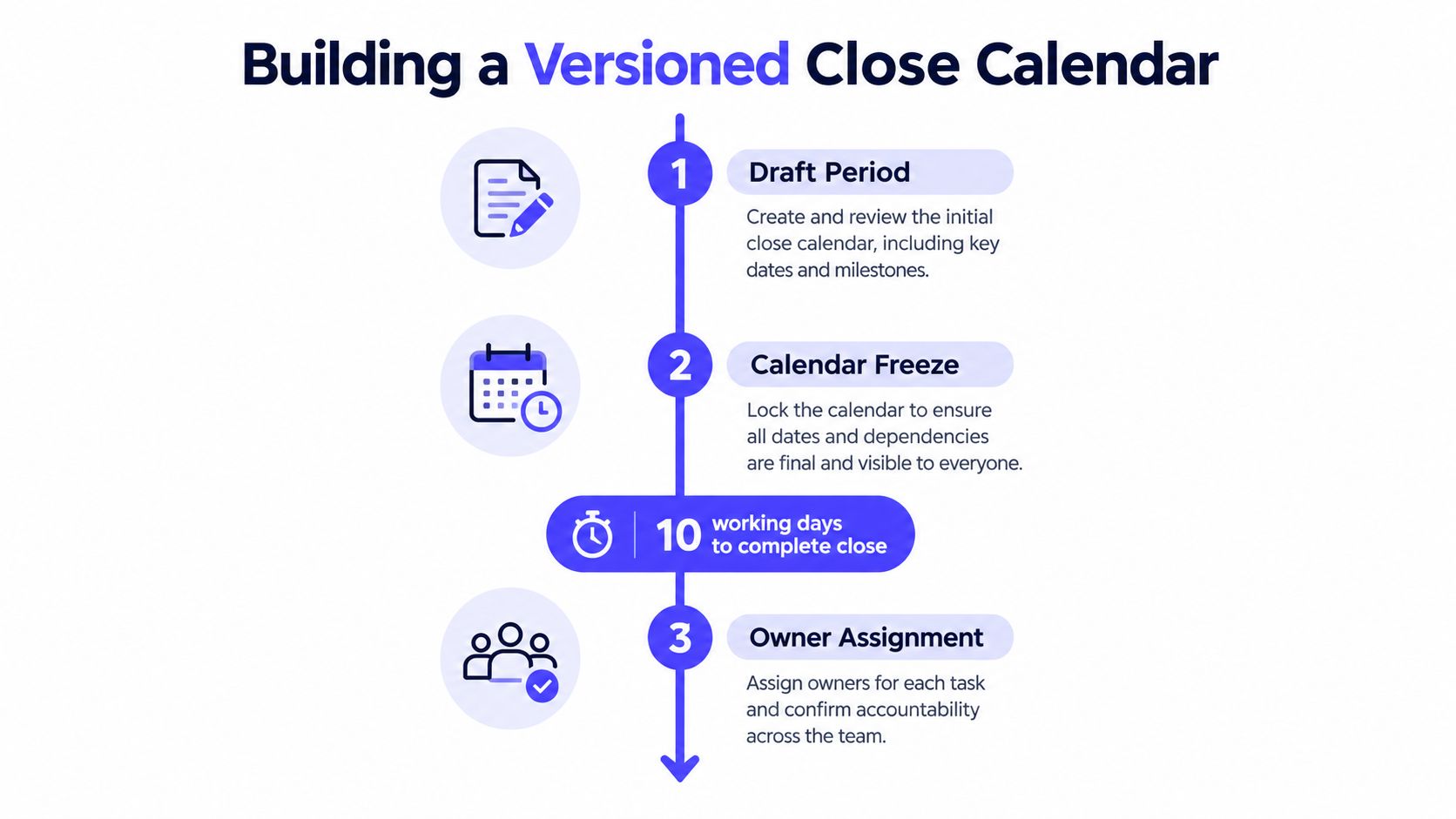
A controlled close runs from a versioned close calendar, not an informal checklist. Every task needs an accountable owner, reviewer, due date, dependency, evidence requirement, and status that can be audited after the period is locked.
The calendar should begin by freezing the reporting period and assigning a close owner. The owner then confirms the reporting date, entity scope, currency rules, consolidation requirements, and final controller approval. Calendar versions matter because changes to deadlines or control steps need a visible history.
Run the sequence in dependency order
A practical sequence looks like this:
- Freeze the period: Confirm the reporting boundary and transaction cutoffs.
- Complete source feeds: Close or import accounts payable, accounts receivable, payroll, fixed assets, inventory, revenue, and intercompany data.
- Post recurring entries: Record approved accruals, allocations, depreciation, payroll, and other recurring journals.
- Reconcile material accounts: Compare the general ledger with independent sources and document exceptions.
- Review movements: Investigate variances against budget, forecast, prior period, and operational metrics.
- Consolidate entities: Process intercompany eliminations, currency conversion, trial-balance validation, and consolidation.
- Approve and lock: Obtain controller review, finalize statements, lock the period, and archive evidence.
The calendar should route exceptions separately from completed work. An unresolved item needs an owner, quantified exposure, root-cause category, supporting evidence, and target-resolution date. A comment saying “follow up later” is not a control.
APQC data cited in close benchmark reporting from Rand Group show top-performing organizations completing the trial-balance-through-consolidated-statements phase in about five days or less, median organizations in roughly six days, and bottom performers in ten or more days. That benchmark is a planning reference, not a universal target. Entity count, transaction volume, reporting complexity, and control requirements still determine the appropriate calendar.
The calendar should track cycle time, late journals, unreconciled-item aging, post-close adjustments, manual-journal percentage, and reconciliation completion rate. Those measures expose bottlenecks more clearly than a green checklist.
Here’s a short visual explanation of the calendar mechanics:
Designing Reconciliations as Audit Controls
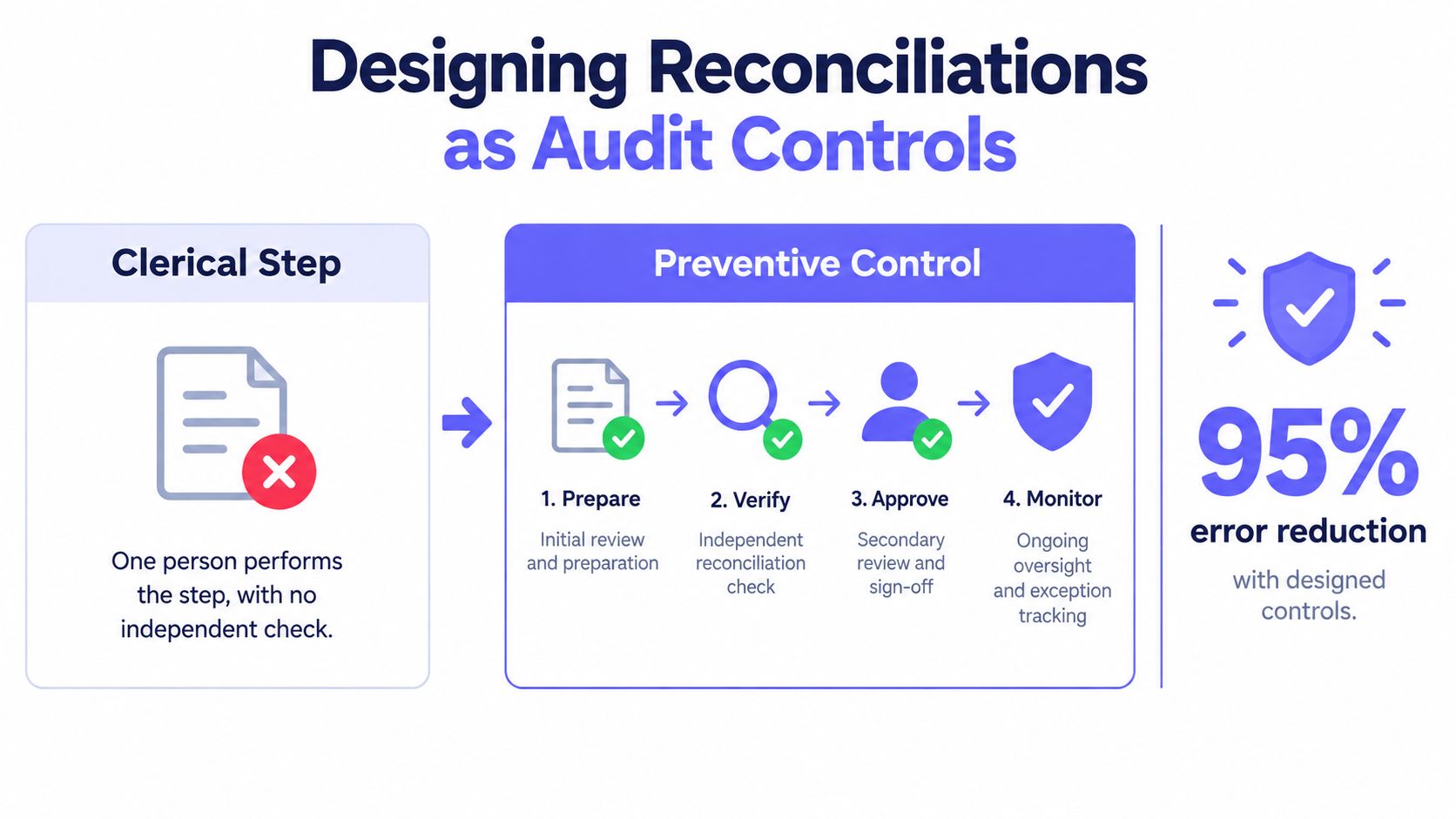
A reconciliation is a preventive and detective control, not a checkbox at the end of close. The U.S. Government Accountability Office defines reconciliation as identifying and comparing transactions from two sets of records to determine whether transactions were recorded properly, remain unrecorded, or were recorded improperly and require correction, as stated in the GAO reconciliation guidance.
A strong reconciliation proves three things. The balance came from a defined source, differences were classified and resolved, and an independent reviewer approved the result. Your auditors want it to hold up without a verbal explanation from the person who prepared it.
Define the control before matching transactions
For every material account, define:
| Control field | Required decision |
|---|---|
| Source of truth | Bank statement, subledger, billing system, payroll report, or other independent record |
| Frequency | Monthly, continuous, or event-driven |
| Materiality threshold | Exposure requiring investigation or escalation |
| Acceptable variance | Difference permitted without additional action |
| Preparer and reviewer | Named individuals with separated duties |
| Evidence location | Version-controlled repository with retention rules |
| Sign-off | Timestamp, approval, and exception status |
The practical sequence is straightforward. Extract the general-ledger balance after cutoff. Obtain the external or subledger balance. Normalize timing, currency, and entity dimensions. Match transactions using stable identifiers. Classify differences as timing, mapping, duplicate, omission, or unexplained.
An account must not receive a “reconciled” status while unexplained differences remain. Each unresolved item needs an evidence-backed explanation and a dated remediation plan. Carrying an old item forward without aging analysis only transfers risk into the next period.
The balance sheet account reconciliation guide provides useful context for structuring that evidence trail. For teams formalizing broader technology controls, a compliance guide for IT procurement can help connect system inventories, ownership, and audit documentation.
Apply stronger review where misstatement risk is higher
Cash, revenue, receivables, payables, intercompany, tax, leases, debt, and equity deserve stronger controls. The GAO Financial Audit Manual states that subsidiary ledgers and supporting records should be reconciled to the general ledger, with supervisor review and approval of reconciliations between recorded receipts and bank statements, as described in the GAO Financial Audit Manual.
The reviewer should inspect the source, the matching logic, the exception classification, and the remediation date. Review evidence should remain attached to the reconciliation. A signed spreadsheet without source support is only a more formal-looking unsupported spreadsheet.
Automating Workflows Without Failing the Audit
Finance automation should execute deterministic, versioned logic for recurring work and route judgment to human owners. Black-box AI agents are a poor fit for journal approvals, reconciliations, and period locks because a control owner must explain what happened, why it happened, and which rule allowed the system write.
Loopfour, the deterministic finance workflow automation platform, converts recurring finance operations into inspectable code running across existing ERP, CRM, billing, and document systems. Loopfour Studio can represent task dependencies, approvals, evidence capture, exception routing, and system writes as a governed execution path. The relevant principle is simple: automation should make the control more inspectable, not less.
Separate interpretation from execution
AI can assist with interpretation tasks such as document parsing, provided confidence thresholds and human fallback are defined. The resulting decision should then enter a predefined workflow. A model may identify a likely invoice date. It shouldn’t independently decide to post an accrual, bypass approval, or reopen a locked period.
A deterministic engine can enforce:
- Preconditions: Required feeds, approvals, and supporting documents exist.
- Decision rules: Materiality, account mapping, entity, period, and variance thresholds are evaluated consistently.
- Approval gates: Controller or designated reviewer approval is required before sensitive writes.
- Exception routing: Slack, Microsoft Teams, or email sends the issue to a named owner.
- Evidence capture: Inputs, actions, approvals, exceptions, and system writes remain available for review.
- Version history: The exact workflow definition used for a close can be identified later.
A detailed automation in finance discussion can help teams distinguish workflow automation from unattended judgment.
Audit test: If a reviewer can’t reconstruct the execution tree from retained evidence, the workflow isn’t ready for a controlled close.
Automate repetition, preserve judgment
Recurring accruals, allocations, intercompany entries, account reconciliations, status updates, and approval reminders are suitable for predefined execution. Unusual transactions, unclear contract terms, material exceptions, and policy changes require human review.
The trade-off is deliberate. Deterministic automation takes design effort and maintenance. It also creates a stable control surface. Probabilistic automation may appear faster during setup, but unexplained variation becomes expensive when auditors ask for evidence or when a system changes upstream behavior.
The right objective isn’t autonomous accounting. It’s auditable finance workflow automation that reduces manual chasing while preserving human accountability.
Connecting Monthly Discipline to SEC Deadlines
Monthly close discipline supports quarterly and annual reporting because public-company deadlines run from the period-end date. Under SEC Form 10-Q rules, large accelerated and accelerated filers must submit quarterly reports within 40 days after the end of each of the first three fiscal quarters, while other registrants generally have 45 days, according to the SEC Form 10-Q requirements.
A weak monthly close defers risk. Reconciliations remain unfinished, intercompany balances stay unresolved, and journal support gets assembled only when a filing deadline approaches. A controlled monthly process produces auditable balances continuously, so quarter-end becomes an extension of governed work rather than a forensic recovery exercise.
Build reporting evidence into every month
The monthly operating model should include:
- Completeness checks: Confirm transaction cutoffs and source-system imports.
- Core reconciliations: Cover bank, receivables, payables, payroll, fixed assets, inventory, debt, tax, and intercompany.
- Judgment entries: Retain support for accruals, estimates, recurring journals, and unusual adjustments.
- Variance review: Explain movements against budget, forecast, prior period, and operating measures.
- Consolidation controls: Document eliminations, currency conversion, entity submissions, and controller approval.
- Evidence retention: Archive reconciliations, journal approvals, source documents, exceptions, and final statements.
Revenue recognition needs particular care in subscription and contract businesses. FASB Accounting Standards Update 2016-20 requires entities applying the revenue-recognition guidance to disclose opening and closing balances for receivables, contract assets, and contract liabilities when those balances aren’t otherwise separately presented. The update also addresses revenue recognized from beginning contract-liability balances and revenue from performance obligations satisfied in prior periods, as described in FASB ASU 2016-20.
The close should therefore roll forward contract balances and distinguish current-period performance from deferred-revenue releases and prior-period adjustments. That distinction belongs in the monthly evidence trail, not in a quarter-end spreadsheet assembled from memory.
For smaller organizations building consistent management reporting, guidance on financial reporting for UK SMEs offers a useful comparison point. The exact reporting framework differs, but the operating principle remains consistent. Reliable reporting depends on controlled inputs, documented review, and retained support.
Troubleshooting Common Close Failures
Close failures usually come from predictable control breaks. The fix is to encode the response in the workflow instead of relying on memory, heroic follow-up, or a spreadsheet tab named “final final.”
Feed timing and unsupported entries
Problem: Accounting reconciles before all source feeds finish. The team later discovers missing invoices, payroll changes, billing events, or bank transactions.
Deterministic fix: Add a feed-completeness gate before reconciliation starts. The workflow should verify the expected import status, reporting period, record count, and cutoff timestamp. A failed gate routes the issue to the source owner and blocks certification.
Problem: A top-side journal entry is posted without sufficient support.
Deterministic fix: Require a source document, preparer, reviewer, account mapping, period, rationale, and approval before posting. The journal should remain in exception status when any required evidence is missing.
Problem: A recurring entry posts even though the underlying business condition changed.
Deterministic fix: Separate recurring calculation from recurring approval. The system may prepare the entry, but a reviewer should confirm the driver, amount, period, and reversal treatment.
Intercompany and aging failures
Intercompany balances fail when one entity posts an entry and the counterparty doesn’t record the matching side. The elimination then becomes a consolidation surprise.
Fix: Require symmetrical confirmation by entity, currency, account, and period. Route unmatched balances to both entity owners. Block elimination approval when the difference exceeds the defined threshold or lacks a dated explanation.
Reconciliations also fail when old reconciling items roll forward indefinitely. Industry guidance recommends monitoring open items by age, with a practical target of zero items outstanding beyond 60 days, while benchmark reporting indicates the slowest quartile of organizations may require ten or more days to complete the close, according to Numeric’s month-end reconciliation guidance.
Use a failure-response matrix
| Failure | Required control response |
|---|---|
| Missing feed | Block dependent task, notify source owner, record cutoff breach |
| Unsupported journal | Reject posting, request evidence, preserve approval history |
| Unmatched intercompany item | Notify both entities, require symmetrical confirmation |
| Unexplained variance | Assign exposure, owner, root cause, and resolution date |
| Aged reconciling item | Escalate by age, reassess materiality, document remediation |
| Spreadsheet version conflict | Lock the approved version, preserve change history, rerun affected control |
| Post-close adjustment | Record cause, approver, affected statements, and control remediation |
The controller should review failure patterns after every close. Repeated exceptions usually indicate a weak upstream contract, unclear ownership, or a workflow rule that needs revision. Fixing the recurring cause is more valuable than congratulating the team for surviving another late night.
A month-end close becomes dependable when the process makes the correct path easier than the improvised path. Loopfour can convert close checklists into deterministic workflows across reconciliations, journal entries, approvals, dependencies, and evidence capture. Visit Loopfour to evaluate how a governed finance workflow can fit the systems your team already uses.