
API integration platforms connect applications through APIs so data and workflow events move between systems without manual re-entry. The popular advice is to pick the platform with the most connectors. That’s the wrong starting point for finance work.
Connectivity is the easy part. The hard part is whether a workflow that posts an invoice, applies cash, or changes a customer record leaves evidence your auditors can reconstruct. A successful API call doesn’t prove the right data, policy, approver, and system state applied at that moment.
That gap is now the norm, not the exception. Postman’s 2024 State of the API survey of more than 5,600 developers and API professionals found 74% of organizations described themselves as API-first and 62% generate revenue from APIs. APIs now carry commercial transactions, not just technical plumbing.
The ten API integration platforms below are judged on four things. First, connector coverage for ERP, CRM, billing, and document systems. Second, security controls around permissions and credentials. Third, control evidence, meaning logs, approvals, and change history. Fourth, ownership, meaning who maintains the workflow when a system or rule changes.
Table of Contents
- 1. Loopfour
- 2. Workato
- 3. MuleSoft Anypoint Platform
- 4. Boomi Enterprise Platform
- 5. Celigo integrator.io
- 6. Jitterbit Harmony
- 7. SnapLogic Intelligent Integration Platform
- 8. Google Cloud Application Integration
- 9. Oracle Integration
- 10. Make
- 10 API Integration Platforms at a Glance
- How to Pick the Platform That Holds Up Under Audit
1. Loopfour
Loopfour targets the part of integration that survives an audit: the workflow itself. Recurring finance work such as accounts payable, billing, cash application, collections, revenue recognition, and month-end close runs as deterministic, versioned code rather than a black-box agent, and each run retains its actions, approvals, exceptions, and system writes for inspection.
How Loopfour Handles Systems With and Without APIs
Native connectors cover Workday, NetSuite, QuickBooks, Xero, Sage Intacct, Salesforce, HubSpot, Stripe, Slack, Microsoft Teams, Box, Dropbox, DocuSign, Ironclad, Google Sheets, and Excel. Where a system has no API, or where calls are metered or expensive, Loopfour connects through secure browser automation instead of forcing a rip-and-replace project. A legal technology company processing 12,000 depositions a month cleared its manual billing queue that way, with no API access and no vendor signoff. AI is confined to interpretation tasks such as document parsing, with confidence thresholds and human fallback.
That maps to internal control expectations. COSO’s Internal Control, Integrated Framework identifies monitoring as one of five components of effective internal control. Execution logs and change history give controllers a way to monitor whether a predefined workflow still operates as designed.
The API is built for the same job. It covers workflows, runs, agents, connections, webhooks, and tables, for defining workflow graphs, capturing execution, handling AI-assisted steps, managing authenticated integrations, receiving provider events, and storing structured data. An OpenAPI specification is published, and GET /api/v1/blocks?kind=integrations lists integration blocks whose results link to their action IDs and input definitions. A run can start from a webhook, a schedule, an API call, or a platform event.
Practical rule: A finance workflow isn’t auditable because it finished. It’s auditable because a controller can replay who approved it, what changed, and what each system recorded.
Evidence from production work is specific rather than sweeping. For a cybersecurity software company, Loopfour automated 19 workflows across e-invoicing, collections, and cash application, and the cash application step matches 97% of partner payments automatically at 95%+ confidence. An HRA administration platform automated employer deposits, ACH initiation, and employee card funding with a full compliance audit trail.
The trade-offs are real. Pricing isn’t published, so value needs a sales conversation. Connector count is not the pitch here, and the platform assumes you keep your existing ERP, CRM, payment processor, and document tools rather than replacing them. Evidence capture is designed to support SOC 1 control audits, with SOC 2 Type II and HIPAA in place, but your team still owns the policy decisions, approver design, and naming standards that make those runs reviewable. Finance engineers handle implementation and ongoing maintenance, including updates when upstream systems or rules change. Visit Loopfour for details.
2. Workato
Workato is a broad enterprise automation platform for teams that want business users and IT building on the same system. Its low-code recipes connect ERP, CRM, HR, billing, and collaboration tools. It’s capable, and it leaves finance control design to your team.
The scale argument for a platform like Workato is strong. MuleSoft’s 2025 Connectivity Benchmark of 1,050 IT leaders reported organizations used an average of 897 applications, yet only 2% had integrated more than half of them. Point-to-point scripts don’t survive that estate.
- Recipe-Based Automation: Reusable workflow logic with process orchestration across applications.
- Lifecycle Controls: Development, test, and production environments with role-based access controls.
- Enterprise Connectivity: Options for on-premises connectivity, data integration, and API work.
Workato’s weakness shows up over time. A growing recipe library without named owners, naming standards, and retirement rules becomes hard to govern. Pricing also combines a platform-edition fee with usage, so scoping matters before rollout.
Generic automation platforms connect systems. Your team still defines approval gates, evidence retention, and segregation of duties for finance workflows. Budget for that governance work explicitly. See Workato for editions.
3. MuleSoft Anypoint Platform
MuleSoft Anypoint Platform suits organizations with integration engineers who want APIs managed as reusable enterprise assets. It covers API design, build, deployment, management, and monitoring in one platform. Smaller teams may find it more platform than the problem requires.
Governance is the reason to consider Anypoint seriously. An IDC survey cited alongside Postman’s 2025 State of the API report found nearly one-quarter of organizations did not know how many APIs they use and approximately 29% of operational APIs were unmanaged. An API catalog with ownership and reuse rules addresses that directly.
Anypoint supports cloud and hybrid deployment, asset reuse, and monitoring in higher-level packages. For a refresher on structuring this kind of program, enterprise application integration patterns covers the architectural choices involved.
The costs are structural, not incidental. Anypoint needs technical expertise and program ownership. Pricing is quote-based with annual contracts, which makes upfront comparison harder.
MuleSoft sells an integration program, not a quick connector fix. Finance teams without dedicated integration staff should treat staffing as part of the purchase price. Details are at MuleSoft Anypoint Platform.
4. Boomi Enterprise Platform
Boomi Enterprise Platform fits teams that want application integration, data integration, and API management under one low-code roof. It connects cloud applications, databases, and on-premises systems, including ERP and finance tools. Plan entitlements decide what your team gets.
Market context helps explain the breadth. Grand View Research’s iPaaS market analysis valued the global market at approximately USD 12.9 billion in 2025 and projects USD 55.5 billion by 2033. Treat those figures directionally, since they’re commercial forecasts, not audited totals.
Where Boomi Works and Where It Strains
Visual development and data mapping reduce hand-built components. A 30-day trial and pay-as-you-go option give teams a low-commitment starting point. Public pricing provides initial cost context that quote-only vendors don’t.
The strain appears at scoping. The pay-as-you-go price is a starting point plus usage, not a guaranteed total. Connector availability varies by plan, so each intended finance workflow needs checking against entitlements before design starts.
Boomi can be more platform than a narrow two-system problem needs. Map required connectors, environments, and expected message volume first. Then price the plan against that map. See Boomi for plan details.
5. Celigo integrator.io
Celigo integrator.io is a cloud-native iPaaS built around prebuilt integrations for common business systems. Mid-market teams running packaged ERP, CRM, and commerce tools get the most from it. Fit depends entirely on whether your system combinations are supported.
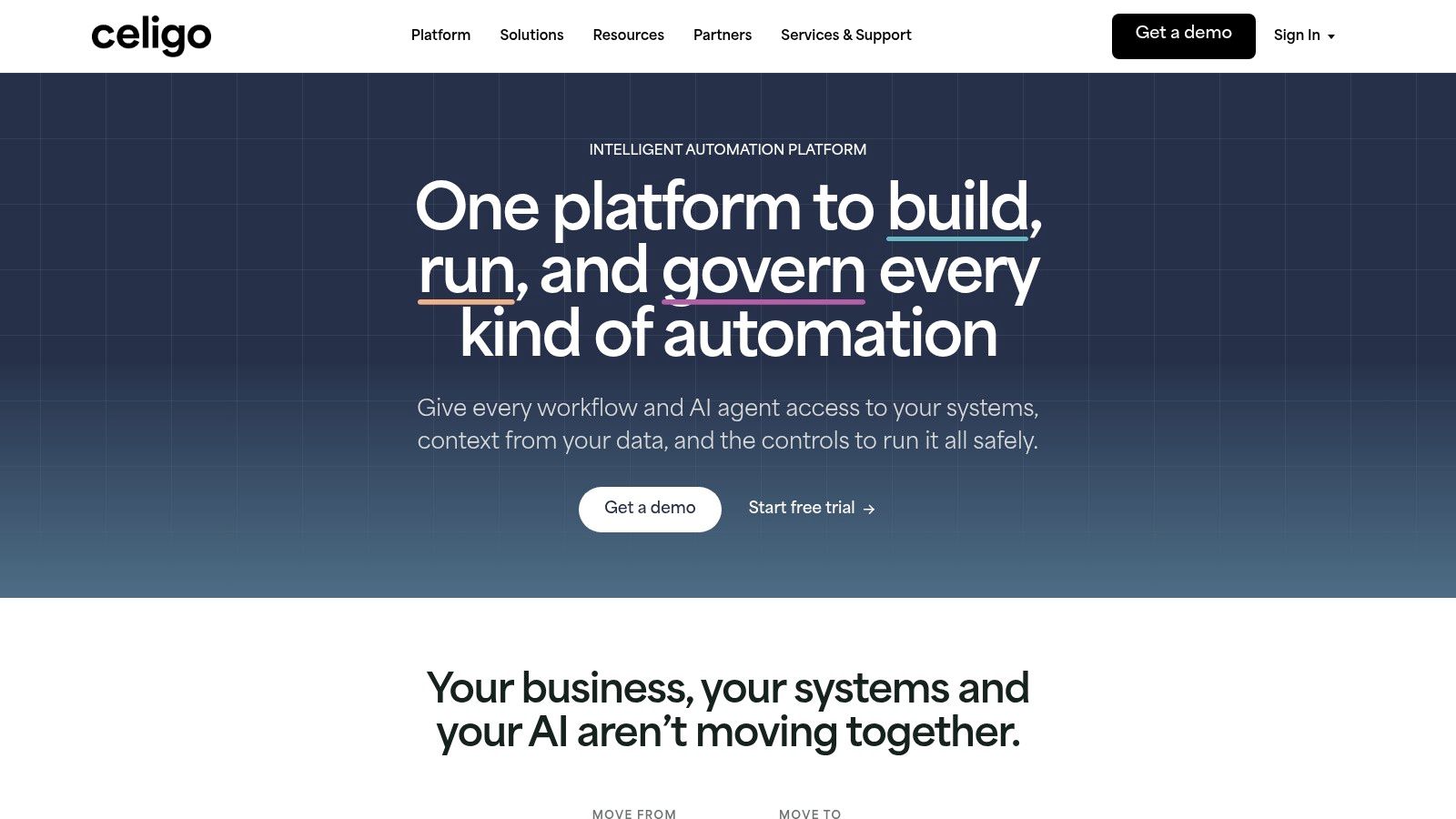
Prebuilt flows shorten implementation, but they don’t remove security review. The OWASP API Security Top 10, 2023 lists risks including Broken Object Level Authorization, Broken Authentication, and Improper Inventory Management. Each prebuilt flow still needs object-level permissions checked against your finance data.
- Prebuilt Integration Apps: Packaged flows for common business-system combinations.
- Visual API Builder: API creation and management through a console.
- Endpoint and Flow Pricing: Pricing based on endpoints and flows rather than transaction volume.
That pricing model makes initial scoping more predictable, provided endpoint and flow counts are mapped carefully. For background on the interfaces involved, types of APIs explained is a useful primer.
Celigo doesn’t define your controls. Approval rules, exception ownership, and evidence retention remain customer responsibilities. Confirm those operating procedures exist before go-live. Visit Celigo to check coverage.
6. Jitterbit Harmony
Jitterbit Harmony makes sense when integration, API management, and EDI are all in scope at once. It combines iPaaS, API management, EDI, and application-development capabilities with a visual designer. Teams with one narrow cloud-to-cloud need will likely overbuy.
Legacy connectivity is Harmony’s practical strength. Private agents help reach systems beyond cloud-to-cloud environments, and a connector builder and SDK cover endpoints without prebuilt support. Guidance on legacy system integration approaches helps frame when an agent-based pattern fits.
The constraint is rarely budget for new software alone. PwC’s 2025 Global Treasury Survey reported budget constraints affected 70% of respondents and limited technology skills affected 56%. A broad platform still needs people who can run it.
Buying breadth doesn’t buy operating capacity. Name the owner for each integration before signing, not after the first failed run.
Harmony uses custom pricing and annual contracts. Plan limits for connections, environments, and private agents need checking against the target architecture. Pricing pages do outline plan differences and support-response targets, which helps comparison. See Jitterbit Harmony for specifics.
7. SnapLogic Intelligent Integration Platform
SnapLogic Intelligent Integration Platform targets enterprise teams that think in data and application pipelines. Its prebuilt connectors, called Snaps, plug into visual pipelines for integration and automation workloads. It’s strong on movement and transformation, lighter on finance-specific control patterns.
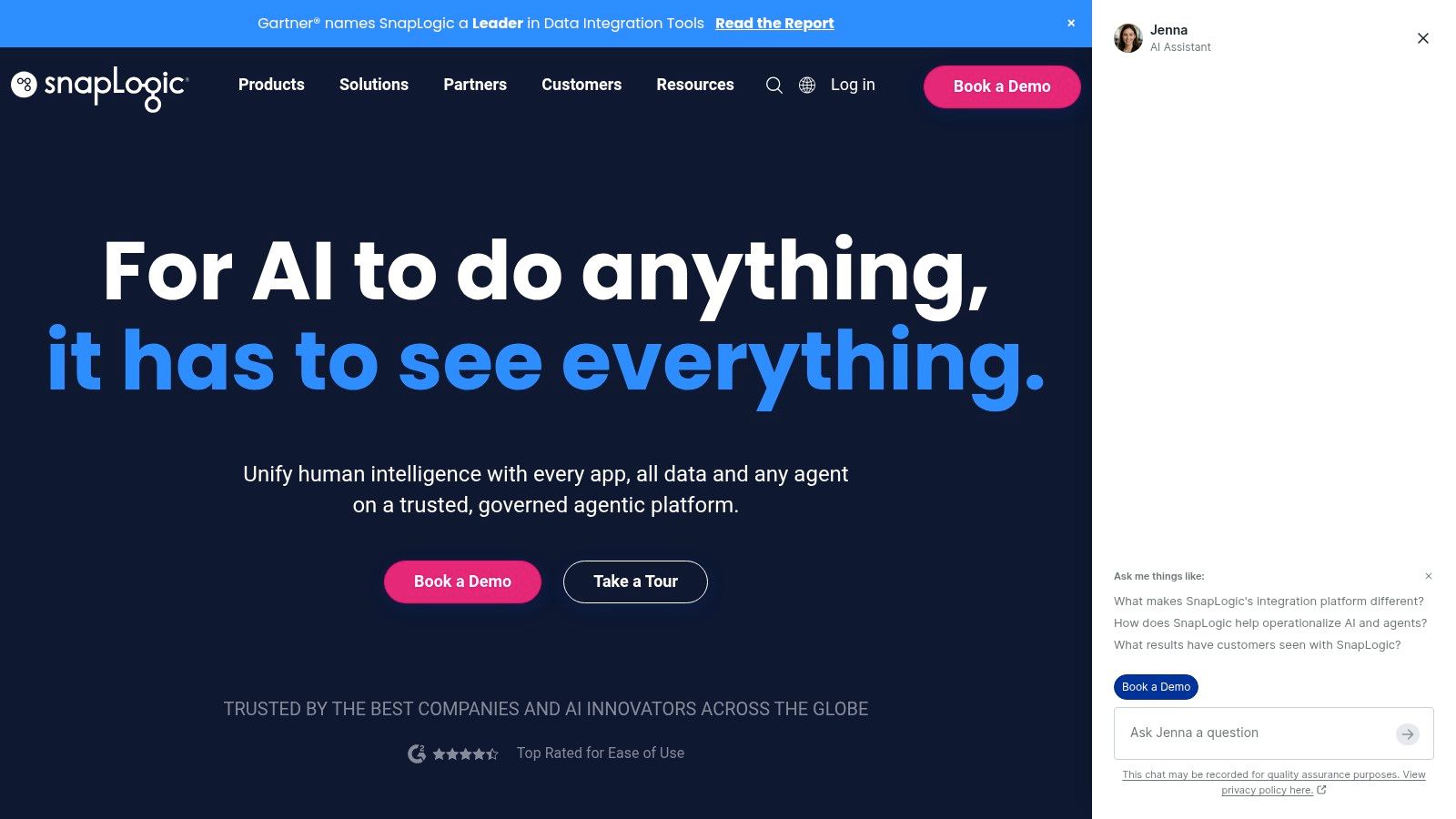
Visibility should drive the evaluation. Research summarized in Salt Security’s 2025 CISO report found only 19% of surveyed CISOs had complete visibility into organizational APIs and only 17% had a fully developed API-security strategy. A pipeline platform without an inventory discipline adds surface area.
Procurement and Fit
SnapLogic sells directly and through AWS, Azure, and Google Cloud marketplaces, which suits organizations that procure through a cloud provider. Prebuilt Snaps cut repetitive API work for supported endpoints. Integration and API-management capabilities sit in the same platform.
Public self-serve pricing isn’t provided. Package contents and premium Snap Pack treatment need confirmation in writing. Those details change total cost materially.
SnapLogic doesn’t automatically supply approval gates, exception ownership, or audit evidence practices for finance workflows. Your team designs those controls around the pipelines. Details are at SnapLogic.
8. Google Cloud Application Integration
Google Cloud Application Integration is the natural shortlist entry for organizations already standardized on Google Cloud. It’s a managed iPaaS for building and running integration workflows inside that environment. Outside Google Cloud, the ecosystem advantage fades quickly.
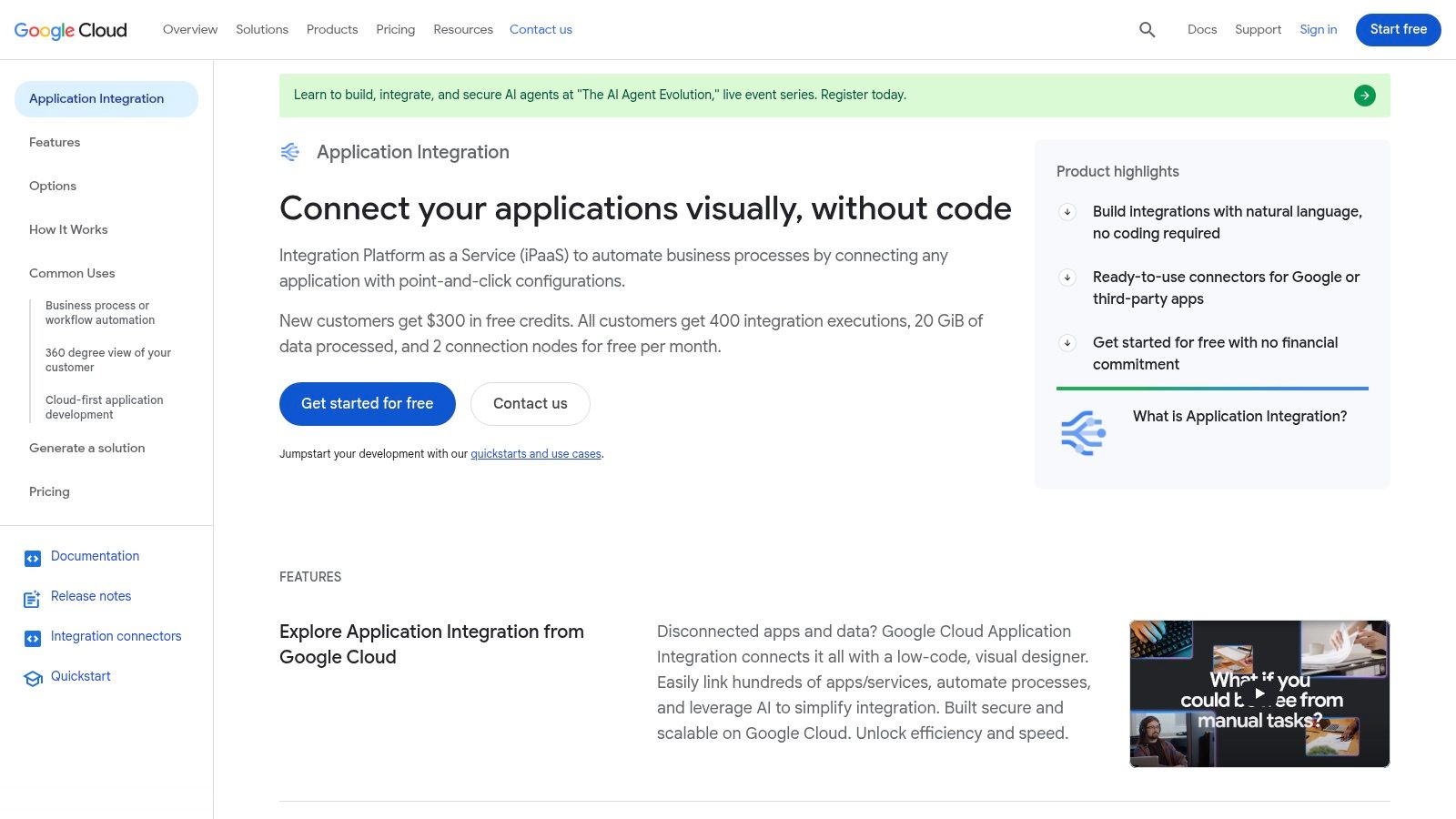
Pricing transparency is a genuine strength. The service uses pay-as-you-go pricing based on executions, data processed, and connection nodes, with a free tier of up to 400 executions and 20 GiB of processed data per month. Published rates support basic cost modeling before commitment.
Sensitive flows still need explicit limits. OWASP’s 2023 API security release notes classify Unrestricted Access to Sensitive Business Flows as a distinct risk and note rate limiting mitigates many such threats. Payment, billing, and reconciliation flows need defined limits and recorded rejections.
- Visual Design: Integration building and execution within Google Cloud.
- Connectors: Google services plus third-party applications.
- Usage Pricing: Executions, processed data, and connection nodes drive cost.
Total cost can also include networking and other Google Cloud resources. Don’t treat the free tier as a production estimate. Model a full month at real volume first. See Google Cloud Application Integration.
9. Oracle Integration
Oracle Integration is most relevant where Oracle ERP or Oracle applications already anchor the stack. It connects cloud and on-premises applications and automates business processes across them. Organizations with few Oracle systems will see less advantage.
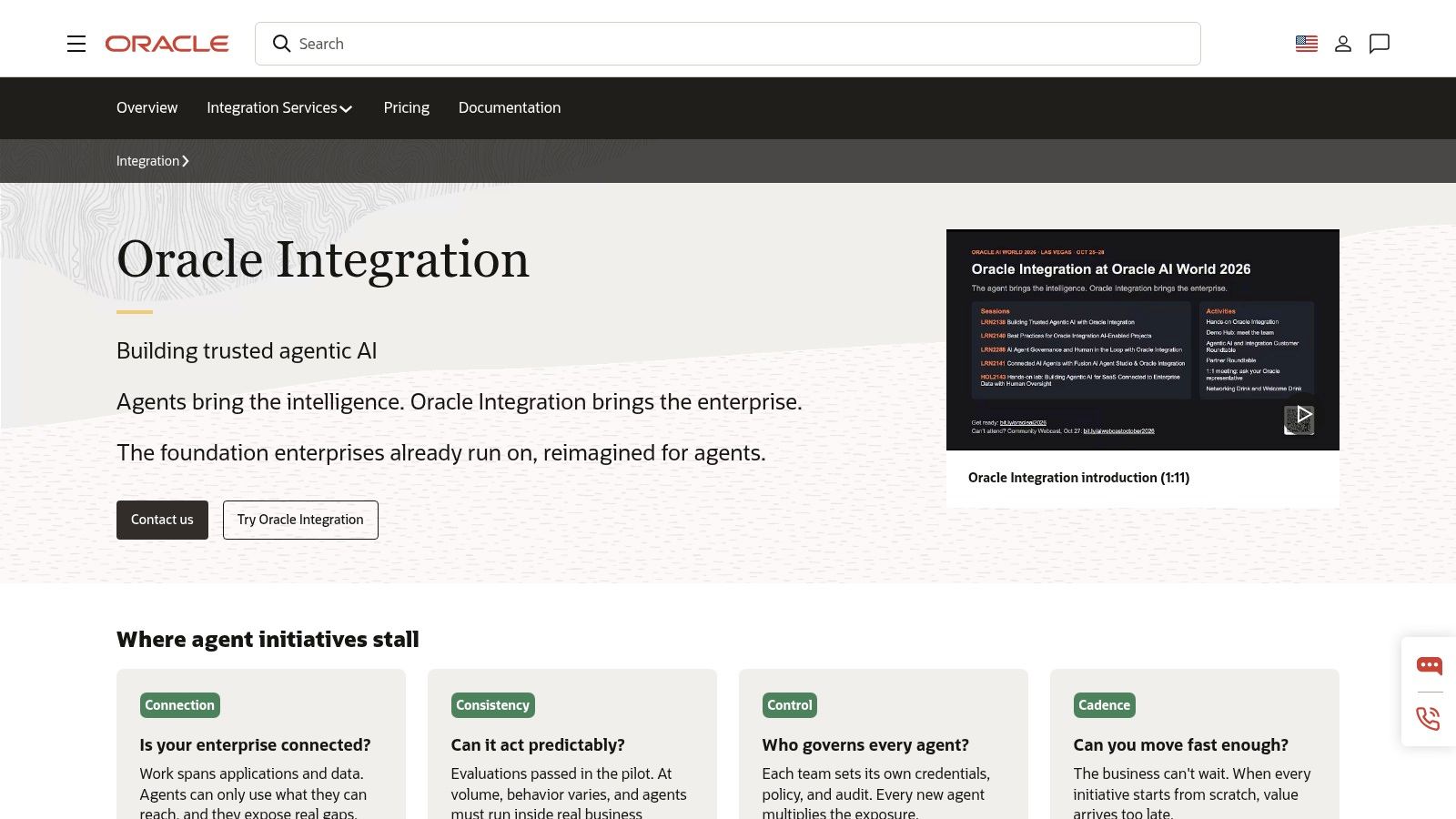
Edition selection drives capability. The Enterprise Edition adds on-premises enterprise application adapters, process automation, B2B, and Integration Insight beyond the Standard Edition. Published price-list information and a cost-estimation path give buyers a starting point.
Credential handling deserves direct questions during evaluation. OWASP’s API security guidance states OAuth and API keys are not, by themselves, authentication mechanisms and recommends established standards over invented token schemes. Ask how each adapter stores credentials and protects recovery paths.
Sizing Before Signing
Pricing based on service units and capacity requires careful sizing. Underestimate message volume and costs rise mid-contract. Overestimate and the platform sits idle.
Verify the required edition, adapters, and usage assumptions against named finance workflows, not generic integration counts. Your auditors want it to hold up, and edition gaps discovered during control testing are expensive. Visit Oracle Integration for editions.
10. Make
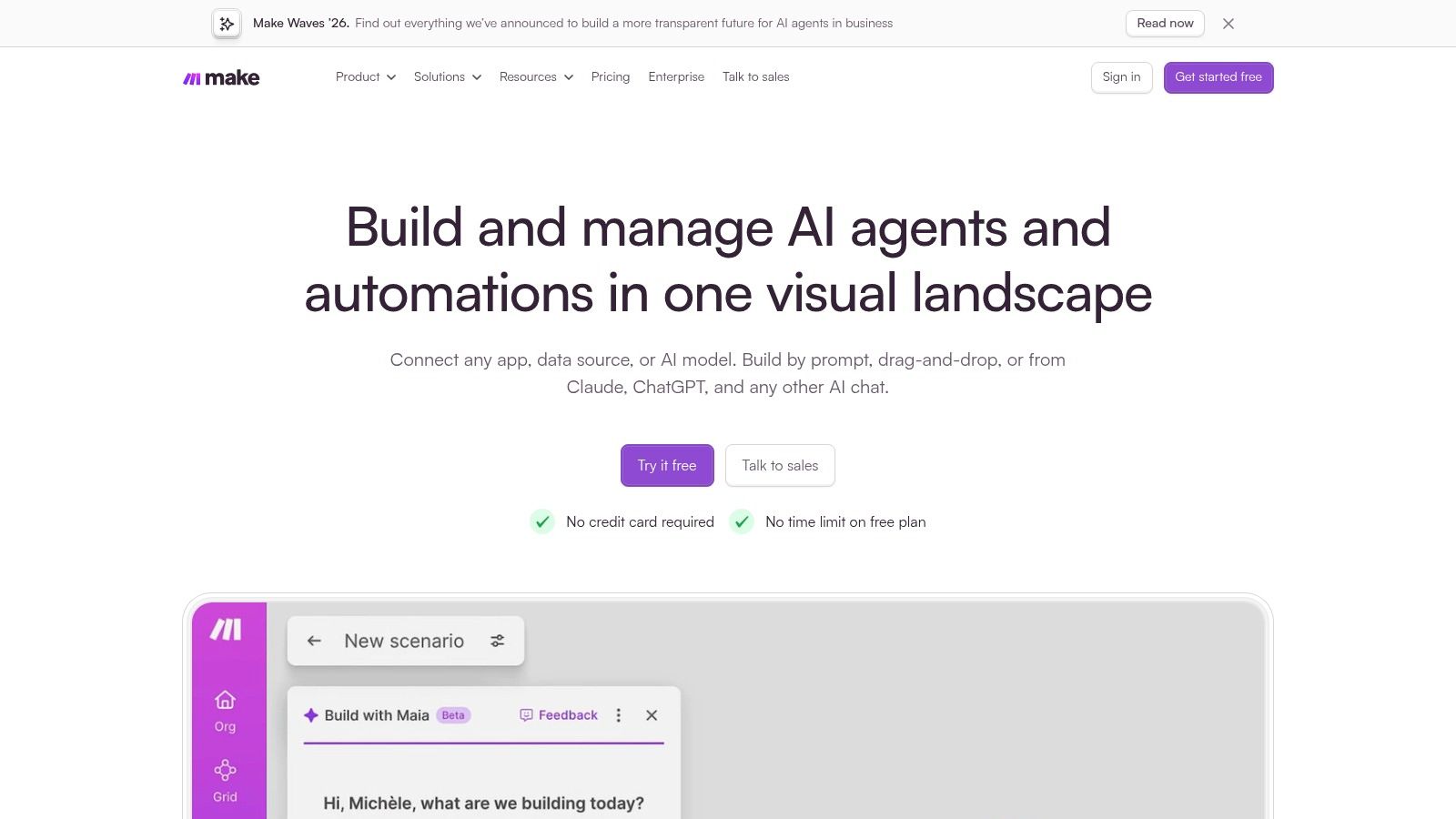
Make is the accessible end of this list, built for operators and smaller teams without dedicated integration engineers. Its drag-and-drop scenario builder with routers and filters handles branching logic beyond simple one-trigger automations. It isn’t a control layer for high-stakes, audited finance operations on its own.
Context matters here. Credence Research’s iPaaS market report valued the global market at USD 13.89 billion in 2024. Make serves the departmental slice of that market well, which is a different job from enterprise integration governance.
- Scenario Builder: Visual workflows with routers, filters, and branching.
- App Catalog: Broad coverage plus support for custom apps.
- Credit-Based Plans: Workflow actions generally consume credits, with Make API access on paid plans.
Credit consumption varies with workflow design and run volume, so costs need monitoring as scenarios multiply. A free plan supports initial experimentation.
The honest limit is evidence. Governance, monitoring depth, and execution records must be tested against your finance-control requirements before Make touches postings or payments. It works well for lower-risk operational automation. See Make for plans.
10 API Integration Platforms at a Glance
| Platform | Best For | Pricing Model | Finance Controls | Standout Limitation |
|---|---|---|---|---|
| Loopfour | Governed finance workflows across existing systems | Not publicly listed; demo-based | Versioned steps, approvals, exception routing, execution logs, and retained evidence | Custom implementation; pricing requires a sales conversation |
| Workato | Enterprise automation across business applications | Platform fee plus usage; scoped pricing | Role-based access and lifecycle tools; finance controls require customer definition | Teams must establish their own finance controls and workflow standards |
| MuleSoft Anypoint Platform | API and integration programs with engineering teams | Quote-based; annual contracts | Monitoring and logs in higher-level packages; governance requires ownership | Requires technical expertise and substantial implementation |
| Boomi Enterprise Platform | Low-code application, data, and API integration | Pay-as-you-go option; usage affects total cost | Integration monitoring and management; finance controls require customer definition | Plan entitlements and connector fit need verification |
| Celigo integrator.io | Prebuilt integrations for common business systems | Based on endpoints and flows | Finance controls and operating procedures are customer-defined | Fit depends on supported applications and careful flow scoping |
| Jitterbit Harmony | Teams combining integration, API management, and EDI | Custom pricing; annual contracts | API security and monitoring options; finance controls require customer definition | Plan limits and connection counts need checking |
| SnapLogic Intelligent Integration Platform | Enterprise application and data integration | Not publicly listed; direct or marketplace purchase | No built-in finance-specific control practices | Package contents and premium connector costs need confirmation |
| Google Cloud Application Integration | Organizations building workflows within Google Cloud | Consumption-based; limited free tier | Workflow execution controls; finance-specific requirements need assessment | Costs can include data, connections, networking, and other cloud resources |
| Oracle Integration | Organizations with significant Oracle investments | Capacity- and usage-based; published price-list information | Edition-dependent process automation and integration capabilities | Sizing and edition selection can make costs complex |
| Make | Departmental and smaller-team workflow automation | Credit-based plans; free plan available | Governance and execution evidence may need assessment | May not provide sufficient controls for high-stakes audited finance operations |
How to Pick the Platform That Holds Up Under Audit
The right API integration platform is the one whose run record a controller can reconstruct months later. Connector count gets a workflow running. Evidence, permissions, and ownership determine whether that workflow survives control testing.
Start with technical capacity. Platforms such as MuleSoft Anypoint Platform and SnapLogic reward teams with integration engineers who can own design standards and lifecycle governance. Workato, Boomi, Celigo, and Jitterbit lower the build barrier, but they don’t remove the need for named owners. Make suits departmental automation where failure costs time, not misstatements.
Next, map the systems involved. List every endpoint a finance workflow touches, including spreadsheets, bank portals, and homegrown tools without APIs. Many evaluations fail here because the demo covers the clean ERP and CRM connections and skips the browser-only system where the work sits.
Test that settles it: Run one real workflow end to end, force an exception, then ask the vendor to produce the complete record. Approvals, inputs, system writes, retries, and the human decision should all be visible without engineering help.
Then score evidence requirements explicitly. Ask how long execution logs are retained and whether they export. Ask how workflow changes are versioned and approved. Ask how duplicate writes are prevented when a run retries after partial failure. Ask who gets paged when a schema changes at 11 p.m. during close.
Security review needs the same specificity. Confirm how credentials are stored, how permissions are scoped per connection, and how sensitive flows are rate limited. Teams formalizing this review can borrow from scoping a security code audit to structure questions about access, change history, and retained evidence.
Cost comparison comes last, and it should include people. Quote-based enterprise platforms carry staffing costs. Usage-based platforms carry volume risk. Credit-based tools carry design risk, because inefficient scenarios burn credits without warning.
Shortlist two or three platforms by control-test readiness, not connector libraries. Pilot each on one consequential workflow, such as cash application or billing, with an exception path included. Reject any platform whose pilot record a controller can’t follow without a developer translating.
For teams whose primary need is audited finance operations rather than general connectivity, Loopfour, the deterministic finance workflow automation platform, is built for that narrower and harder job. Its predefined, versioned workflows keep approvals, exceptions, and system writes inspectable on the stack already in place. That’s a smaller promise than connecting everything. It’s also the one finance teams most need kept.
Loopfour converts recurring finance operations across your ERP, CRM, billing, and document systems into deterministic, auditable workflows, with approval gates, exception routing, and retained execution evidence on every run. Finance engineers implement and maintain those workflows as systems and rules change, so your team isn’t left governing fragile scripts. Visit Loopfour to book a workflow review and see what an audit-ready run record looks like.