
Could a financing program improve the buyer’s cash position while making a supplier more fragile? Accounts payable financing lets a funder pay a supplier before an approved invoice is due, while the buyer pays the funder later. It can improve cash timing, but it only works responsibly when the cost, supplier impact, liability classification, and audit evidence are controlled.
By Loopfour Editorial Team, finance workflow editors
Table of Contents
- Accounts Payable Financing Options Compared
- How a Financed Invoice Moves From Approval to Settlement
- What AP Financing Really Costs Each Party
- When AP Financing Harms Suppliers or Your Business
- EU Payment Deadlines and Late-Payment Costs
- Controls Auditors Check on Financed Invoices
- Implementation Steps and How Automation Changes Outcomes
- Frequently Asked Questions About AP Financing
- Confirm Whether AP Financing Fits Your Payables
Accounts Payable Financing Options Compared
Which party gets cash sooner, and who pays for it? Accounts payable financing covers arrangements in which a funder or buyer pays a supplier before an approved invoice’s due date, while the buyer’s payment happens later or the supplier accepts a discount. The labels overlap, so compare each option by its funding source, cost allocation, and risks.
Published estimates of the supply-chain-finance market vary widely by definition. The World Trade Organization valued global supply-chain finance at approximately $2.3 trillion in 2024 (World Trade Organization statement). That figure gives broad context, but it does not make differently defined financing products directly comparable.
Compare the main options
| Option | Who starts it | Who provides early cash | Who usually pays the cost | Main risk |
|---|---|---|---|---|
| Reverse factoring | Buyer enrolls suppliers | Bank or specialist funder | Supplier, through a discount; buyer may extend terms | Term extensions and dependence on one funder |
| Dynamic discounting | Buyer offers early payment for a discount | Buyer’s own cash | Supplier, through the discount | Buyer ties up cash that could fund other needs |
| Supplier-led invoice factoring | Supplier sells the invoice | Factor | Supplier, through a fee or discount | Recourse and costs suppliers may not see |
| Approved payables financing | Buyer approves invoices for a funder | Funder | Program terms and fee schedule determine the allocation | Funder eligibility limits and program dependence |
In reverse factoring, the buyer enrolls suppliers and a bank or specialist funder pays against approved invoices. The supplier may bear a discount, while extended buyer terms can increase reliance on the funder.
In dynamic discounting, the buyer pays early from its own cash in exchange for a supplier discount. The supplier receives funds sooner, but the buyer gives up cash available for other uses. With supplier-led factoring, the supplier sells selected invoices to a factor and pays a fee or discount. The supplier should check whether the arrangement includes recourse, which can leave it responsible if the buyer does not pay.
Approved-payables financing connects buyer-approved invoices to a funder. Program terms and the fee schedule determine who bears the cost; eligibility limits and reliance on the program remain risks. To compare supply chain finance models, examine how each structure assigns funding, cost, and responsibility.
The right fit depends on the parties’ cash needs and the terms they can accept. A buyer with spare cash may consider dynamic discounting; a supplier seeking cash against selected invoices may consider factoring. In every case, check who initiates the arrangement, where early cash comes from, who pays, and who carries the risk.
How a Financed Invoice Moves From Approval to Settlement
In reverse factoring, the funder pays the supplier before maturity, and the buyer pays the funder on the original or an extended due date. Each financed invoice should leave a record from validation through final settlement.
The buyer’s invoice approval, supplier enrollment, discount selection, maturity terms, and settlement are separate control points, not just steps in a payment-method change. A 2024 empirical study using approximately 90,000 loan facilities and 9 million invoices found that suppliers’ receivable days declined by an average of eight days, about 20% of their pre-enrollment receivable days, after supply-chain-finance enrollment (Riksbank working paper on supplier outcomes).
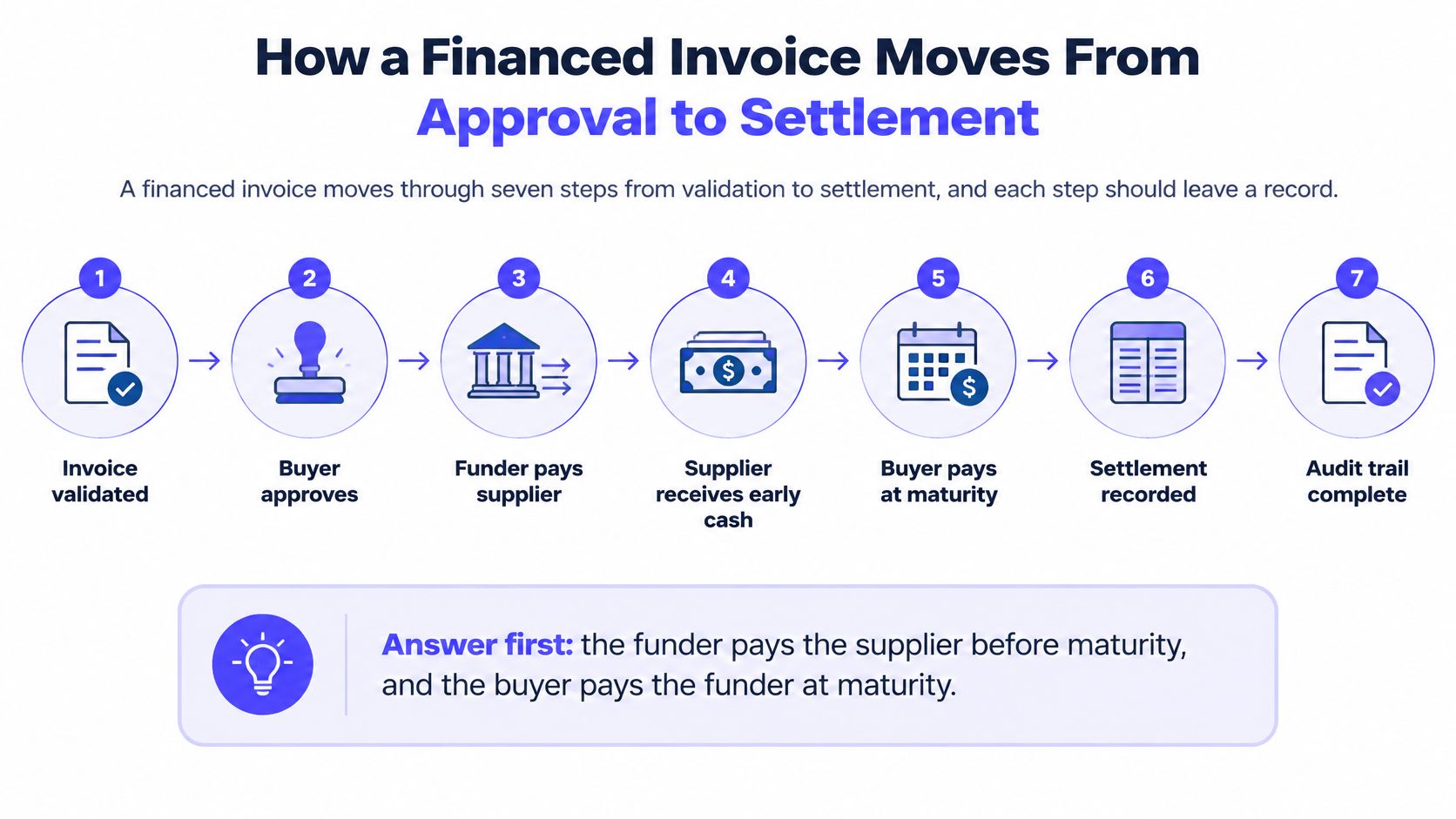
The seven records in the workflow
-
Validate the invoice. Match the invoice to its purchase order and goods receipt. Record the invoice timestamp and the result of each match.
-
Confirm buyer approval. Check that the payable is approved and not disputed or already paid. Record the approved amount, approver, and approval timestamp.
-
Offer the invoice to the funder. Apply the program’s supplier and invoice eligibility rules. Record the funder, rule version, and offer date.
-
Capture the supplier’s choice. The supplier accepts or declines the early-payment offer. Record the acceptance and the financing fee before funding proceeds.
-
Record early payment. The funder pays the supplier on the early-payment date. Store that date and the amount sent to the supplier.
-
Settle at maturity. The buyer pays the funder on the contractual due date, whether original or extended. Record the applicable due date and final settlement date.
-
Reconcile all records. Match the AP subledger to the bank statement and funder report. Resolve differences before closing the invoice.
For practical context on the upstream invoice controls that support these steps, see Loopfour’s guide to the accounts payable procure-to-pay process. The working record should carry consistent fields for the invoice timestamp, approved amount, early-payment date, contractual due date, financing fee, funder, and final settlement date.
Control rule: Financing starts only after the payable clears the buyer’s controls. Each financed invoice must map to exactly one ERP liability.
What AP Financing Really Costs Each Party
The direct cost is the financing fee divided by the cash advanced, then annualized for the days the supplier receives cash early. A discount that looks small in dollars can be expensive when the supplier pays it for a relatively short acceleration.
Consider a hypothetical $100,000 invoice due in 60 days. The supplier accepts payment 45 days early and pays a $1,500 fee.
| Calculation | Result |
|---|---|
| Invoice face value | $100,000 |
| Fee | $1,500 |
| Supplier receives | $100,000 − $1,500 = $98,500 |
| Fee as a share of cash advanced | $1,500 ÷ $98,500 = about 1.52% |
| Approximate annualized cost | 1.52% × 365 ÷ 45 = about 12.4% |
The annualized figure is a comparison aid, not a promise of the buyer’s borrowing rate or the supplier’s exact cost of capital. The supplier should compare it with the cost of its own short-term borrowing. The buyer should compare its total program cost with the cost of other funding and the value of keeping cash longer.
Costs that don’t appear in the discount
The invoice fee isn’t the only cost. Supplier enrollment takes time, slow approval pushes back settlement, and disputed invoices may not qualify for financing. Extended terms can also transfer liquidity pressure to suppliers, even where early payment is offered.
A controller can compare each invoice using four fields:
- Fee: $1,500.
- Days accelerated: 45.
- Buyer’s funding rate: Enter the buyer’s actual comparable rate.
- Net benefit: Compare the value of holding cash for those days with the fee and any operating or supplier costs.
That last line must use the buyer’s own funding rate and program terms. A lower invoice discount isn’t automatically a better outcome if suppliers face expensive funding, approval delays, or longer payment terms. The useful number is the cost of cash accelerated, considered alongside who bears the fee and what the arrangement changes.
When AP Financing Harms Suppliers or Your Business
Accounts payable financing can harm suppliers when extended buyer terms shift liquidity pressure onto them, or when fees, disputes, or program withdrawal disrupt access to cash. Recent U.S. payment data from Atradius indicates that nearly half of businesses delayed payments to their own suppliers to protect liquidity, roughly 40% of B2B invoices were overdue, and 5% were written off as bad debt (Atradius’ U.S. Payment Practices Barometer).
Public-company disclosures cited in that barometer show supplier-finance programs with payment terms of 60 to 180 days. When the buyer materially lengthens its terms, a supplier may technically be free to decline the financing but still feel compelled to join to get paid earlier.
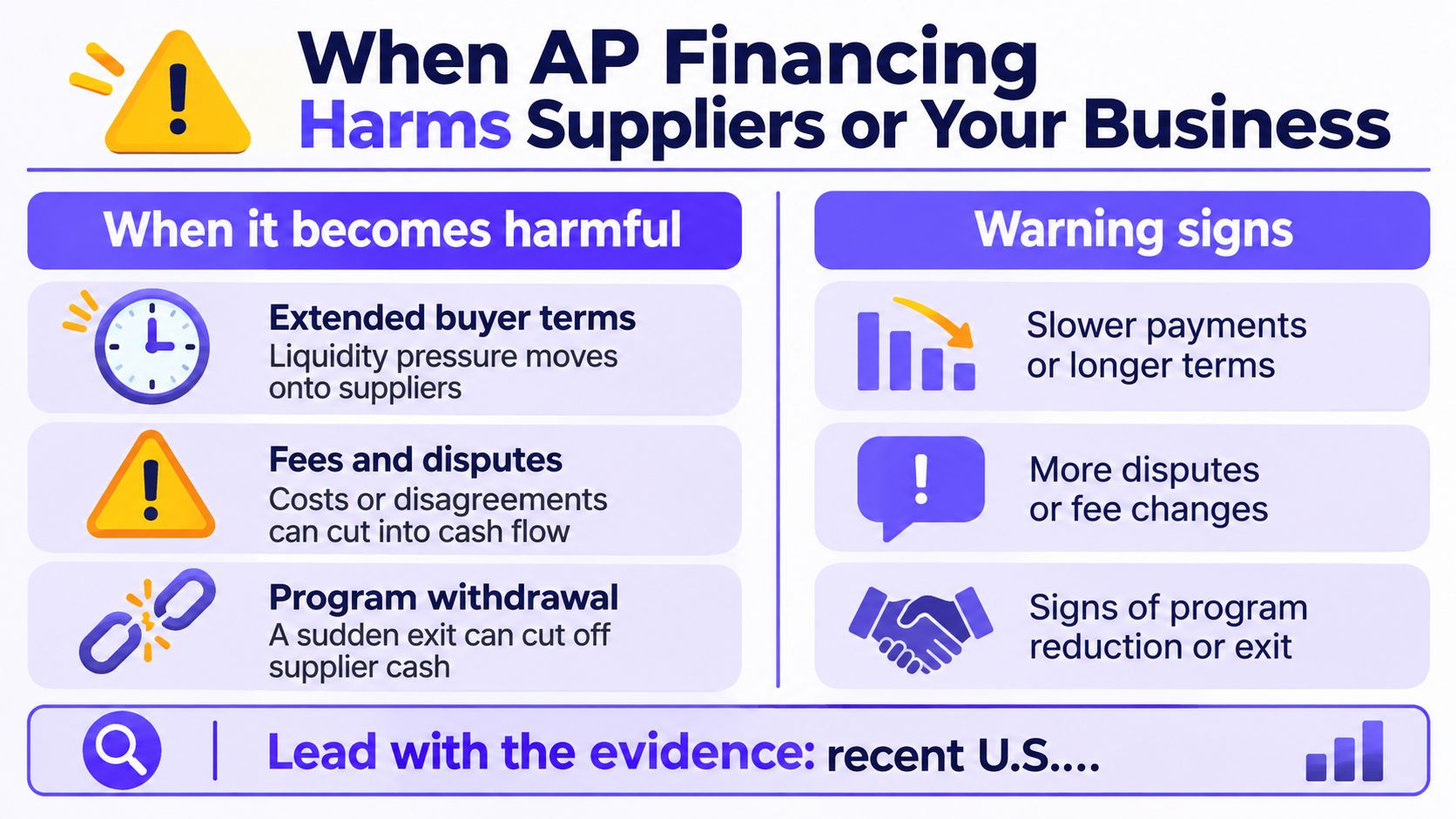
Check the trade-offs before setting a discount rate
Before setting the rate, segment suppliers by size, geography, concentration, dispute frequency, and dependence on the buyer. A single discount rate can miss the difference between a large supplier with other funding options and a smaller supplier that relies heavily on the buyer’s business.
- Buyer benefit: The buyer preserves cash and may support a steadier supplier base.
- Supplier benefit: The supplier can receive cash earlier, but accepts a discount.
- Supplier exposure: The supplier may depend on one funder and face an abrupt loss of access if the program changes or ends.
- Buyer exposure: The buyer may face strained relationships, invoice disputes, or working-capital volatility if supplier participation falls.
A fast workflow can repeat an erroneous invoice just as quickly as a correct one. Duplicate checks must therefore happen before funding, not only during bank reconciliation. Finance teams should also record approved invoices, early-payment uptake, discount rates, exceptions, supplier concentration, and changes in payment terms.
Optional participation isn’t meaningful if the buyer lengthens terms until the supplier has little practical choice.
The launch test is direct: would this supplier survive if the program stopped next month?
EU Payment Deadlines and Late-Payment Costs
Under the EU Late Payment Directive, the default payment period for commercial invoices is 30 days from invoice receipt, or from receipt of goods or services when there is no invoice. Accounts payable financing doesn’t remove that deadline (European Union summary of the Late Payment Directive).
| Rule | EU value | What finance teams record |
|---|---|---|
| Default payment period | 30 days | Invoice receipt date, or goods and services receipt date if no invoice exists |
| Longer agreed terms | Up to 60 days where expressly agreed and not grossly unfair | Contract clause and original due date |
| Late-payment interest | ECB main refinancing rate plus at least 8 percentage points | Interest start date, the day after the deadline, and rate applied |
| Fixed recovery compensation | €40 per late commercial invoice | Payment date and invoice reference |
| Additional recovery costs | Reasonable costs beyond the fixed amount | Supporting cost records |
The default period runs from the event that establishes receipt. Finance teams should preserve that date rather than relying only on when an invoice enters an ERP. The EU framework permits different terms within applicable safeguards. Terms extending beyond 60 days require express agreement and must not be grossly unfair to the creditor (EU overview of late-payment rules).
Interest applies from the day after the contractual or statutory deadline. EU materials describe a late-payment rate based on the European Central Bank’s main refinancing rate plus at least eight percentage points, alongside fixed recovery compensation and reasonable additional recovery costs (EU materials on late-payment remedies). Finance teams should retain the rate applied and the dates used in the calculation.
A financed invoice that is approved and paid according to its agreed schedule is not automatically an overdue invoice. The team must distinguish the supplier’s early funding date from the buyer’s contractual maturity date and record settlement against the correct obligation. For monitoring due dates and exceptions, an accounts payable aging report can help organize the underlying invoice records.
These are EU rules. Payment deadlines and remedies outside the EU differ, so the applicable local rules require legal review.
Controls Auditors Check on Financed Invoices
Under IFRS, accounts payable financing is auditable when each invoice traces to a valid liability, approval, and settlement. A liability qualifies as a trade payable only when it represents an obligation for goods or services, is invoiced or formally agreed with the supplier, and forms part of working capital in the entity’s normal operating cycle (IFRS Interpretations Committee agenda decision on reverse factoring).
If the buyer’s obligation to the supplier is derecognized and replaced by a liability to a financial institution, the replacement may require presentation as borrowing. Cash-flow classification may also change: settlement can be operating when the liability remains a trade payable, or financing when it represents borrowings. The assessment depends on the arrangement’s substance and terms, not just the payment file’s label.
Build the control record around the invoice
| Control | What to record | Failure it prevents |
|---|---|---|
| Invoice validation | Receipt date, PO match, goods receipt match | Paying for goods or services never received |
| Approval evidence | Approver, timestamp, approval limit | Unauthorized approval of financed invoices |
| Program eligibility | Supplier enrollment date, eligibility rule version | Financing ineligible invoices |
| Duplicate prevention | Invoice number, supplier, amount | Double financing or double payment |
| Cutoff | Period in which the liability is recognized | Liability recorded in the wrong period |
| Bank and funder reconciliation | Settlement date, funder report line, bank line | Unmatched cash and missing fees |
| Terms change approval | Old and new maturity, approver, reason | Silent extension of payment terms |
Concentration and refinancing risk also need monitoring. Many suppliers relying on one funder can create exposure if that funder withdraws, while maturity extensions beyond the underlying operating cycle can alter the nature of the liability.
A versioned arrangement register should identify the funder, terms, eligibility rules, and changes over time. Each financed invoice should map to its original supplier liability. Exceptions need routing when the maturity, counterparty, or accounting classification changes. Teams documenting evidence can use a defined audit trail process to keep actions and approvals traceable.
Auditors should be able to inspect the approvals, contractual terms, financing notices, and settlement records. This classification discussion uses IFRS. U.S. GAAP reporters should confirm their applicable presentation requirements with their auditors before applying the IFRS test.
Implementation Steps and How Automation Changes Outcomes
An accounts payable financing program should be set up in a fixed order before the first invoice is funded. Automated execution is useful only when eligibility, approvals, and exception rules are predefined and changes leave an auditable record.
-
Map the invoice fields. Connect the ERP invoice number, supplier, approved amount, and due date to the financing record. Keep field definitions consistent across systems.
-
Version eligibility rules. Document which suppliers and invoices qualify. Retain the rule version used for every financing decision.
-
Enroll suppliers. Record each supplier’s consent, terms, and enrollment date. Make participation status available to the workflow before an invoice is offered.
-
Connect settlement records. Match funder reports and bank lines to the AP subledger. Route unmatched items with the relevant invoice and payment details attached.
-
Pilot before launch. Run the rules against a sample of the previous quarter’s approved invoices. Compare financing costs, supplier impact, eligibility decisions, and exceptions before live funding.
Make each automated step do a control job
Purchase-order and goods-receipt matching should stop unvalidated invoices before the funder sees them. Approval routing should move approved invoices to the offer stage, while exceptions should reach the responsible owner with the invoice and reason attached.
Measure approved invoices, early-payment uptake, discount rates paid, exceptions, supplier concentration by funder, and changes in payment terms each month. These measures give finance leaders a way to distinguish a functioning program from one that moves cash faster.
Loopfour’s AP automation captures invoices, matches them against purchase orders and receipts, routes approvals to the spend owner, and attaches evidence to payments. Deterministic workflow automation helps when the rules are fixed in advance; it doesn’t replace the need to approve those rules or log who changed them.
Frequently Asked Questions About AP Financing
Is accounts payable financing the same as invoice factoring?
No. Reverse factoring is buyer-led: a funder pays the supplier against the buyer’s approved invoice. Invoice factoring is usually supplier-led: the supplier sells its receivable to a factor.
Does AP financing count as debt?
The classification depends on the arrangement and applicable accounting framework. Under IFRS, a liability to a financial institution may need to be presented as borrowing rather than trade payables.
Can a supplier refuse to join a buyer’s program?
A supplier can decline participation in principle. But when the buyer materially lengthens payment terms, the choice may not feel optional, so the buyer should document the supplier’s decision and the applicable terms.
Does the EU 30-day default still apply to financed invoices?
Yes. Financing doesn’t erase the applicable legal payment period or late-payment rules. The buyer should track the contractual maturity and distinguish it from the supplier’s early-payment date.
What should a finance team record for each financed invoice?
Record the invoice timestamp, approved amount, early-payment date, contractual due date, financing fee, funder, and final settlement date. Use consistent field names across the ERP and financing records.
Confirm Whether AP Financing Fits Your Payables
Accounts payable financing fits only when supplier impact, effective cost, and liability classification all pass review. Three checks can establish whether a proposed program is workable:
-
Test supplier impact. Review each supplier group for dependence on the buyer and exposure to longer terms. Flag any group that would lose needed liquidity if the program ended.
-
Calculate effective cost. Use the fee divided by cash advanced, annualized over the days paid early. Compare the result with the buyer’s own short-term borrowing rate and the supplier’s funding alternatives.
-
Confirm accounting and evidence. Ask auditors how the arrangement’s liability should be classified and which records they expect. Use the invoice-control matrix to identify gaps before the program begins.
Loopfour, the deterministic finance workflow automation platform, runs predefined finance workflows on the systems organizations already use. Its accounts payable automation matches each invoice to its purchase order and receipt, routes approvals to the spend owner, and attaches evidence to the payment. Every action, approval, exception, and system write is logged for review.
A controller doesn’t need to start with a funder presentation. Pull last quarter’s approved invoices and run the supplier-impact and cost checks this week.
Loopfour provides finance workflow automation for accounts payable and related finance operations, with deterministic workflows and retained execution evidence. Visit Loopfour to explore how governed automation can support a more controlled financing workflow.