
Can a revenue engine produce the right journal entry but still leave a controller unable to explain it? Yes. The best revenue recognition tools connect approved contract terms, accounting policies, recognition schedules, and posted entries with evidence that auditors can inspect. The right choice depends on the company’s existing stack and contract complexity, not vendor popularity.
Contracts don’t care which tool a finance team picks. Revenue recognition tools range from ERP add-ons to dedicated revenue engines and finance workflow automation platforms. A useful comparison separates accounting calculations from contract extraction, ERP and CRM synchronization, exception handling, and pricing disclosure.
The accounting baseline is clear. IFRS 15 requires a five-step model covering contracts, performance obligations, transaction price, allocation, and recognition when obligations are satisfied. Software should make those decisions traceable, not merely generate a waterfall.
The ranking below prioritizes audit evidence and stack fit. It isn’t a measured performance leaderboard.
- Existing systems, fragmented workflows: Governed automation can connect contracts, approvals, calculations, and postings without replacing core software.
- ERP-centered finance teams: Native revenue modules can keep schedules close to the general ledger.
- Complex enterprise contracts: Dedicated revenue engines merit evaluation for allocations, modifications, and event-driven recognition.
- Subscription and payment-centered businesses: Billing-adjacent tools can work well when their transaction data captures the underlying commercial arrangement.
A dashboard can look complete while the exception queue remains someone’s spreadsheet. Controllers need proof beyond the dashboard.
Table of Contents
- 1. Loopfour
- 2. NetSuite Revenue Management
- 3. Zuora Revenue
- 4. Stripe Revenue Recognition
- 5. Sage Intacct Revenue Recognition
- 6. Maxio
- 7. RightRev
- 8. Zenskar
- 9. HubiFi
- 10. Recurly RevRec
- Revenue recognition tools at a glance
- Frequently Asked Questions About Revenue Recognition Tools
- Pick the Tool Your Auditors Can Verify
1. Loopfour
Loopfour fits mid-market and enterprise teams that want deterministic, auditable revenue workflows across existing systems. Its distinction is governed execution from contract terms through ERP posting, rather than an isolated recognition calculator.

The platform pulls contract terms from Salesforce, CPQ, and billing systems, generates revenue schedules, and posts resulting entries to the ERP. Customer-defined policies govern standalone selling price allocations, multi-element arrangements, deferred-revenue releases, and contract modifications.
AI interpretation doesn’t decide how revenue gets booked. Document interpretation is confidence-gated, with human fallback. Predefined code applies approved accounting policies, while versioned workflows retain actions, approvals, exceptions, and system writes.
Where the audit evidence is strongest
The platform’s strongest fit is a revenue process whose controls span several applications. An industrial manufacturer replaced manual revenue recognition workarounds with a six-step pipeline from Epicor to posted, auditable journal entries.
- Contract evidence: The source PDF remains attached behind each billed entry.
- Modification history: Upgrades, downgrades, and cancellations recompute schedules under customer rules, preserving before-and-after changes.
- Execution controls: Approval Gates, Exception Routing, and execution records make workflow decisions inspectable.
- Stack coverage: Connectors and secure browser automation support applications with and without APIs.
Unmanaged scripts can execute a posting without preserving governed change history. Loopfour does versioned execution with retained evidence instead. AI Copilot builds workflows from natural language, but runtime accounting remains deterministic.
Trade-off: Implementation requires finance and IT coordination. Ambiguous terms still need accounting judgment, and predefined policies must exist before automation can apply them consistently.
Pricing disclosure: No price is stated here. Commercial evaluation should separate workflow implementation, integrations, and ongoing maintenance.
Audit demonstration: Trace a signed amendment through approval, revised allocation, deferred balance, and ERP posting. The retained record should explain both the original treatment and the change.
2. NetSuite Revenue Management
NetSuite Revenue Management is a strong starting point for companies already standardized on NetSuite. Its practical advantage is keeping revenue plans, allocations, and financial reporting close to the general ledger.
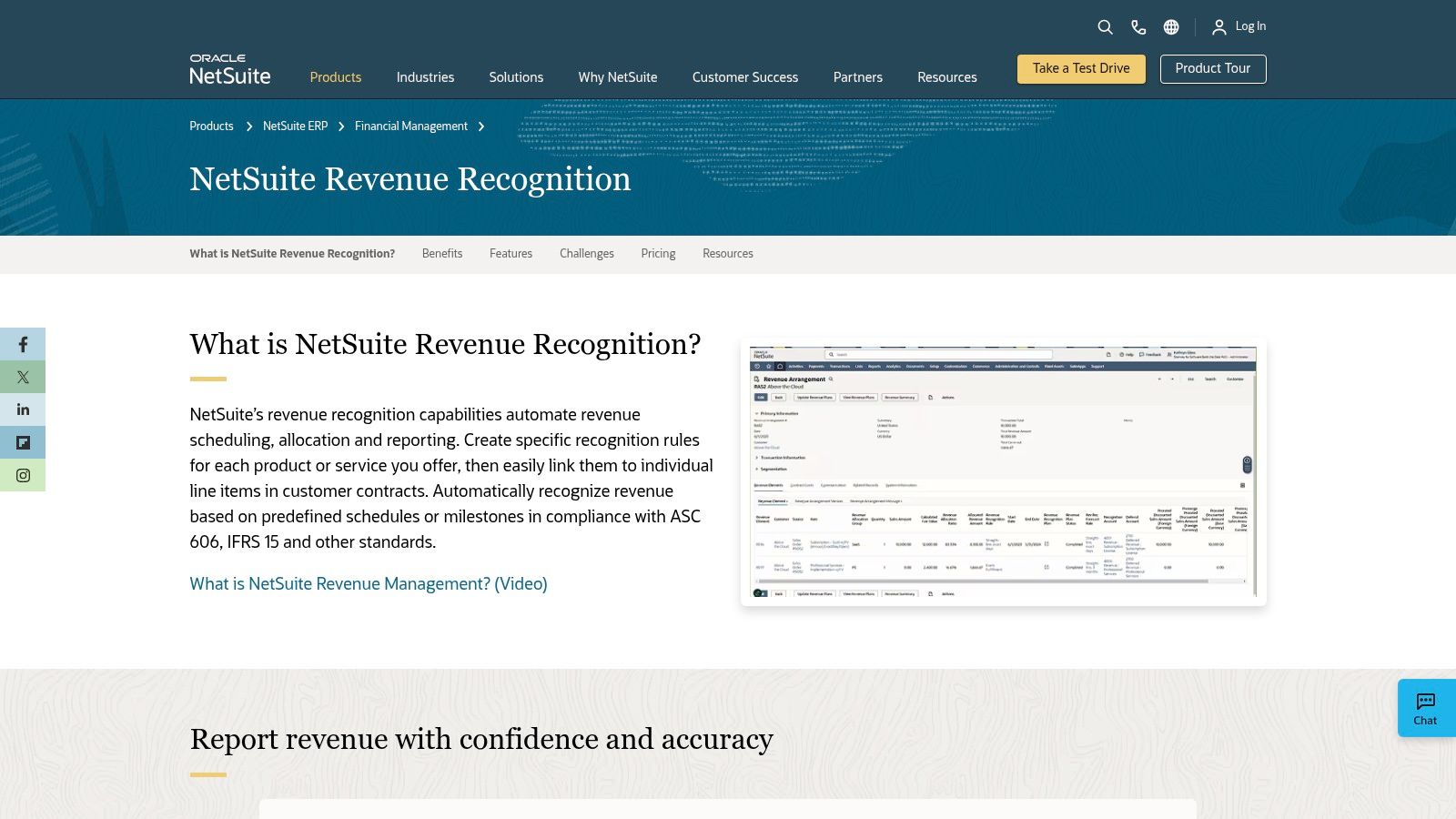
NetSuite Revenue Management creates revenue plans from configured rules and contract line items. Recognition can reflect subscriptions, fulfillment, project milestones, or time-and-materials activity, with allocation and contract-change capabilities.
ERP proximity isn’t the same as complete contract evidence. A controller still needs to establish how negotiated terms entered the system and whether amendments reached the correct arrangement.
- Best fit: Mid-market and enterprise organizations with NetSuite as their accounting system of record.
- Principal benefit: Fewer accounting-system transfers between recognition schedules and ledger reporting.
- Main constraint: Complex policies can require substantial configuration and implementation work.
- Pricing disclosure: Standalone list pricing isn’t published on the linked product page.
The NetSuite revenue recognition implementation guide helps frame the relationship between accounting configuration and upstream workflows. Where internal capacity is limited, NetSuite staffing specialists are a resourcing option, not a substitute for controller-owned policy.
Practical rule: A native ERP module removes a system boundary. It doesn’t remove the need to reconcile source contracts to revenue arrangements.
Audit demonstration: Start with a CRM amendment, not a clean ERP order. Follow the revised terms into the revenue plan and confirm that rejected updates remain visible.
3. Zuora Revenue
Zuora Revenue belongs on enterprise shortlists when allocations and changing contracts exceed basic recurring schedules. Its dedicated revenue subledger is relevant to subscription, usage-based, bundled, and frequently modified arrangements.

Zuora Revenue provides configurable recognition policies, standalone selling price calculations, contract modification handling, and multi-book accounting. The appeal is accounting depth rather than merely placing invoices on a recognition calendar.
That flexibility creates implementation obligations. Finance must define contract grouping, allocation policy, source-field ownership, and the treatment of late-arriving events.
When a dedicated subledger earns its place
Zuora Revenue makes sense when accounting complexity justifies a separate revenue platform. It’s less compelling when straightforward schedules already work reliably inside the ERP.
- Advantages: Broad policy configuration, complex transaction handling, and dedicated revenue reporting.
- Trade-offs: Meaningful design work, another system to reconcile, and governance over configuration changes.
- Pricing disclosure: Quote-based evaluation should include implementation and upstream integration costs.
The revenue recognition audit guide provides a useful basis for designing evidence requests before a demonstration. The critical distinction is whether an auditor can reconstruct an allocation, not merely view its final result.
Audit demonstration: Process a bundled contract with an amendment and delayed usage data. Require the original allocation, revised treatment, approval record, and reconciliation to posted journals.
A successful demo should also show failure handling. An unmatched source record should enter an owned exception queue rather than disappear from the recognized-revenue report.
4. Stripe Revenue Recognition
Stripe Revenue Recognition is a practical option for businesses whose payment and billing activity already lives in Stripe. Its fit weakens when material contract terms or revenue streams sit elsewhere.
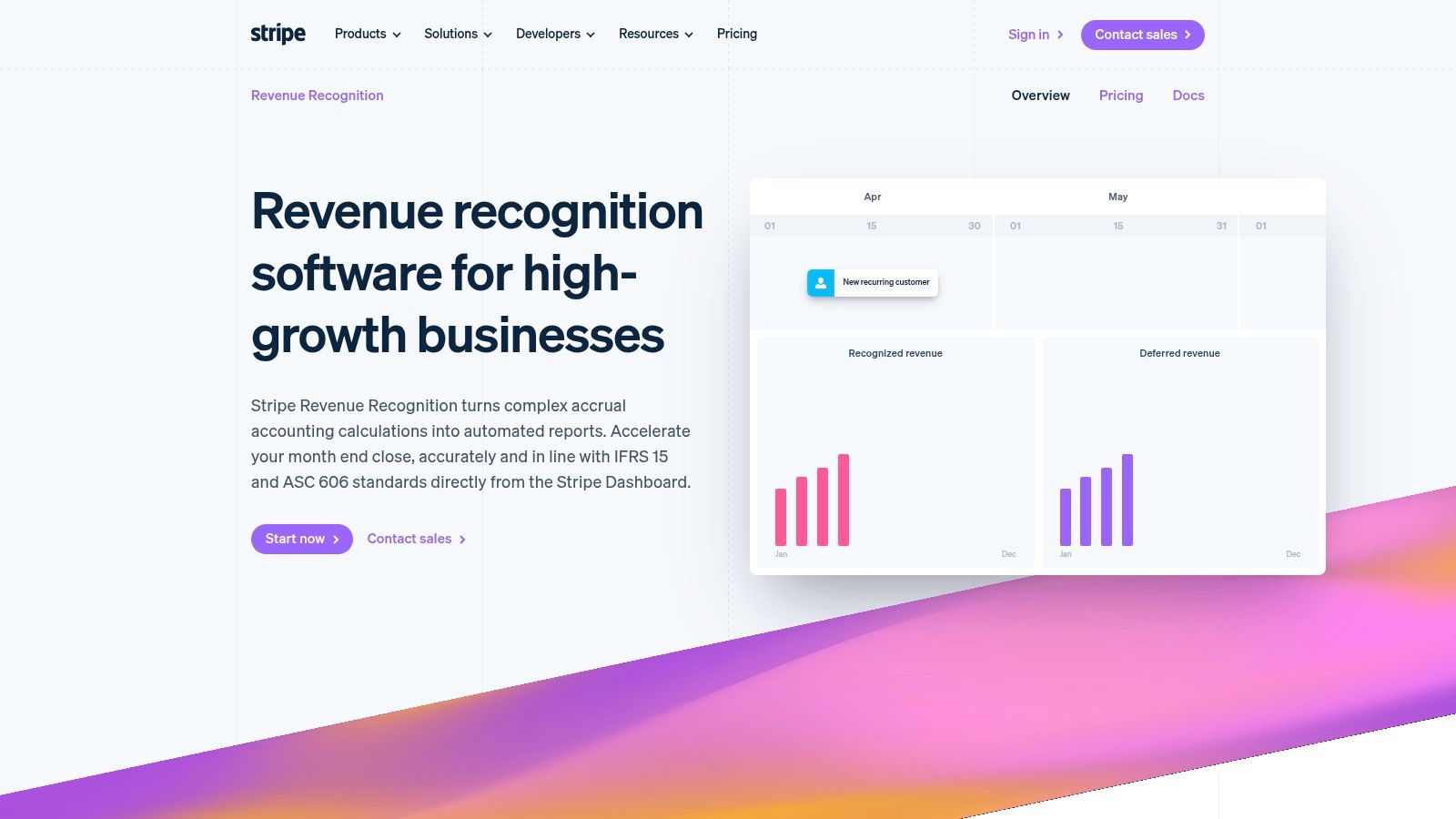
Stripe Revenue Recognition provides recognition rules, journal entries, revenue reports, waterfall charts, and transaction-level detail. Its capabilities include credit notes, multicurrency transactions, accounting-period controls, and chart-of-accounts mapping.
Transaction completeness is the central audit question. Payment records can establish collection, but they don’t necessarily establish every performance obligation or negotiated acceptance condition.
- Best fit: Smaller and growing businesses with Stripe-centered billing and relatively contained accounting complexity.
- Useful evidence: Transaction drill-down and accounting exports support reconciliation between activity and reported balances.
- Constraint: Non-Stripe revenue and externally negotiated terms require explicit completeness testing.
- Pricing disclosure: Public pricing supports initial budgeting, although applicable volume charges need evaluation.
The revenue recognition journal entry guide helps distinguish billing, cash, deferred revenue, and recognized revenue. Those events shouldn’t be treated as interchangeable.
A reconciled payment feed can still be an incomplete accounting input.
Audit demonstration: Combine a subscription, credit note, cancellation, and externally billed transaction. Reconcile the recognized revenue and deferred balances to the ERP, including adjustments.
For finance teams retaining separate CRM contracts, the demonstration should also establish how signed terms change recognition rules. A clean Stripe dataset cannot resolve terms that never reached Stripe.
5. Sage Intacct Revenue Recognition
Sage Intacct Revenue Recognition suits growing organizations that want recognition and core accounting in the same financial platform. It’s a broader finance-system decision, not merely a lightweight scheduling purchase.
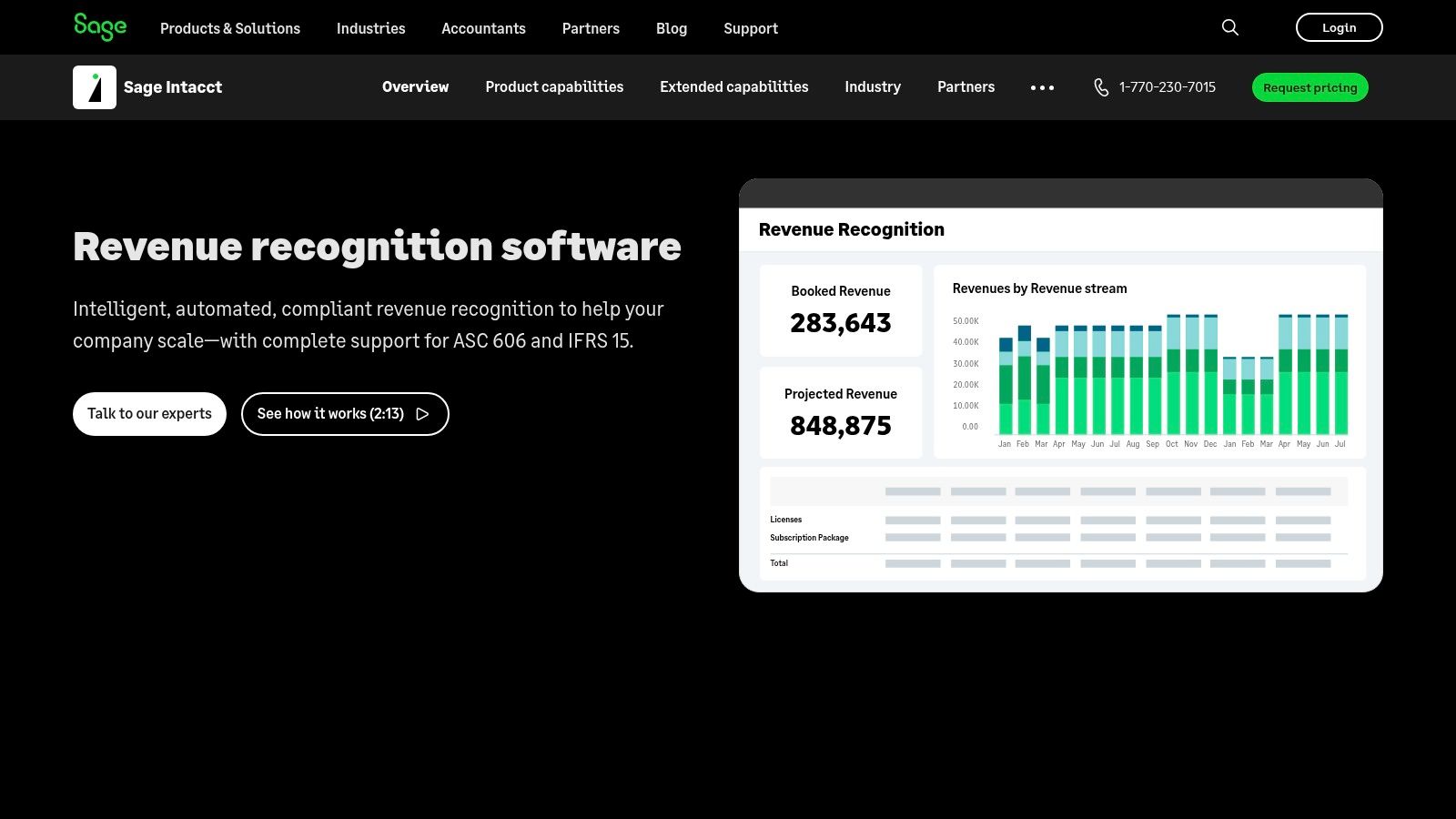
Sage Intacct Revenue Recognition supports ASC 606 and IFRS 15 revenue accounting within its financial management environment. Automated schedules and accounting workflows keep recognition connected to broader reporting.
The buying question is whether the company also wants that accounting environment. Replacing a functioning ERP solely to improve revenue schedules can introduce a much larger implementation scope.
The mid-market control test
Sage Intacct merits attention when multi-entity reporting and revenue accounting are part of the same platform evaluation. Integration depth still needs proof at the object and transaction level.
- Strength: Revenue accounting sits alongside the general ledger and other finance processes.
- Trade-off: Platform consolidation can expand migration, configuration, and training requirements.
- Pricing disclosure: Standard public list pricing isn’t published.
- Validation priority: Contract modifications, allocation policies, upstream CRM data, and exception ownership.
Audit demonstration: Follow an approved commercial change from the CRM into the accounting environment. Inspect the updated schedule, entity coding, posting record, and evidence of review.
The demonstration should distinguish native accounting records from imported contract data. A field arriving successfully doesn’t establish that its meaning matches the signed agreement.
For companies already using Sage Intacct, the evaluation can remain narrower. The focus becomes missing functionality and control gaps rather than wholesale finance transformation.
6. Maxio
Maxio is most relevant to B2B SaaS teams that want billing, subscription management, revenue schedules, and operating metrics together. Advanced allocation requirements deserve a separate evaluation rather than an assumption of coverage.

Maxio combines recurring billing, collections, revenue capabilities, and SaaS analytics. Advanced Revenue adds allocation capabilities for performance obligations, making product scope important during commercial evaluation.
For a growing SaaS company, a combined platform can reduce handoffs between subscription operations and accounting. That advantage matters less when the company intends to retain a different billing system.
- Works well: Closely linked subscription billing and standard accrual-based revenue schedules.
- Needs testing: Bundles, reallocations, milestone-based treatment, and unusual commercial terms.
- Pricing disclosure: Published pricing offers an initial budgeting reference; advanced functionality may require additional scoping.
- Control concern: SaaS metrics and recognized revenue need separate definitions and reconciliations.
Audit demonstration: Process an upgrade, a cancellation, and a bundled arrangement. Compare subscription records with accounting allocations, deferred balances, and posted entries.
A controller should also inspect how corrections propagate. A changed billing record shouldn’t alter the historical evidence behind a closed accounting period.
Maxio’s appeal is consolidation around SaaS operations. The trade-off is accepting the platform’s commercial and accounting model, including how advanced revenue functionality fits the selected package.
7. RightRev
RightRev deserves evaluation when recognition depends on usage, delivery, milestones, bookings, or custom events. Its dedicated-engine approach suits companies that want to retain existing billing and ERP systems.
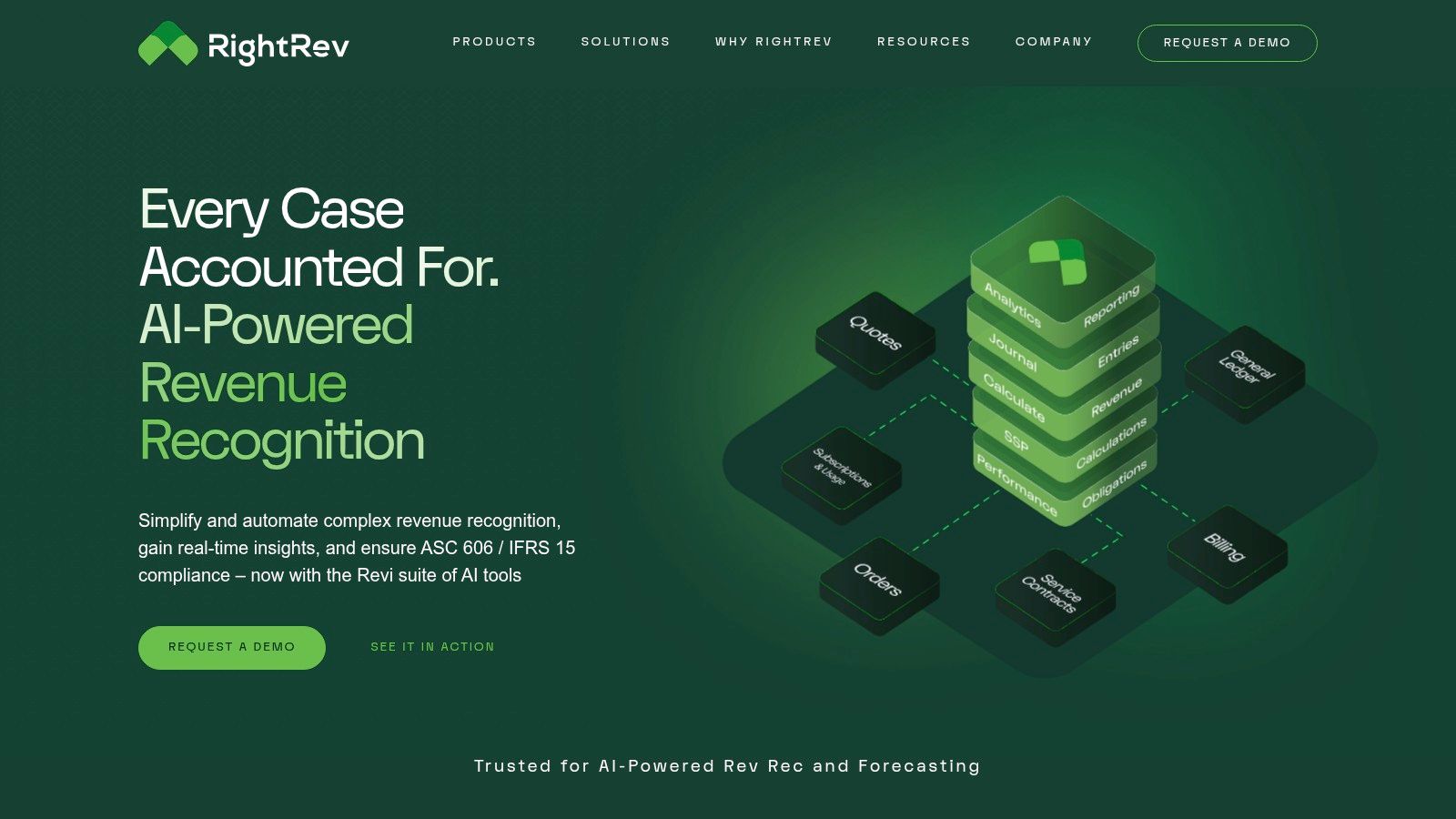
RightRev provides configurable recognition triggers, standalone selling price calculations, allocations, contract modifications, waterfall reporting, and journal entries. The practical distinction is separating recognition events from invoice dates.
Consider a contract combining software access with implementation accepted after delivery. A billing schedule alone may not provide sufficient evidence for the recognition trigger.
Event-driven recognition needs event controls
RightRev’s flexibility is useful only when upstream events are reliable. Finance and engineering teams must agree on event identifiers, effective dates, correction handling, and ownership.
- Best fit: Mid-market and enterprise businesses with varied recognition triggers.
- Advantage: A dedicated revenue engine can operate alongside existing systems.
- Trade-off: Policy design and integration governance remain substantial responsibilities.
- Pricing disclosure: Public pricing isn’t listed.
Audit demonstration: Deliver an event late, send it again, and then correct it. Inspect duplicate prevention, accounting-period treatment, and the exception log.
ERP and CRM integration depth should be tested with actual business objects. A connector listing doesn’t establish that amendments, credits, reversals, and posting acknowledgments synchronize correctly.
For event-heavy revenue operations, the decisive evidence is the link between fulfillment and recognition. A waterfall without that link remains an output, not a complete explanation.
8. Zenskar
Zenskar is relevant when invoiced items don’t map cleanly to revenue obligations. Its separation of billing and recognition can suit SaaS businesses with usage pricing, bespoke terms, or mixed commercial models.
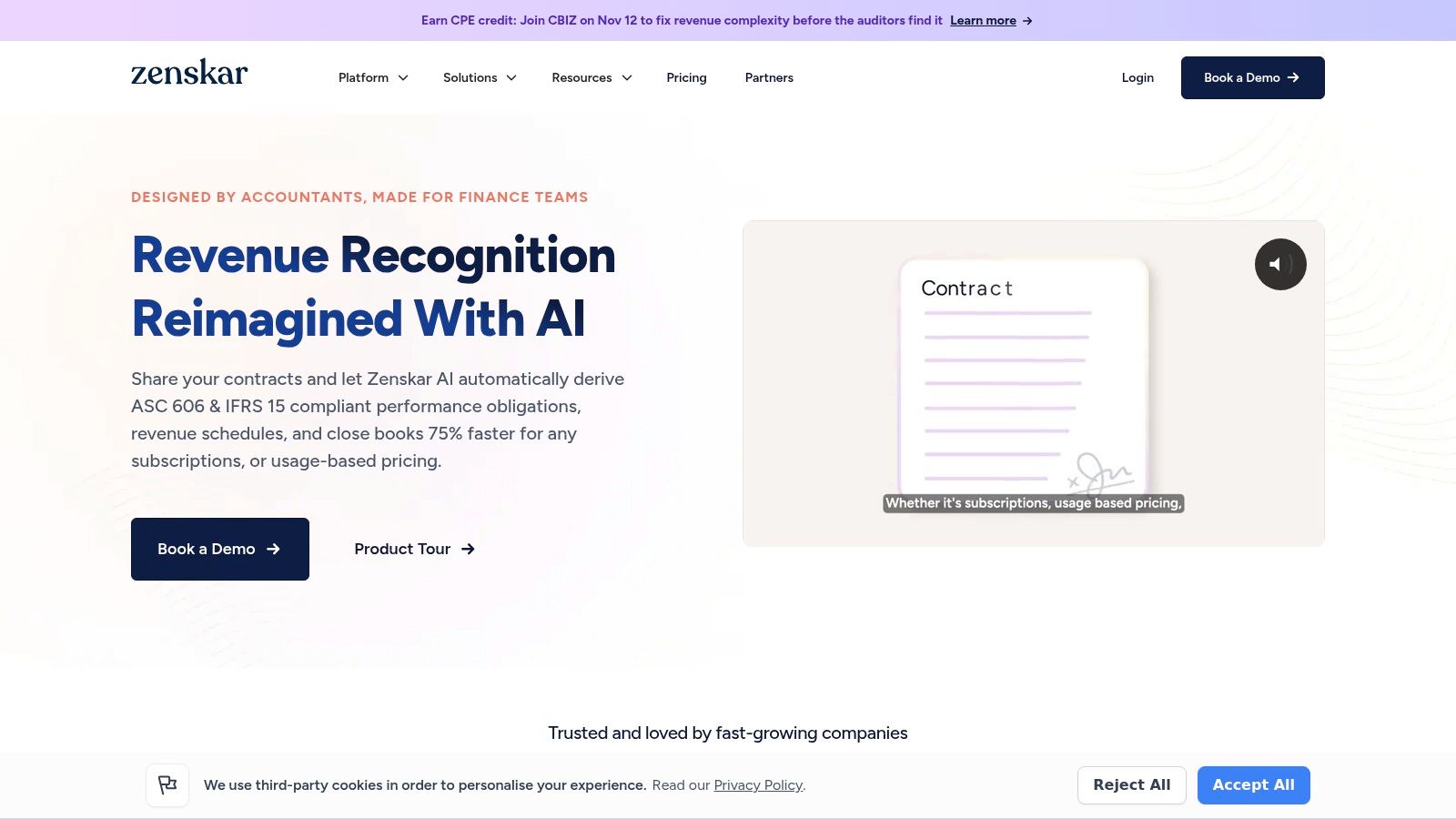
Zenskar’s revenue recognition platform includes schedules, performance obligations, journal entries, a revenue subledger, and integrations across ERP, CRM, and payment systems. Configurable recognition supports arrangements that aren’t neatly represented by invoice lines.
That separation addresses a real accounting distinction. An invoice documents a billing event; the revenue model must explain the underlying promises and their satisfaction.
- Potential advantage: Recognition obligations needn’t inherit every limitation of the billing structure.
- Best fit: Growing and mid-market businesses combining subscriptions, usage, and custom contracts.
- Trade-off: Flexible rules require finance ownership, implementation resources, and ongoing review.
- Pricing disclosure: Quote-based.
Control boundary: Billing flexibility should never allow commercial edits to change accounting policy without review.
Audit demonstration: Use a contract whose invoice lines differ from its performance obligations. Follow the mapping, allocation, recognition trigger, and resulting journals.
Contract extraction should receive its own test. Structured CRM fields and parsed signed terms aren’t equivalent inputs, especially when negotiated exceptions appear only in an attachment.
The platform’s fit depends on whether its flexibility simplifies the company’s actual contract mix. A configurable model that requires constant manual intervention hasn’t eliminated the underlying workload.
9. HubiFi
HubiFi fits high-volume businesses that need revenue accounting across processors, billing platforms, and sales channels. Its emphasis on reconciliation and source-level drill-down is relevant when completeness is harder than schedule calculation.
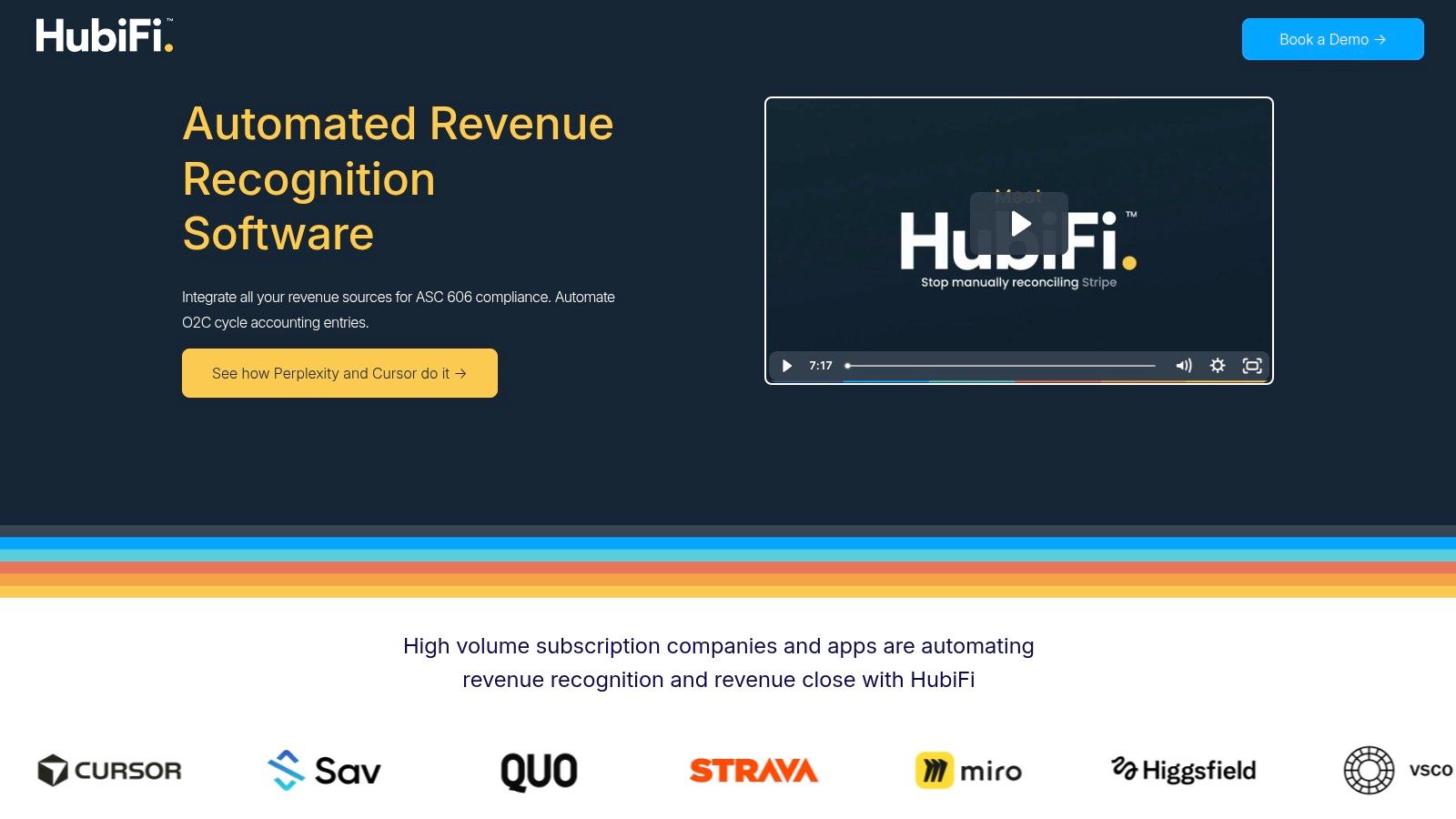
HubiFi’s revenue recognition software supports subscription, usage-based, and multi-channel revenue accounting. Its integration scope includes systems such as Stripe, app stores, Sage Intacct, and NetSuite.
The control problem is source coverage. A correct calculation over an incomplete transaction population still produces an incomplete accounting result.
Reconciliation before reporting
HubiFi’s transaction-level lineage is relevant to teams that must explain summarized entries using underlying records. Package selection matters because integration and journal-entry capabilities vary.
- Strength: Multi-source accounting and transaction drill-down.
- Best fit: Mid-market and enterprise businesses with substantial transaction complexity.
- Constraint: A high-volume focus may exceed a simple single-system workflow’s needs.
- Pricing disclosure: Published annual starting prices provide an initial budget signal.
Audit demonstration: Reconcile source transaction counts and amounts through transformation, recognition, and ERP posting. Include missing records, refunds, duplicate feeds, and timing differences.
The exception log should distinguish unresolved accounting issues from technical ingestion failures. Those problems require different owners, even when both delay posting.
For smaller teams, the commercial assessment should include whether reconciliation complexity warrants a dedicated platform. Transaction volume alone doesn’t establish that need.
10. Recurly RevRec
Recurly RevRec is a subscription-focused option that can be evaluated separately from billing replacement. Its contract review and accounting features merit attention when upgrades, downgrades, and cancellations drive recurring manual work.
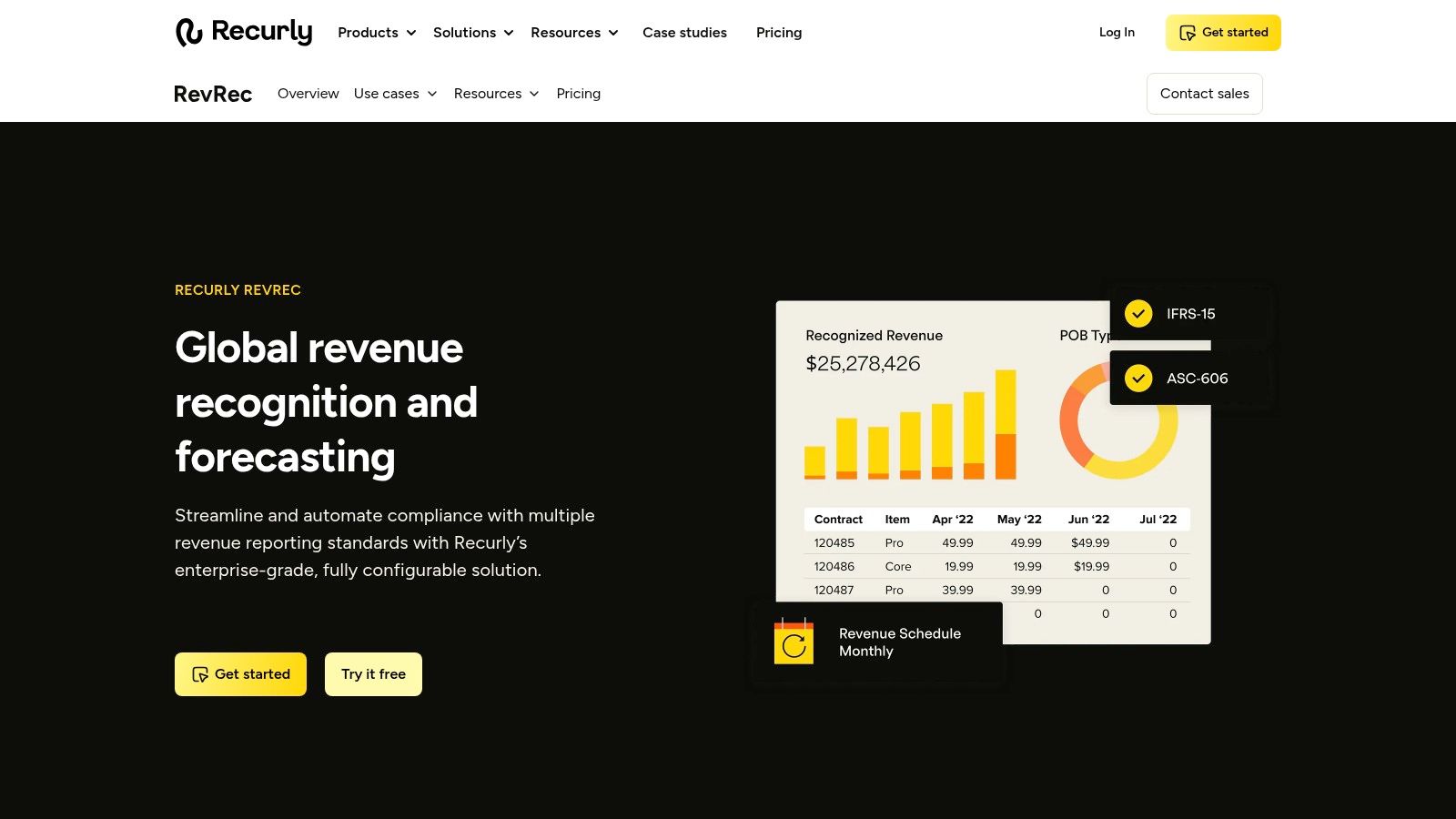
Recurly RevRec supports ASC 606, IFRS 15, multicurrency, and multi-book accounting. Recurly describes standalone availability, while its documentation covers contract grouping, performance obligations, variable consideration, standalone selling prices, and workbench review.
Standalone availability isn’t proof of integration completeness. The company’s particular billing platform and ERP still need an end-to-end test.
- Advantages: Subscription-oriented contract changes, revenue schedules, configurable reporting, and review controls.
- Useful evaluation material: Product documentation and API information help assess setup before implementation.
- Trade-off: Non-subscription and highly bespoke arrangements require careful testing.
- Pricing disclosure: Revenue recognition product pricing isn’t clearly published.
Audit demonstration: Process an upgrade followed by a partial cancellation and credit. Inspect contract grouping, allocation changes, reviewer actions, and the final posting acknowledgment.
The workbench should support an owned review process, not merely display items awaiting attention. Finance needs to establish who resolves each exception and what evidence remains after resolution.
Recurly RevRec belongs on subscription-company shortlists where its documented accounting model matches the contract population. Billing familiarity alone isn’t sufficient justification.
Revenue recognition tools at a glance
| Item | Deployment Model | Best For | Public Pricing | Main Limitation |
|---|---|---|---|---|
| Loopfour (Recommended) | Configurable workflows across existing finance systems | Auditable finance operations spanning multiple tools | Not publicly stated | Custom workflows require planning; exceptions need review |
| NetSuite Revenue Management | NetSuite ERP add-on | Organizations already using NetSuite | Standalone list pricing not published | Best suited to NetSuite users; complex policies may need significant setup |
| Zuora Revenue | Dedicated revenue automation platform | Enterprises with complex subscription and usage-based contracts | Quote-based | May be excessive for simple needs; implementation requires design work |
| Stripe Revenue Recognition | Stripe-integrated revenue recognition tool | Companies with revenue data primarily in Stripe | Public pricing available | Less suitable when substantial revenue data sits outside Stripe |
| Sage Intacct Revenue Recognition | Capability within Sage Intacct financial management | Growing companies seeking accounting and revenue recognition together | Public list pricing not published | Part of a broader financial system decision |
| Maxio | Billing, subscription management, and revenue platform | B2B SaaS teams linking billing with revenue schedules | Published pricing available | Advanced allocation and complex cases may need additional evaluation |
| RightRev | Dedicated platform integrated with existing systems | Teams with varied recognition triggers and complex contracts | Not publicly listed | Requires policy design, implementation, and ongoing governance |
| Zenskar | Revenue recognition platform connecting multiple systems | Businesses with complex pricing, usage, or bespoke contracts | Quote-based | Flexible rules and complex scenarios may require ongoing resources |
| HubiFi | High-volume, multi-source revenue accounting platform | Organizations managing revenue across multiple channels | Published annual starting prices | May exceed the needs or budget of smaller teams |
| Recurly RevRec | Standalone subscription revenue recognition product | Subscription businesses handling contract changes | Pricing not clearly published | Fit with specific billing systems and bespoke models should be verified |
Frequently Asked Questions About Revenue Recognition Tools
Revenue recognition tools should be evaluated against accounting policy, source completeness, and retained evidence. The following answers address the decisions that most directly affect selection.
What does a revenue recognition tool actually do?
A revenue recognition tool translates contract terms and fulfillment evidence into allocations, recognition schedules, and accounting entries. An SEC-filed ASC 606 policy disclosure explains that recognition follows the transfer of control, either over time or at a point in time.
Can revenue recognition software guarantee ASC 606 compliance?
Revenue recognition software can apply approved policies consistently, but software alone can’t establish appropriate accounting judgment. An SEC-filed contract policy identifies enforceable rights, payment terms, commercial substance, and probable collection as contract considerations that precede scheduling.
How should revenue recognition tools handle variable consideration?
Revenue recognition tools should preserve the source term, estimate, allocation, review, and subsequent adjustment. An SEC-filed revenue policy identifies milestone payments as variable consideration, illustrating why a fixed billing schedule may be insufficient.
Does a revenue recognition tool need contract extraction?
Contract extraction is useful when signed terms contain accounting inputs missing from structured systems. Extraction should retain the source document, identify uncertain interpretations, and route ambiguity for approval rather than converting text into accounting policy.
What proves that ERP and CRM integrations are deep enough?
ERP and CRM integration depth is demonstrated by complete business events, not connector logos. A meaningful test follows a new contract, amendment, credit, rejected update, retry, and posting acknowledgment while preserving source identifiers and exception ownership.
Pick the Tool Your Auditors Can Verify
The right revenue recognition tool is the one that can explain the company’s actual contracts and postings. Finance leaders should shortlist a small set against contract mix, systems of record, and control requirements before evaluating interface preferences.
Confidence alone isn’t enough. Leapfin’s revenue-accounting automation survey reported that 79% of respondents felt somewhat or very confident about compliance and passing audit, while only 13% of systems personnel were satisfied with the process. Those measures describe different perspectives, but the operational warning is useful: reported confidence doesn’t establish that integrations and exceptions are well controlled.
Company size helps narrow the list, but stack architecture should decide the next step. ERP-centered organizations should begin with their native module. Complex enterprises should test dedicated subledgers. Subscription businesses should compare billing-adjacent capabilities against their actual allocation needs.
- Existing ERP, fragmented handoffs: Evaluate governed workflows across the current stack.
- Complex bundles and modifications: Prioritize allocation history, contract grouping, and policy versioning.
- High-volume, multi-source revenue: Prioritize completeness controls and transaction lineage.
- Straightforward subscription accounting: Avoid implementation complexity that doesn’t address a demonstrated problem.
Then run a real multi-element contract end to end. Include its signed terms, allocation policy, billing events, fulfillment evidence, amendment, and final journals.
The evidence package should preserve the accounting explanation, not just the calculation. A controller should be able to identify the applicable policy version, reviewer, exception disposition, source records, and posting response without reconstructing them manually.
Loopfour, the deterministic finance workflow automation platform, fits teams that want to keep their current systems and add governed, inspectable workflows on top. Its relevance is strongest where contract interpretation, approvals, calculations, and ERP writes currently depend on disconnected handoffs.
Industry context still matters. Teams evaluating financial reporting for growing WISPs should apply the same distinction between operational billing detail and auditable accounting evidence.
A final commercial review should cover configuration ownership, maintenance responsibilities, evidence export, and treatment of upstream changes. The cheapest license can still leave finance carrying the integration workload.
The purchase decision should follow the journal entries and audit trail. A convincing demonstration ends with evidence that a controller can reproduce and an auditor can inspect.
Loopfour offers deterministic revenue recognition workflows that connect approved contract terms, predefined accounting policies, deferred-revenue schedules, and ERP postings. Visit Loopfour to discuss a contract-to-journal workflow demonstration using an existing finance stack and its audit requirements.