
Integration with ERP is a control problem before it’s a connection problem. In 2025, 46.45% of EU enterprises ran ERP software and 88.71% of firms with at least 250 employees did, yet no connector dashboard can tell you whether last night’s invoice posted once, in the right entity, in the right period, under an approved identity. Integration with ERP is the governed exchange of master data and accounting transactions so the ledger stays the system of record.
Your close calendar says day three. Every interface shows green. The ERP trial balance is short two invoices, and the person who built the mapping left in March.
By Zuny Fester, Head of Operations and Marketing
Table of Contents
- What Integration with ERP Means for Finance
- Connection Methods and When Each Fits
- How a Governed Posting Stays Accurate
- Why ERP Integrations Fail in Practice
- Finance Workflows That Need the ERP
- Choose Batch or Continuous Writes
- Questions Finance Teams Ask Next
What Integration with ERP Means for Finance
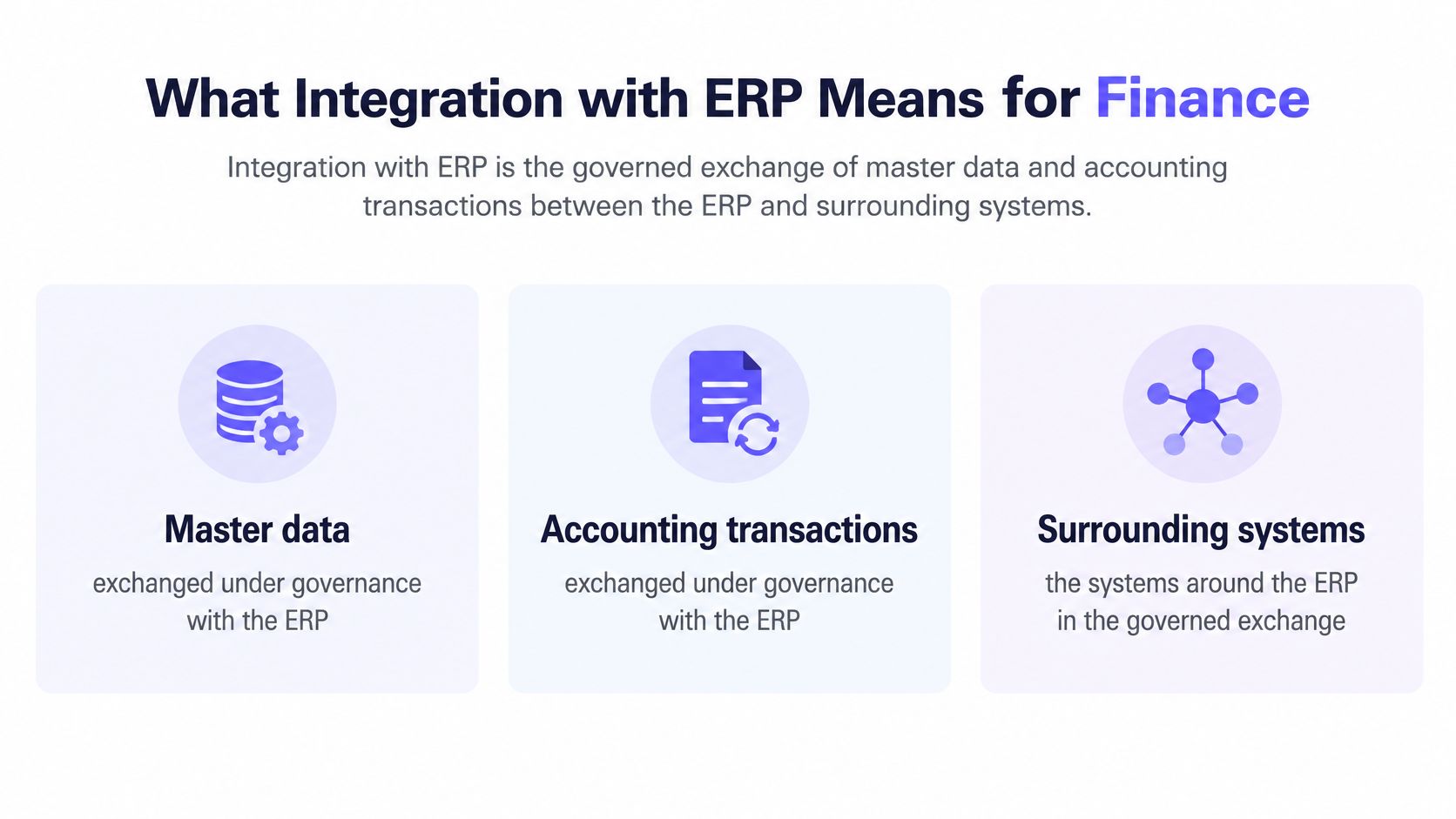
Integration with ERP means the governed exchange of master data and accounting transactions between the ERP and the systems around it, so every invoice, payment, and journal lands once, in the right entity and period, under an authorized identity. The ERP is the ledger system of record. It isn’t a warehouse for every field a CRM, billing tool, or inventory app happens to collect.
Scale explains why this matters now. In 2025, 46.45% of enterprises in the European Union used ERP software, according to Eurostat’s e-business integration statistics, ranging from 41.08% of small enterprises with 10 to 49 employees to 88.71% of enterprises with at least 250 employees. Among information and communication firms, 61.28% ran ERP. The ERP stopped being a large-manufacturer tool and became the transaction layer everything else plugs into.
That shift changes the job. A 300-person company with a CRM, a billing system, a bank feed, and a reporting stack doesn’t need help moving data. It needs the ledger to stay correct while five systems claim to own the same customer, currency, and invoice.
The test that matters: when the interface team has moved on, can a reviewer take last month’s run and show that one invoice posted once, with an approval, in the right entity?
A green connector status tells you the last call returned. It says nothing about whether the amount matched the contract, whether the period was open, or whether a retry two hours later created a second journal. Those are control questions, and the answers live in design choices rather than a vendor’s uptime page.
Multi-system coordination gets concrete fast. Connecting CRM, ERP and construction software is a useful model for the harder version of this problem: a job record, a contract, and a ledger that all have to agree on the same fields before anyone trusts a report.
The rest is method: the connection type that fits the assertion, posting rules that survive a retry, the failure patterns that recur in real projects, the workflows to wire first, and the evidence an auditor can test after go-live.
Connection Methods and When Each Fits
The right way to connect is the one whose timing and failure mode match the accounting assertion you’re making, not the newest connector in the catalog. Pick one primary method per business event and refuse a second hidden path that can also post to the ledger.
| Method | Fits when | Control watch-out | Typical timing |
|---|---|---|---|
| Native API or vendor connector | Cloud ERP with a documented, stable API | A retry can duplicate a journal, invoice, or vendor | Seconds to minutes |
| Integration platform or middleware | Many SaaS apps mapped through one hub | Field maps drift when either system changes | Minutes |
| Scheduled file or batch | Close, bank files, and high-volume journals | A late or partial file misses cutoff if rejects have no owner | Hours or once a day |
| Bank or payment feed | Cash position and payment status | Feed totals rarely equal open items without a match rule | Intraday or daily |
| Embedded ERP component | A product must show or write ERP data in its own UI | Finance often doesn’t own the embedded write path | Interactive |
| Secure browser session | Legacy or homegrown tools with no API | A screen change breaks the step; sessions need tight permissions | On demand |
Read the table by column, not by row. Timing sets the control design, because a write that lands in seconds has no reconciliation step between the source event and the ledger entry.
Leave a native API when the contract isn’t documented or the vendor ships field changes without notice. At that point you’re maintaining a mapping against a moving target.
Leave middleware when it becomes the only place the mapping exists. Middleware fails: a field map drifts after either system changes, and the first symptom is a close that doesn’t tie.
Leave batch when the business event needs a same-day cash answer. Batch itself is fine; batch without a named owner for the reject file is where cutoff breaks.
Leave a bank feed when you expect it to clear invoices. A feed updates cash status, and matching it to open items takes a rule, a tolerance, and a person for the exceptions.
Leave an embedded component when finance can’t test the write. A product writing to the ledger through its own path is convenient for users and invisible to the controller.
Leave a browser session as the last resort, and lock it down with a named service account, least privilege, and per-step session logs.
Choosing the hub underneath all of this is a separate decision, and this comparison of API integration platforms covers the trade-offs. Teams wiring a lending or funding product into the ledger hit the same read-versus-write split, and ERP integration for MCA funders is a useful companion on how that access gets scoped.
The connector is the easy half. What the write is allowed to do is the part that decides whether the books hold.
How a Governed Posting Stays Accurate
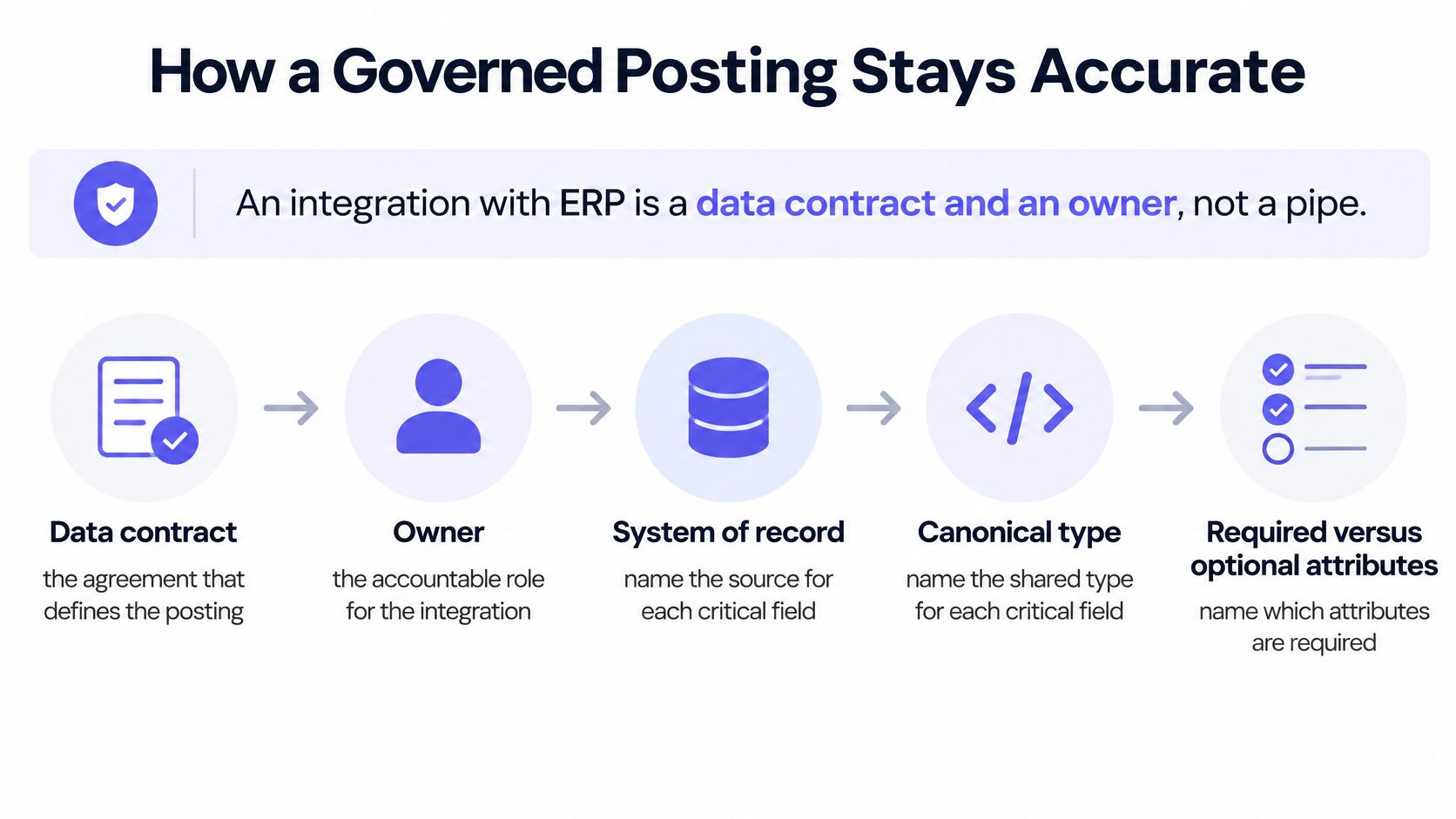
A governed posting stays accurate because the interface is a data contract with a named owner, not a pipe between two systems. Define the contract once, field by field, and the rest of the control set follows from it.
Idempotency comes first. A retry after a network timeout must not create a second journal, invoice, payment, or vendor record. The mechanism is a business-event key built from entity, document number, fiscal period, and source transaction ID, persisted before the ERP write. If the call fails, retry with the same key. If the key already exists, the interface returns the original result instead of posting again.
A review of 72 technical ERP-failure articles published in Data & Knowledge Engineering found that integration complexity rises when different stakeholders implement competing interpretations of what must be integrated. That’s a governance finding wearing a technical costume.
For each critical field, the contract names the system of record, the canonical data type, required versus optional attributes, authentication, timeout behavior, retry policy, error meaning, and version. Rejected records route to a named owner with the original payload, the ERP response, and a correlation ID.
Never use last-write-wins on master data. CRM, billing, and ERP updates overwrite each other, and the first you hear about it is a customer with two addresses and one tax code.
Practical rule: resolve a master-data conflict with an ownership rule, not with a timestamp.
Before production, profile the source for nulls, duplicate keys, invalid codes, mixed currencies, and bad effective dates, then block the post when validation fails. Contract-test against multi-entity, period-close, reversal, and partial-failure scenarios. NIST SP 800-53 AU-2 sets the logging bar: chosen events, a logging frequency, a written reason each event supports after-the-fact investigation, and a periodic review of that selection. Authentication failures and privilege use belong in the log next to successful transfers.
Evidence each interface run must keep
| Evidence item | What to store | Control it supports |
|---|---|---|
| Initiating identity | User or service that started the run | Authorization |
| Source payload | Values sent, including entity and period | Completeness |
| ERP response | Status and document reference returned | Accuracy |
| Business-event key | Entity, document number, fiscal period, and source transaction ID | No second journal on retry |
| Rejects and corrections | Original payload, response, correlation ID, and named owner | Exception ownership |
| Final write | Destination ledger result | Books match the run |
| Approval | Person and timestamp for an override | Auditor reconstruction |
The posting rule decides whether the books balance, and automated journal entries covers how that rule gets versioned and tested. Any run should show five things to a reviewer: who started it, what went in, what the ERP returned, who approved the exception, and whether a retry reused the same key.
Why ERP Integrations Fail in Practice
A journal can post successfully and still be wrong. The integration may have omitted transactions, applied an outdated rule, or accepted a change without the right approval. Treat ERP integration as a control problem: the goal is complete, accurate, authorized postings with evidence you can replay.
Process and ownership failures often surface as technical defects. Teams may not agree on the business rule, who approves a change, or who owns rejected transactions. A review of 55 studies identified 35 recurring failure factors, including thin executive support, inadequate training, strategic mismatch, weak project management, and user resistance, in this analysis of ERP failure factors.
For finance, the practical response is to keep standard ERP behavior where it works and manage company-specific rules in a versioned workflow. Require approval for rule changes, and assess their impact before release. An unowned script can encode a controller’s judgment without documenting who authorized it or what happens when the rule changes.
| Failure | What breaks in the books | Metric to watch |
|---|---|---|
| Poor process understanding | The interface encodes the wrong business rule | Exception rate by rule |
| Excessive customization | Standard ERP behavior is bypassed and hard to test | Share of writes outside standard objects |
| Bad source data | Nulls, duplicate keys, bad currencies, wrong effective dates | Reject rate before posting |
| Weak change control | A field or rule change silently stops the journal | Failed-run rate after a release |
| No owner for rejects | A partial file looks successful | Percent of transactions needing a person |
| Thin logging | A reviewer cannot reconstruct the write | Evidence retained per interface run |
Track six measures for each interface: successful-run rate, exception rate by rule, end-to-end latency, retry count, duplicate-prevention events, and the share of transactions that need a human. Real-time sync is not a control measure. Faster transfers can spread bad master data before anyone notices.
Ownership also becomes harder when a workflow crosses teams or systems. Revenue-cycle handoffs are one example; what RCM services actually deliver describes services in that area. For any cross-team workflow, name who resolves rejects and who can authorize a correction.
Baseline the six measures for one workflow before adding another system. If you cannot state the exception rate by rule, you do not yet have enough control to scale the interface.
Finance Workflows That Need the ERP
Three workflows put a bad integration straight into the ledger: revenue recognition, payment reconciliation, and order-to-cash. Each has a countable population, a period cutoff, and an auditor who wants the tie-out.

Revenue recognition is where manual workarounds hide longest. An industrial manufacturer replaced its workarounds with a six-step pipeline from Epicor to posted, auditable journal entries: pull the terms, build the schedule, post once. Loopfour, the deterministic finance workflow automation platform, runs these as predefined steps and writes back to the ERP the customer already has.
Payment reconciliation is the workflow that exposes a weak match rule. A healthcare technology company retired a 4,000-row spreadsheet for a deterministic four-way match across pricing, orders, the general ledger, and invoices. Cleared matches post back to the ERP with the trail attached. Unmatched items go to a person with the payload, never into a side file.
That payment workflow is also the one most likely to be automated in the wrong order. The matching rule has to exist before the posting step, or the ERP absorbs whatever the spreadsheet said.
Order-to-cash fails because the touchpoints multiply. A cybersecurity software company automated 19 workflows across e-invoicing, collections, and cash application, so every reminder and applied payment stays tied to the invoice that produced it. The accounts payable automation process makes the same point on the buy side: the control is the link from document to posting, not the volume processed.
Contrast the failure mode. A spreadsheet or an unowned script does the same math until a person leaves or a column moves. A predefined run does the same math every period and keeps the execution tree behind it.
Interface logging is where finance and IT often disagree. GAO guidance on federal information-system controls calls for logging interface processing events tied to significant business processes, and asks whether those events are sufficient for error identification, research, and resolution. A simple success message doesn’t demonstrate control over a partial run.
Evidence retention follows the same logic. Dated execution logs, approvals, and permission changes across the review window beat a screenshot captured after go-live.
Start with the workflow that has the most re-keying and an unambiguous system of record. That’s usually revenue recognition in a subscription business and payment reconciliation everywhere else.
Choose Batch or Continuous Writes
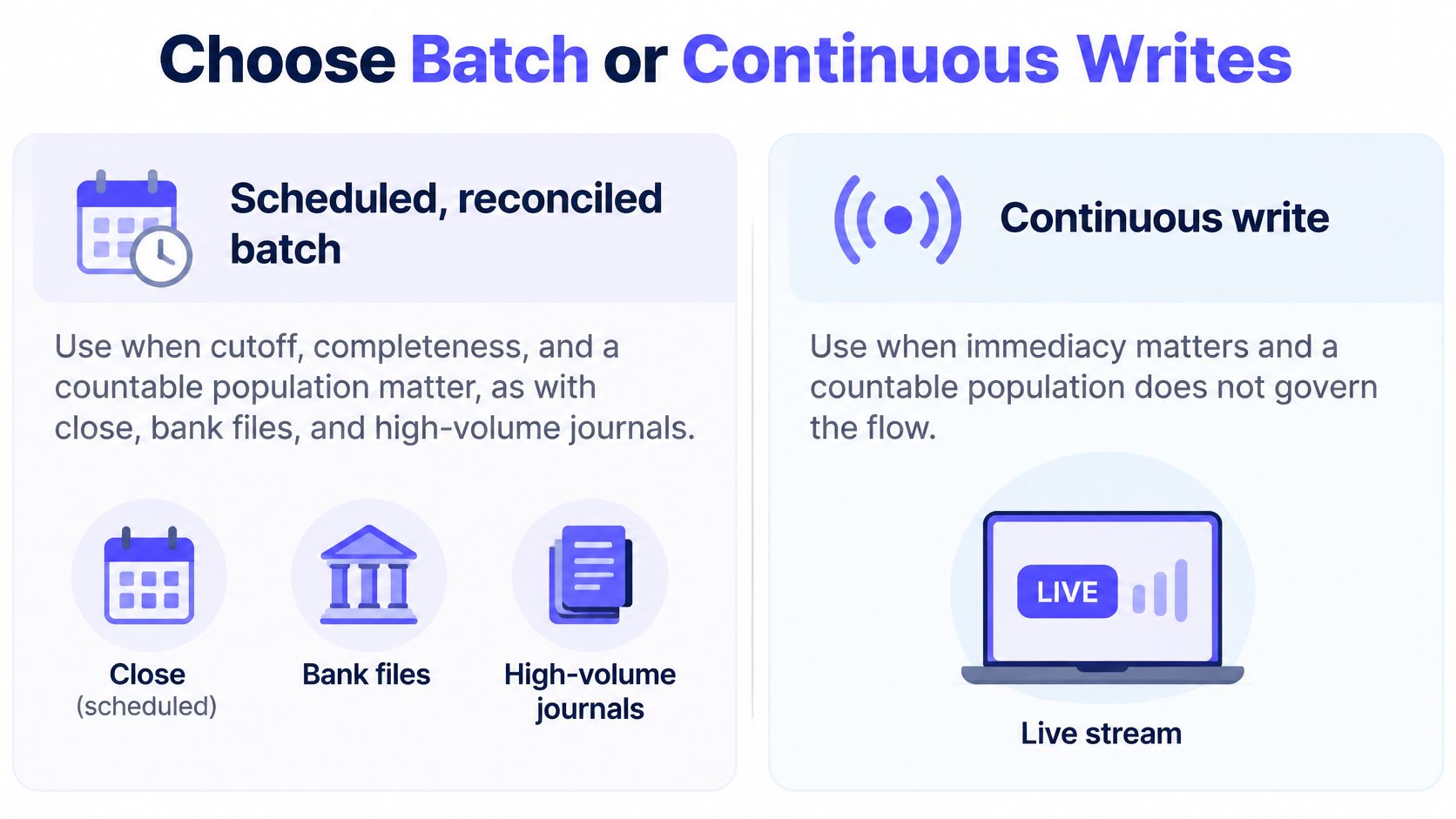
Use a scheduled, reconciled batch when cutoff, completeness, and a countable population matter, as with close, bank files, and high-volume journals. Use a continuous write when volume is low, master data is clean, and the posting contract already blocks a second journal.
The pressure to go real-time is real, and so is the cost. In a survey of U.S. CFOs summarized in Airwallex’s guide to ERP system integration, 55% identified data accuracy and consistency as significant hurdles, while 48% named integration complexity as their top challenge.
Real-time sync can spread a bad customer, item, or currency faster than your team can see it. A wrong tax code that would have shown up in a nightly reject file instead posts to 400 invoices before anyone opens the exception report.
Score the decision against the assertions instead of the architecture diagram: completeness, accuracy, authorization, cutoff, segregation of duties, and change management. A batch that ties source record counts and monetary totals to ERP postings is easier for your auditors to test than a stream of success messages with nothing to sample.
What to ask before you turn on real time: which control catches a bad field first, and how many records does it touch before that control fires?
Ad-hoc scripts make this worse. They hop between CRM, billing, and the ERP, and they leave a trail thin enough that reconstructing a single posting takes a day of log reading.
Loopfour runs the timing you chose as predefined, versioned steps, writes results back into NetSuite, QuickBooks, Xero, Sage Intacct, or Rillet, and keeps your existing ERP, CRM, payment processor, and approval path in place.
The next action is a timing call for one workflow, not a connector catalog. Pick the business event, name the assertion it threatens, and decide how often it has to land.
Questions Finance Teams Ask Next
How many EU enterprises run ERP in the cloud
In 2025, 15.88% of EU enterprises used cloud services for ERP, according to Eurostat figures summarized in AppseConnect’s ERP integration statistics. Cloud delivery changes where the connector runs, not where the books live. The ERP stays the ledger.
Is the ERP software market shrinking
No. The ERP software market was reported at approximately $48 billion in 2022, with forecasts of about 7% annual growth from 2023 through 2032. A second estimate placed 2023 at $50.57 billion and projected $123.41 billion by 2032, a 10.4% compound annual growth rate, both compiled in Anchor Group’s ERP integration statistics. Definitions of ERP software differ between analysts, and both series expand rather than contract.
How long should integration evidence be retained
Long enough to cover the audit period, not just go-live. A SOC 2 Type II examination tests whether controls operated effectively across a defined observation window rather than whether they were designed on one date. One source cited in CloudQuery’s SOC 2 explainer uses a six-month minimum, while other summaries describe windows of three to twelve months. Keep dated execution logs, approvals, permission changes, and remediation records for the whole window.
Does a success message satisfy an auditor
No. A 200 response proves the call arrived. An auditor wants the reject file, the named owner who cleared it, the correction, and the final ledger result, because the risk sits in the partial run that reported success at the interface layer and posted nothing at the ledger.
What does a green connector status not prove
It doesn’t prove completeness, accuracy, authorization, cutoff, or that the write happened once. It proves the last call returned. Those five assertions need reconciliation between source counts and ERP postings, plus evidence tied to the identity that triggered the run.
Can you integrate with an ERP that has no API
Yes, through a controlled browser session. Scope the credentials to a named service account with the minimum permissions the task needs, log every step, and capture the resulting document reference. The trade-off is fragility: a screen change breaks the step, so budget for monitoring rather than assuming it runs unattended forever.
Loopfour turns recurring finance workflows into deterministic, versioned steps that run across the ERP, CRM, billing, and bank tools you already own, and it keeps the execution evidence an auditor can test after the build team has moved on. If your close still depends on a spreadsheet tying two systems together, start with the workflow that has the most re-keying and a clear system of record. Visit Loopfour to see how one run gets defined, approved, and evidenced.