
The invoice posted successfully, but the customer carried the wrong subsidiary. The CRM record looked normal. NetSuite accepted the transaction. Accounts receivable discovered the problem during month-end review, when the source aging report no longer agreed with the ERP balance. Integration with NetSuite is not primarily a connectivity project. It is a data-ownership, posting-control, and audit-evidence project.
A reliable design makes identical inputs produce identical outputs, rejects invalid records before posting, and preserves enough lineage to explain every write. The practical standard is deterministic, auditable, predefined behavior, with exceptions routed to named finance owners instead of being hidden inside retries, spreadsheets, or ad hoc scripts.
Table of Contents
- What Integration with NetSuite Actually Means for Finance
- Authentication, Connectors, and Data Mapping the Right Way
- Where Manual NetSuite Integration Quietly Fails
- Error Handling, Retries, and Test Plans That Survive Audit
- Go-Live, Versioning, and Ongoing Governance
- A Real Failure Scenario and How Deterministic Controls Catch It
- Frequently Asked Questions About Integration with NetSuite
- Is OAuth 2.0 enough for SOX-relevant NetSuite workflows?
- How can a finance team defend NetSuite governance limits to an auditor?
- Why aren’t CSV imports and saved searches a durable AR or AP bridge?
- What evidence should a deterministic workflow retain for each NetSuite posting?
- How should saved searches and custom records be versioned after go-live?
- When does a SuiteTalk SOAP call matter more than REST?
What Integration with NetSuite Actually Means for Finance
A customer update can pass an API check and still damage the close. A sales order sync matches a name, overwrites a field, and carries the wrong subsidiary into an invoice. NetSuite reports a successful request. Accounts receivable finds the problem later, when aging, revenue detail, or intercompany reporting no longer reconciles.
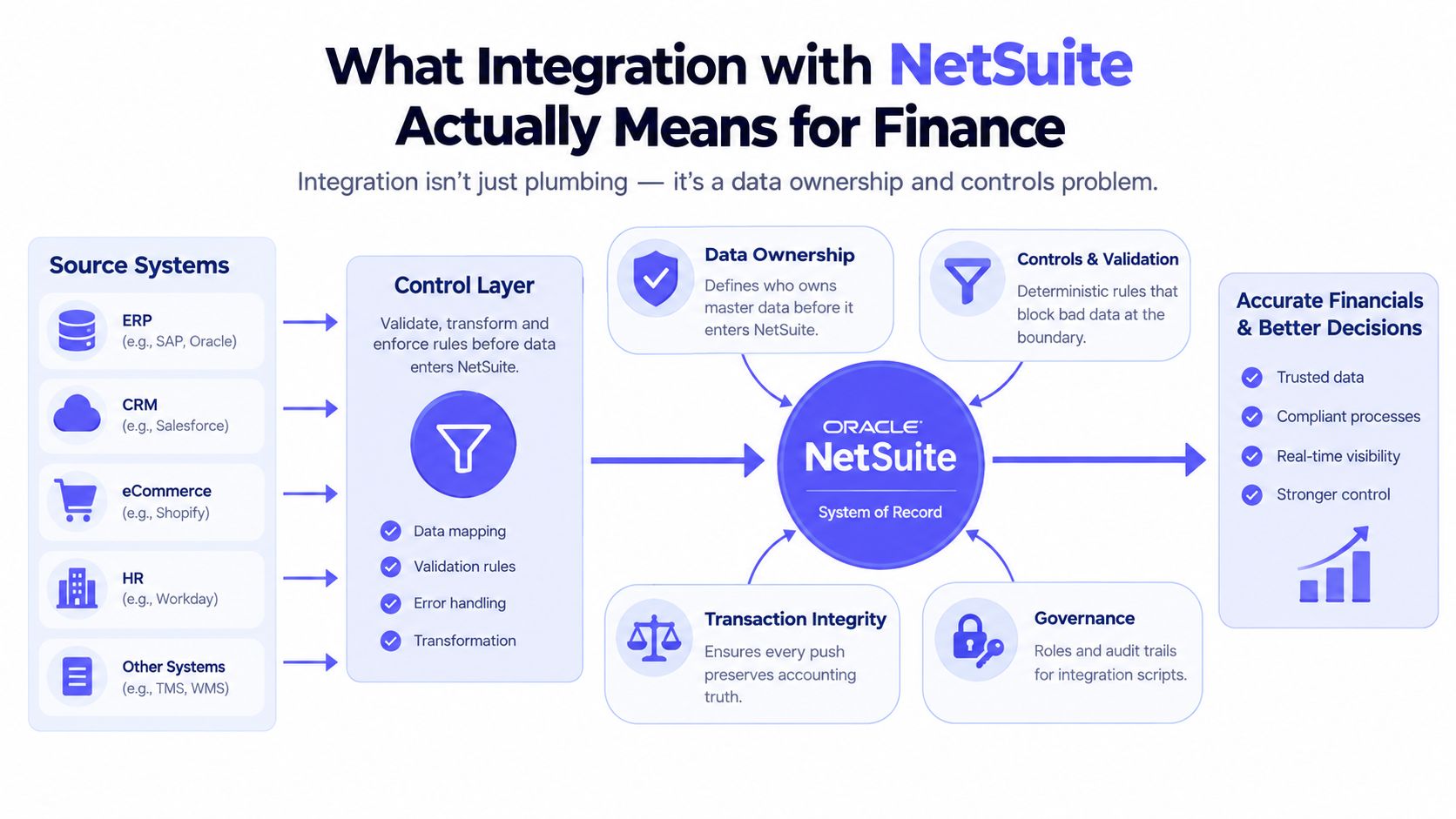
Integration with NetSuite means controlling data ownership and transaction integrity across systems, not merely moving records between APIs. NetSuite should receive finance-ready data only after the source, mapping, validation, and exception path are defined. The key question is not whether a connector can write a record. It is which system owns each value, who approves a disputed value, and what evidence remains after posting.
NetSuite’s ecosystem makes this a broad control problem rather than a niche implementation concern. Oracle stated that more than 12,000 companies and divisions were running NetSuite solutions by 2013, supporting demand for standardized connections across ERP, CRM, ecommerce, and accounting workflows in the SuiteCloud developer network history. That maturity does not make every connector safe. Finance teams still need to test ownership rules, field mappings, duplicate prevention, and post-go-live exception handling.
The finance guarantees that matter
A finance-grade integration needs three properties:
- Idempotency: Reprocessing the same source event does not create a second customer, invoice, payment, or journal entry.
- Lineage: Each NetSuite record points to the source identifier, source version, mapping version, and execution evidence.
- Reversible error states: A rejected or quarantined record stays visible, assigned, and recoverable without changing the original transaction.
Deterministic workflows apply predefined rules and produce the same result for the same inputs. Probabilistic workflows depend more on timing, retries, interpretation, or undocumented human judgment. They may assist with document interpretation, but finance postings require controlled thresholds and a human fallback.
Practical rule: NetSuite should be the system of record for approved accounting outcomes, not the place where unresolved source ambiguity disappears.
Before selecting a connector, finance leaders should document which system owns the customer, product, tax, currency, payment, and account dimensions. An overview of ERP system types for growing companies provides broader context, but the integration decision still rests on the organization’s control design.
Authentication, Connectors, and Data Mapping the Right Way
The right NetSuite integration begins with least-privilege authentication, explicit field ownership, and mappings that controllers can inspect without reading code. REST with OAuth 2.0 is Oracle’s preferred technology for new integrations, while legacy SOAP-based connectivity is being gradually removed, as documented in Oracle’s NetSuite integration architecture guidance.
Build the connection around roles
Start in sandbox. Create separate roles for read and write operations, and keep integration users away from closed-period posting unless the control narrative explicitly permits it. Token-Based Authentication may remain relevant for existing deployments, but new REST designs should evaluate OAuth 2.0, token scope, rotation, and revocation as one security decision.
Governance belongs in the connector design. NetSuite exposes a governanceLimits operation that returns account concurrency, unallocated concurrency, and limit type for a specific integration. The connector should poll those limits, interpret errors, and reschedule work when concurrency is constrained, as described in this NetSuite API governance guide.
Use external mapping tables rather than burying accounting rules in SuiteScript. A controller should be able to review a subsidiary rule, currency transformation, or account fallback without waiting for a developer to explain a code branch. A Contextsync store on Creem can be useful context when evaluating how external workflow products represent connected-system state, but the accounting mapping still belongs under finance ownership.
Core NetSuite Integration Mapping Reference
| Source Object | NetSuite Record | Key Fields | Common Error |
|---|---|---|---|
| Customer account | Customer | External ID, subsidiary, currency, payment terms | Duplicate master record or incorrect subsidiary |
| Sales order | Sales Order | External ID, customer, item, quantity, tax, location | Item or tax mismatch |
| Invoice | Invoice | Invoice number, customer, date, currency, GL dimensions | Duplicate posting or wrong accounting period |
| Payment | Customer Payment | Source payment ID, customer, amount, currency, application | Partial application or unapplied cash |
| Journal entry | Journal Entry | External ID, account, debit, credit, department, class | Unbalanced entry or invalid account combination |
A practical mapping checklist should include:
- Define ownership. Identify the authoritative source for each master and transaction field.
- Validate dimensions. Check subsidiary, class, department, location, account, tax, and currency before the write.
- Preserve source identifiers. Store stable external IDs on every record that can be retried.
- Document failure modes. Each mapped field needs a rejection, quarantine, or correction path.
- Reconcile outputs. Saved searches should compare source totals, record counts, and control-account balances.
Where Manual NetSuite Integration Quietly Fails
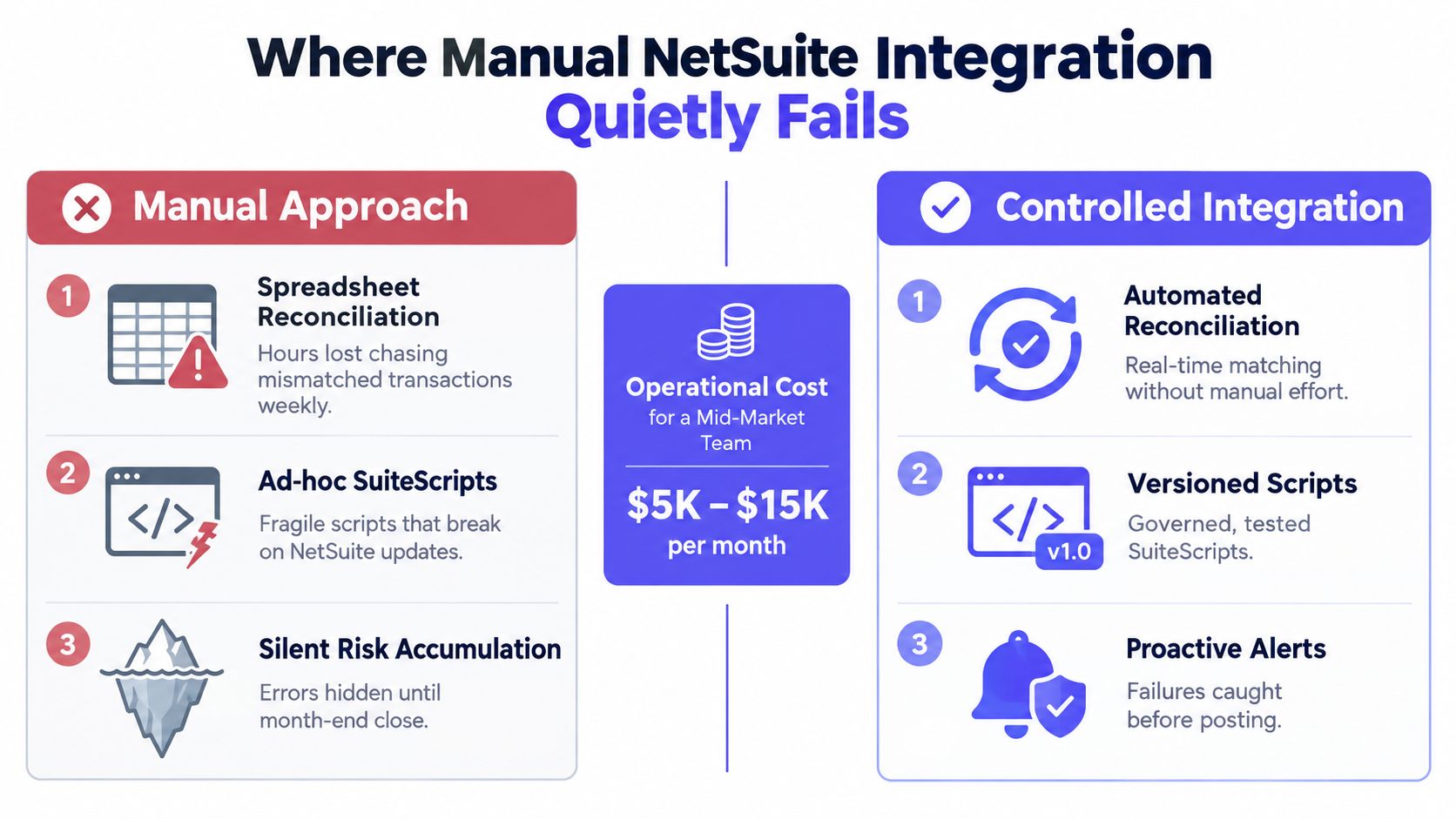
Manual NetSuite integration fails because spreadsheets and ad hoc scripts can show completion without proving completeness, uniqueness, or accounting accuracy. The visible task may finish while duplicate invoices, partial payments, or closed-period postings remain undetected.
A spreadsheet reconciliation often depends on one person knowing which export to run, which columns to normalize, and which exceptions to ignore. A small SuiteScript may handle the happy path but miss duplicate invoice numbers across subsidiaries or payment records that apply only part of the source amount. A scheduled script can also run after a period closes and create a posting that requires manual correction.
The operational burden is material. Plan notes often cite 20 to 60 hours per month for break-fix reconciliation in a mid-market finance team, but that figure isn’t present in the verified source set and shouldn’t be treated as a universal benchmark. The defensible conclusion is qualitative: recurring manual reconciliation consumes close capacity and still leaves finance exposed to late adjustments.
What auditors ask for
NetSuite provides a transaction audit trail for most financial transactions through Transactions > Management > View Audit Trail, according to Oracle’s transaction audit trail documentation. Oracle also identifies an important limitation. Journal entry edits after approval, and edits by the approver before approval, don’t have an audit trail.
That limitation changes the control design. A deterministic workflow should preserve its own immutable execution record, including the source event, decision, mapping version, owner, timestamp, prior state, and NetSuite response. NetSuite’s user-facing audit logs can be filtered by action and user when the appropriate permissions exist, which supports review and evidence collection through Oracle’s audit-log guidance.
Manual reconciliation does the problem. Point-to-point integration documents why direct system-to-system links become difficult to govern as dependencies multiply. Loopfour, the deterministic finance workflow automation platform, uses predefined workflow steps, exception routing, and retained execution evidence instead of relying on an operator’s memory.
The video below provides an additional visual explanation of the operational comparison.
Error Handling, Retries, and Test Plans That Survive Audit
NetSuite error handling should separate transient capacity failures from permanent accounting failures. Retries are appropriate for temporary congestion. They are dangerous when they repeat an invalid mapping or duplicate a journal entry.
NetSuite’s REST governance model exposes integration-specific concurrency information through governanceLimits, and related governance guidance describes polling, error handling, and gradually increasing retry delays. A resilient connector should therefore use bounded exponential backoff, but it shouldn’t assume that a retry is safe merely because the API returned an error.
Design the retry boundary
The retry key belongs to the record, not the batch. A single malformed invoice shouldn’t consume the retry budget or lock the queue for unrelated payments. Each record needs an idempotency key, a status such as staged, validated, posted, rejected, or quarantined, and a record-level lock that prevents concurrent writes.
Journal entries require special care. The workflow should check the external ID before creating an entry, verify debit and credit balance, and store the NetSuite internal ID after posting. A repeated source event should resolve to the existing record rather than create another posting.
Oracle recommends log.audit() for production scripts and documents that logging volume is limited within a 60-minute period under N/log governance rules in its NetSuite script logging documentation. Logs should therefore capture decisions and identifiers, not every low-value field operation.
Error Type vs Response Action for NetSuite Integration
| Error Type | Detection Point | Response Action | Audit Artifact |
|---|---|---|---|
| Expired token | Authentication handshake | Stop the affected connector and route for credential renewal | Authentication error, owner, remediation time |
| Concurrency limit | Request admission | Back off and reschedule the record | Limit response, retry sequence, final status |
| Duplicate external ID | Pre-write validation | Quarantine and require master-data review | Duplicate key, source payload, reviewer decision |
| Invalid account or dimension | Field validation | Reject before posting | Failed rule, mapping version, corrected payload |
| Partial payment | Post-write reconciliation | Hold application and route to AR | Source amount, NetSuite amount, exception owner |
| Closed period | Transaction validation | Route for approved period treatment | Period check, approval, reversal or reschedule record |
Test the control, not just the connection
The test pack should contain field-mapping unit tests, duplicate-posting scenarios, closed-period cases, partial-payment cases, and reconciliation reports that compare source totals with NetSuite control accounts. A sign-off checklist should link every control to its evidence, owner, expected result, and exception treatment.
A successful API response proves transport. It doesn’t prove accounting correctness. NetSuite to Salesforce integration should therefore be tested as a lead-to-cash control chain, not as two isolated connector endpoints.
Go-Live, Versioning, and Ongoing Governance
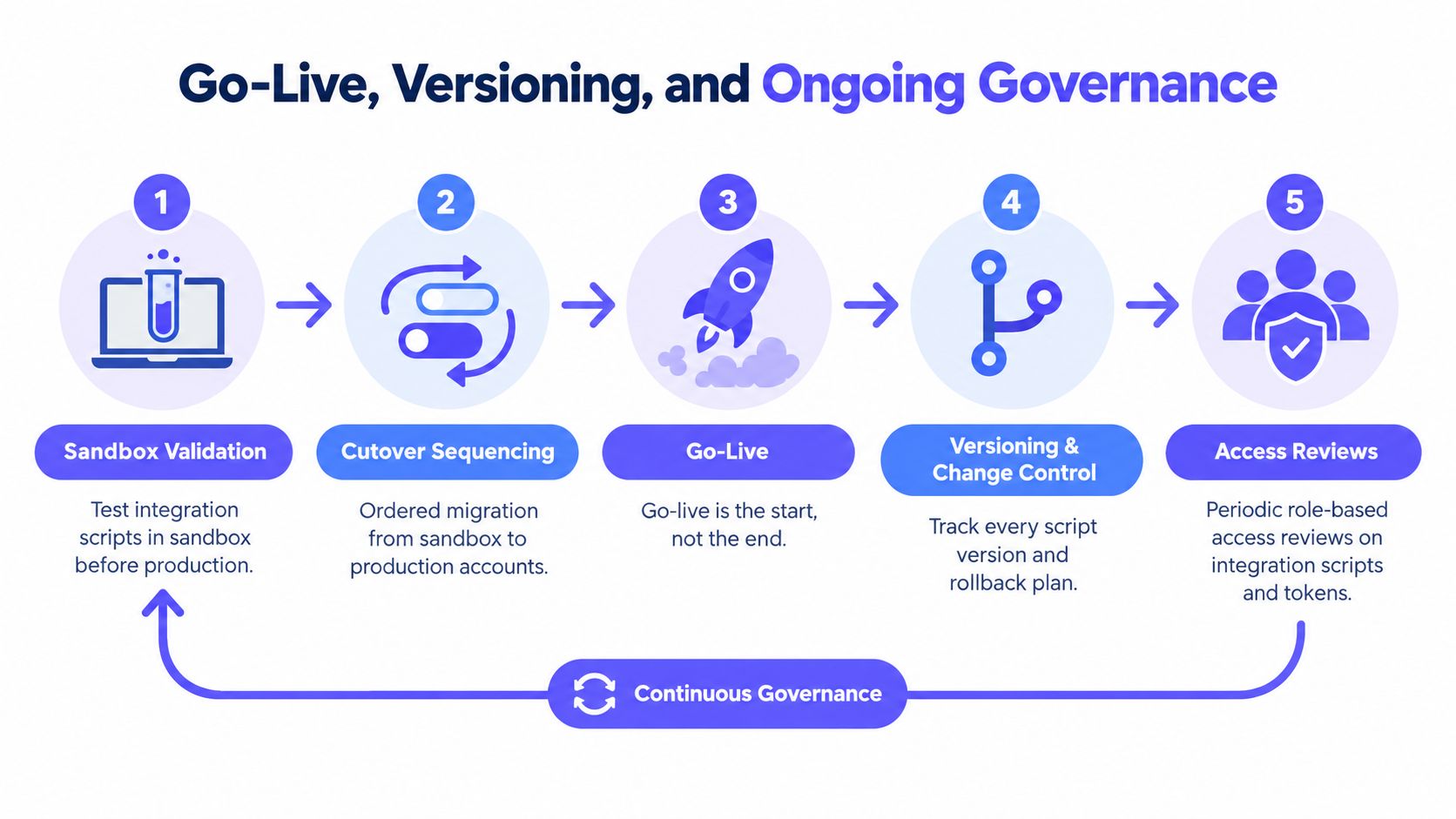
NetSuite go-live starts the first operating cycle of the integration. A controlled deployment connects sandbox validation, ordered cutover, versioned mappings, access reviews, and a rollback path that finance can execute under pressure. Treat ownership of records, mappings, and approvals as part of the deployment design, not as post-launch administration.
Oracle’s product direction makes lifecycle governance a practical requirement. NetSuite REST web services documentation and integration guides have existed since 2016. Oracle now states that REST with OAuth 2.0 is preferred for new integrations, while legacy SOAP services are being reduced. NetSuite’s 2026.1 release is described as closing remaining REST API gaps to support transition away from SOAP-based integrations in Oracle’s REST web services documentation. Use that documentation as the primary reference when choosing endpoints and planning migrations.
Make change review operational
A workable governance cycle includes:
- Sandbox validation: Test scripts, saved searches, permissions, mappings, and exception routes with representative scenarios.
- Cutover sequencing: Move configuration in an approved order, then verify record counts and control totals before enabling writes.
- Versioned definitions: Apply semantic versions to mappings, scripts, saved searches, and custom records.
- Change control: Require impact analysis, approval, test evidence, and a rollback plan for SDF bundles and connector changes.
- Access reviews: Review integration roles, tokens, script deployments, and permissions on a recurring schedule.
System Notes, workflow history, saved-search definitions, and transaction audit records support the evidence trail. Oracle’s cloud security documentation states that logs are centralized and retained under Oracle requirements, with retention compliant with PCI DSS requirements. It also describes security logs supporting forensic review and incident response under need-to-know and least-privilege access in the NetSuite cloud service security documentation.
A quarterly review should compare live mappings and role configuration with the approved baseline. The deprecation policy should specify when an endpoint, authentication method, saved search, or connector version must be retired. Without that decision record, an upgrade can become an unplanned finance incident.
A Real Failure Scenario and How Deterministic Controls Catch It
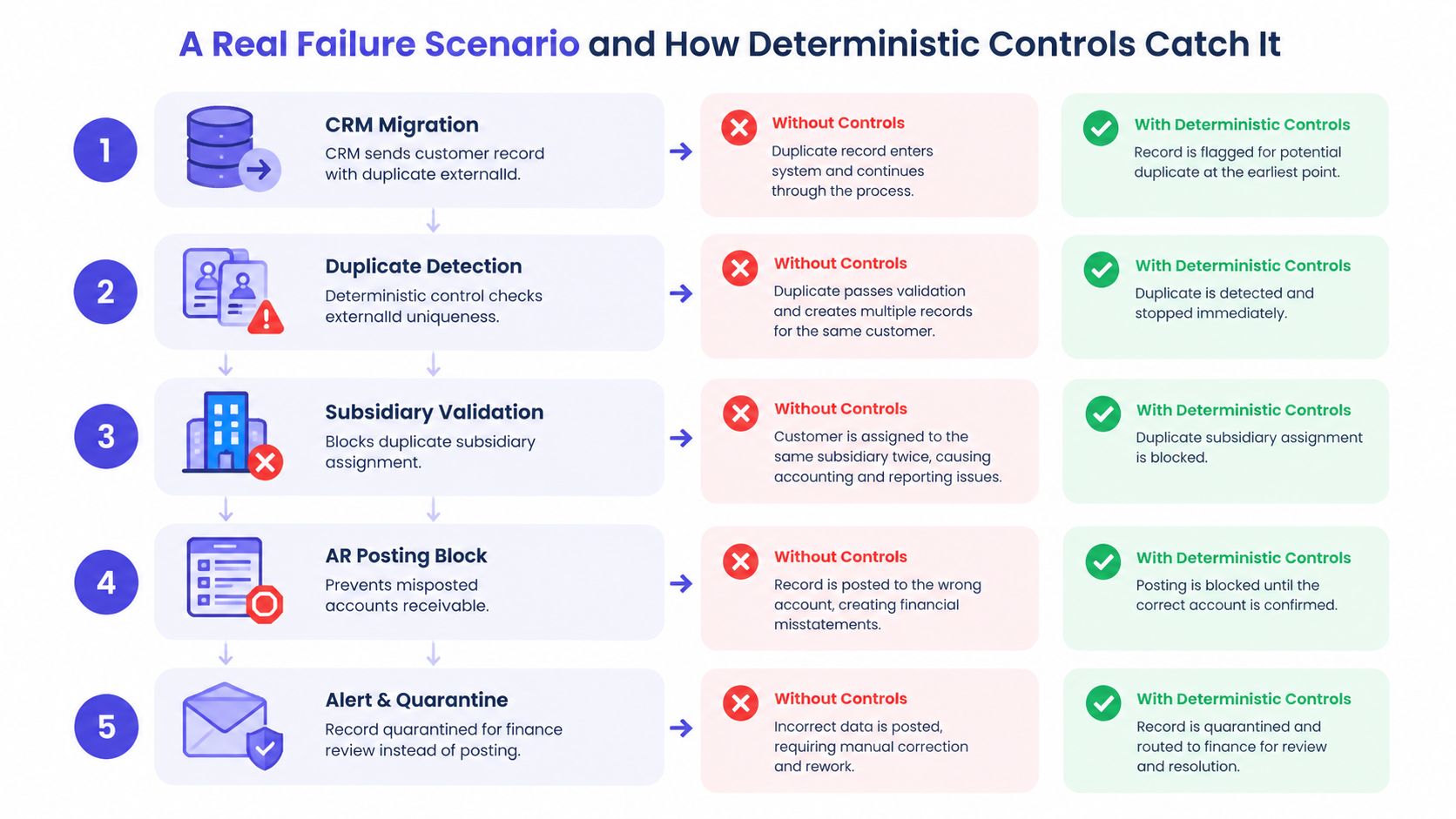
A duplicate external ID can turn a routine CRM migration into a subsidiary and AR posting problem. Deterministic controls catch the issue before the customer write, during transaction validation, or through post-posting reconciliation.
Consider a CRM migration that sends a customer record with an external ID already assigned to another customer. The integration matches on a non-unique field, applies the wrong subsidiary, and prepares an invoice against the resulting customer record. The scenario is realistic because master-data duplication, expired credentials, permission gaps, governance limits, and custom script conflicts are all identified as common post-go-live failure modes in NetSuite re-implementation warning signs for CFOs.
The control sequence should look like this:
- Pre-write uniqueness check: Query a customer-external-ID index before any NetSuite mutation. A duplicate moves to quarantine.
- Subsidiary validation: Compare the source subsidiary against the approved customer and transaction rules. A mismatch blocks invoice creation.
- Transaction-line validation: Check account, class, department, currency, tax, and subsidiary combinations before submission.
- Post-posting reconciliation: Compare CRM AR aging with NetSuite invoice balances and the relevant trial-balance totals.
- Controlled remediation: Finance reviews the exception, corrects the source record, and creates an approved reversal or reposting action where needed.
The evidence package matters
An auditor won’t accept “the integration failed” as the complete explanation. The evidence package should include the source payload, duplicate-key result, validation rule, mapping version, integration role, execution timestamp, NetSuite response, quarantine owner, and final disposition.
The log entry should identify the stable external ID and the blocked action. The saved search should show the duplicate criterion, subsidiary filter, transaction status, and exception state. A reversal journal should reference the original NetSuite internal ID and the approved correction reason.
Automated journal entries require the same discipline. Automation can prepare and post a journal, but the workflow still needs balanced-entry validation, duplicate protection, approval evidence, and a reversible state.
The precise financial exposure window depends on where the control fires. A pre-write control prevents the posting. A mid-flight control prevents the invoice. A post-posting control detects the issue after the write and triggers correction. That distinction belongs in the control narrative because detection timing affects close procedures, owner escalation, and remediation evidence.
Frequently Asked Questions About Integration with NetSuite
Is OAuth 2.0 enough for SOX-relevant NetSuite workflows?
OAuth 2.0 isn’t sufficient by itself. NetSuite authentication must be paired with role-level permissions, separation of read and write access, token lifecycle controls, period restrictions, approval gates, and retained execution evidence. Oracle identifies REST with OAuth 2.0 as the preferred technology for new integrations, but authentication establishes identity. It doesn’t prove that the posting was valid or approved.
How can a finance team defend NetSuite governance limits to an auditor?
A finance team should show that the integration measures capacity, throttles requests, and preserves every retry decision. NetSuite exposes governanceLimits for integration-specific concurrency information, while the connector should record the response, backoff interval, attempt count, record lock, and final state. The control narrative should explain why a transient capacity error is retried and why an invalid accounting record is quarantined.
Why aren’t CSV imports and saved searches a durable AR or AP bridge?
CSV imports and saved searches are useful tools, but they don’t provide a complete transaction-control framework. A CSV can support a one-time migration or controlled correction. A saved search can identify exceptions. Neither, alone, proves idempotency, mapping version, ownership, retry behavior, or a reversible staging state for every posting.
What evidence should a deterministic workflow retain for each NetSuite posting?
The workflow should retain source identifiers, source payload or hash, mapping version, validation results, approval decision, integration role, timestamps, NetSuite internal ID, response, and final reconciliation status. NetSuite’s audit trail and filterable audit logs provide important native evidence, but Oracle documents an exception for certain journal entry edits after approval. External execution evidence closes that gap.
How should saved searches and custom records be versioned after go-live?
Saved searches and custom records need an approved baseline, change owner, test result, effective date, and rollback definition. A finance team should compare the live definition with the approved version during recurring control reviews. System Notes and workflow history can support the review, but the change process should also preserve why the definition changed and which downstream workflows were tested.
When does a SuiteTalk SOAP call matter more than REST?
SOAP may still matter for a legacy integration that has not yet been migrated, but new designs should favor REST and OAuth 2.0. Oracle is gradually removing SOAP web services in favor of modern channels, and the 2026.1 direction closes remaining REST gaps. A migration plan should inventory SOAP calls, test equivalent REST behavior, verify saved searches and extracts, and define a deprecation date rather than waiting for a finance close to expose the break.
Loopfour provides deterministic finance workflow automation across NetSuite, CRM, billing, and document systems, with predefined steps, exception routing, version history, and retained execution evidence. Finance leaders managing customer, invoice, payment, or journal-entry flows can visit Loopfour to assess a governed integration design that preserves control evidence instead of treating connectivity as the finish line.